
Beyond doubt, the automotive software market is and will be growing, signaling that software capability is now a core competitive moat. As Devox Software intensely works with product and engineering teams on modernization, we see that many vendors look similar on slides but diverge on functional safety rigor and process maturity.
With this material, we try to rectify the situation and help you reach tangible results quickly with minor (or major) improvements. For this purpose, here’s a list of the best companies for automotive software development for you to totally rely on in 2026.
What Does Automotive Software Development Need in 2026?
Automotive software development requires writing and implementing code for vehicle systems. This includes everything from basic engine controls to more advanced features like infotainment, ADAS (Autonomous Driving Assistance Systems), and self-driving capabilities. It also involves combining software with hardware to make modern vehicles safer, more efficient, and easier to use.
Automotive software includes in-vehicle, cloud, and mobile apps, all of which must follow strict safety and compliance rules, including:
- ADAS and autonomy support,
- Embedded and ECU/Domain/Zonal architectures (RTOS, middleware, and diagnostics) and ISO/SAE 21434 vehicle cybersecurity,
- OTA (over-the-air) updates, telematics, and remote diagnostics connectivity,
- EV ecosystems requirements,
- Fleet and enterprise layers include dealer systems, service flows, and logistics integration.
The hardest part is always following automotive rules for verification, traceability, and lifecycle control.
Top 10 Custom Automotive Software Development Companies in 2026
Note: this list is a shortlist, not an absolute ranking. It’s meant to help you discover vendors quickly, but not assess each company’s availability and trustworthiness. So, prepare for some research and comparison.
1. Devox Software, Miami, Fl
Devox Software opens the list of top automotive software companies with their full-cycle custom development and legacy modernization. They stand out as they approach automotive-adjacent platforms where the hard part is not “overbuilding features,” but optimizing and lowering the costs while shipping reliably.
It’s a 100% fit when you have an existing system that needs modernization without a risky big-bang rewrite. Devox Software has perfected phased refactoring, integration cleanup, cloud-native enablement, and quality/process reinforcement so releases become predictable thanks to strong ISO adherence and the proprietary AI Solution Accelerator™.
Best for: Legacy modernization and platform rebuilds in automotive-adjacent systems such as dealer/service platforms, fleet apps, and enterprise backbones where you need faster releases.
2. SDLC Corp, San Francisco, CA
SDLC Corp is one of the automotive software companies that work on mobile apps, web platforms, and enterprise systems. They also list their areas of expertise on their public profiles, such as Odoo development and modification, RPA, and new technologies like AR/VR and gaming. Their services messaging focuses on:
- end-to-end IoT development
- use of AI/ML, edge computing
- real-time analytics.
Best for: Custom software for the automotive industry that needs a partner who can “build and automate,” especially if your program has to do with both operations and product UX.
3. Vention, NYC
Vention is an engineering partner for SDV-focused projects where cloud connectivity, IoT, and AI-enabled modules are important. Vention has been in business for more than 20 years and helps small startups and huge corporations with engineering and technology. This company can handle projects of any size or difficulty and comes up with great solutions that enable clients to focus on growing their businesses and finding new prospects.
Best for: Connected vehicle and SDV-oriented product builds that span cloud + IoT + apps and need fast cross-layer execution.
4. Zco Corporation, Nashua, NH
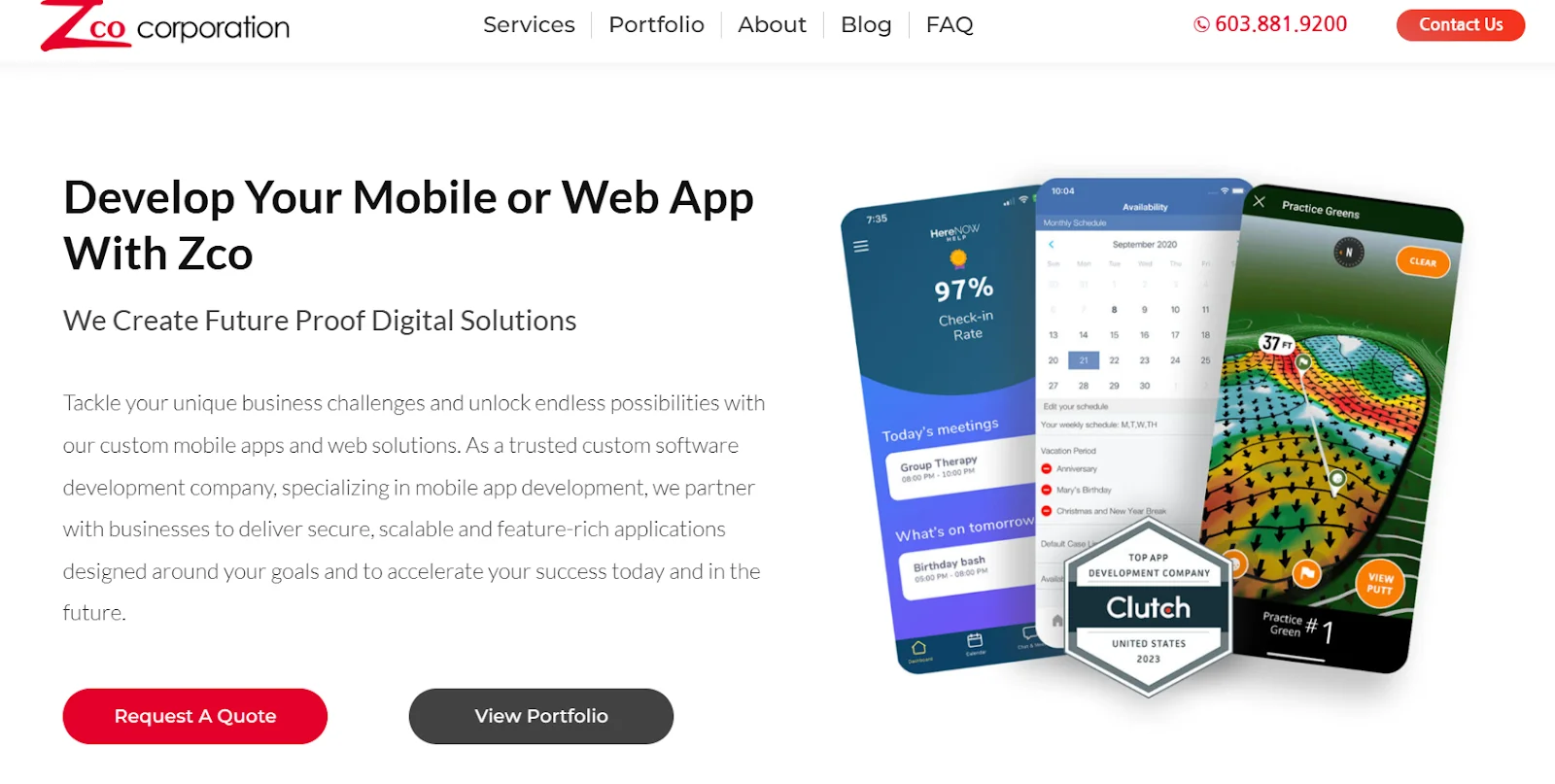
Zco is included in this list of automotive software companies since it is a long-established custom development company with a strong emphasis on mobile and enterprise software. They map automotive software on the “business and user experience” side: dealer tools, fleet dashboards, aftermarket platforms, and operational systems.
Moreover, they tend to match well when the scope is platform-heavy rather than deeply buried, and you want a seasoned delivery partner for enterprise-grade implementations.
Best for: Mobile and enterprise automotive software on the business-experience side: fleet dashboards, dealer tools, aftermarket platforms, and operational systems.
5. Simform, Orlando, Fl
As one of the automotive software development companies, Simform focuses on cloud engineering and data platforms, which are a good fit for fleet and telematics solutions, such as streaming pipelines, analytics, connectors, dashboards, and scalable back-end architecture.
Simform is great at turning vehicle and operations data into dependable products like fleet management systems, predictive maintenance tools, or optimization processes, especially when clients want platform engineering that can adapt to future needs instead of focusing on specialized solutions.
Best for: Telematics/fleet platforms and data-driven automotive products where cloud scale, analytics, and integrations are the core value.
6. RightPoint, Chicago, IL
Rightpoint is a big player in the automotive software industry, especially when it comes to the user experience. They are one of the top automotive software companies for OEMs that need to plan the future of the digital cockpit. Moreover, their work with Cadillac and Chevrolet has won awards.
Best for: digital experiences in cars (HMI) and associated apps.
7. Cognizant, Plano, TX
Cognizant is a large-scale digital transformation provider that conducts enterprise-grade SDV programs end-to-end. They often focus on GenAI enablement, platform modernization, and operating model change at scale.
They’re often best suited for OEMs, Tier-1s, or large mobility companies that need program control, multi-team delivery, and long-term lifecycle support across numerous products and geographies.
Best for: Enterprise-scale SDV transformation programs requiring governance, multi-team delivery, and long-term lifecycle support.
8. SumatoSoft, Boston, MA
People usually think of SumatoSoft as a custom, end-to-end build partner for IoT and data-centric solutions that are similar to linked vehicle and telematics use cases. When you want one team to be in charge of everything from discovery to delivery for a certain product scope, they are a good choice. They emphasize that their approach is guided by five main points:
- Focusing on delivering business value
- Making the software delivery process clear and easy to understand
- Using only applicable ideas, techniques, and technology
- Building reliable and trustworthy communication
- Working together as the key to success.
Best for: Custom end-to-end builds for connected vehicle and IoT-style platforms where one team must own delivery from discovery to launch.
9. Fueled, NYC
Fueled is among the best companies for automotive software development that makes interfaces for high-end auto companies and luxury EVs. They know that drivers want digital touchpoints that are smooth and elegant, much like the car itself.
They specialize in other areas besides deep telematics or complicated backend systems, but if you work with a good engineering partner, they can develop an interface that helps your product stand out in a crowded market.
Best for: High-end, design-focused apps for luxury car makers.
10. SoluLab, Los Angeles, CA
SoluLab positions itself generally around AI/blockchain/Web3, but its automotive-relevant pitch is often clearest in EV ecosystems and digital mobility products: apps, charging experiences, data platforms, and automation/analytics.
They can fit teams seeking fast MVP-to-scale execution for customer-facing EV and mobility applications; rigorous scope and delivered expectations around safety-critical work are addressed openly.
Best for: EV ecosystem software and digital mobility products (charging experiences, apps, data platforms) with MVP-to-scale execution.
Our Research Method
As soon as we’ve made a list of top automotive software companies, without a rating, consider this material as a solid base for further discovery and examination. In particular, throughout our research, we’ve been grounded on:
- open sources with descriptive material,
- industry-connected market reviews like GoodFirms to double-check vendor visibility,
- validation criteria based on the cybersecurity lifecycle (R155/R156), knowledge of ISO/SAE 21434, and signals of process maturity (Automotive SPICE)
with all respect for the companies and agencies in the market.
Quick Guide to Reading “Automotive Software Companies” on the First Call
When picking an automobile software partner, ask the questions below to ensure your potential vendor can cover your niche needs. This brief algorithm will help sift through the candidates before the first touch.
- Begin with the project scope. Are you buying work that is related to ADAS or safety, embedded ECU or zonal, linked or OTA with cloud, the EV ecosystem, or the enterprise or fleet?
- Do a short compensated discovery. Check the architecture decisions, integration plan, risk controls, and how the team communicates in two to four weeks.
- Use behavior, not certificates. Look for a steady flow of needs, clear ownership, control over changes, sprint cleanliness, and discipline when it comes to releases.
- Check to see if it fits in the long run. Automotive programs often last for years, so ensure they can keep staffing levels stable, provide support after launch, and scale up or down without losing important knowledge.
This table will give a hint for the negotiation strategy with potential vendors.
| Best-fit vendor profile | What to ask | |
| Safety-adjacent/ ADAS work |
Strong verification/validation, embedded, and traceability discipline | Show your V&V approach and safety/cyber traceability workflow. |
| Connected car and OTA | Cloud-native, telemetry, and release governance | How do you run SUMS-style update governance and rollback strategy? |
| Enterprise and fleet layers | Strong integrations, data platforms, and scalable backend | How do you prevent integration sprawl and keep change safe? |
| Modernization | Proven monolith-to-services and platform refactor experience | What’s your phased cutover plan and risk controls? |
Closing Thought
In 2026, the best companies for automotive software development will be those that can show that they can deliver on time and on budget while following strict industry rules like traceability, verification/validation rigor, cybersecurity lifecycle, and safe update governance.
Devox Software, with years of building, modernizing, and innovating in the automotive industry, helps partners meet their business goals quickly and future-proof.
Frequently Asked Questions
-
How do I choose the right automotive software development company?
After determining your scope, for example, ADAS, embedded, connected/OTA, EV, fleet/enterprise, you need to confirm the delivery rigor using the V&V approach, cybersecurity/update governance, and process maturity. Then you can move to prior consultations with automotive software companies to assess the communication and transparency personally.
-
What’s the difference between automotive-grade and general software vendors?
Automotive software companies demonstrate change control, secure update management, traceability, and verification discipline. Although general suppliers can produce features quickly, they often struggle to meet the demands of long-term lifecycles, safety, and compliance.
-
How long does an automotive software project usually take?
Platform programs typically take 12 to 30 months due to integration, validation, and rollout phases; however, modules can be shipped within months if the scope is well-defined. Coding speed has less of an impact on timelines than governance and testing. Moreover, internal solution acceleration pipelines can significantly reduce the development time from initiation to deployment.
-
Should I choose a large integrator or a specialized partner?
Choose based on your specific scope and scale. Multi-program transformations are best suited for large integrators, whereas specialized partners are best in specific areas. The optimal option demonstrates proof in your particular use case.