
Sometimes, clients and automotive AI vendors speak different languages, like two drivers using different map apps. Both say “turn left,” but one means “now,” and the other means “in 300 meters.” That’s how AI projects start to drift apart: when businesses say “reduce maintenance cost,” vendors might respond with “we’ll train a model,” and no one can pinpoint the connection.
That’s why we’ve come up with an idea for this article. At Devox Software, treat automotive AI as a full production system. Additionally, we encounter many clients who have suffered due to problematic vendors, and we would like to highlight the engineering aspects involved. So if you need a comprehensive decision framework based on real experience, let’s get started.
Core Principles in Evaluating Automotive Software Solutions
Automotive AI is growing quickly, but different methods and focus areas lead to different predictions. As “market size” depends on how you define it, the experts vary in their calculations: the worldwide automotive AI industry would be worth $14.92 billion by 2030 and $38.45B in 2030. Despite the differences, the growth pattern is obvious.
That’s why it’s not about whatever number is “right.” Buyers are expecting delivery to be production-ready and with quantifiable results. This is what makes selecting an AI software development company in the automotive industry crucial. The following principles will serve you as a foundation for your search.
New Ideas and Technology
“Current” and “trendy” denote different characteristics. The purpose of the “new tools” offered should always be to reduce cycle time, improve reliability, or achieve other specific goals. That’s why your partner should be at the cutting edge of new ideas, using the newest tools and methods in software development, but aware of which goals they help to achieve.
Consider how well they have used new technology and how well they can devise new solutions that give them an edge over their rivals.
Standards and Compliance
Automotive AI operates within a regulated environment. Your ecosystem still has to follow standards and rules, even if you aren’t deploying an ADAS capability. Key things to consider:
- ISO 26262 (hazard-oriented engineering approach for automotive) is often used as a reference for functional safety objectives.
- Cybersecurity engineering often follows ISO/SAE 21434, and rules like UNECE R155 (CSMS) and R156 (SUMS) have a big impact on how updates and cybersecurity are managed.
- The INCIBE-CERT document gives a clear overview of the requirements of R155/R156.
To evaluate a partner, ask for artifacts instead of opinions. For example, ask for an overview of the threat model, a sample plan for rolling out updates, and an explanation of how they ensure proof and traceability throughout the process, from requirements to implementation to verification.
User Experience
Moreover, the software solutions should prioritize user experience, ensuring that both employees and customers can easily use them. Look at how your partner designs user interfaces and how serious they are about usability testing. Also, consider how they use feedback to improve the user experience, creating software that is both useful and fun.
Cybersecurity
As cars become more connected, cybersecurity is another concern. Make sure the partner has strong security procedures in place to guard against attacks and weaknesses. Find out how much experience they have in making safe designs and how they employ encryption and authentication mechanisms. A reliable partner will take a proactive approach to cybersecurity by always upgrading their defenses to deal with new threats.
How to Choose a Custom Software Development Company?
Automotive software engineering expertise has gone so far beyond just writing clean code. In addition to the strict criteria for the software described above, a reliable partner must understand vehicle systems, embedded and cloud integration, safety expectations, cybersecurity risks, and the long lifecycle of automotive products. That is why the next section will shed light on the criteria and, moreover, the process.
- Good Record. Check out how much experience the partner has gathered in AI in automotive by completing projects as planned and satisfying customers as promised. For this, ask for case studies, testimonials, and references that show their prior successes and the business value they brought to the customers.
- Technology (Hard) Skills. The engineering team should be top-notch professionals at software development, system integration, and quality assurance. They should know how to apply the newest tools and technologies.
- Communication Standards. The partner should be willing to talk to you often, provide you with updates, and ask for comments throughout the development process. Consider how they handle working capacity, are willing to share details, and are in line with your project objectives.
- Problem-Solving. Check how well your spouse can solve problems and how well they can adjust to new situations. Everyone could err. A trustworthy partner, unlike an unreliable one, will be able to bounce back and come up with new ideas when things get tough.
- Creating a Long-Term Partnership. It’s important to choose the best automotive software partner not just for your current requirements but also for the long term. To make sure your collaboration works, consider a common vision, flexibility, and a culture of innovation.
- Investment-vs.-Value Balance. Cost is a crucial aspect, but it shouldn’t be the only one that matters. Think about the value the partner brings to the table, including the quality of their solutions, support services, and the chance for a long-term connection.
As a result of the above, you get the idea of how your partner should look and act. So let’s consider them in detail.
The “Partner Fit Triangle”
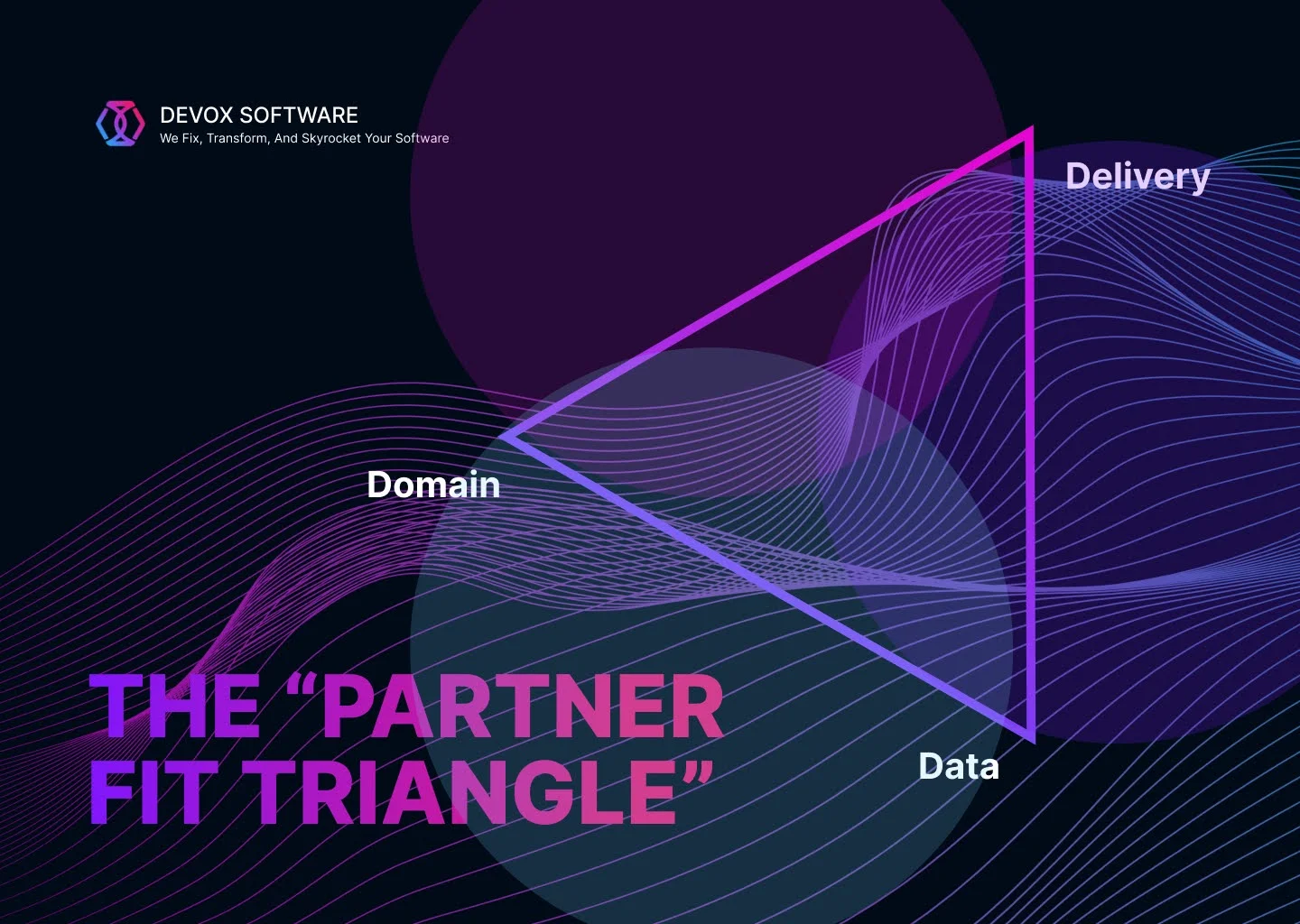
The Partner Fit Triangle is a simple but useful tool for checking how well two businesses work together. It is built on three pillars that rely on each other: Domain, Delivery, and Data. If one side is weak, the imbalance will show up later as more effort, delays, or danger to the business. Let’s look closely at them.
Domain Knowledge
- Norms. Automotive-Specific Constraints, Safety Mindset, Supplier Reality- Automotive limits stem from strict legislative norms like ISO 26262, ASPICE, and UNECE, which are not debatable. Partners need to have a strong understanding of these frameworks.
- Safety Mindset. Every choice is made with the safety of the driver and passengers in mind. This mindset calls for careful release methods, backups, and thorough testing.
- Supplier Reality. Tier-1 and Tier-2 suppliers need to agree on quality, scheduling, and integration. A mismatch here might lead to warranty claims, recalls, or damage to your reputation.
Delivery Standards
- Continuous Integration and Delivery (CI/CD) accelerates innovation, yet it needs to be adapted where safety holds paramount importance.
- OTA (Over-the-Air updates). Modern cars need secure, dependable pipelines with rollback options since a compromised or unstable update pipeline introduces potential defects and security risks.
- QA Discipline. Testing all levels of hardware, software, and integration thoroughly ensures that everything works.
- Risk Management. Having playbooks for failures cuts down on downtime and maintains customers’ confidence.
Data
- AI-Readiness. Before using data in automotive AI models, it must be cleaned up and checked for reliable results, while updating AI models identifies drift, bias, or performance problems before they become problems.
- Quality Assurance. Automated checks stop faulty data from getting into production processes.
- Lineage. Keeping track of where data comes from and how it changes ensures that it can be held accountable and audited.
- Privacy. Following the rules set by GDPR, CCPA, and automotive-specific data legislation is required.
When one side of the Partner Fit Triangle isn’t strong, it affects the whole system. Launch delays may occur due to supplier disagreements or quality assurance issues, which can impede innovation and annoy customers. This triangle is like a three-legged stool: if you weaken one leg, the whole thing falls down.
Evaluation Scorecard
To make the evaluation more practical and objective, use the scorecard below to compare potential partners across the capabilities that matter most in automotive AI delivery.
| What you’re verifying | Evidence you should ask for | |
| Automotive domain fit | They understand your use case category | Comparable case examples and constraints discussion |
| OTA delivery maturity | Updates shipped safely at scale | Rollout plan, rollback story, telemetry and gating |
| Cybersecurity by design | Attack surface reduced proactively | Threat modeling approach and secure update flow |
| Data readiness discipline | Data becomes usable and governed | Data contracts, quality checks, access controls |
| MLOps/LLMOps | Models remain reliable over time | Drift monitoring, retrain triggers, eval gates |
| Quality engineering | Regressions prevented | CI gates, testing strategy, and defect prevention |
| Execution | Predictable delivery | Sprint artifacts, risk log, communication cadence |
| Commercial clarity | Partnership is governable | SOW structure, SLAs, RACI, and IP/security clauses |
So how to choose a software development company? First, write out your objectives, limitations, and expected cooperation model. A basic framework lets you compare suppliers in four areas:
- How well they suit your domain
- How good their technical skills are
- How mature their delivery is
- How well they connect with your company
This makes it easy to evaluate mates based on how well they fit, not simply how well they promote themselves. As soon as the appropriate partner is expected to have relevant expertise, it might be able to communicate clearly, have a defined approach, and adapt to changes and contingencies in the project. In the end, this will help meet your demands and provide you with long-term value.
Details about Contracting and Governance
If you’re wondering how to choose a custom software development company, don’t look at engineering only. Governance determines what happens. Minimum parts of a contract include:
- SOW (Statement of Work) as deliverables and artifacts, not only hours, for example, architecture, test plan, deployment plan, runbooks, and more
- SLAs/SLOs (Service Level Agreements/Service Level Objectives) for software qualities, such as how often they are available and how quickly they respond to incidents
- The RACI matrix ensures that duties don’t get mixed up, pinpointing who is in charge of model monitoring, rollback, and security updates
- IP and data clauses, including how to handle training data, how long to keep it, and how to move it, etc.
- Security responsibilities that fit with the rules you have to follow, particularly when it comes to update governance
As a result, you create a partnership that is simpler to run, safer to grow, and far less likely to collapse due to unclear expectations. A good contract lays out the rules for how the software will be produced, maintained, updated, and managed over time. That is why robust governance should be a key factor in choosing a bespoke software development business, not something to think about later.
Let’s Synthesize
The greatest results from automotive AI come from partners that can turn business objectives into systems that can be delivered and kept secure, up-to-date, and measured after launch. Use the Partner Fit Triangle, require artifacts, execute a proof sprint, and make sure your contract covers governance. That’s how you choose a partner who gives you actual value, not simply a pilot.
If you tell Devox Software how you want to incorporate cutting-edge automotive AI functionality into your systems and who you want to sell it to, we’ll convert it into a one-page assessment brief and weighted scorecard that you can use to narrow down your options and perform a proof sprint.
Frequently Asked Questions
-
What’s the fastest way on how to choose a software development company?
The best way is practice; after you shortlist the candidates and receive quotes, run a 2–4 week proof sprint with identical inputs for each vendor and assess them on evidence according to the scorecard, including the marks on architecture, delivery, security posture, data plan, QA plan, and delivery transparency.
-
What should I prioritize first: AI model quality or delivery maturity?
Delivery maturity is typically the most important thing for manufacturing. A model that is a little weaker but ships safely, updates consistently, and remains monitored is better than a superb model that can’t handle real-world drift and OTA complexity.
-
How do I avoid vendor lock-in with automotive AI?
You should inlay portability in the contract from the start: from requirements of clear documentation, transparent model, and data ownership to pipelines that can be exported and IP terms that let you move.
-
Do we need automotive standards expertise for non-ADAS?
You still need to improve your cybersecurity and upgrade your governance. Even if ISO 26262 depth isn’t always necessary, disciplined engineering and evidence-based QA are still crucial in the automobile industry.