Table of content
This report maps out how Java, .NET, and PHP systems typically modernize in 2026 — a year where engineering habits, AI-assisted development, and cloud-first delivery finally start moving in the same direction. For most enterprises, the goal is simple: increase engineering velocity, tighten security, reduce operational overhead, and set the foundation for AI-driven work. And 2026 brings a welcome shift — many programs now achieve cost recovery in under two years, with efficiency gains compounding after that.
Modernization follows a clear, staged execution process. Teams update systems domain by domain, using modular extraction, automated refactoring, code intelligence, and functional-equivalence testing to keep production steady while shrinking analysis and redesign cycles. The work becomes more manageable and predictable.
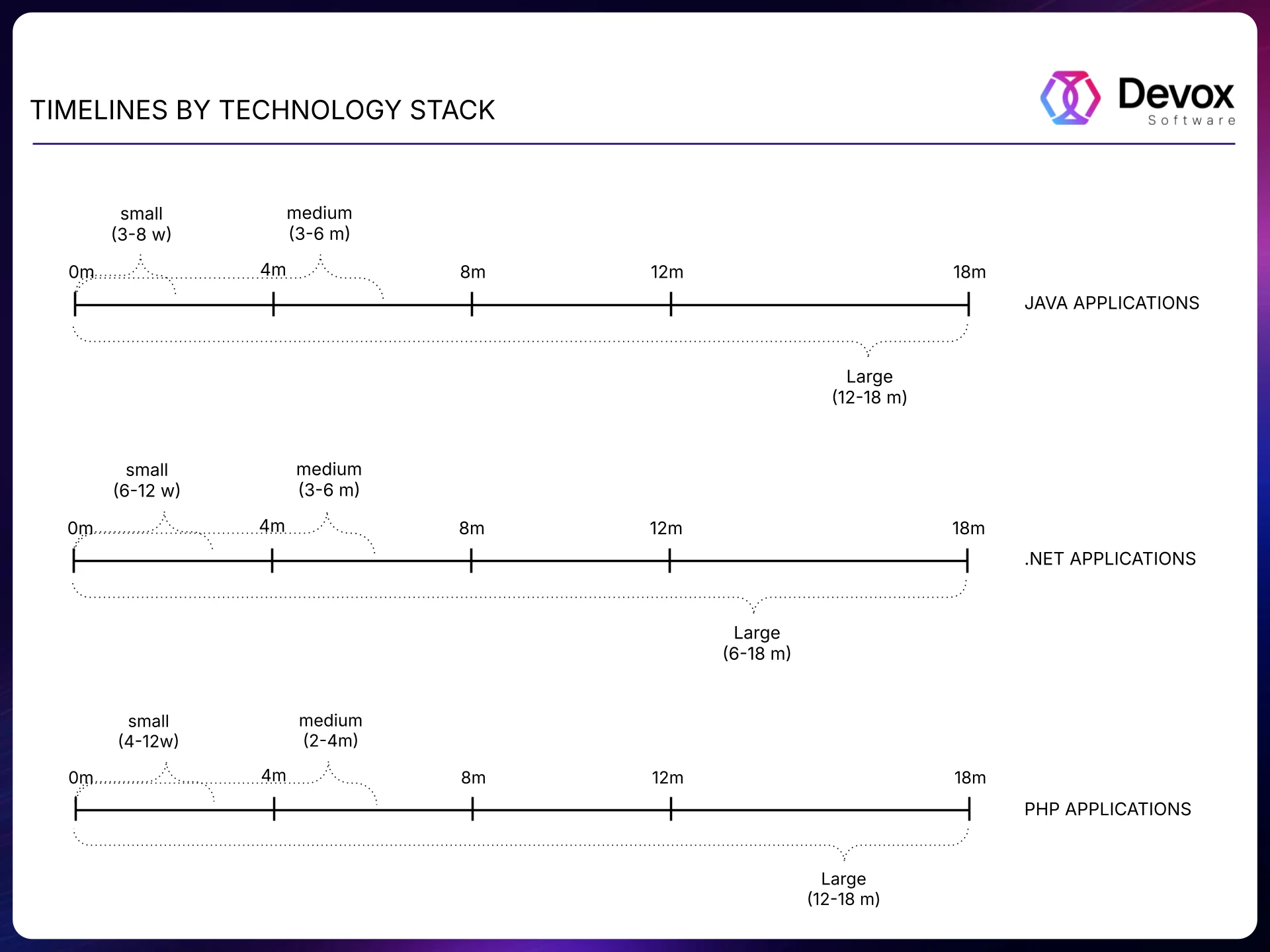
Timelines reflect this maturity. Medium-sized Java and .NET applications typically take three to six months to modernize. Large estates land in the six-to-eighteen-month range. PHP systems often track similarly — sometimes faster — depending on how the architecture has grown over time. With solid tooling and steady delivery habits, teams make these ranges predictable across entire portfolios.
This report offers a 2026 view of modernization that feels more grounded and achievable. Each phase strengthens stability, performance, and release cadence, creating a trajectory that compounds value across the whole application estate — one cycle at a time.
Stakeholder Concerns
Business Impact & ROI Confidence
Modernized apps on cloud or modern platforms typically achieve faster time-to-market and reduced downtime. For example, analysts find that moving applications to cloud PaaS can increase developer efficiency by up to 25% and reduce downtime by up to 25%. These improvements translate into financial gains: reduced operational costs, fewer breach incidents, and faster feature delivery. A strong business case clearly quantifies the expected return on investment. Microsoft recommends planning for break-even within 18-24 months of modernization, with full profitability by 24-36 months. This aligns with experience that early wins in the first 6 months help build momentum, medium-term efforts target larger systems, and long-term initiatives deliver the majority of benefits. (Microsoft)
Delivery Risk & Modernization Strategy
Stakeholders (especially non-technical executives) worry about risk, cost overruns, and lengthy projects. A structured approach can manage these concerns. Risk management means prioritizing high-value applications and using phased rollouts and automated testing. (gartner’s “TIME” model (Tolerate, Invest, Migrate, Eliminate) helps rationalize which applications to modernize and how. Incremental modernization — often via the Strangler Fig or continuous-update patterns — further mitigates risk. Instead of a massive “big-bang” rewrite, organizations can modernize components one by one, continuously delivering value. This means old and new code coexist during the transition, so the system continues operating while modernization proceeds. (Gartner.com, Thoughtworks)
Cost Governance & Financial Predictability
A robust modernization plan also includes FinOps (financial operations) and careful cost forecasting. Teams should build detailed cost-benefit analyses, including lower maintenance costs and potential new revenue streams. Microsoft’s guidelines advise using predictive cost modeling (FinOps) with scenario planning and rightsizing to control cloud OpEx. Continuous monitoring of KPIs (cost savings, performance gains, increased revenue) ensures the business case remains viable and aligned with objectives. In summary, staging modernization as a business-driven, incremental transformation helps reassure decision-makers: it contains risk and frames ROI in measurable terms (Microsoft.com, Gartner.com)
Modernization Approaches: Big-Bang vs. Continuous
1. Big-Bang Rewrites Rarely Pay Off
Traditional “rip-and-replace” efforts try to rebuild the entire system at once. Timelines stretch, benefits stall, and requirements drift before the new system ever ships. Gartner explicitly recommends continuous modernization instead — small, rolling increments focused on real business constraints.
2. Incremental Modernization Turns Risk Into Flow
Rather than betting everything on a future cutover, teams slice work into small, verifiable steps. The Strangler Fig pattern — gradually surrounding the legacy system with new components and migrating capabilities over time — embodies this mindset. This approach “acknowledges that modernization is a process of discovery” and delivers features continuously, not at the very end (Microservices.io).
3. Multiple Sources Consistently Report Similar Benefits
ThoughtWorks notes that gradual replacement reduces migration risk, minimizes disruption, and ensures continuous value delivery throughout the process. Microservices.io (Microservices.io) highlights that incremental migration shows value early: new services start working in production immediately, whereas big-bang rewrites deliver nothing until cutover. Iterative validation and real user feedback also prevent the unpleasant surprises that often surface at the end of monolithic rewrites.
4. Functional Equivalence Ensures a Smooth and Safe Transition During Cutover
Functional equivalence keeps cutover safe by ensuring the new system produces the same outputs as the old one. Modern teams rely on verification tools to shrink risk: “capture & replay” testing in AWS Blu Insights (AWS) validates behavior against real traffic, Dual Run (Google Cloud) compares mainframe and cloud results in parallel, and Kodesage (Kodesage) echoes the same pattern of parallel validation to de-risk the transition.
5. Continuous Modernization Builds Confidence and Roi
A structured, test-driven approach reduces anxiety across the business. Instead of waiting years for a rewrite to (maybe) land, teams show progress in steady cycles.
By proving equivalence piece by piece, they keep stakeholders engaged, demonstrate incremental wins, and guide the organization through a safer, more predictable modernization journey (ThoughtWorks).
AI-DRIVEN ACCELERATION IN 2026
AI becomes the primary force that compresses modernization cycles for Java, .NET, and PHP systems in 2026. Discovery, refactoring, dependency mapping, and behavioral validation shift from slow, manual processes to continuous, machine-assisted workflows that raise delivery speed across entire portfolios.
Structural Visibility
Models analyze large codebases, extract business logic, map relationships across modules, and produce complete dependency graphs. This replaces long discovery phases with immediate architectural visibility and gives teams a stable foundation to plan modernization slices.
Automated Refactoring
Automated pipelines upgrade frameworks, transform legacy APIs, streamline controllers, reduce dead logic, and regenerate patterns that align with current standards. Java systems move toward Spring Boot or Jakarta EE, .NET estates advance to .NET 6/8 and Blazor, and PHP platforms transition to modern frameworks with optimized upgrade paths. Much of the effort that previously required manual rewriting now runs as repeatable automation.
Behavioral Assurance
Models compare outputs between legacy and modernized components under identical conditions, detect behavioral drift, and guide corrective fixes. This creates confidence during parallel operation, allows teams to release new modules alongside existing ones, and maintains stability across production flows.
Intelligent Sequencing
Planning tools forecast effort, highlight high-value modernization slices, surface risk drivers, and recommend domain boundaries that increase delivery flow. This produces reliable modernization roadmaps and stabilizes timelines for portfolios of any scale.
Compressed Iterations
Developers receive rapid insights on dependency hotspots, inconsistent patterns, architectural gaps, and configuration risks.
High-Velocity Delivery
Discovery becomes immediate. Refactoring becomes automated. Behavioral assurance becomes continuous. Planning becomes data-driven. These capabilities fundamentally reshape modernization speed in 2026, bringing enterprise portfolios into upgrade cycles that operate with product-level velocity and predictable delivery.
Timelines by Technology Stack
Java Applications
Modernization timelines vary widely with application size, complexity, and chosen methods. Benchmarks are scarce, but both industry guidance and case examples give rough ranges. Critically, automation and AI-assisted tools are compressing these timelines. IIoT systems powered by AI Java Applications. Java is ubiquitous in enterprise legacy systems. A recent analysis suggests that with modern tools, a mid-sized Java monolith often can be modernized in 3-6 months, whereas a large portfolio of applications (phased) might take 12-18 months (legacyleap.ai).
These figures assume use of automated dependency mapping and refactoring tools. For example, IBM reported shortening one legacy Java system modernization from 12 weeks down to 3-4 weeks by using code analysis tools (ibm.com). Modern Java frameworks (Spring Boot, Jakarta EE) and cloud platforms offer advantages — containerization, rich libraries, and cross-platform portability — that can speed up rehosting or refactoring. Challenges include outdated libraries (e.g. EJB, Struts) and massive codebases. Automation can help migrate older constructs (e.g. replacing javax.* with jakarta.*) and discover hidden dependencies. In practice, teams often scope modern Java upgrades by module or service, using patterns like strangler fig to tackle one business domain at a time.
By 2026, the maturity of AI-driven refactoring tools and the integration of Project Loom and GraalVM are anticipated to bring even ‘Large’ projects, which historically required 12-18 months, closer to a phased modernization timeline of 9-12 months, with a primary focus on cloud-native architectures for maximum efficiency and resource utilization.
.NET Applications
Legacy.NET apps (e.g..NET Framework) typically run on Windows servers and often use rich Microsoft technologies (WinForms, WCF, ASP.NET MVC).
Moving to modern.NET (Core/6/7+) often involves upgrading to cross-platform, cloud-friendly frameworks. While explicit survey data are limited, industry guidance suggests similar scale to Java: small apps might modernize in a few weeks to a few months, medium apps in 3-6 months, and large portfolios 6-18 months. For instance, one vendor notes “small apps in 6-12 weeks; medium 3-6 months; large 6-18 months” for.NET migrations.
.NET’s strong tooling (Visual Studio Upgrade Assistant, Azure Migrate) and abundant cloud support are advantages. However, challenges include Windows-specific dependencies (Legacy COM, IIS, proprietary libraries) and the need to modernize or replace outdated UI frameworks such as Web Forms and WPF. Windows-only GUIs or COM components may require rewriting or replacement..NET modernization also often intersects with database and deployment changes (e.g. from SQL Server to Azure SQL or containers). In large enterprises, migration is typically staged by subsystem, with teams using automated refactoring to convert legacy.NET APIs to.NET Core equivalents and leveraging cloud migration services on Azure.
By 2026, AI-native tools and the adoption of Blazor will dramatically accelerate the replacement of Windows-only UI components and legacy dependencies, pushing the completion of large-scale modernization portfolios toward the lower end of the projected 6-18 month range.
PHP Applications
PHP powers many web applications (including WordPress, Drupal sites and custom frameworks like Laravel). Modernization often means upgrading PHP 5.x/7.x code to current PHP 8.x, or replatforming to a framework (Laravel/Symfony) and moving to container/cloud hosting.
Compared to Java/.NET, PHP monoliths tend to be simpler (often <100k LOC) , so timelines can be shorter for small apps. For a simple PHP site or microservice, modernization (rewrite or refactor) might take a few weeks to a few months. For larger PHP systems (many tens of thousands of lines) , projects might span 6-18 months. (As one example case study notes, refactoring a 100k+ LOC PHP monolith took ~12-18 month.)
Key challenges include PHP’s dynamic typing (which can make code analysis harder) and outdated libraries (e.g. migrating from old CMS or framework versions). Frameworks like Laravel, along with tools such as Rector and Composer, streamline and accelerate upgrade efforts. Advantages: PHP workloads are typically stateless web apps, so containerization is straightforward; the developer community is large; and performance considerations are generally easier than heavy enterprise apps.
By 2026, the increased maturity of AI-assisted refactoring tools and the standardized upgrade pathways provided by modern PHP frameworks will make complex, large-scale rewrites of 100k+ LOC PHP monoliths closer to the 12-month mark, allowing organizations to focus on leveraging cloud-native hosting for performance and scalability.
Tools and Techniques for Modernization
A variety of specialized tools and platforms have emerged to assist modernization. These include assessment tools to understand legacy code, refactoring/translation tools to automate rewriting, and validation tools to test new systems against the old. Together they accelerate projects and reduce uncertainty. Notable examples include:
Integration & Migration Hubs
Execution hubs streamline lift-and-shift. AWS Migration Hub (AWS) and Azure Migrate (Microsoft) orchestrate discovery, dependency mapping, and workload movement across servers, databases, and apps. They reduce planning overhead even when code transformation isn’t required.
Automated Refactoring & Rewrite
Tools automate large portions of language conversion. Velocity (Mobilize.Net) translates VB6, PowerBuilder, and WinForms to .NET/Blazer with 90%+ automation. Mainframe Rewrite (Google Cloud) assists COBOL→Java/C# transformations. .NET Upgrade Assistant (Microsoft) and AWS ProServ Modernization (AWS) shorten migration cycles by automating predictable refactoring.
AI-Assisted Code Comprehension
New platforms shrink reverse-engineering time. CodeConcise (ThoughtWorks) blends LLMs with code graphs to extract requirements, detect unused logic, and summarize architectures. Mechanical Orchard (Mechanical Orchard) incrementally rewrites mainframe code into modern languages, refining outputs until they match legacy behavior.
Integration & Migration Hubs
AI closed-loop control will become standard in battery manufacturing by 2026, slashing electrode-process downtime by 30%. Closed-loop control will constantly rewrite electrode parameters mid-run, eliminating variation once fixed manually.
Assessment & Analysis
AI-driven scanners map legacy estates fast. Google Cloud’s MAT (Google Cloud) analyzes COBOL/PL/I and generates dependency graphs and modernization plans. IBM Transformation Advisor (IBM) and AWS Application Discovery (AWS) estimate migration effort, while CAST Highlight/Imaging (CAST) surfaces technical debt and blockers early.
Toolchains in Combination
Enterprise teams mix tools to match system shape: MAT for inventory, automated rewrite for core logic, Dual Run for validation, CAST for refactoring planning; or in .NET, analyzers, translators, and Azure DevOps pipelines. Modern toolchains transform formerly manual, months-long analysis into a streamlined and fast-paced modernization process.
Managing Risk and Measuring ROI
In terms of cost projection, total cost of ownership (TCO) models help frame modernization costs realistically. Many teams see sizable multi-year savings once legacy systems move onto cloud-native platforms — driven by lighter infrastructure, fewer licenses, and higher developer throughput. The exact numbers vary, but the principle is consistent: include ongoing operational savings in ROI.
Modernization also needs the right expectations. It’s as much organizational change as technical work, and some legacy will always remain. Clear 6-18-month milestones and visible deliverables keep momentum steady. Over time, those steps compound into a fully modern platform — ideally before the old one forces an urgent cutover.
✓ Phased/Micro-Services Approach: Break large systems into smaller domains or services. Use patterns like strangler fig to replace slices of functionality step-by-step (thoughtworks.com). Each phase is a mini-project with its own timeline and deliverables. This limits the impact of any single failure and provides early business value (e.g., migrating a single reporting module can immediately reduce operational costs).
✓ Pilot and Proof of Concept: Begin with a non-critical or representative subsystem as a pilot. This establishes processes, uncovers hidden complexity, and provides an early win for stakeholders.
✓ Continuous Verification: Embed testing early. Build automated tests (unit and integration) against the legacy system before rewriting, so you can apply them to the new code. Use data-driven or behavior-driven testing: record inputs/outputs of key jobs over past months and use those as validation benchmarks. This “characterization testing” approach traps drift and ensures the new system meets real-world usage (cloud.google.com).
✓ Risk Registers and Contingency: Identify major risks up-front (e.g. lack of documentation, scarce skills, third-party dependencies). Maintain a risk register and mitigation plans (e.g. “if critical legacy library not supported, plan to rewrite those modules”). Allocate contingency in budget/time (industry practice often reserves 20-30% of effort for unknowns). Regular executive reviews should update on risk status.
✓ Governance and Metrics: Use a formal framework (like FinOps) to track spending against forecasts(learn.microsoft.com). Define ROI metrics: e.g. decrease in maintenance cost, reduction in security incidents, or increase in deployment velocity. (gartner suggests mapping modernization efforts to business KPIs (like reduced business downtime cost or increased customer engagement).
✓ Stakeholder Communication: Keep business leaders in the loop with demos of migrated features. Show partial results (e.g. new UI module) and articulate cost savings. Document assumptions versus actuals (e.g., “we expected 30% code compaction; actual was 25%” and explain variances).
Conclusions and Recommendations
Application modernization is now a mainstream initiative, but its success hinges on balancing business and technical needs. For decision-makers worried about long timelines and high risk, the message is: use the right strategy and tools to break big problems into small ones. Benchmarking experience suggests that with automation and AI:
- Mid-size enterprise apps often take on the order of months to modernize, especially if approached incrementally.
- Large systems may take over a year, but phased delivery ensures business continuity and ROI along the way.
- Cloud-native and AI-driven tools (Dual Run, MAT, CodeConcise) can significantly shorten testing and analysis phases.
Continuous modernization patterns (e.g. strangler fig) dramatically reduce risk and improve ROI by delivering value early.
In practice, recommended steps are: perform a thorough assessment (technical and business) , classify each application using frameworks like TIME, and prioritize by risk/value. Adopt incremental modernization patterns and leverage specialized tools for comprehension and refactoring. Build and track an ROI model (break-even in ~2 years) and use FinOps-like financial rigor to stay on budget
By following these practices, organizations can turn concerns about modernization into a well-structured transformation initiative. The modernization journey becomes continuous improvement rather than a one-time gamble. Stakeholders see tangible improvements within months, and by the 2-3 year mark most legacy risk is eliminated with the business enjoying improved agility and efficiency(Microsoft.com) (Gartner.com). In this way, modernization projects become predictable and strategic rather than open-ended risks, fulfilling the potential of modern technology to drive business value.
The Modernization Path 2026
The 2026 modernization landscape converges around three forces: AI-driven code rewriting, infrastructure automation through IaC, and modular hybrid-cloud architectures that enable stepwise migration away from legacy cores. These forces form a unified execution path that organizations can follow over the next twelve months.
- Step 1. Target an 18-24-month break-even and year-three profit compounding by building a structured inventory of all Java, .NET, and PHP systems — their dependencies, runtime and security risks — and linking every item to TCO and ROI.
- Step 2. Prioritize high-impact systems and retire low-value components that drain capacity by classifying each application with TIME (Tolerate, Invest, Migrate, Eliminate) against value, risk, and effort.
- Step 3. Deliver production value in small, low-risk slices by using strangler-fig and continuous-update flows with legacy and modern components operating side by side and each slice is scoped as a self-contained project that keeps risk surfaces tight.
- Step 4. Enable frequent, predictable releases while keeping cloud OpEx tied to realized value by establishing container platforms, IaC, shared APIs, and DevSecOps pipelines as the common backbone for all Java, .NET, and PHP teams.
- Step 5. Accelerate modernization to 3-6 months for mid-size systems and 6-18 months for large estates by applying code-intelligence — AI refactoring for Java, .NET Framework-to-Core upgrade tools, and Rector/Composer for PHP.
- Step 6. Prove behavioral parity while tracking performance, incident, and telemetry improvements by capturing production behavior from legacy systems and using characterization tests, traffic replay, dual-run, and automated regression suites.
Run modernization as a standing program tied to KPI gains like reduced downtime and maintenance effort with a rolling 6-18-month roadmap, explicit contingency (20-30%), and executive reviews that link each release to outcomes.
Info
-

Source:
Based on leading modernization research -
Date:
Dec 9, 2025 -
Read:
13 min -
Study Methodology:
Synthesis of analyst and engineering evidence