





Market Overview and Current State
The EdTech market in 2025 is growing at a breakneck pace, largely driven by the increasing integration of AI and rapid advances in adaptive technologies. The end goal here is to make education more accessible and scalable, and that’s happening. This overview provides a snapshot of the current landscape, including the market size estimates we’ve been tracking, the major trends that are shaping adaptive learning, regional developments (particularly in Europe and the US, where some of the most interesting work is happening), and just how these changes are affecting K-12 and higher education. The data reflects trends through late 2025, preparing platforms for the 2026 wave of adaptive learning modernization.
- Edtech companies in Europe are leveraging AI and advanced technologies to improve education accessibility, inclusivity, and scalability, promoting lifelong learning through innovative platforms.
- Recommending remedial learning materials to fill knowledge gaps is a key strategy in edtech, with research showing that using data effectively can personalize student recommendations.
- Project-based learning is gaining traction at the university level for supply chain education, combining real-world experience with theory to improve graduate preparedness in the edtech ecosystem.
- Enlearn’s platform applies generative adaptation to math and English language arts, differentiating from competitors focused solely on math, contributing to the diverse edtech market landscape.
- Educative plans to add adaptive learning features to its platform, adapting content based on user progress, highlighting continued innovation in programming education tools.
- Pittsburgh’s edtech hub emphasizes collaboration, combining a focus on math adaptive technology and STEM to create integrated learning solutions.
Key Trends in Adaptive Learning
By 2026, the EdTech scene is going to be a whole lot different thanks to some pretty radical advancements in adaptive learning: we’re talking real growth and investment here. Looking specifically at the numbers for next year and the predictions for the year after, this rundown has been put together using only the most up-to-date sources, with the focus being on the 2025 data — whether it’s been published or is just a projection at this stage, including things like revenue forecasts, funding rounds, and the economic kick that comes from all this connectivity. It’s going to be interesting to see how this sets the scene for the big EdTech modernisation push in 2026, and where the likes of AI-driven learning.
- Revenue in the online learning platform market is expected to reach US$60.39bn in 2025, with an expected annual growth rate (CAGR 2025-2030) of 8.53%, resulting in a market volume of US$90.81bn by 2030.
- Several US and UK-based EdTech startups raised multi-million-dollar investments in 2025, reflecting rising interest in adaptive AI for K-12 education.
- UK-based edtech social enterprise Everybody Counts secured £500,000 in new funding in May 2025 to scale its inclusive maths learning platform, highlighting growth in AI-powered adaptive tools.
- New startup Wild Zebra brings an AI tutor to thousands of students and raises $2M in 2025 for wider rollout, demonstrating funding for adaptive AI education systems.
- In Bellevue, a district serving over 19,000 students, leaders are incorporating AI guidance into 2025 strategies, focusing on adaptive learning in schools.
Technological Innovations
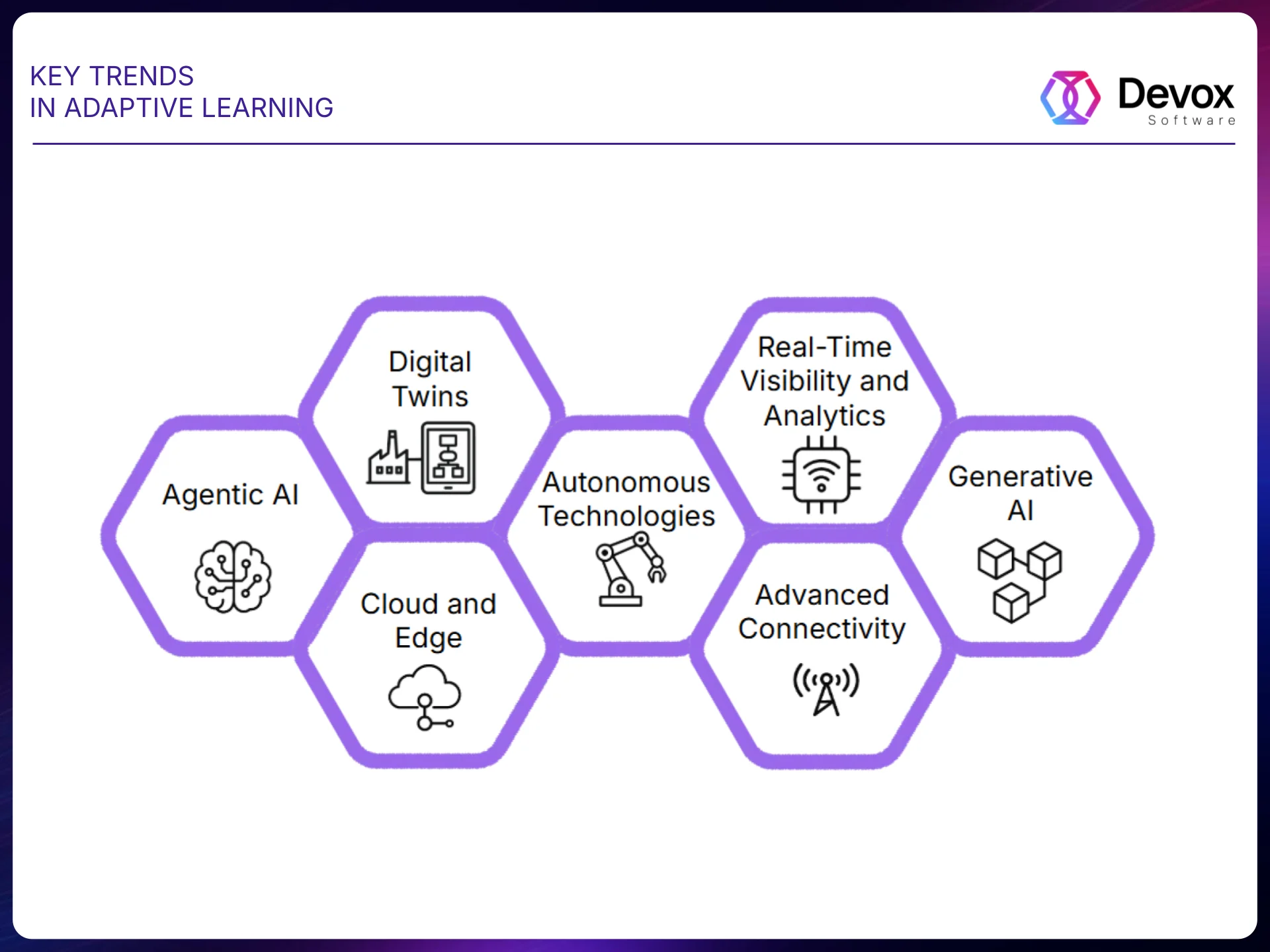
Edtech Platforms are pushing the boundaries of AI-driven adaptive learning to make education more about the individual and less about a one-size-fits-all approach—but they’re doing it with ethics front of mind and a focus on getting the underlying infrastructure right so everyone has a fair shot at an education.
Adaptive learning works by using AI to create a plan that matches each individual. This happens in real time, tailoring the learning experience to each student’s unique needs. There are many clever examples of how this works, such as probabilistic models that predict what a student might need most help with, and generative AI (think of something like ChatGPT) to help with tricky tasks. Platforms are also starting to use agentic AI to keep workflows flexible and dynamic.
Key Trends:
- Morris wants to help community organizations deal with the rapid AI-powered changes in education, after completing her PhD in 2026..
- While adaptive learning is a tried… intelligence and machine learning capabilities. K-12 education CIOs should prepare for the impact and understand the implications of adoption.
- Gartner expects that by 2026, enterprises that have adopted AI engineering practices to build and manage adaptive AI systems will outperform their peers in the number and time it takes to operationalize artificial intelligence models by at least 25%.
- In 2026, expect its economic, financial, and social consequences to grab attention. This research aims to develop an AI-assisted platform for personalized education, adapting to individual student needs and learning styles.
- Higher ed plans through 2025 include deploying adaptive learning tech. Investments in AI ethics and regulation for education. Internet access enables connectivity for adaptive platforms.
- MIT invests in AI for ecosystem monitoring, adaptable to EdTech. Guild Grow for talent development, including education benefits.
- Investments in broadband subsidies and community hubs aim to close divides, with U.S. efforts projecting GDP gains from bandwidth improvements.
- A 10% rise in connectivity can enhance schooling years by 0.6% and GDP per capita by 1.1%, with initiatives targeting underserved areas to enable adaptive tools.
Impact on Learning Outcomes
- Connectivity drives schooling gains: Boosting school internet access by 10% can extend effective education time by about 0.6% and lift per-person economic output by 1.1%, with tools like adaptive platforms enabling tailored content for better retention.
- In low-connectivity regions, improved infrastructure is forecast to increase adjusted learning years by up to 11%.
- AI boosts higher ed perceptions: Around 65% of college students view AI as a key enhancer for learning processes, with over half noting better access for diverse groups, though online quality concerns persist.
- Market growth signals outcome potential: The worldwide online learning sector is set to hit nearly $400 billion by 2026, fueled by adaptive algorithms that customize paths and improve engagement.
- Predictive AI for deeper cognition: Models such as Naive Bayes classify discussion depth with 73% accuracy, helping adaptive systems foster advanced thinking in online courses.
- Generative tools aid task mastery: AI like ChatGPT handles subject questions correctly about half the time, promoting critical evaluation and scaffolding for improved assignment outcomes.
- Hybrid models increase involvement: Blended virtual setups raise participation and flexibility, leading to higher comprehension through interactive videos and personalized feedback.
- Personalized platforms optimize study: AI analyzes performance to target weak spots, cutting study time while improving test results and mimicking one-on-one tutoring for skill development.
Future Outlook
- Personalized AI tools for lifelong skills: Platforms using AI to tailor content based on performance, like virtual tutors for languages or modular classes, are set to grow, promoting skill development in engineering and frontline work, with outlooks emphasizing reduced gaps and digital transformation.
- Advancements in agentic and immersive AI: With AI investment at $124 billion in 2024-2025 and job postings up 985% for agentic systems, future education may feature autonomous workflows and VR/AR for interactive training, shifting to human-AI collaboration in learning environments.
- Global market expansion for digital learning: Projections indicate the worldwide e-learning sector will approach $400 billion by 2026, with the US leading in platform revenues.
- Economic spillover from improved outcomes: Better connectivity and adaptive tech could drive 12-19% GDP per capita growth in developing nations by building skilled workforces, with broader impacts on innovation and poverty reduction through community-wide digital access.
- Online learning still faces engagement and quality concerns, highlighting the need for stronger AI training and digital safety frameworks.
- Focus on responsible innovation: Trends point to transparent AI in education, with high adoption scores emphasizing trust and augmentation over replacement, preparing for ethical, immersive learning ecosystems in the coming years.
- AI integration accelerating in classrooms: By 2026, interest in AI policies is expected to rise, with nearly all US state agencies noting increased demand for guidance; 65% of undergraduates believe AI will enhance learning processes.
Challenges and Barriers
- Widening digital divides in access: Urban areas enjoy high internet connectivity (around 87%), but rural and least-developed regions lag at just 10%, exacerbating educational inequities and limiting adaptive platform rollout, with calls for bridging gaps through initiatives like Giga by 2030.
- High infrastructure and logistical costs: Developing connectivity in remote or challenging terrains, such as deserts or mountains, inflates expenses and hinders EdTech adoption; for instance, bandwidth costs can be 25 times higher in landlocked countries than in neighbors.
- Affordability hurdles for broadband: In developing nations, internet costs consume over 5% of income (vs. under 1% in developed nations), and taxes add billions in barriers, creating homework gaps where 25% of households lack access and impacting self-paced learning.
- Insufficient teacher training and integration: Educators often resist digital tools due to skill gaps, with 85% learning informally. Shifts in the post-pandemic landscape require targeted upskilling, but limited resources during transitions reduce effectiveness in online environments.
- Online safety and distraction risks: Rising concerns over child exploitation (e.g., 75% of children facing upsetting incidents) and cyber threats create parental and teacher pushback, necessitating better regulations as adaptive AI tools expand.
- Device and hardware shortages: Limited access to computers or tablets, compounded by taxes like 18% GST in some markets, restricts personalized learning; low-cost solutions show promise but face fiscal trade-offs.
- Content localization and curriculum mismatches: Global EdTech resources often fail to align with local needs, slowing adoption; adaptive systems need tailored content to avoid widening attainment gaps, where disadvantaged students lag by half a grade.
- Generative AI tools still require critical evaluation due to hallucination risks and bias, reinforcing the importance of ethical frameworks.
- Student engagement and retention challenges: Online formats struggle with motivation and require coaching; disparities in digital literacy widen divides, and institutional support like reduced assessments sometimes backfires.
- Systemic friction and inequities: Entrenched traditional models resist adaptive shifts, amplified by digital redlining affecting marginalized groups; pandemics exposed these, pushing for equity-focused preparations but highlighting ongoing resource gaps.
See our learning management system modernization for a practical deep dive.
Strategy Road Map
As adaptive learning becomes a central part of EdTech products, rather than just a separate feature, EdTech leaders are taking a step back to think about how their systems will evolve. The future is all about EdTech platforms that can instantly adapt to each user, reason through problems, and respond on the fly – all while still being able to scale up to serve huge numbers of users. The roadmap below outlines how top EdTech companies will prepare their technical setup, data, and delivery models to take advantage of adaptive learning by 2026 in manageable chunks.
Step 1. Getting on the Same Page.
Build a clear, accurate picture of the platform: its architecture, what it relies on, how data flows through it, and the risks and constraints at play. From now on, make decisions based on what’s actually true, not just what we’d like to believe.
Step 2. Deciding What Matters.
Break the platform down into clear, distinct areas of value and functional pieces. Each piece should map to a specific business goal, user experience, or operational outcome.
Step 3. Slice-by-Slice Enablement
Bring the platform up to date bit by bit, rather than trying to do everything at once. Modernize backend systems in production, make releases the norm, and keep the platform running.
Step 4. Building a Data Backbone.
Create a single data and analytics framework that the whole platform can rely on. A shared language and clean signals are key to driving adaptive, AI-powered workflows.
Step 5. Scaling Change Smartly.
Scale your change efforts by being disciplined about how you work: continuous integration, continuous delivery, tracking what’s going on, controlling risks, and keeping a steady delivery pace.
Step 6. Continuous Evolution.
Embed modernization as an ongoing platform capability. New models, features, and markets integrate smoothly without large-scale transformation cycles.
Related services and details: our Adaptive Learning Software Development. We cover the hands-on side in our EdTech Platform Migration & Adaptive Learning Enablement.


