

In 2026, organizations face converging pressures that make legacy modernization a critical, proactive strategic imperative rather than a reactive IT task. Software built in the 1990s and 2000s now carries rising maintenance costs as original vendors withdraw support. Cloud-native competitors move faster. AI adoption demands architectures that legacy systems simply cannot support.
Legacy modernization is the strategic process of updating or replacing outdated software systems, architectures, and infrastructure to better align with current and future business objectives. This includes everything from COBOL mainframes and on-premises ERP systems from 2002 to monolithic Java and .NET applications from the early 2010s.
The distinction matters: “keeping the lights on” is not the same as using modernization to enable new products, faster releases, and data-driven decisions. At Devox Software, we’ve been modernizing banking, logistics, and SaaS platforms across EU and US markets since around 2017. We’ve seen firsthand what separates successful modernization efforts from costly failures.
What this research covers:
- Scope of legacy modernization in 2026
- Key reasons and benefits of modernizing
- Practical modernization strategies (the “R’s”)
- Common challenges and risks
- Step-by-step roadmap and best practices
Business Rivers of Legacy Modernization
In 2026, legacy modernization is shaped by the convergence of AI-driven code rewriting, infrastructure automation, and modular cloud architectures that are transforming how enterprises evolve their core systems.
Analyst data from Gartner, McKinsey, IDC, and Forrester indicate an accelerating pressure on organizations to reduce operational inefficiencies, address security and compliance gaps in existing systems, and unlock AI-ready data flows.
AI code assistants are projected to reach 90% enterprise adoption by 2028, while RPA+ML is expected to deliver 10-40% process savings.
This research paper synthesizes these market signals into a clear modernization outlook and a practical implementation roadmap: conducting a structured assessment of legacy systems, building an automated foundational infrastructure layer, deploying AI-accelerated SDLC workflows, extending operational automation, and moving toward modular hybrid-cloud environments. Together, these shifts form the strategic foundation for enterprises seeking resilience, speed, and measurable transformation outcomes in 2026.
Business drivers for modernization in 2026 include building resilient AI infrastructure to reduce technical debt through AI-native development platforms, enabling efficiency and business value.
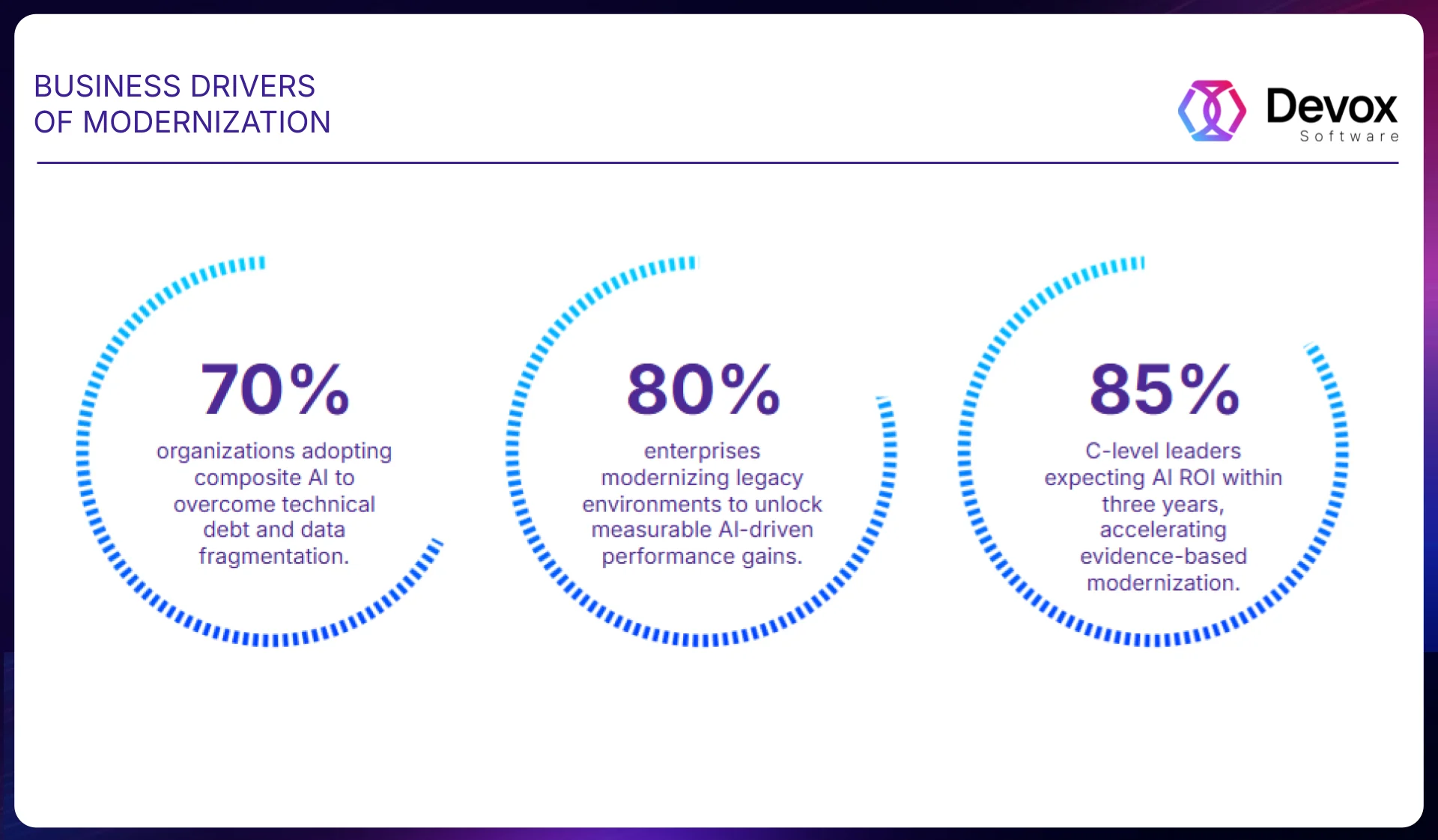
Productivity gains of 20-30% and cost reductions up to 15% via AI and hybrid models for legacy systems drive regulatory compliance and market agility for 40% of enterprises (Мckinsey). Addressing technical debt, security gaps, and data fragmentation through composite AI adoption by 70% of organizations fuels better alignment with business goals and enhanced decision-making (IDC)
Prioritizing AI ROI for growth among 70% of G2000 CEOs compels 80% of organizations to modernize legacy environments, achieving 10% logistics cost cuts and 15% higher operating margins via human-AI collaboration.
Expecting AI ROI within three years, 85% of C-level executives push evidence-based transformations, governance for trust, and deferral of 25% of AI spend to focus on defensible business value. Global transformation spending, reaching $3.4 trillion by 2026, is propelled by cloud adoption over 90%, emphasizing productivity, sustainability, and competitiveness in legacy modernization (Statista)
What Is Legacy Modernization?
Legacy modernization is the structured process of upgrading or transforming outdated applications, data stores, and infrastructure so they stay secure, scalable, and aligned with today’s business goals. A successful legacy modernization project begins with a thorough assessment of existing applications to determine their business value and technical health.
Concrete examples of what this looks like:
- Migrating a 2005 on-premises CRM to a microservices-based solution on AWS
- Wrapping a 1998 mainframe policy system in APIs so modern systems can consume its functionality
- Rewriting a 2010 .NET monolith into modular services with proper test coverage
Modernization does not necessarily mean completely replacing legacy systems. It involves a range of strategies to improve performance, scalability, security, and maintainability while leveraging existing investments. The scope covers both technology layers (UI, business logic, data, and infrastructure) and operating model (DevOps, CI/CD, and observability).
Most enterprises approach this incrementally—they rarely “turn off” a core system overnight. Legacy modernization is a pillar of broader transformation but narrower in scope, focusing on technology rather than full business reinvention.
Understanding Existing Systems and Technical Debt
A legacy system isn’t just “old software.” It’s any business weak link that is hard or risky to change: unsupported vendor stacks, no test coverage, missing documentation, or knowledge concentrated in a few specialists approaching retirement. Common legacy system types include:
| Type | Description | Typical Environment |
| Mainframe COBOL | COBOL and PL/I applications on IBM z/OS remain prevalent in banking, insurance, and government in 2026. They handle batch processing for settlements, claims, and regulatory reporting reliably but lack modern integration capabilities.
Core banking, claims processing built in the 1980s–1990s |
IBM z/OS, batch processing |
| Client-server apps | Two-tier or three-tier systems built on .NET Framework 2.0–4.0, Delphi, or PowerBuilder connected to on-premises SQL Server or Oracle. Common in manufacturing, logistics, and internal ERPs with proprietary protocols complicating cloud migration.
Insurance and manufacturing apps from the early 2000s |
.NET Framework 2.0–4.0, Delphi, PowerBuilder |
| Monolithic web apps | Single large Java EE or .NET apps deployed on application servers (WebSphere, WebLogic, JBoss, IIS) bundling UI, business logic, and data access. Scaling and testing these tightly coupled systems is difficult.
Large Java EE/.NET apps deployed ~2010 |
WebSphere, WebLogic, JBoss, IIS |
| Custom line-of-business tools | Excel-macro workflows, Access databases, and bespoke systems bridging enterprise software gaps. Often critical but fragile, dependent on individual knowledge holders. | Excel macros, Access databases, and one‑off bespoke tools |
| Third-party packaged systems | Older CRM/ERP versions where vendor support has ended, or upgrades are prohibitively complex | Customized SAP ECC, Microsoft Dynamics AX 2009 |
Technical debt accumulates through years of urgent patches—for PSD2, GDPR, and HIPAA compliance—without corresponding refactoring. The result is brittle code with regression risks, duplicated logic, and outdated frameworks like Struts or ASP.NET Web Forms.
Outdated systems often create “process debt” that complicates modernization, as business logic becomes tightly coupled with workflows, making it hard to update or replace systems without significant disruption. This non-technical debt means business rules are embedded in code instead of documented processes, creating dangerous dependencies on a few near-retirement specialists.
Why Modernize Legacy Systems? Benefits of Legacy Modernization
Legacy systems typically consume 60–80% of IT budgets in maintenance, leaving little room for innovation. Modernization addresses high maintenance costs, security vulnerabilities, and limited scalability of outdated systems. Here’s what organizations gain:
Improved agility and time to market
Modernized applications are easier to update, allowing development teams to release new features faster and respond more quickly to changing market conditions. Teams can move from quarterly monolith releases to weekly or daily deployments using CI/CD and microservices—cutting feature delivery from 6 months to 6 weeks.
Enhanced security and compliance
Unsupported operating systems like Windows Server 2012 (end of support in 2023) and outdated frameworks no longer receive patches. Modernization improves security and compliance by enabling features like zero-trust architectures. This matters for GDPR, HIPAA, PCI DSS, and ISO 27001 requirements.
Scalability and performance
On-premises hardware from 2010 cannot cope with 2026 traffic volumes. Cloud autoscaling and caching improve stability during Black Friday or other seasonal peaks without massive capital investment.
Cost optimization
Modernization can reduce operational costs by shifting from annual mainframe maintenance and proprietary UNIX hardware to pay-as-you-go cloud models. Organizations save by decommissioning data centers and eliminating Oracle license costs after migration.
Access to modern capabilities
Modern platforms provide native access to advanced AI, machine learning, and analytics tools that legacy systems cannot support. Real-time dashboards, AI assistants, and automation require APIs, event streams, and clean data—not siloed legacy databases.
Talent attraction and retention
Finding developers to maintain COBOL or outdated frameworks is increasingly difficult. Modern stacks (Kubernetes, .NET 8, Java 21, Node.js, Go) attract talent and reduce hiring costs.
Modernized systems streamline processes, automate manual tasks, and eliminate bottlenecks, resulting in faster response times, reduced errors, and increased operational efficiency. Legacy modernization can also improve customer experience by offering better user interfaces, improving consistency across platforms, and enabling personalization with data-driven recommendations.
Legacy Modernization vs. Digital Transformation
Digital transformation is a broad business strategy focused on changing how an organization operates and delivers value to its customers using digital technologies. Meanwhile, legacy modernization is a crucial component because it involves updating the underlying technical systems that support new business models and processes.
The key distinction:
- Modernization = Update systems, infrastructure, and architectures
- Digital transformation = Reimagine how the business creates value with technology
Consider a retailer modernizing their 2009 ERP to the cloud—that’s legacy modernization. Launching an omnichannel experience with real-time inventory, personalized offers, and AI-driven recommendations? That’s broader digital transformation.
Moreover, the latest often includes legacy modernization initiatives, such as cloud migration and mainframe modernization, which feed into its broader scope of changing entire business workflows and models. At Devoxsoftware, we typically start by modernizing a critical system, then help clients expand into broader transformation initiatives.
Legacy Application Modernization Strategies: The Practical R’s
Companies adopt different approaches to legacy application modernization based on risk and budget, often categorized as rehosting, refactoring, or replacing systems entirely. Modernizing legacy systems requires a strategic balance between minimizing business risk and maximizing long-term technical value. Modernization strategies vary; the right choice depends on business priorities, risk tolerance, regulatory constraints, and budget.
| Approach | What It Means | Key Actions | Benefits | Best For |
| Encapsulation (Wrapping) | Add APIs around legacy systems without changing core code | API gateways, middleware, service exposure | Low risk, fast integration | Stable systems needing connectivity |
| Rehosting (Lift & Shift) | Move apps to cloud with minimal changes | VM migration to AWS, Azure, GCP | Fastest migration, low effort | Infrastructure-driven limitations |
| Replatforming (Lift & Reshape) | Optimize parts during migration without full rewrite | Managed DBs, runtime upgrades | Better performance, moderate effort | Systems needing efficiency gains |
| Refactoring / Re-architecting | Redesign system into modern architecture | Microservices, Kafka, RabbitMQ | High scalability, long-term ROI | High-growth or complex systems |
| Rebuilding | Rewrite app from scratch | New codebase, modern stack | Maximum flexibility, clean architecture | High technical debt systems |
| Replacing | Switch to SaaS or packaged solutions | Salesforce, Dynamics, SAP | Lower maintenance, fast deployment | Standardized business processes |
| Hybrid Approach | Mix multiple strategies | Combine encapsulation, replatforming, refactoring | Balanced risk and cost | Complex systems with varied needs |
What’s New for 2026: Technologies for Legacy Modernization in 2026
RPA + ML in Legacy Modernization
RPA and ML enhancements in legacy-code modernization focus on automating operational flows, enabling predictive maintenance, and extending legacy systems through smarter integrations that cut errors and operating costs.
Enterprise-Scale Agents
McKinsey (2025) reports that 62% of organizations experiment with AI agents and 23% scale them. High performers use agents in IT for legacy optimization at roughly three times the rate of others. AI helps reduce costs by 25-40% across targeted processes, though 51% of respondents report accuracy-related issues that demand tighter controls. (McKinsey)
Integration Breakpoint
Deloitte (2025) finds that nearly 60% of AI leaders view legacy-system integration as the primary barrier to agentic AI adoption. Physical AI faces infrastructure challenges in 35% of organizations. By 2026, RPA with ML is projected to unlock 10-30% cost savings in manufacturing and logistics through modernization benefits. (Deloitte)
Automation Investment Wave
IDC (2025) estimates the intelligent process automation (IPA) market — which includes AI/ML-enabled RPA — will reach $65.3 billion by 2027 (21.7% CAGR from 2021). In 2022, it was $24.5 billion, up 16.7%. By 2025, two-thirds of businesses will use GenAI with retrieval-augmented generation for self-service across legacy processes, and enterprises will direct more than 40% of core IT spending toward AI-driven innovation. (IDC)
Precision SDLC Velocity
Forrester (2025) underscores AI/ML as a pervasive force across the software development lifecycle, with 70% of transformations slowed by legacy infrastructure that RPA and ML help streamline through targeted automation. (Forrester)
Infrastructure as Code (IaC)
Infrastructure as Code provides a programmable foundation for modernizing legacy environments by automating infrastructure configuration, enabling controlled cloud migration, and applying AI-driven governance and optimization across multi-cloud environments. mckinsey.com
AI Budget Concentration
McKinsey (2025) notes that high performers allocate more than 20% of their digital budgets to AI, with roughly 75% achieving scale. Higher infrastructure maturity correlates with stronger value creation, reflected in a 39% EBIT impact from AI applied to legacy-modernization programs.
Governance-First IaC
Deloitte (2025) reports that more than half of AI leaders flag infrastructure control as a core challenge. Sovereign AI strategies rely on IaC to coordinate multi-cloud deployments, with a 2026 outlook showing governance taking priority over model performance in legacy-system integration.
Unified DevOps Shift
Forrester (2025) anticipates that half of enterprises will shift from best-of-breed stacks to unified DevOps platforms built around IaC. Spending on AI infrastructure is expected to decline by 25% for one major vendor due to supply shortages, pushing teams toward more integrated automation ecosystems.
Accelerator-Powered Infrastructure
IDC (2025) forecasts that by 2027, spending on server accelerators for AI and IaC workloads will overtake CPU investment at a 55/45 ratio ($37 billion vs. $32.3 billion). By 2025, 60% of enterprises will mandate automation tied to KPIs, with IaC embedded in modernization programs for legacy environments.
Modernization with Cloud and Containerization
Containers became a key enabler with Docker’s rise around 2013–2014 and Kubernetes’ mainstream adoption around 2017. They provide portability and consistency across environments.
Containerizing legacy applications means packaging a Java 8 monolith or .NET Framework app into containers, standardizing runtimes, and simplifying deployment. This doesn’t require rewriting—it’s often the first step.
Organizations use managed Kubernetes (Amazon EKS, Azure AKS, Google GKE) or serverless containers (AWS Fargate, Cloud Run) to reduce operational overhead. This enables incremental modernization: first lift and shift into containers, then gradually carve out microservices, modernize data stores, and introduce event-driven patterns.
Supporting cloud services enhance the modernization process: managed databases, message queues, API gateways, and monitoring tools (Prometheus, Grafana, cloud-native APM) provide observability that legacy environments lacked.
Devoxsoftware designs containerization strategies, sets up CI/CD pipelines (GitHub Actions, GitLab CI, Azure DevOps), and guides teams through phased adoption—ensuring cloud infrastructure delivers actual value rather than just moving problems to new locations.
Key Challenges and Risks in Legacy Modernization
A phased roadmap typically prioritizes incremental changes over “big bang” overhauls when updating legacy systems. But even careful approaches face obstacles:
System complexity and hidden dependencies: Legacy codebases contain millions of lines with hard-coded integrations and undocumented batch jobs. Legacy systems are often tightly integrated with other applications, making it hard to disentangle dependencies during modernization and creating significant risk if not managed properly. Discovery tools and dependency mapping are essential before any change.
Data migration and quality: Migrating data from legacy systems can be complex because of incompatible formats and numerous dependencies, making it hard to ensure data accuracy and consistency during the transition. Migrating decades of customer or transaction data from Oracle or DB2 to PostgreSQL or cloud databases requires addressing duplication, inconsistencies, and archival policies.
Business continuity and downtime: Defining acceptable RPO/RTO, planning cutovers, and implementing blue-green or canary deployments minimizes outage risk for mission-critical systems.
Regulatory and compliance constraints: Finance, healthcare, and public sector organizations face strict audit and data residency requirements. Compliant environments and traceability during the migration process are non-negotiable.
Change management and culture: Resistance to change is common in modernization projects, as employees accustomed to legacy systems may resist adopting new technologies, requiring effective change management strategies. Training users on new UIs and communicating benefits clearly reduces friction.
Budget constraints and skills gaps: Modernization projects can be hindered by budget constraints, as hidden costs and the complexity of legacy systems can lead to unexpected expenses. Engaging experienced partners bridges expertise gaps during transitions.
The Legacy Modernization Journey: Step-by-Step Roadmap
Effective legacy modernization uses an incremental approach, such as the “Strangler Pattern,” to replace components in stages rather than all at once. Here’s a practical roadmap:
- Discovery and assessment: Inventory applications, infrastructure, integrations, and data stores. Classify systems by business criticality, risk, and technical health using architecture diagrams and scoring models. Analyze your existing application portfolio to identify modernization priorities.
- Define target state and priorities: Align with the 2–3 year business strategy—expansion into EU markets in 2027, a mobile-first customer experience, and AI-driven analytics. Define target architectures and platforms based on business objectives.
- Select modernization strategies per system: Apply the R’s based on complexity, budget, and time to value. Document rationale for each decision.
- Build the foundation: Establish cloud landing zones, security baselines (Zero Trust principles, IAM, encryption), CI/CD pipelines, and observability stack before large-scale migrations.
- Execute pilots: Choose one or two medium-risk, high-impact applications as pilot projects. Measure release frequency, defect rate, and performance improvements to refine patterns.
- Scale and industrialize: Create reusable templates, reference architectures, and playbooks. Subsequent apps modernize faster with less risk.
- Continuous improvement: Regular architecture reviews, technical debt budgets, and modernization backlogs prevent new legacy from forming in the 2030s. Modernization ensures an organization’s IT infrastructure aligns with current and future technological advancements, avoiding obsolescence and providing a foundation for continuous innovation.
Best Practices Devoxsoftware Recommends
Based on our experience across modernization projects in regulated industries, here’s what works:
- Anchor decisions in measurable business outcomes: Tie each initiative to KPIs—deployment frequency, incident duration, customer NPS, infrastructure cost reduction
- Modernize in slices: Apply the strangler-fig approach—wrap existing functionality with APIs and gradually replace modules
- Invest in automated testing and CI/CD early: Tests are the safety net enabling faster change; prioritize unit, integration, and regression tests for critical business flows
- Standardize on a small set of technologies: Avoid creating a new zoo of frameworks; settle on a modern, supportable stack aligned with team skills
- Embed security from day one: Adopt DevSecOps, automated security scanning, secrets management, and regular penetration testing
- Plan for knowledge transfer: Document domain logic discovered during modernization, record design decisions, and train teams to own modernized systems
- Work with experienced partners: External expertise bridges skills gaps and accelerates timelines
AI-Assisted Code Rewriting
Accelerator-Powered Infrastructure, refactoring, and migration across legacy systems such as COBOL and older Java estates, reducing both cost and delivery risk. Key data points paint the scale of the shift.
AI-Driven SDLC
By 2028, 90% of enterprise software engineers are expected to use AI code assistants across the SDLC, up from under 14% in 2024. This includes autonomous rewriting of legacy code, shifting engineers’ focus toward orchestration and system design. By 2027, 70% of organizations with platform teams will embed GenAI into their internal developer platforms to accelerate modernization (Gartner)
Workflow-Level Change
88% of organizations already apply AI in at least one function, including software engineering, to reduce costs in legacy modernization. Workflow-level change. Sixty-four percent report innovation gains from AI, while only 39% see EBIT impact above 5%. (McKinsey)
Developer Role Rebalance
Forty-nine percent of developers already use or plan to adopt GenAI assistants for coding, with only 24% of their time now spent on direct code writing; the rest shifts to design, testing, and debugging. A notable forecast: at least one organization will try to replace 50% of its developers with AI and fail because of the complexity of its legacy systems. (Forrester)
GenAI as Interface
By 2027, GenAI assistants will serve as the primary interface for 25% of enterprise software interactions, including legacy code modernization. RAG will support domain-specific tasks, supported by projected AI investments reaching $423 billion by 2027 (26.9% CAGR). (IDC)
AI Assistants in the Ci/CD Loop
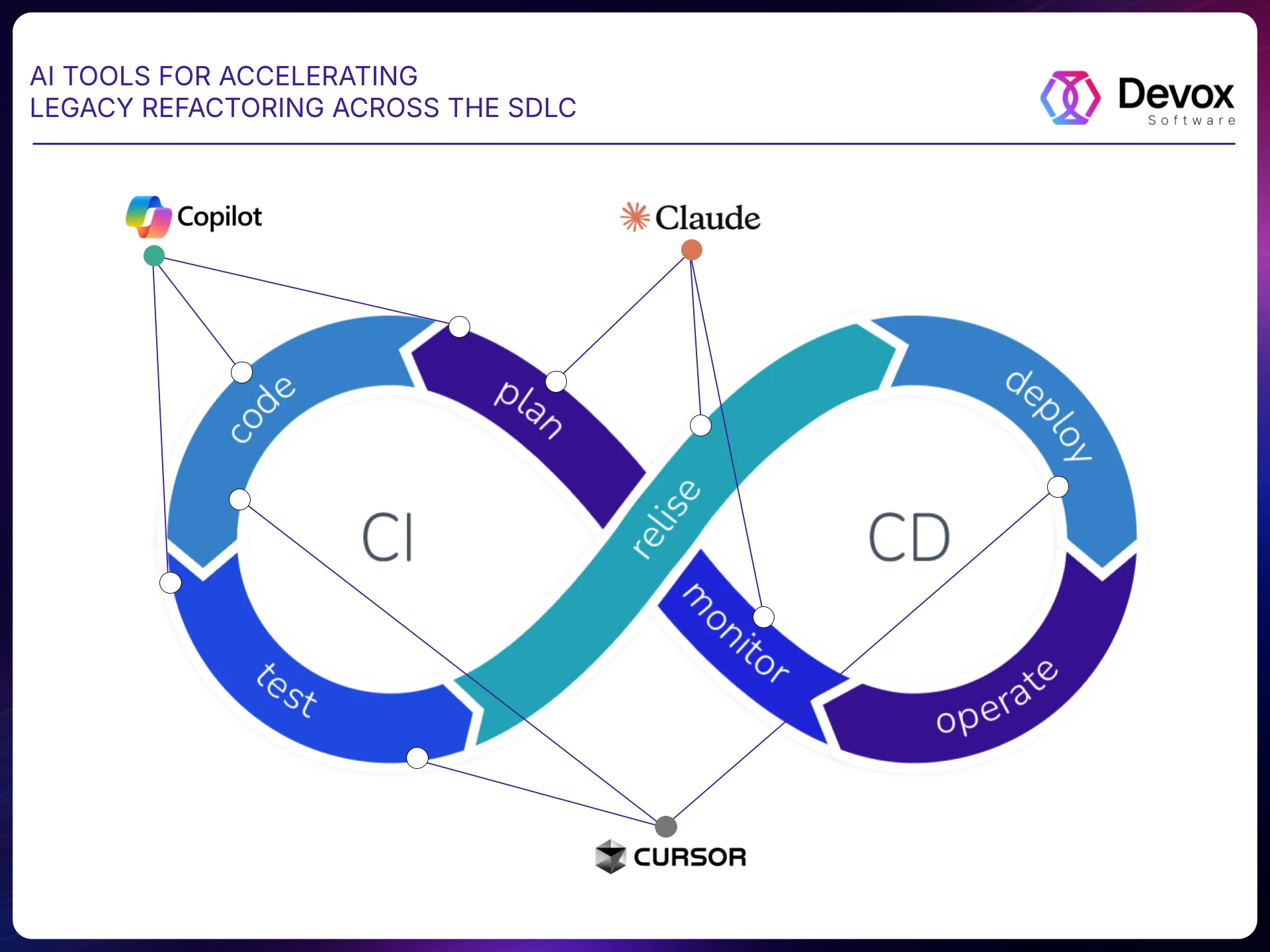
In 2025 reports, McKinsey’s Technology Trends Outlook highlights Claude Code alongside tools like Gemini Code and Codex for advanced multistep reasoning in code-related tasks, contributing to broader productivity gains projected at up to $4.4 trillion annually, with software development—including legacy modernization—as a key beneficiary.
Gartner’s Magic Quadrant for AI Code Assistants positions GitHub Copilot as a leader for the second year, emphasizing its capabilities in legacy code refactoring and application modernization through features like multi-file edits, vulnerability detection, and agentic workflows, estimating the market at $3.0-3.5 billion in 2025 with forecasts of 90% enterprise adoption by 2028 and 30% productivity gains in software development.
Gartner Peer Insights rates Cursor at 4.4 stars for enhancing code refactoring and efficiency in complex codebases, though without an explicit legacy focus; integrated tools like Claude in Copilot ecosystems demonstrate practical legacy code analysis, such as summarizing 80,000 lines of code in under an hour, aligning with Gartner’s prediction that AI will automate 70% of routine coding by 2030.
The Modernization Roadmap in 2026
Three key forces shape the modernization landscape in 2026: AI-driven code rewriting, infrastructure automation via IaC, and modular hybrid-cloud architectures that enable gradual migration away from legacy cores. These forces form a unified modernization roadmap for the next twelve months.
Legacy Baseline Intelligence
Create a structured assessment of legacy systems that reveals hidden dependencies, operational inefficiencies, and high-impact areas for AI-driven code rewriting, giving leaders a clear view of where modernization efforts will generate the strongest returns.
Infrastructure Spine Activation
Build a foundational infrastructure layer — containerization, IaC, unified APIs, and DevSecOps — to replace fragmented environments with a predictable, automated platform that can absorb rapid AI-driven change without destabilizing core systems.
AI-Accelerated SDLC Flow
Introduce AI-accelerated SDLC workflows that shift engineering work from manual code manipulation to continuous monitoring, automated refactoring, and expert-led review, shortening development cycles while improving architectural clarity.
Operational Automation Lift
Extend automation across operational workflows with RPA and ML to offload repetitive legacy tasks, reduce incident volatility, and create breathing room for teams as the system transitions toward modular patterns.
Modular Architecture Shift
Evolve the legacy estate into modular, cloud-native, and hybrid-cloud architectures that decouple change, strengthen resilience, and unlock AI-driven adaptability as the default operating model.
Continuous Modernization Loop
Establish a continuous modernization cycle where telemetry, AI-driven diagnostics, and architectural reviews feed into a repeatable process that keeps the estate adaptive.
How Devox Software Can Support Your Legacy Modernization
Devox Software is a technology partner specializing in modernizing .NET, Java, and JavaScript/TypeScript ecosystems, as well as cloud-native greenfield development.
Typical engagement models:
- Short discovery and assessment (4-8 weeks)
- Pilot modernization project (2-3 months)
- Long-term roadmap execution and support
Our capabilities include: cloud migration (AWS, Azure, Google Cloud Platform), microservices architecture design, containerization and Kubernetes, data migration, legacy applications performance engineering, and DevOps enablement.
We have experience with regulated industries and handle compliance requirements including GDPR, SOC 2, and ISO 27001. Our legacy modernization services help organizations achieve substantial cost savings while maintaining business continuity.
Ready to take action? Request an architecture review, modernization workshop, or proof of concept with Devox Software.
Conclusion
Legacy modernization in 2026 is no longer optional for organizations that want to remain competitive, secure, and efficient. The aging software systems that once served your core business operations now create more risk than value.
The safest path forward is incremental: prioritize the highest-value systems, choose suitable strategies, and build modernization capabilities over time. Transforming legacy applications doesn’t require a “big bang”—it requires a strategic process with clear milestones and measurable outcomes.
Devox Software can help design the roadmap, execute complex migrations, and ensure long-term stability of modernized platforms.