Table of content
The global supply chain is like the cardiovascular system of our contemporary economy, but recent events have shown how vulnerable it is. This represents a crisis in decision-making frameworks, where defining data points is important in the midst of the noise.
Devox Software has been developing intelligent transportation management systems (TMS) and intelligent solutions for logistics for decades. We’ve collected this experience into a strategic overview of supply chain orchestration for 2026. Want to keep your finger on the pulse of the industry advancements? Let’s start.
The AI supply chain orchestration “Three-Body Problem”
In logistics ecosystems, the main blockers for businesses with traditional TMS are based on several pressure points that constantly interact with each other. They include three inherently different groups:
- Manufacturers/OEMs need stability, predictable inputs, and cost efficiency to keep production and distribution aligned with demand.
- Suppliers/partners face their constraints, from raw material shortages and labor availability to geopolitical disruptions that affect supply continuity.
- Customers/market demand becomes increasingly volatile, shaped by AI-driven logistics software features, sustainability expectations, and rapid innovation cycles.
Each of these “bodies” presses on the others, rising instability: delays, shortages, or sudden pivots. Just like in physics, there’s no neat closed-form solution; instead, companies rely on simulation, predictive analytics, and adaptive strategies to keep the system balanced. This scenario is exactly where AI paves the road to business evolution.
Autonomous Supply Chain Software in Action
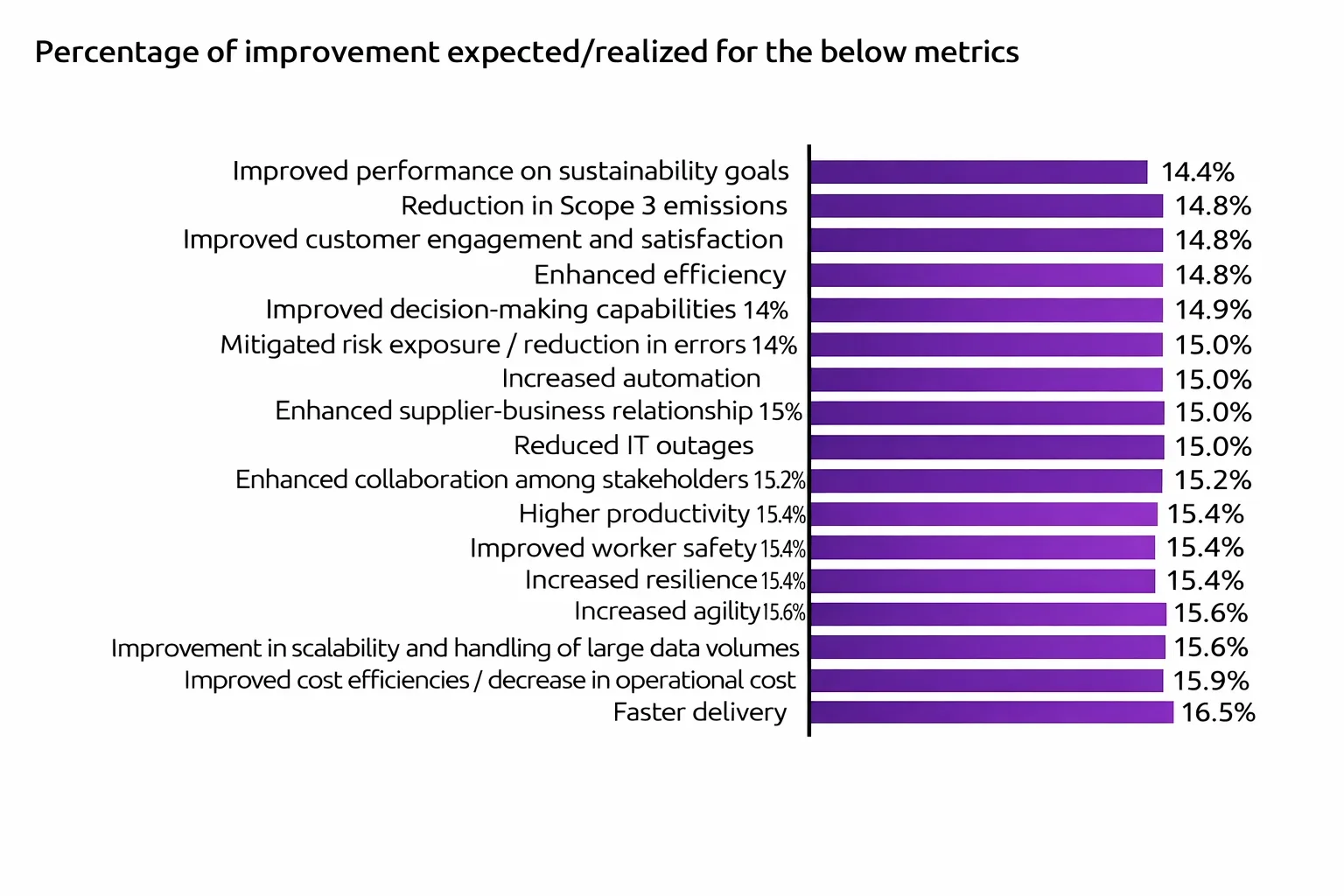
The reality shows that 72% of supply chain leaders are actively investing in AI capabilities. They connect this investment with their 72% higher yearly net profits, and their annual revenue increases by 17%. At the same time, AI-enabled supply chain management reduces logistics costs by 15%, representing a valid argument why AI not only gives new opportunities but also cuts expenditure.
Intriguing? Let’s get going to review AI-driven features closely.
AI-Orchestrated Supply Chains: How They Work
In an AI orchestration platform for logistics, AI functions as a digital “conductor” for the whole network. In particular, generative AI identifies environment and logic shifts in real time, while agentic AI takes actions. In their turn, the machine vision technology adds live visibility from the physical environment, while digital twins create a simulation layer for testing decisions before real-life execution.
Together, they bring together departments like planning, sourcing, and logistics that previously used to work separately. This table shows how it may look in practice.
| Technology | Core role | Key supply chain capabilities | Typical data sources | Business impact |
| Generative AI | Generate forecasts, reports, and any other structured outputs based on your data and documents | Demand forecasting, scenario simulation, operational reporting | ERP, WMS, contracts, shipment data, market signals | Faster planning, improved decision-making |
| Agentic AI | Agentic AI is forged to act. They take measures, call tools/APIs, and execute tasks with guardrails | Route optimization, automated scheduling, and disruption mitigation | ERP, TMS, IoT telemetry, fleet systems | Faster response to disruptions, operational logistics process automation |
| Machine Vision | Interprets visual data from cameras and sensors | Warehouse monitoring, inventory tracking, and safety detection | Cameras, warehouse sensors, robotics systems | Reduced operational errors, improved safety, and visibility |
| Digital twin supply chain AI | Virtual replicas of logistics systems used for simulation | Network modeling, disruption testing, capacity planning | IoT sensors, operational systems, and telematics | Better forecasting, optimized network design |
Let’s review each closely.
Layers of AI-Orchestrated Supply Chains
Modern AI supply chain optimization usually looks like this:
1. Sensing Layer
- Real-time telemetry. With the help of IoT sensors, GPS trackers, and telematics data, this feature monitors vehicle performance and cargo conditions. By capturing high-quality device telemetry in near real-time, businesses eliminate the “visibility gap” where traditional systems fail to account for current operational reality.
- Machine vision. Machine Vision currently takes care of quality control, safety monitoring, and syncing digital twins in real time. AI-powered cameras now act as real-time sensors within warehouses: pallet tracking, quality control inspection, safety monitoring, inventory counting, warehouse digital twin synchronization, etc.
- IoT sensors. They help to regularly inspect commodities, equipment, and logistics environments. Thanks to IoT sensors’ raw real-time inputs, supply chains monitor temperature, humidity, vibration, equipment health, and asset movement across warehouses, fleets, and production environments.
2. Intelligence Layer
- Predictive Demand Forecasting. Traditional approaches use historical averages, whereas modern AI models use sales history, weather patterns, social media trends, competition pricing, and macroeconomic cues to provide dynamic projections, reducing inventory costs and stockouts.
- Anomaly detection. It helps to identify deviations in financial transactions, equipment vibrations, or shipment patterns faster than human operators. In warehouse environments, predictive maintenance agents analyze telemetry from conveyor belts and forklifts to flag abnormal vibrations or overheating, reducing unplanned downtime.
- AI route optimization. AI route optimization algorithms analyze live traffic, weather events, delivery windows, and fuel prices to adjust delivery paths on the go. These systems can reduce empty miles (deadhead), improving fleet utilization and reducing overall logistics costs.
3. Simulation Layer
- Digital twins. A digital twin is a virtual model of a physical supply chain system, continuously updated with real-time operational data. As an “innovation layer” that sits on top of current ERP and WMS software, these virtual models let you run thousands of “what-if” scenarios to prevent problems by analyzing live data from IoT devices: warehouse simulation, logistics network optimization, inventory flow modeling, disruption impact analysis, scenario modeling, etc.
4. Orchestration Layer
- Agentic AI. Agentic systems plan, decide, and act independently across operational systems. They automatically alter procurement levels, reroute shipments, reallocate warehouse inventories, and update delivery schedules if delays or unexpected demand spikes occur. As a result, supply networks adapt to interruptions in minutes instead of hours or days.
- Control towers. Automated control tower systems serve as the centralized intelligence hub, connecting previously siloed data from ERP, WMS, and TMS platforms to provide 360-degree visibility. Multi-agent AI supply chain orchestration detects problems and autonomously executes solutions. By contextualizing real-time data, these towers resolve disruptions nearly twice as fast as traditional manual research.
- Autonomous workflows. These workflows automatically execute predetermined actions across connected enterprise systems when an AI system recognizes an issue or optimization opportunity. The most common examples include: automated shipment rescheduling following delays, moving inventory between warehouses, informing logistical partners of route adjustments, and so on.
In simple terms, the sources say that they are the “how” (technologies) that are employed to get to the “what” (use cases).
Legacy TMS Replacement Solutions
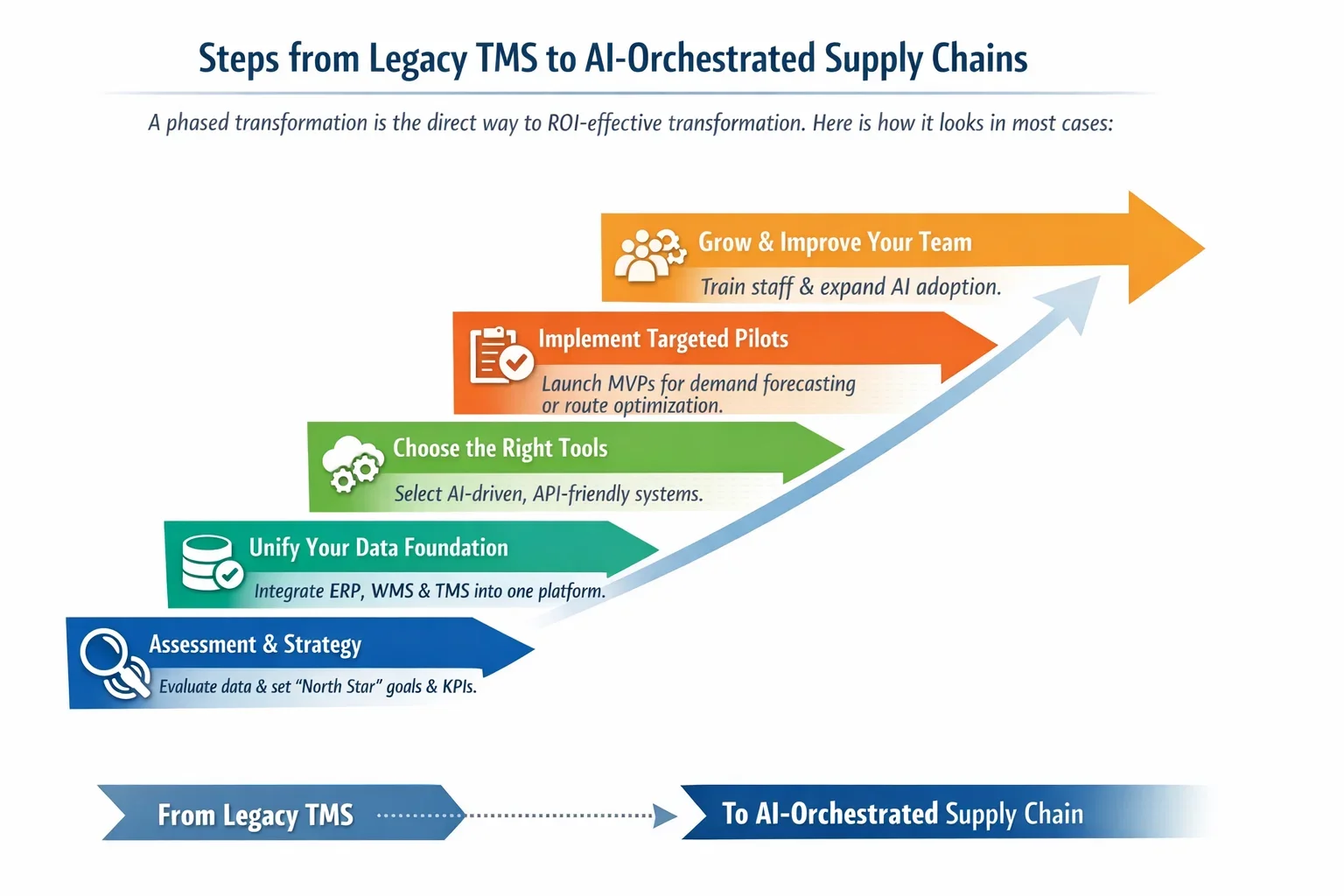
A phased legacy TMS modernization is the direct way to ROI-effective transformation. Here is how it looks in most cases:
- Assessment and Strategy: Start by looking over your present data and infrastructure to find “high-impact” areas where AI may provide value right now. Set specific goals for your “North Star” plan and set quantifiable KPIs, such as lowering costs or improving delivery accuracy.
- Unify Your Data Foundation: AI can’t work well on “Franken-systems” that are broken apart. You need to bring together the separate data from your ERP, warehouse (WMS), and transport (TMS) systems into one place.
- Choose the Right Tools: Pick cloud-native systems with built-in AI that can grow with your company. Put systems that enable deep integration via APIs at the top of your list so that various agents may talk to each other without any problems.
- Start with targeted pilots; don’t attempt to alter everything at once. To illustrate the business case, start with a Minimum Viable Product (MVP) in a controlled setting. This may be an automated demand forecasting or route optimization tool.
- Grow and Improve Your Team: Once you know the AI is useful, slowly spread it out over the world. Put money into change management to teach your workers how to operate with AI. This will shift their jobs from doing tasks to making decisions and setting a strategy.
Conclusion
The coming together of new technologies creates a single, smart supply network. This technology doesn’t only transport pallets; it also handles value, risk, and ethics on its own. The basic issue for every C-suite executive and logistics innovator is still: Are you developing a supply chain for 2026 or an ecosystem that can live on its own till 2050?
At Devox Software, we help logistics businesses move from fragmented legacy systems to AI-orchestrated supply chains built for long-term resilience.
Frequently Asked Questions
-
What is AI-enabled supply chain management?
AI-enabled supply chain management is when logistics networks use artificial intelligence to coordinate planning, execution, and optimization throughout the supply chain. Instead of using static planning tools, AI systems constantly analyze signals from fleet telemetry, warehouses, suppliers, and demand channels.
Based on these signals, the system estimates demand, detects abnormalities, simulates potential outcomes, and takes actions.
-
How can AI improve my legacy TMS?
AI improves legacy Transportation Management Systems by layering predictive intelligence and automation on top of conventional logistical procedures. For instance, machine learning algorithms forecast demand and plan routes. AI optimization engines reduce empty miles, increase fleet utilization, and dynamically change transportation plans.
When combined with real-time telemetry and control tower systems, AI transforms legacy TMS settings from reactive planning tools to enterprise AI logistics solutions.
-
What are the best solutions to migrate from legacy TMS to AI platforms?
The most effective modernization strategy to migrate TMS to AI platform is incremental. Firstly, you need to integrate existing ERP, WMS, and TMS platforms into a single data architecture. The next stage is to include analytics capabilities.
Once reliable data flows have been established, businesses can implement AI optimization engines, digital twins, and orchestration layers such as control towers or agentic AI, gradually transforming old infrastructure into an intelligent logistics platform.
-
How much does it cost to modernize a legacy TMS with AI?
Intelligent supply chain software costs vary greatly. The price is based on system complexity, data infrastructure, and the extent of modernization. Smaller projects, such as route optimization, can cost in the low $100,00. Large corporate transformations that include data platform integration, digital twins, and control tower orchestration cost anything from $200,000 to $2,000,000.
Despite the price, the return on investment is high, since AI supply chain optimization reduces costs and increases service levels.
-
How to implement AI-orchestrated supply chains successfully?
Organizations should start by building a solid data foundation that links ERP, WMS, TMS, and IoT technologies. The next step is to use analytics capabilities like predictive forecasting and anomaly detection to produce actionable insights.
Moreover, you can use simulation technologies, such as digital twins, to test operational situations before implementing changes.
Finally, orchestration technology, such as control towers and agentic AI, may automate operational responses and streamline workflows throughout the supply chain.
-
What are the challenges of moving from legacy TMS to AI-driven logistics?
One of the most significant difficulties is data fragmentation. Disconnected systems hinder real-time visibility. So, integrating various technologies into a single data platform might be challenging. Furthermore, security, governance, and model openness are all significant factors, especially in the case of autonomous decision-making systems.
-
How to evaluate AI orchestration platforms for the supply chain?
When assessing AI orchestration solutions, enterprises should consider various variables. First and foremost, the platform should be easy to interface with existing ERP, WMS, and TMS systems. Second, it should be able to process data in real time and provide scalable analytics capabilities such as demand forecasting, route optimization, and anomaly detection. Simulation tools like digital twins and operational control towers can also provide significant value. Finally, governance capabilities—such as security controls, audit trails, and human-in-the-loop oversight—are vital for safely integrating AI in mission-critical logistics operations.
-
What benefits can enterprises expect from AI-orchestrated logistics?
AI supply chain orchestration helps enterprises enhance operational efficiency and reliability. For instance:
- Predictive forecasting decreases inventory volatility and stockouts
- AI route optimization increases fleet utilization and reduces transportation expenses
- Real-time telemetry and anomaly detection help to prevent disruptions
- Digital twins and control towers improve visibility
As a result, AI-enabled supply chains allow firms to operate more agilely, increase service reliability, and make faster data-driven decisions.