



An industry-wide shift from mechanically driven to software-defined vehicles (SDV) packed with artificial intelligence (AI) and machine learning (ML) is no joke in the market. 38% of luxury automobile owners in Germany would switch brands if they had a better digital experience. That’s why 74% of executives think that by 2035, AI will power most cars. These numbers signal that AI is no longer an enhancement; it is the core expectation.
As we’ve been working with automotive and manufacturing clients for a decade, we’ve seen firsthand the transition of vehicle telemetry data from being a “technical add-on” to becoming a board-level strategic asset. With the advent of AI, the trend only strengthened. What used to be simple CAN bus diagnostics is now a continuous data stream powering predictive maintenance, digital twins, and so on.
This material, based on our hands-on practice, will show how you can leverage and monetize AI in the vehicle telemetry system. Let’s dive in.
What is Vehicle Telemetry Data?
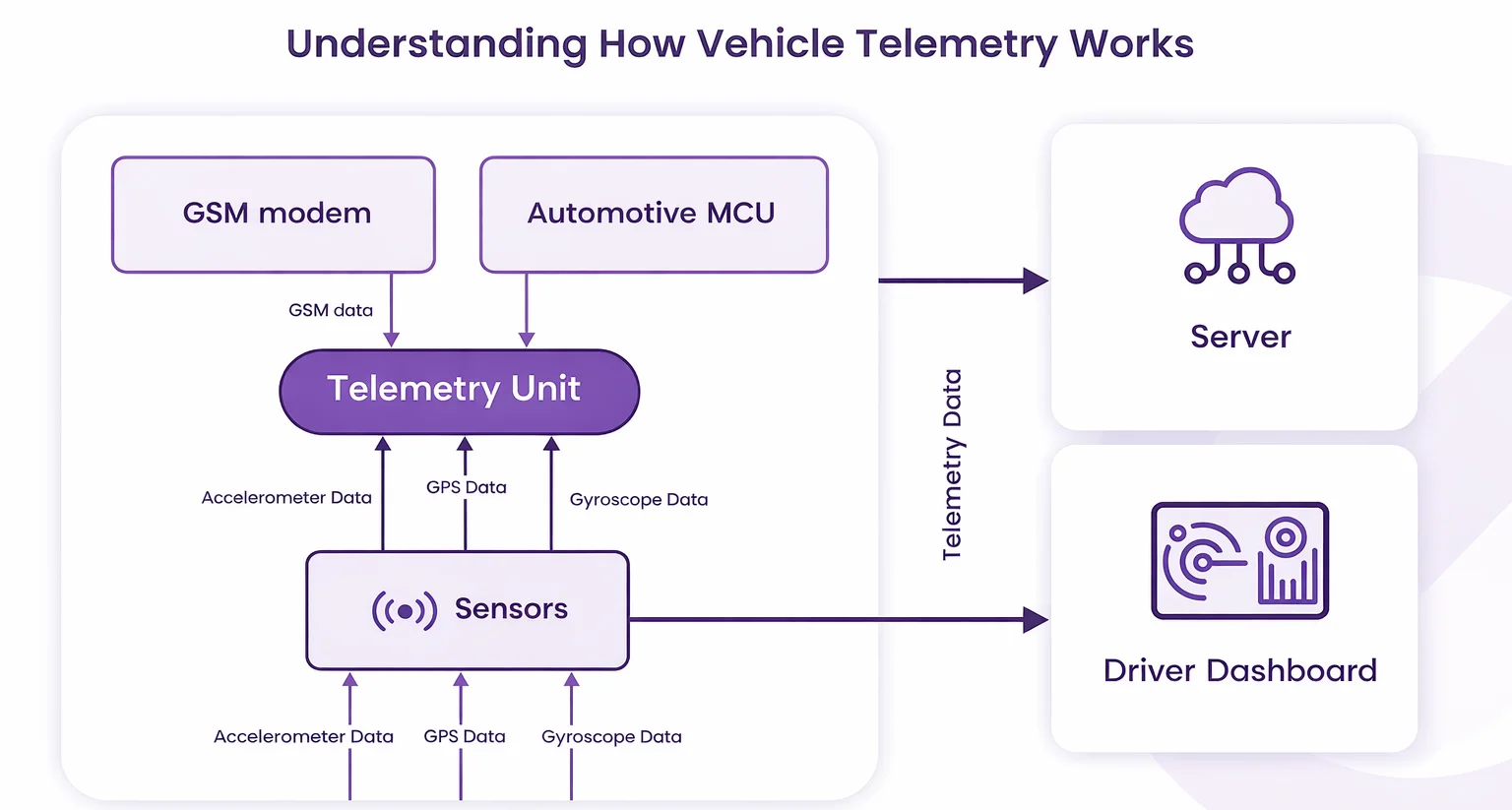
Vehicle telemetry data denotes real-time information from a vehicle to a centralized data system to improve vehicle performance in terms of safety, savings, and customer experience. This way, it typically includes the following metrics:
- Speed and acceleration
- Engine performance metrics
- Battery health (especially for EVs)
- Fuel consumption
- GPS location
- Driver behavior
- Environmental sensor data, including in-cabin and out-cabin information
Simply put, telemetry vehicle systems transform physical vehicle activity into structured digital signals, so cutting-edge tech systems could improve driving. A modern vehicle telemetry system consists of five core layers as follows:
| Layer | Function | Business Role |
| Sensors & ECUs | Capture raw data | Physical data origin |
| Telematics Control Unit (TCU) | Aggregates & transmits | Connectivity gateway |
| Edge Processing | Local inference | Low latency & privacy |
| Cloud Platform | Storage & AI analytics | Revenue intelligence |
| Business Applications | Dashboards, APIs, services | Monetization layer |
This stack enables vehicle data acquisition and telemetry at scale. That’s why telemetry has become the foundation of subscription services, predictive intelligence, and software-defined vehicle revenue models. Let’s consider it more closely.
What Is the Difference between the Traditional Vehicle Business Model and the SDV Model?
In a traditional automotive model, manufacturers’ revenue is realized at the point of sale. In a software-defined vehicle model, on the contrary, revenue extends across the vehicle lifecycle. Features can be activated, upgraded, or personalized remotely. Telemetry vehicle data becomes a monetizable asset. That’s the main distinction; however, they are legion, as you can see from the table below.
| Traditional Automotive Model | Software-Defined Vehicle (SDV) Model | |
| Revenue Timing | Revenue realized primarily at the point of sale | Revenue extends across the entire vehicle lifecycle |
| Profit Drivers | Margins depend on manufacturing efficiency and scale | Margins driven by software, services, and digital experiences |
| Post-Sale Relationship | Limited to maintenance, repairs, and spare parts | Continuous digital engagement and subscription services |
| Feature Deployment | Features fixed at production | Features activated, upgraded, or personalized remotely via OTA |
| Business Model | CapEx-heavy, product-centric | Recurring revenue, platform-centric |
| Data Role | Operational diagnostics only | Data becomes a monetizable strategic asset |
| Customer Experience | Hardware-driven differentiation | Software-driven personalization and AI-powered experiences |
| Competitive Edge | Engineering & production efficiency | Software innovation & data intelligence |
| Role of Telemetry | Reactive monitoring | Core enabler of predictive services and recurring revenue |
As telemetry vehicle systems continuously stream performance, behavioral, and environmental data, companies can accumulate and analyze it. The insights from it let manufacturers build recurring revenue services rather than one-time transactions.
How to Monetize Connected Car Data? Use Cases
Monetizing connected car data is not about selling raw vehicle telemetry data. It’s about converting structured vehicle data acquisition and telemetry into scalable services, revenue layers, and ecosystem partnerships.
Although the SDV model seems more beneficial, the shift toward it is a continuous process. It requires transforming vehicle data acquisition and telemetry into structured flows with insights and recurring services. Below are practical, delivery-tested use cases for turning vehicle data acquisition and telemetry into revenue streams.
Selling Comfort: Habitat on Wheels
Cabins are changing from a mere cockpit to a complex “habitat on wheels” with multimodal telemetry vehicle AI to learn about its passengers and tune comfort for them. Now, cars can comprehend and adjust the interior with the same accuracy as they adapt to the road by combining input from speech, gestures, and LIDAR spatial sensors.
In particular, Natural Language Processing (NLP) lets in-car attendants operate as real concierges. These systems don’t simply perform what they’re told; they also use biometric feedback to change the climate settings based on how the driver feels or propose media that fits the passenger’s mood. So the car adapts to the driver and passenger instead of them adapting to the car.
Selling Accessibility: Edge Computing
From cloud to edge, systems change as a direct answer to three problems with the cloud: latency, connection, and privacy. Now, cars perfectly perform without being connected to a 5G network thanks to high-performance System-on-Chip (SoC) designs and specialized Neural Processing Units (NPUs).
39% OEMs and Tier 1 suppliers confirm that offline availability is a must-have for sophisticated AI features. So while cloud solutions usually have latencies of 1,000 to 2,200 milliseconds, edge systems cut reaction times down to a sharp 300 to 700 milliseconds, which is crucial for real-time safety and smooth interaction.
Selline Reliability: AI-Powered Maintenance
Machine learning is extending the lifespan of cars by transitioning from reactive maintenance to proactive health management. AI can find little “fever” signs in a car, such as battery wear or engine performance problems, long before a breakdown happens. Just by watching sensor data in real time.
For owners, this means far cheaper repair costs and longer vehicle lifespans. For manufacturers, it makes quality control across the whole fleet easier than ever before. Additionally, it allows for remote diagnostics with less downtime.
Selling Intelligence: AI-Powered Features
“AI isn’t just enhancing the business model. By 2030, it will be the business model.” — IBM
We can see this vertical integration and cooperation happening right now. BMW has teamed up with AWS to power its next-generation automated driving platforms. Honda, on the other hand, is using IBM’s Generative AI to speed up the transfer of information between experienced and new engineers.
This investment proves that vehicle data acquisition and telemetry are strategic assets. This strategy lets OEMs work together on the essentials of software architecture while also competing on the experience that makes their brand unique.
Selling Safety: Digital Twins
Manufacturers use AI and digital twins to make lighter and stronger designs. Engineers keep collecting telemetry vehicle data and testing new features in these digital copies without any danger before stamping any steel.
Synthetic data speeds up this process by letting you simulate unusual and tough road conditions that are hard to find in real life. For example, NVIDIA employs AI to put self-driving software through millions of simulated miles under various weather and traffic situations. So new models can hit the road with more “experience” than a human driver could get in a lifetime.
Conclusion
As cars become more like computers, the industry is changing how it measures success from things like torque and tires to things like intelligence and flexibility. This vehicle telemetry monitoring change makes one last, thought-provoking inquiry for every potential automobile buyer: In a world where every car is a powerful computer, would you pick your next car based on how it drives or how it thinks?
That’s why Devox Software stays on the brink of innovation with forward‑thinking and progressive technologies. We help businesses deliver value here and now to lay the foundation for their future.


