

Today’s fintech businesses compete on onboarding speed, underwriting automation, repayment flexibility, compliance readiness, and customer experience. This guide reveals the exact practices fintech founders, CTOs, or product leaders could use in lending app development. Focusing on the US and UK fintech markets, we’ve included local advice, such as the CFPB and FCA regulatory compliance.
At Devox Software, we help fintech companies build and modernize secure lending platforms and payment services, fully PCI-DSS Level 1 compliant, scalable, and aligned with business goals and long-term growth strategies. Let’s get started.
A Smart B2B Lending App in 2026: What Is It?
A B2B lending app is a digital platform that allows businesses to apply for, manage, distribute, or monitor business loans and financing products online. Unlike consumer lending applications designed for individual borrowers, businesses commonly use B2B lending apps for working capital loans, invoice financing, trade financing, supply chain financing, etc.
For example, a logistics company may use a B2B lending platform to receive short-term financing for fleet expansion, while an eCommerce marketplace may embed lending directly into its seller dashboard to offer inventory financing to merchants.
Furthermore, B2B lending apps and B2C lending apps solve very different operational, regulatory, and financial problems. B2B lending platforms serve businesses, financial institutions, or enterprise operations where lending processes are more complex, data-heavy, and compliance-driven. Here are the major differences.
| B2B Lending Apps | B2C Lending Apps | |
| Target Users | Businesses, SMEs, enterprises, vendors, and financial institutions | Individual consumers |
| Loan Types | Invoice financing, working capital, equipment financing, supply chain financing, trade credit | Personal loans, payday loans, BNPL, microloans |
| Approval Complexity | Multi-step underwriting with financial statements and risk models | Faster consumer credit scoring |
| Compliance Requirements | Enterprise-level compliance, audit trails, and accounting integrations | Consumer protection and personal data compliance |
| Integrations | ERP, CRM, accounting systems, banking APIs | Payment gateways, mobile wallets, banking APIs |
| Security Requirements | Enterprise-grade access control and permissions | Standard fintech user security |
| Reporting | Advanced analytics, portfolio dashboards, and financial reporting | Personal repayment and spending insights |
The most significant difference is the borrower itself. B2B platforms serve small and medium businesses, enterprises, suppliers, vendors, and marketplace sellers — all business entities that may need a loan. This way, it involves a larger financial risk and more operational and underwriting complexity. This is exactly the case where modern technologies can leverage the
Key Takeaway
B2B lending apps, unlike those focused on individuals, enable scalable financial operations, complex underwriting workflows, enterprise integrations, compliance management, and long-term relationship financing for businesses. It lets them function less like mobile apps and more like full-scale fintech infrastructure ecosystems.
Why Fintech Businesses Invest in B2B Lending Apps: Benefits
Modern lending applications have evolved far beyond simple consumer loan tools. Today, digital lending platforms serve as operational infrastructure that supports underwriting, onboarding, servicing, analytics, compliance, and customer engagement within a single ecosystem.
Moreover, lending applications allow users to register remotely, verify identities digitally, apply for loans online, upload documents securely, receive automated approvals, and manage repayments directly from mobile devices. For fintech businesses, this translates into reduced operational costs, faster loan processing, stronger scalability, improved customer acquisition, and better data-driven decision-making.
Additional business benefits include:
- Faster KYC and Customer Onboarding. Automated Know Your Customer (KYC) verification, document scanning, biometric authentication, and identity checks onboard users in minutes instead of days.
- Reduced Loan Servicing Costs. Automation eliminates manual handling through document verification, repayment reminders, loan calculations, etc.
- Higher Loan Processing Capacity. Cloud-native lending platforms process significantly larger application volumes without proportionally increasing staffing costs.
- AI-Assisted Underwriting and Risk Assessment. Modern fintech companies increasingly use AI and machine learning to improve credit risk scoring, fraud detection, customer segmentation, predictive repayment analysis, personalized lending offers, and more.
- Real-Time Borrower Analytics. Instead of relying on static monthly reports, fintech businesses gain real-time operational intelligence that improves strategic decision-making.
- Improved Repayment Tracking and Collections. Automated repayment systems improve collection efficiency through smart reminders, automated payment retries, dynamic repayment scheduling, risk-triggered notifications, AI-driven collection prioritization, and so on.
- Better Regulatory and Compliance Management. Automated audit trails, reporting systems, permission controls, and transaction monitoring simplify regulatory operations and reduce compliance risks across the CFPB (United States), FCA (United Kingdom), PCI DSS, GDPR, and AML/KYC framework regulations.
- Faster Product Innovation. Cloud-native lending platforms make it easier to launch new loan products, BNPL solutions, SME lending services, and subscription financing.
Each capability translates into a feature that moves lending apps toward scalable, AI-assisted, data-driven lending ecosystems capable of supporting long-term growth.
The Advancements of Modern vs. Traditional B2B Lending Apps
Powered by solid benefits, let’s see how modern lending apps leverage businesses with modern features.
| Traditional
B2B Lending Apps |
Modern
B2B Lending Apps |
|
| Loan Application Process | Manual forms, email submissions, and branch visits | Fully digital onboarding with mobile and web applications |
| KYC & Identity Verification | Manual document review and delayed approvals | Automated KYC/AML verification with AI and third-party APIs |
| Data Sources | Limited financial statements and credit reports | Open banking, ERP data, transaction history, and alternative financial data |
| Risk Assessment | Static historical analysis | Predictive analytics and real-time risk monitoring |
| Fraud Detection | Manual review and reactive controls | AI-driven anomaly detection and behavioral analytics |
| Compliance Management | Manual audits and fragmented documentation | Automated audit trails and regulatory monitoring |
| Multi-User Access | Limited role management | Advanced role-based permissions and approval workflows |
| Infrastructure | On-premise or legacy systems | Cloud-native, microservices-based architecture |
| Security | Basic authentication and perimeter security | MFA, biometric login, encryption, zero-trust security models |
| Operational Costs | High due to manual processing | Lower through automation and workflow orchestration |
| Lending Models | Fixed loan structures | Embedded finance, BNPL, revenue-based financing, dynamic credit lines |
Instead of functioning as standalone loan management tools, modern B2B lending platforms become the core financial infrastructure that market players within a unified ecosystem. This is exactly why for fintech businesses operating in competitive US and UK markets, legacy modernization is a strategic advantage that directly impacts scalability, profitability, customer retention, and long-term growth.
Must-Have Features for a Money-Lending App
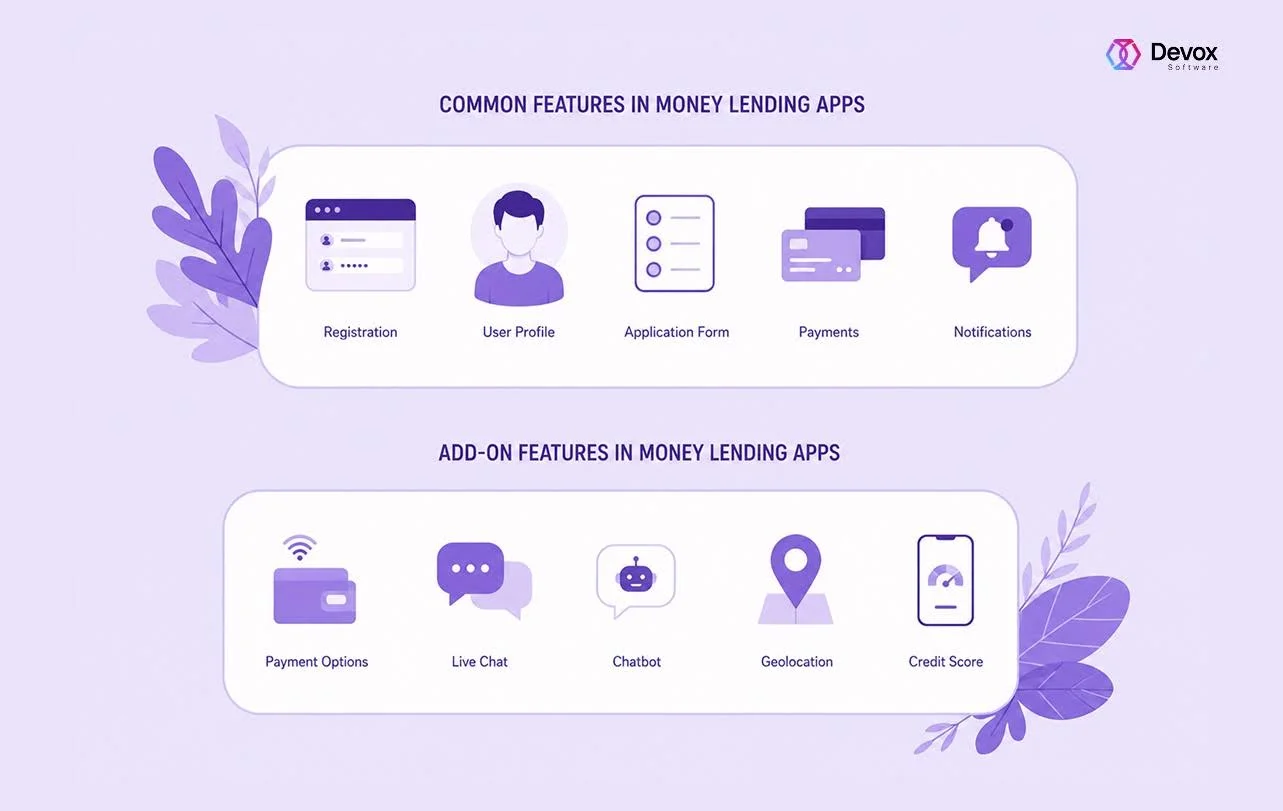
There are the basic features every fintech product should have and, beyond that, the optional features for the owner’s consideration. Use them or not, but all of them ensure a smooth user experience and make an app more competitive. Here, we concentrate on must-haves, so here are the options for you to consider based on our experience:
- Registration. The registration workflow often includes identity verification, phone and email confirmation, facial recognition checks, OTP verification, and consent collection for compliance. However, for B2B lending apps, registration may also support additional workflows like company onboarding, role-based access permissions, and corporate account management.
- User Profile Management. A user profile stores borrower information, tracks activity, and enables users to manage their financial interactions with the lender. Modern lending apps also provide users with visibility into active loans, remaining balances, repayment schedules, approval hierarchies, department-based permissions, accounting integrations, and more, like centralized financial management.
- Loan Application Form. It allows borrowers to request financing digitally without relying on manual paperwork or physical branch visits. Advanced fintech platforms increasingly offer dynamic application forms, AI-assisted data extraction, open banking integrations, autofill functionality, and real-time eligibility checks to reduce manual input requirements and improve approval speed.
- Payments and Billing. It’s a centralized repayment environment where users can manage the services they use. Transparency is especially important in fintech products because users expect clear visibility into crucial info, such as outstanding balances, interest accumulation, due dates, loan terms, etc.
- Notifications. They help borrowers stay informed while improving repayment performance and platform engagement, including payment due dates, loan approvals, application status updates, security alerts, etc.
- AI-Powered Features. AI-powered lending platforms increasingly use intelligent notification systems that personalize communication based on user behavior, repayment history, risk profile, financial activity, and so on, to reduce potential delinquency risks and automatically trigger proactive repayment reminders.
Additional features are the ones you may or may not include, but they can help to get more loyal customers. In a multi-tasking world, good customer service is the key to all doors: in this case, a live chat is a great idea for improving your customer relationships. Such additional features are highlighted below:
- Different payment options
- Live chat
- Chatbot
- Location
- Credit history
6 Steps to Develop a Loan Lending App
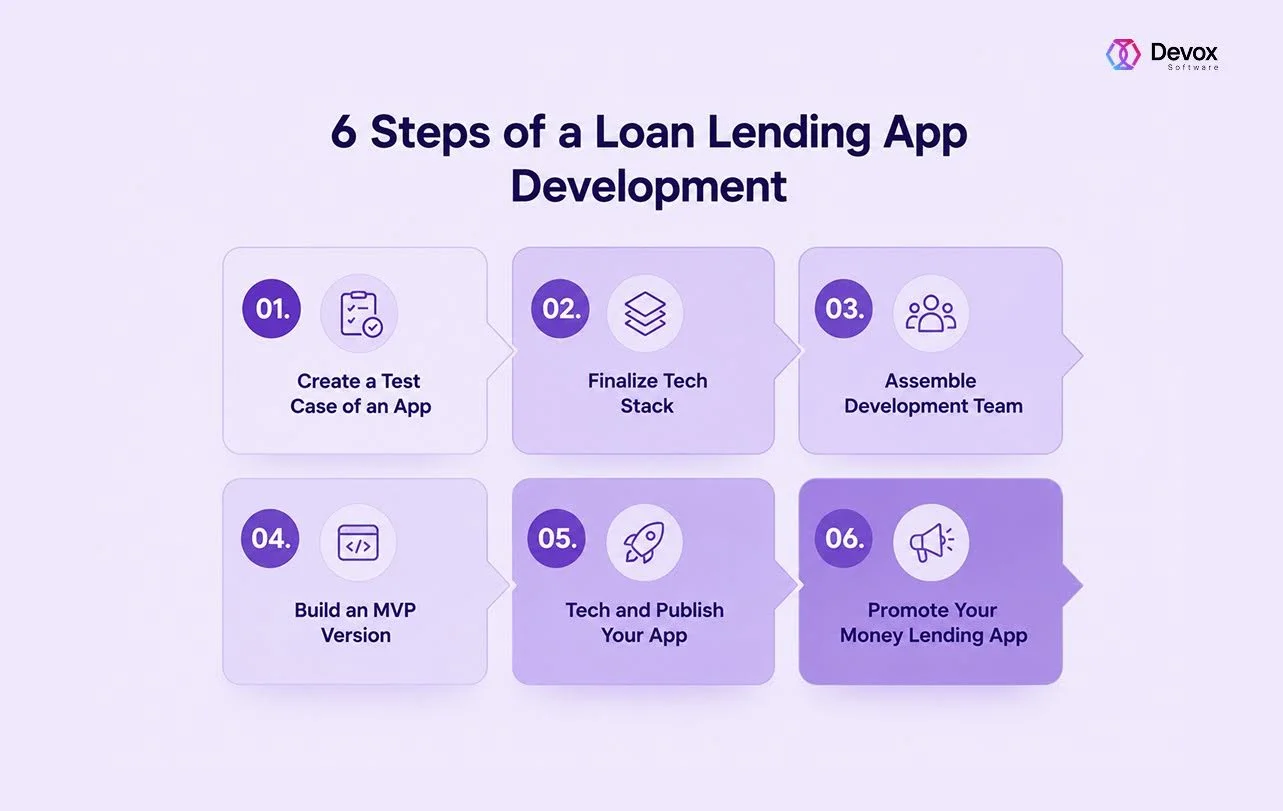
Before you dive into a mobile development process, you need to prepare a business strategy. Once you’re done, you can proceed with technical preparations.
Step 1. Validation and Technical Discovery
Before development starts, validate both the business model and the technical architecture of the future lending platform. This phase defines whether the product can scale operationally, comply with regulations, and remain profitable under real lending conditions.
A proper fintech discovery process usually includes market and competitor analysis, identifying the following:
- Target borrower segment (SMB, enterprise, consumer, embedded finance users)
- Lending model (BNPL, invoice financing, credit lines, working capital, P2P lending)
- Revenue streams (interest, servicing fees, subscriptions, interchange, commissions)
- Geographic scope and regulatory exposure
- Risk tolerance and underwriting logic
This includes a technical feasibility assessment, compliance assessment (CFPB, FCA, PCI DSS, GDPR, AML/KYC), API ecosystem analysis, underwriting workflow mapping, user journey mapping, and more.
At the technical level, the discovery phase defines:
- Core platform architecture
- Required integrations
- Data flows
- Security requirements
- Scalability targets
- Infrastructure constraints
The extensive first step will be well paid back later, preventing major complications in compliance and ensuring a good market fit.
Helping Questions
Which features belong in MVP
Which workflows should be automated
Which third-party services reduce development time
Which operations require custom development
Step 2. Choose a Scalable Fintech Tech Stack
Technology selection directly impacts the future scalability, throughput, security, and so on. That’s why, as a standard, modern lending platforms typically use cloud-native and API-first architectures instead of monolithic systems.
We’ve prepared a brief list of technologies that are essential in most cases for creating a money-lending app in 2026.
| Recommended Technologies | Purpose in B2B Lending Platforms | Business Impact | |
| Mobile Development | Swift, Kotlin, Flutter, React Native | Build mobile lending applications for iOS and Android | Faster customer onboarding and reduced MVP delivery time |
| Frontend Development | React, Angular, Vue.js | Create borrower dashboards, admin panels, and underwriting portals | Better UX, higher conversion rates, improved operational visibility |
| Backend Frameworks | .NET 8 / .NET 9, Java Spring Boot, Node.js, Python | Power lending logic, underwriting workflows, APIs, and repayment engines | High scalability, faster transaction processing, and enterprise reliability |
| API Architecture | REST APIs, GraphQL, Open Banking APIs | Connect banking systems, payment providers, KYC services, and ERP platforms | Faster integrations and ecosystem expansion |
| Deployment Model | Containerized deployment with Docker and Kubernetes | Manage scalable fintech infrastructure across environments | Improved uptime and automated scaling |
| Cloud Infrastructure | AWS, Microsoft Azure, Google Cloud | Host fintech workloads, databases, AI services, analytics pipelines | Global scalability and enterprise-grade reliability |
| Infrastructure as Code | Terraform, Helm | Automate infrastructure provisioning and environment consistency | Faster deployments and reduced operational errors |
| CI/CD Pipelines | GitHub Actions, GitLab CI/CD, Azure DevOps | Automate testing, deployment, and release workflows | Faster feature delivery and safer production releases |
| API Management | API Gateways, Rate Limiting, Service Mesh | Secure and orchestrate communication between services | Improved security and platform stability |
| Database Layer | PostgreSQL, MongoDB, Redis, and Elasticsearch | Handle transactions, caching, flexible data storage, and search | High-performance lending operations and real-time analytics |
| Transactional Database | PostgreSQL | Store repayment schedules, loans, borrower accounts, transactions | ACID-compliant financial operations |
| Caching Layer | Redis | Accelerate API responses and session management | Reduced latency and better platform responsiveness |
| Search & Analytics | Elasticsearch | Enable search, reporting, and portfolio analytics | Faster operational decision-making |
| Authentication & Identity | OAuth 2.0, OpenID Connect, MFA, Biometrics | Secure borrower and admin authentication | Reduced fraud risk and stronger compliance |
| Security Infrastructure | Encryption, Zero-Trust Access, Tokenization, SIEM | Protect financial and personal data | Enterprise-grade security and regulatory alignment |
| Compliance Support | Audit logs, monitoring systems, KYC/AML integrations | Support CFPB, FCA, PCI DSS, and GDPR compliance requirements | Reduced regulatory risk |
| AI & Analytics | Python, ML models, predictive analytics engines | Power underwriting, fraud detection, and repayment forecasting | Better lending decisions and portfolio optimization |
| Payment Infrastructure | Stripe, Adyen, Plaid, Dwolla, Marqeta | Process payments, transfers, and repayment automation | Faster transaction handling and financial automation |
Step 3. Assemble a Fintech Product Delivery Team
Lending applications require significantly more expertise than standard mobile apps because they combine many technologies in one. A typical fintech delivery team includes:
- Product and Business Unit: Product Manager, Business Analyst, Fintech Compliance Consultant
- Design Unit: UI/UX Designers, Product Designers
- Engineering Unit: Frontend Developers, Backend Engineers, Mobile Developers, DevOps Engineers, Data Engineers, AI/ML Engineers
- Quality and Security Unit: QA Engineers, Automation QA Specialists, Security Engineers, Performance Testing Specialists
Furthermore, depending on the MVP speed requirements, internal technical capabilities, and budget constraints, you choose your engagement model. In our practice, fintech companies often choose dedicated development teams over staff augmentation and offshore development.
Step 4. Build and Validate an MVP
MVP (Minimum Viable Product) is a test version in loan lending app development that helps to validate customer expectations before releasing a fully featured app. MVP should promote the product functions and make it easy for early customers to evaluate its functionality. Typical MVP modules include the following:
- Registration and authentication
- KYC onboarding
- Loan applications
- Admin dashboard
- Payment processing
- Notifications
- Basic underwriting workflows
Before entering this stage, you need to have high-fidelity mockups and low-fidelity wireframes to test each screen and make sure your app is user-friendly. After the UX/UI is complete, a software engineer creates a trial version with as many essential features as possible.
At this stage, you will understand what’s working well and what modifications you should make. If the MVP launch is successful, you can release a final product and start making money. If it receives plenty of negative feedback, you’ll need to go back and change the core app parts.
Step 5. Perform Enterprise-Grade Testing
Testing in fintech software development goes far beyond functionality checks. This is comprehensive quality assurance with validation for security, compliance, stability, scalability, etc. Fintech platforms usually undergo the following set of testing practices.
| What Is Tested | Purpose in Fintech Lending Platforms | Business Value | |
| Functional Testing | Registration, onboarding, loan applications, repayments, notifications, and admin workflows | Validate that all platform features work correctly under normal conditions | Prevent operational failures and improve user experience |
| Penetration Testing | Infrastructure, APIs, authentication flows, network security | Simulate real cyberattacks to identify exploitable vulnerabilities | Reduce cybersecurity risks and financial fraud exposure |
| Integration Testing | Banking APIs, payment gateways, ERP systems, and credit bureaus | Validate stable communication across external systems | Ensure uninterrupted lending operations |
| Performance Testing | High transaction volume, concurrent users, repayment peaks | Measure stability and responsiveness under heavy load | Support scalability and prevent downtime |
| Load Testing | Simulated spikes in applications and payment activity | Identify system bottlenecks before production launch | Improve infrastructure resilience |
| Stress Testing | Extreme operational scenarios and traffic overload | Determine platform breaking points and recovery behavior | Minimize outage risks during peak demand |
| Regression Testing | Existing workflows after updates or feature releases | Ensure new deployments do not break previous functionality | Maintain stable production environments |
| Usability Testing | Borrower journeys, admin workflows, and onboarding UX | Measure ease of use and interaction quality | Increase conversion rates and customer retention |
| AI/ML Model Validation | Fraud detection accuracy, underwriting logic, predictive scoring | Verify the fairness, reliability, and accuracy of AI decisions | Improve lending quality and reduce risk exposure |
As a result, you get a 360-degree protected app.
Step 6. Launch, Scale, and Continuously Optimize
Launching the platform is only the beginning of the lending product lifecycle. After release, fintech companies focus on infrastructure, fraud, portfolio monitoring, conversion optimization, customer acquisition, and more.
Growth-stage fintech companies also expand functionality through embedded finance, BNPL products, credit scoring engines, AI-powered financial recommendations, and more. The most successful lending apps evolve into full financial ecosystems rather than standalone loan management tools.
Create a Loan App: Key Takeaways
Money-lending apps are pretty straightforward: users create accounts, link their bank credentials, and request loans. They can choose a lender with the best interest rate and suitable repayment terms.
What customers need first is security. They trust an app with their private data and expect it to secure it from scammers. Besides, users need to be sure the app is reliable enough to fix their financial troubles.
Working with a reliable technology partner will make this process much easier for you. Contact Devox Software to handle your project. Our experience in fintech app development and AI-powered features lets us reduce development timelines by up to 30% as compared to the average in the market.
Frequently Asked Questions
-
What is a B2B money lending app?
A B2B money lending app is a digital platform that allows businesses to apply for, manage, distribute, or monitor loans and financing products online. Unlike consumer lending apps, B2B platforms support more complex underwriting workflows, integrations with ERP and accounting systems, multi-user access management, and enterprise-level compliance requirements.
-
How is a B2B lending app different from a consumer lending app?
B2B lending apps focus on financing businesses, suppliers, vendors, and enterprise operations, while B2C apps target individual borrowers. B2B platforms typically require: advanced underwriting logic, multi-step approval workflows, ERP and banking integrations, audit trails and compliance reporting, enterprise-grade security controls, and more.
-
How long does it take to build a money-lending app?
Development timelines depend on product complexity, integrations, compliance requirements, and AI capabilities. A fintech MVP usually takes 4-6 months, while a full enterprise-grade lending ecosystem may require 9-18 months, especially when integrating underwriting engines, banking APIs, fraud detection, and compliance systems.
-
Which technologies are commonly used in lending app development?
Modern lending platforms commonly use .NET 8/.NET 9, Java Spring Boot, Node.js, Python for AI and analytics, React or Angular for frontend development, PostgreSQL and Redis, AWS, Azure, or Google Cloud, Docker and Kubernetes, REST APIs, and Open Banking integrations.
-
What security measures should a lending app include?
Most fintech platforms usually implement Multi-factor authentication (MFA), end-to-end encryption, tokenization, zero-trust access controls, secure API gateways, SIEM monitoring, intelligent fraud detection systems, biometric authentication, and more.
-
What compliance regulations apply to lending apps in the US and UK?
Lending platforms targeting the US and UK markets commonly align with:
- CFPB regulations (United States)
- FCA regulations (United Kingdom)
- PCI DSS
- GDPR
- AML/KYC requirements
- SOC 2 practices
- Open Banking standards where applicable
-
How does AI improve lending platforms?
AI is increasingly used in fintech lending for credit risk scoring, fraud detection, predictive repayment analysis, customer segmentation, and more, offering a step up for efficiency and performance for systems.
-
How much does it cost to build a lending app?
The costs vary and usually depend on product complexity, compliance scope, AI functionality, integrations, onshore or offshore development, and more.
A basic fintech MVP may start from $15,000, while enterprise-grade lending ecosystems with AI, compliance automation, and banking integrations may require significantly larger investments.