



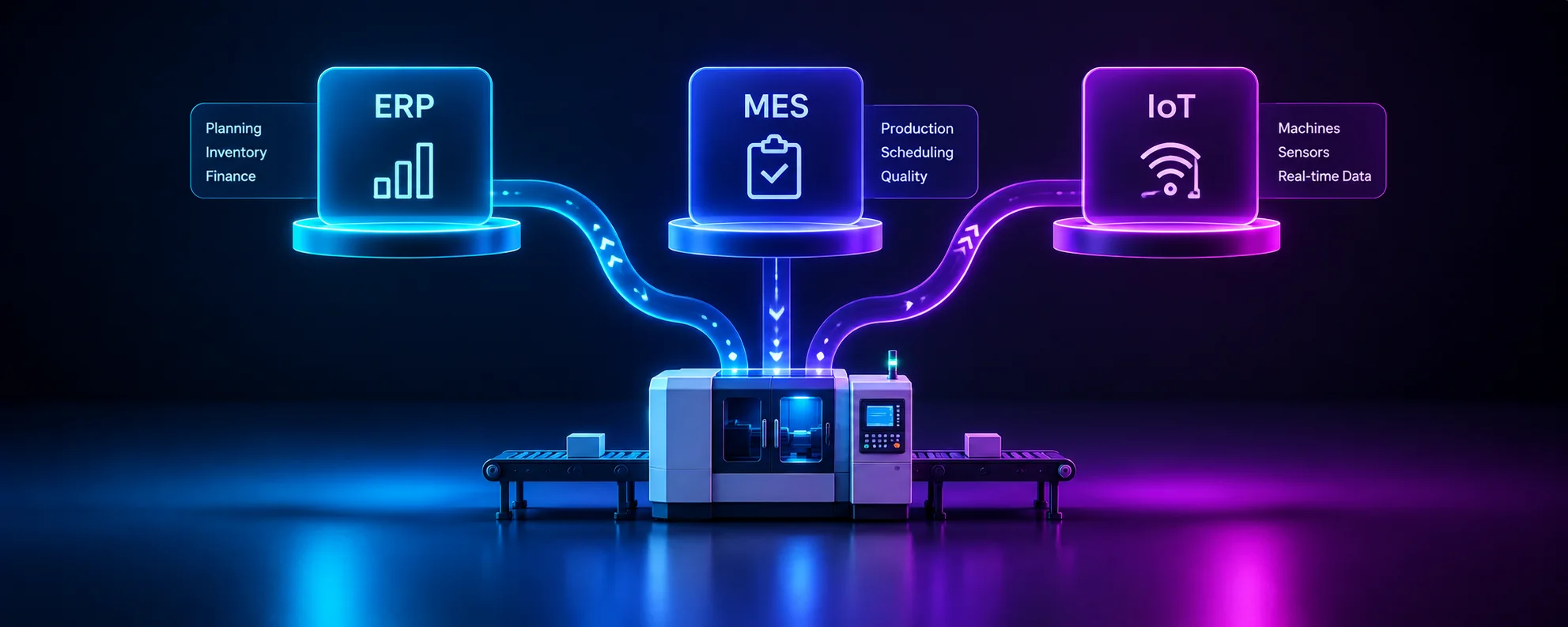

American manufacturing has crossed a line it will not cross again. The old ISA-95 pyramid no longer keeps pace with how fast plant data has to move. In this new reality, enterprise software is moving from recording what happened to acting on what is happening.
ISA-95 still describes which layer owns what. What broke is the assumption that batch data can keep up with an agent making real-time decisions. A system of action is an event bus with a signed write path, not a replacement pyramid.
The real challenge in defining ERP today lies in connecting OT and enterprise data. That gap has become the choke point. It’s the main barrier to any meaningful use of AI on the shop floor. Without a contextualized, real-time data flow between OT and IT systems, even the best models stay stuck in read-only mode instead of driving real decisions and actions.
How to Build the System of Action
You do not get from a monolith to event-driven operations in one jump. In this guide, we break down the foundational architecture industrial manufacturers must adopt in 2026 to keep pace.
- The unified namespace, or UNS: Giving plant data one backbone.
- Edge computing: Keeping raw IoT traffic from swamping the network.
- Composable architecture: Replacing inflexible monolithic systems with modular components
- Zero trust security: Securing the converged IT/OT landscape.
- Agentic AI: Setting up guardrails for autonomous, real-time decision-making.
Manufacturers seeing the strongest results today are not those chasing the most advanced AI features. They are the ones who first built a reliable, governed data foundation and only then added intelligent automation on top of it. What still separates the pack is not the choice of an MQTT broker or an edge platform, but the discipline to keep the data trustworthy.
Event-Driven Architecture: Setting up a Unified Namespace
A UNS gives factory data one nervous system. It’s a centralized, event-driven framework that enables every device and system in an industrial setup to exchange data without a maze of one-off integrations.
Ditching Point-to-Point for a Hub-and-Spoke Model
Most legacy industrial setups rely on complex point-to-point connections, often called spaghetti diagrams. They become a maintenance trap fast. UNS gets you out of that point-to-point mess. Instead of systems talking directly to each other, MES integration connects everything to a central message broker.
Sensors still talk to a PLC. The change is the next step: the gateway publishes a named topic into the UNS instead of a one-off point-to-point feed. SCADA and MES subscribe. ERP gets the business event, not the raw tag.
MQTT and Kafka: Split the Work
Today, the industry standard for a scalable UNS is a hybrid approach using MQTT and Apache Kafka.
MQTT carries shop-floor telemetry. Kafka stores and distributes the business event. Sparkplug B (or your named equivalent) prevents every new cell from creating its own schema.
How it’s Built: Data Bridges and Structured Data Organization
This is where integration discipline matters. Tech partners like Devox Software usually handle this task by deploying “Data Bridges.” A Data Bridge is the translation layer. It pulls data from an MQTT topic, cleans it to match the company’s internal model, and pushes it to Kafka. These bridges often use aggregation points to keep topic sprawl under control. For example, instead of having thousands of one-off streams for each sensor, the bridge can bundle them into a single organized Kafka topic.
To ensure consistency, we adhere to strict naming conventions such as Sparkplug B, which defines a clear message hierarchy.
Hybrid Three-Tier Infrastructure: Edge, On-Premises, and Cloud
In MES-ERP integration, modern heavy industry has found that moving everything to the cloud falls apart on the plant floor. By 2026, the practical pattern is now three-tier: edge, on-prem, and cloud. Edge devices handle anything that needs a split-second response.
Edge Computing: Filtering Petabytes of IoT Data
Industrial devices generate massive amounts of data from thousands of devices. Pushing it all upstream makes the network the bottleneck.
Edge computing fixes these issues by moving processing power directly to the machines on the floor. Edge gateways separate signal from noise before the WAN ever sees it. For example, high-speed computer vision at the edge can spot defects as small as 0.6 mm at speeds faster than a human can blink, triggering a stop command in milliseconds. A cell generates more samples than the WAN should handle. The gateway forwards labeled events. Edge vision can hold a unit and open a quality ticket within the station cycle. A line stop still goes through the PLC interlock and a designated owner. Quote pixel size and takt only with the camera and material attached. The cloud gets the event, not the firehose.
Staying Online When the WAN Goes Down
Industrial sites are often in remote locations where a stable internet connection (WAN) isn’t guaranteed. But for mission-critical systems, such as managing work in progress, even a brief disruption in cloud connectivity can shut down the line.
In modern architecture, we keep business-critical MES transactions local and run them on-premises. This gives the factory “local autonomy.” Even if the facility loses its connection to the outside world, the line keeps operating smoothly. Once the network is back up, the local software automatically syncs the data back to the cloud via Kafka.
The Vendor’s Perspective: Cutting Cloud Costs with Edge Inference
As data volumes explode, many companies hit a “cloud tipping point,” where their monthly cloud bills are 60-70% higher than the cost of buying the equivalent hardware to run it themselves. Inference on every frame in the cloud is where costs spike. Train and version in the cloud. Package the detector and run it on the station or the on-prem node. Compare three months of egress and GPU costs against the hardware cost before you call it a tipping point.
To protect the client’s budget in MES-ERP integration, engineering teams now use a pattern called “edge inference”:
- Train in the Cloud: Use the cloud’s massive, scalable power to build and train heavy AI models.
- Run at the Edge: Once the model is ready, package it into a container and push it to the factory’s local servers.
- Local Predictions: The model predicts equipment failure on-site.
Software becomes the next bottleneck. Real-time, event-driven manufacturing cannot operate effectively on monolithic legacy systems. You need software that is as modular and flexible as your new data architecture.
Composable ERP & MES: Swapping the Monolith for “Legos”
Most mid-market plants still run a monolith as the system of record. Composable in 2026 means a stable ERP/MES core plus small services built around clear contracts: schedule propose, quality hold, inventory reserve. A big-bang cutover of the core is still an expensive way to fail. Companies are now making small, API-driven tweaks instead of relying on large-scale “big bang” upgrades that carry significant risks of failure. This lets you swap in a new planning tool or a sustainability module without crashing the plant’s entire digital core.
Breaking Down the Monolith
Modern architects aren’t trying to customize one giant software package anymore. Instead, they’re managing a “catalog” of services that plug into a stable ERP backbone. This makes ERP integration with the shop floor and front office much more flexible.
Manufacturers aren’t stuck waiting on a single vendor’s roadmap anymore. If you need a specific scheduling tool right now, you build it as a microservice. You keep latency-sensitive workloads on local servers and move the rest to the cloud.
Data Contracts: Keeping Everyone on the Same Page
When you have several different modules running, they have to speak the same language. That’s why we use data contracts. Think of these as an agreement on how data is defined and named. To keep errors from propagating across systems, we set up automated ETL pipelines at the boundary that reject bad data early, validating it before it moves from one system to the next.
Syncing CAD and the Shop Floor
For “Engineer-to-Order” companies, the expensive gap is still between engineering intent and what reaches the floor. Usually, an engineer creates a design in CAD, and then someone still ends up keying the BOM into ERP by hand. That is where transcription errors creep in—for example, procurement orders the wrong parts.
We solve this with integration gateways that:
- Auto-sync the BOM from CAD directly into the ERP and MES. No manual entry, no typos.
- Sync changes in real time. When an engineer modifies a drawing, the operator’s digital instructions on the floor refresh instantly.
IT/OT Convergence
Connecting production lines to business systems, IT/OT convergence, is a double-edged sword. The old castle-and-moat model does not survive IT/OT convergence. Zero trust is now the baseline: “never trust, always verify.” In this setup, being on the plant network no longer buys a device trust.
Dealing with “Non-Human” Identities on the Floor
In a typical office, Zero Trust is straightforward—you use certificates and 2FA on phones. But on a factory floor, most of the “users” are PLCs.
That’s why we treat them as non-human identities. Since these devices cannot authenticate themselves, the system identifies them by their hardware identity. Every sensor and controller needs an identity the policy layer can verify.
Microsegmentation and Industrial DMZs
To keep the front office and the shop floor safely separated, we use an Industrial DMZ (IDMZ). It gives IT and OT a controlled handoff point. It also serves as the controlled gateway for data, so there’s never a direct line from the corporate IT layer to critical OT systems.
On top of that, we use microsegmentation. We break the plant floor into small, isolated zones called “Protect Surfaces.” Each machine or cell gets its specific access rules. This stops “lateral movement”—if a hacker compromises one sensor on a packaging line, the compromise dies in that zone. They can’t jump to the next machine or access the ERP core.
Edge Security Without Added Latency
The catch with industrial zero trust is latency. If security checks slow down the network, they can disrupt physical processes and cause a shutdown. A security control that trips production is its own operational incident.
At Devox Software, we address these issues with specialized edge gateways. These gateways act as policy enforcement points. They handle authentication so the older controllers don’t have to. We’re also replacing broad VPN access with ZTNA—Zero Trust Network Access. If a technician needs to fix a robot, they get just-in-time access to that device and nothing else for the duration of their shift. It improves security without disrupting production.
Autonomy Levels
Nowadays, we’re seeing a major shift from AI that advises to AI that can actually touch the process. We’re discussing specialized AI agents, where the difference lies in write authority.
Sandboxes and Digital Twins
The hard part is giving AI authority without letting it outrun the controls. Traditional testing is simple: if you put in “A,” you always get “B.” But AI is probabilistic; it reasons toward a goal and might take different steps each time.
That is why autonomy needs a proving ground; the architecture uses isolated environments:
- Digital twins: a proving ground for changes before they touch the line. You can simulate “what-if” scenarios here before the AI interacts with real equipment.
- Sandboxes: A plant will not give an agent a write token until the same action has run in a twin or a shadow queue against live tags. The sandbox is a gate, not a sales statistic.
Setting Up Guardrails for Autonomous Operations
To keep an agent from crossing a cost or safety boundary, you have to hard-code guardrails into the system. When designing the ERP/MES/IoT ecosystem, we draw a hard line between two classes of action:
- Bounded autonomy: hold a unit. Cutting-parameter writes require a supervisor’s confirmation and a recipe signature. The 2026 pattern on a live cell is propose-then-approve unless the plant has already signed that specific action.
- Human-in-the-loop: reserve it for decisions with real downside. Where a mistake can cost six figures or put people at risk, the AI handles the analysis and re-prioritizes orders, but a person still owns the final click.
The architecture has to be transparent. Every write path needs a kill switch and a way back.
The Real-Time Dashboards
Integrating AI agents into the factory floor only works if operators will actually take their calls. This means operators move from executing every step to supervising a queue of proposed actions.
Technical partners like Devox Software make this happen by building custom UI/BI dashboards:
- Near-Real-Time Data: The HMI cannot be ten minutes behind the process. If an operator is looking at 10-minute-old data, the operator is already looking at yesterday’s truth.
- Value Clarity: OEE alone does not tell an operator whether to trust the next action. The screen has to show its work. If an AI agent suggests a change, the dashboard should clearly explain why that action helps the specific shift or work center.
Sum Up
The manufacturers pulling ahead in 2026 are not necessarily those with the most autonomous agents or the newest platforms. They are the ones who invested in a clean, governed, event-driven foundation and built the operating discipline to keep it clean.
UNS is moving from architecture experiment to operating baseline.
Frequently Asked Questions
-
What is the primary difference between an ERP and an MES system?
When comparing ERP and MES, think of the difference between these two like the brain versus the nervous system. ERP is your strategic hub. It’s focused on the “what” and “how much”, handling the big-picture business logic, the finances, and the orders across the whole company. It’s a planning tool that looks at the world in days or hours, making sure every department is on the same page.
Manufacturing execution system IoT becomes clearer when asking what is a MES system, as it acts as the literal heartbeat of the shop floor. It answers the “how.” While the ERP is busy with high-level planning, the MES lives in real-time, tracking every single detail on the line, from machine uptime to the quality of a specific part. If the ERP says, “We need 100 units by Friday,” the MES is the one on the ground making sure each of those units is being built correctly, second by second.
-
Why is MES integration with ERP critical for manufacturers?
At its core, connecting ERP and MES is about ending the guessing game. Front office promises based on outdated spreadsheets can be incredibly frustrating. With effective ERP integrations, the “brain” and the “hands” of the company are finally on the same page. It closes that stressful gap between a sales order and the shop floor, ensuring that what’s planned is actually what’s possible.
Instead of waiting for a shift report to discover that something went wrong hours ago, you are witnessing the truth in real time. It’s not just about achieving targets; it’s also about the reassurance that comes from having a clear understanding of your current position. When these systems talk, the chaos of the factory floor settles into a predictable rhythm, allowing everyone to focus on doing their best work instead of just putting out fires.
-
How does IoT system integration enhance manufacturing software?
Integrating IoT is really about ending the ‘black hole’ of manual data entry. Instead of waiting on a report that’s already outdated by the time you read it, the software gets the truth straight from the source. It shifts the software from being a passive record-keeper to a living part of the team that actually knows what’s happening right now.
The biggest shift, though, is in the atmosphere of the workplace. IoT flips that. When the equipment flags its wear and tear before a failure happens, you’re not reacting to disasters anymore; you’re staying ahead of them. It replaces that constant underlying anxiety with a predictable rhythm, letting the team focus on doing great work instead of just surviving the shift.
-
Can these integrations be customized for specific industrial machinery?
Let’s be honest: no factory floor is a perfect showroom. Most facilities operate a mix of legacy equipment and modern systems that are not inherently compatible, and trying to force a “standard” solution on them is just a recipe for frustration. Customizing the integration is the only way to stop the constant data errors and manual workarounds. You have to get into the weeds, tweaking the APIs or protocols, to make sure the software actually respects your hardware’s quirks. Without that, you’re just looking at attractive charts that don’t match what’s actually happening on the line.”
It significantly reduces operational friction once the systems are properly integrated and you stop having to ‘babysit’ the connection. When the integration is dialed in for your specific gear, you aren’t constantly second-guessing if the numbers are right or why a report is lagging. That technical friction just disappears. It turns a chaotic, fragmented process into a steady rhythm where you can finally trust the data on your screen. It’s not about some fancy digital vision; it’s just about having a setup that works as hard as you do, so you can focus on the big picture instead of putting out fires.


