Autonomous Mobile Robot (AMR) Software for Logistics

Let's Talk
  • AUTOMATE FASTER THAN YOUR COMPETITION SCALES

    Your robotics investment starts generating returns from the first deployment, not after months of integration delays that let competitors pull ahead.

  • INTEGRATE ONCE. DEPLOY AT SCALE

    Stop rebuilding the same integration for every new warehouse; one architecture handles every facility you add from here on out.

  • SYNC YOUR FLOOR WITH YOUR FINANCIALS

    Every warehouse operation reflects instantly in your ERP, cutting reconciliation, chargeback, and audit friction that comes from systems that never talk to each other.

Why choose Devox Software?

What We Offer

Seamless ERP Integration

We build an abstraction layer over your legacy ERP, modernizing your architecture without core disruption. Continuity remains the priority throughout the transition.

Unified Fleet Orchestration

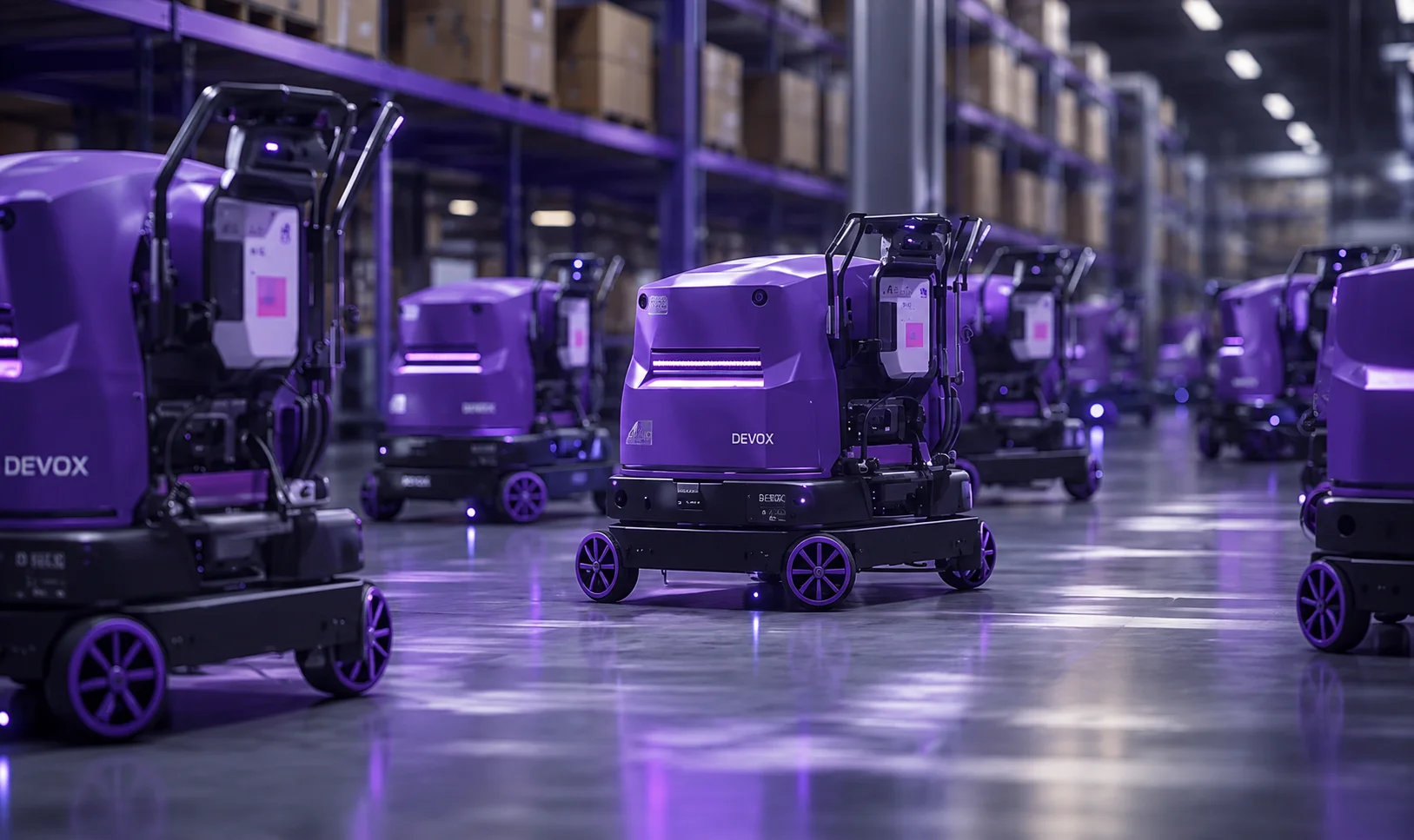
Multi-vendor environments create interoperability bottlenecks. We consolidate heterogeneous robot fleets and map protocols into a single orchestration layer using VDA 5050 and Open-RMF.

Real-Time Synchronization

Data drift between floor operations and your ERP leads to audit failures and chargebacks. We eliminate this gap via real-time, bidirectional sync between your robotics stack and financial ledger.

Growth-Ready Architecture

For a mid-sized company, opening a second warehouse means repeating the entire integration cycle over again. Devox builds an architecture that scales; a new facility connects to the existing infrastructure using a template, not from scratch.

What We Deliver

Services We Provide

We do not rely on generic, one-size-fits-all SaaS platforms; instead, we provide Custom Software Development to build a proprietary system where your specific logistics or automotive processes become the core architecture.

  • AMR Fleet Integration Service

    • AMR automation. We build a bidirectional integration layer between your robotic fleet and your WMS or ERP using REST APIs or an event-driven architecture powered by MQTT. Every robot status update, task completion, location change, or error instantly synchronizes with your operational systems, requiring no manual intervention.
    • Coordinate System Translation Layer. We normalize disparate coordinate systems, bridging CAD-based WMS data with robot-native SLAM. Your WMS and fleet operate on a single source of truth, regardless of the map format.
    • Robot Onboarding Framework. Instead of writing custom code for each new robot model, we build a standardized connection framework. A new vendor or model is connected via a template rather than from scratch.
    • Real-Time Telemetry Pipeline. We set up streaming telemetry collection from each robot and critical operational metrics and transmit this data to your operational dashboard. The dispatcher sees the entire fleet in real time without latency. We’ve applied similar fleet visibility principles in practice. For a transportation company operating more than 600 buses, we built a centralized operational platform that consolidated maintenance and operational data into a single source of truth, enabling real-time monitoring and faster operational decision-making.
    • Integration Testing. Before deployment, we stress-test the system against hundreds of edge cases, including mid-task order cancellations, Wi-Fi outages, and simultaneous requests from hundreds of robots. Every critical scenario is validated with fallback logic before it can impact warehouse operations.


  • Warehouse Execution System Development

    • Task Orchestration Engine. We develop a WES core that receives high-level commands from the WMS (e.g., pick order #5421) and automatically breaks them down into specific tasks for each machine and employee, considering their current location, workload, and order priority.
    • Human-Robot Task Balancing. We build the logic for real-time dynamic task distribution between robots and humans. The system accounts for which zones are serviced by robots, where employees are currently located, and which tasks require human intervention, so that robots and humans work in the same space without conflicts or downtime.
    • Warehouse AMR automation. Automated logic for exceptions, urgent orders, and zone outages. WES autonomously reprioritizes the task queue and redistributes the fleet, eliminating manual intervention during operational disruptions.
    • WES Performance Dashboard. We develop an operational dashboard that shows fleet throughput, average task completion time, zone workload, and bottlenecks in real-time. In addition to dashboards and visualizations, there are specific metrics that the operations director can use to make decisions in real time during a shift.
  • Legacy WMS/ERP Modernization for Robotics

    • Architecture Audit and Bottleneck Analysis. We start with a deep audit of your existing codebase, mapping dependencies between modules and identifying where the system cannot handle the volume of API requests from the robot fleet. The output is a specific map of bottlenecks with priorities for what to change first, rather than general recommendations.
    • Strangler Fig Migration. Instead of a full system rewrite, we gradually replace legacy modules with new microservices one by one. The old monolith continues to work while the new components take on the load. The warehouse ships goods every day while we change the architecture under the hood.
    • Event-Driven API Layer. We build a modern event-driven layer with REST or GraphQL APIs on top of the existing core, without rewriting the business logic that has worked for years. Your SAP or Oracle gains the ability to process thousands of simultaneous requests from the robotic fleet that it never had before.
    • Data Pipeline Modernization. Legacy systems often store critical data in formats that modern platforms simply cannot read. We build ETL pipelines that extract, transform, and transmit this data in real-time between the legacy core and the new infrastructure, without losing history and without manual export.
    • Cloud Readiness Preparation. We prepare the system for a gradual transition to major cloud providers, containerization of critical services, setting up CI/CD pipelines, and implementing monitoring. Every step is verified in a staging environment before going into production.
  • Multi-Vendor Fleet Orchestration

    • VDA 5050 Protocol Implementation. We implement the VDA 5050 standard as a single communication language between your central management system and robots from different vendors. We develop an MQTT broker that translates transport orders and receives status reports from each machine, regardless of who manufactured it.
    • Fleet Adapter Development. Each robot speaks its own internal command language. We write custom Fleet Adapters that translate the orchestrator’s unified commands into specific instructions for each model, regardless of the robot vendor.
    • Traffic Management. In a busy warehouse, robots of different brands without coordination block each other at intersections and in narrow aisles. We implement Open-RMF with space-time path planning; the system reserves routes in advance and automatically resolves conflicts before they arise.
    • Unified Fleet Dashboard. Instead of separate management panels from each vendor, there is a single interface that shows the entire fleet in real-time. Location, task status, charge level, and the performance of each machine, all in one place for the dispatcher and operations director.
  • Real-Time Inventory Sync Engine

    • Event-Driven Inventory Update Architecture. Every core warehouse operation generates an event that the event-driven layer instantly transmits to the ERP. Instead of batch updates once an hour or once a day, the financial system reflects the current state of the warehouse in real-time, constantly.
    • Multi-Location Inventory Reconciliation. For companies with multiple distribution centers, it is critically important to have a single picture of inventory across the entire network. We build a centralized reconciliation layer that aggregates data from all locations and automatically identifies discrepancies between what is physically present and what is recorded in the system before they turn into an audit problem.
    • Order Cancellation. One of the most complex scenarios is when an order is canceled at the moment a robot is already carrying the goods to the shipping zone. We develop exception handling logic that instantly stops execution, returns the goods to the correct location, and updates the status in the ERP, without manual operator intervention.
    • Chargeback Prevention Layer. Discrepancies between actual shipments and what is recorded in the system are the main cause of penalty chargebacks from large retailers. We implement a verification layer that reconciles every shipment with the order in real time and blocks dispatch if there is a discrepancy right at the warehouse, not after receiving a fine.
    • Inventory Audit Trail & Reporting. A full history of movements is available for internal audits and resolving inventory discrepancies with customers or suppliers.
  • Robotics Software Dedicated Team

    • Resource Alignment. Before proposing a team, we conduct a technical brief to understand your stack, architecture, and specific tasks. We select engineers with specific experience in C++, Python, ROS 2, Computer Vision, or real-time systems depending on what the project actually needs, rather than who is free right now.
    • Embedded Team Model. The team works as part of your internal R&D, participating in your stand-ups, working in your task tracker, and communicating directly with your product and operations managers. No Chinese whispers through intermediate managers on our side between you and the people writing the code.
    • Knowledge Continuity. All code written by the team is accompanied by technical documentation, architectural decisions, and comments. If you decide to build an internal team in the future, new engineers will be able to enter the project without months of sorting through the legacy.
    • Team Scaling on Demand. Peak load before launching a new warehouse or a major release requires more hands. We scale the team up or down within a week, without long-term commitments and without the costs of hiring and firing full-time employees.
  • Warehouse Slotting and Wave Orchestration

    • SKU Velocity and Slotting Optimization. We analyze the picking history for each SKU, frequency, seasonality, and correlation with other items in the same order. Based on this data, we build an algorithm that calculates the optimal placement for each item in the warehouse so that robots travel the minimum distance for the most frequent operations.
    • Dynamic Slotting Recalculation. Optimal item placement changes due to seasonality, new SKUs, and shifts in demand. The system automatically recalculates slotting based on current data, suggests movements, and calculates the expected efficiency gain. The warehouse adapts to current demand instead of relying on outdated planning assumptions.
    • Wave Planning and Batch Efficiency. We develop wave planning logic that groups orders by warehouse zones, shipping time, and item type. Robots and employees receive tasks in batches that minimize idle runs and maximize the number of order lines per trip.
    • Demand Forecasting Integration. We connect an ML demand forecasting model for each SKU with a horizon of one week to three months, taking into account seasonality, holidays, and promotions. The slotting algorithm receives both historical and forecast data, which helps the warehouse prepare for peak loads in advance.
    • Slotting Performance Reporting. We record average robot travel distance, picking cycle time, and zone workload before and after optimization. The report shows a specific operational increase in figures, throughput, time per order, and floor space usage, making the value of optimization obvious to the operations and financial directors.
  • Digital Twin & Simulation

    • 3D Warehouse Model Development. We build a high-fidelity digital replica of your warehouse, including racking, aisles, loading areas, charging stations, doors, and elevators, using your CAD drawings and sensor data. The digital twin reflects the actual operating environment, including its unique constraints and real-world conditions.
    • Robot Behavior Simulation. We simulate fleet behavior in the digital environment, including routing, travel speeds, robot interactions, and obstacle response. This lets you see how the fleet performs under different configurations before you introduce any changes on the warehouse floor.
    • Peak Load Testing. We model peak-demand scenarios such as Black Friday, seasonal order surges, or multiple robot failures and identify where performance begins to degrade. Bottlenecks discovered in simulation are far less costly than those uncovered during peak production periods.
    • Configuration Optimization. We evaluate alternative warehouse configurations, including charging station placement, aisle widths, and picking area layouts, and measure their impact on fleet throughput. Physical changes are driven by simulation data rather than assumptions.
    • Pre-Deployment Validation. Before any major update, whether it is a new robot type, a routing algorithm change, or a warehouse expansion, we first deploy the changes in the digital twin and validate the results. Only proven configurations move into production.


Working Together

Our Deployment Roadmap

01.

01. Architecture Review

We start by analyzing your current infrastructure, systems, and robot fleet to understand how everything connects. This means real conversations with your engineering and operations teams, not just a questionnaire. At the end of this phase, you receive a written technical assessment that pinpoints the friction and what to address first. Everything in that document is specific to your stack, nothing generic, nothing copy-pasted from another engagement.

02.

02. Scoping and Team Assembly

Once we understand your environment, we define what gets built and in what sequence. Scope is driven by operational priority; what's costing you the most right now comes first. We then assemble a dedicated team matched to the specific technical requirements of your project. You meet every engineer before work begins. There are no surprises about who's actually doing the work.

03.

03. Foundation Build

Core components get built in two-week sprints with a working demo at the end of each cycle. You see functional software on a regular cadence, not status updates, not slide decks. If priorities shift mid-build, the sprint structure makes it straightforward to adjust without derailing the broader timeline.

04.

04. Integration

Before the system touches a live order, we run it against the scenarios that actually break warehouses: a volume spike that doubles the task queue, an order canceled while a robot is mid-haul to the shipping zone, and two fleets contending for the same aisle. We don't wait for these to surface in production—we force them in a controlled environment and confirm the system recovers cleanly each time. Where the digital twin is available, we replay it against your real layout first, so go-live holds under the conditions that usually expose the gaps no test script anticipated.

05.

05. Controlled Rollout

Production deployment happens in stages: one zone, one shift, and one facility before expanding further. Your operations team runs alongside the new system during this period so that by the time full control is handed over, they have already been working with it long enough to trust it. Problems that surface during a controlled rollout are contained. Problems that surface during a full cutover are far more disruptive.

06.

06. Long-Term Partnership

The relationship continues after the go-live. The first months in production are when real-world edge cases emerge that no test environment fully anticipates. We stay engaged, monitoring performance, resolving issues under agreed SLAs, and refining the system based on live operational data. As your footprint grows, with new facilities, new robot vendors, and higher volume, the architecture we built is designed to absorb that growth without starting over.

  • 01. Architecture Review

  • 02. Scoping and Team Assembly

  • 03. Foundation Build

  • 04. Integration

  • 05. Controlled Rollout

  • 06. Long-Term Partnership

Case Studies

Our Latest Works

View All Case Studies
Stromcore Stromcore

Stromcore: Web Interface for Real-Time Battery Monitoring in a PaaS Logistics Platform

A web interface enabling real-time forklift battery tracking and predictive maintenance scheduling.

Additional Info

Core Tech:
  • React
  • TypeScript
  • Node.js
  • GraphQL
  • AWS
Country:

Canada Canada

Green Space Pro: Franchise Management Platform for a Highly-Regulated Industry Green Space Pro: Franchise Management Platform for a Highly-Regulated Industry

Green Space Pro: Franchise Management Platform for a Highly-Regulated Industry

A centralized digital workspace for cannabis franchise vendors and regulators to manage operations, ensure compliance, and streamline regulatory communication in a highly regulated industry.

Additional Info

Core Tech:
  • Svelte.js
  • Node.js
  • REST API
  • CI/CD
  • Progressive Web App (PWA)
  • manual and automated QA
Country:

USA USA

Web 3 White-label PaaS NeoBank Web 3 White-label PaaS NeoBank
  • Web3
  • Fintech

Web3 PaaS Ecosystem for Next-Gen NeoBanking, RegTech, and Secure Data Vaulting

A blockchain-powered PaaS ecosystem enabling financial providers to launch custom neobanking solutions with secure infrastructure.

Additional Info

Core Tech:
  • Blockchain
  • .NET
  • Node.js
  • AWS
  • Docker
  • PostgreSQL
  • React Native
Country:

USA USA

Testimonials

Testimonials

Carl-Fredrik Linné                                            Sweden

The solutions they’re providing is helping our business run more smoothly. We’ve been able to make quick developments with them, meeting our product vision within the timeline we set up. Listen to them because they can give strong advice about how to build good products.

Darrin Lipscomb Darrin Lipscomb
Darrin Lipscomb United States

We are a software startup and using Devox allowed us to get an MVP to market faster and less cost than trying to build and fund an R&D team initially. Communication was excellent with Devox. This is a top notch firm.

Daniel Bertuccio Daniel Bertuccio
Daniel Bertuccio Australia

Their level of understanding, detail, and work ethic was great. We had 2 designers, 2 developers, PM and QA specialist. I am extremely satisfied with the end deliverables. Devox Software was always on time during the process.

Trent Allan Trent Allan
Trent Allan Australia

We get great satisfaction working with them. They help us produce a product we’re happy with as co-founders. The feedback we got from customers was really great, too. Customers get what we do and we feel like we’re really reaching our target market.

Andy Morrey                                            United Kingdom

I’m blown up with the level of professionalism that’s been shown, as well as the welcoming nature and the social aspects. Devox Software is really on the ball technically.

Vadim Ivanenko Vadim Ivanenko
Vadim Ivanenko Switzerland

Great job! We met the deadlines and brought happiness to our customers. Communication was perfect. Quick response. No problems with anything during the project. Their experienced team and perfect communication offer the best mix of quality and rates.

Jason Leffakis Jason Leffakis
Jason Leffakis United States

The project continues to be a success. As an early-stage company, we're continuously iterating to find product success. Devox has been quick and effective at iterating alongside us. I'm happy with the team, their responsiveness, and their output.

John Boman John Boman
John Boman Sweden

We hired the Devox team for a complicated (unusual interaction) UX/UI assignment. The team managed the project well both for initial time estimates and also weekly follow-ups throughout delivery. Overall, efficient work with a nice professional team.

Tamas Pataky Tamas Pataky
Tamas Pataky Canada

Their intuition about the product and their willingness to try new approaches and show them to our team as alternatives to our set course were impressive. The Devox team makes it incredibly easy to work with, and their ability to manage our team and set expectations was outstanding.

Stan Sadokov Stan Sadokov
Stan Sadokov Estonia

Devox is a team of exepctional talent and responsible executives. All of the talent we outstaffed from the company were experts in their fields and delivered quality work. They also take full ownership to what they deliver to you. If you work with Devox you will get actual results and you can rest assured that the result will procude value.

Mark Lamb Mark Lamb
Mark Lamb United Kingdom

The work that the team has done on our project has been nothing short of incredible – it has surpassed all expectations I had and really is something I could only have dreamt of finding. Team is hard working, dedicated, personable and passionate. I have worked with people literally all over the world both in business and as freelancer, and people from Devox Software are 1 in a million.

Insights

Our Experts' Insights

Adapt Or Die. Interview With Magma Trading Managing Director

Steps from Legacy TMS to AI-Orchestrated Supply Chains

Artificial Intelligence in Logistics: From Fuss to Real Impact

FAQ

Frequently Asked Questions

  • How do you integrate with my existing WMS/ERP without disrupting operations?

    We build an integration layer on top of your existing systems—SAP, Oracle, Manhattan, or custom—leaving the core architecture untouched. Our incremental approach ensures zero downtime. We audit your architecture to identify exact friction points, then build connectors that bridge the gap. Every step is scoped and verified before production deployment. Related to this, teams often explore our Autonomous Logistics Orchestration.

  • What is the typical timeline from pilot to operational ROI?

    For a mid-size distribution center with a well-defined integration problem, you’re typically looking at a working prototype in 6-8 weeks and full deployment within a quarter. We’ll give you a realistic timeline after a one-week architecture review and a concrete number based on your actual stack, your team, and your operational constraints.

  • How much of my team’s time is required to manage the project?

    Less than you’d expect. We run on a structured cadence, with weekly syncs, async updates, and a dedicated PM on our side handling the day-to-day. Your team’s involvement stays at decision points: architecture sign-off, UAT, and go-live. We’ve built this model specifically for operations teams already stretched thin. You stay informed and in control, so you don’t get pulled into the weeds. See how this fits into our wider logistics.

  • How does your architecture scale for future facility growth?

    Scalability is a core architectural decision we make on day one. The first warehouse is where we establish the foundation, integration templates, fleet management logic, data pipelines. Every location after that connects to the same infrastructure using a proven pattern.

  • What should we expect during the first 30 days?

    Weeks one and two: architecture review. We map your current systems, data flows, and operational bottlenecks. You receive a clear technical assessment and a project roadmap, something concrete to work from, built around your actual environment.

    Weeks three and four: we align on scope, team composition, and timeline. By the end of week four, your dedicated team is assembled, and development is underway. We move fast because we have already solved these problems.

Book a call

Want to Achieve Your Goals? Book Your Call Now!

Contact Us

We Fix, Transform, and Skyrocket Your Software.

Tell us where your system needs help — we’ll show you how to move forward with clarity and speed. From architecture to launch — we’re your engineering partner.

Book your free consultation. We’ll help you move faster, and smarter.

Let's Discuss Your Project!

Share the details of your project – like scope or business challenges. Our team will carefully study them and then we’ll figure out the next move together.


    By sending this form I confirm that I have read and accept the Privacy Policy

    Thank You for Contacting Us!

    We appreciate you reaching out. Your message has been received, and a member of our team will get back to you within 24 hours.

    In the meantime, feel free to follow our social.


      Thank You for Subscribing!

      Welcome to the Devox Software community! We're excited to have you on board. You'll now receive the latest industry insights, company news, and exclusive updates straight to your inbox.