


- Synthetic Data. We train computer vision models to detect product-specific defects such as surface flaws, weld issues, and missing components. We can do it all in real time at full speed. When real defect samples are limited, we can use synthetic data to expand training coverage and improve model performance.
- Production Validation. Before launch, we validate the model in your production environment. We ensure it works on the test bench and makes accurate calls on the factory floor. Multi-camera validation helps reduce blind spots on complex parts.
- Edge-First Deployment. We compress the models so they run directly on the camera, without sending all the footage to the cloud. This delivers sub-50ms responses while keeping footage inside your network.
- Data Annotation. We handle data collection, cleaning, and labeling, which are often the most time-consuming parts of model training. We keep the training set accurate, representative, and current as your products and processes evolve.
- System Integration. We connect the vision system to the production software, machines, and tools your operators already use. After we’re up and running, we’ll monitor model performance and let you know if it drifts; we can even do scheduled retraining to keep it accurate over time.

Computer Vision Development Services
-
INSPECT EVERY PART AT LINE SPEED
Move from sample checks to a model that inspects each part on every shift. Each flagged part comes with the location and size of the flaw, so operators trace it to the station that produced it. -
CUT FALSE REJECTS FROM RULE-BASED VISION
Replace fixed inspection rules with a model trained on the natural variation in your parts. Surface texture and glare stay within tolerance, and real defects get flagged. -
MOVE THE PILOT ONTO THE LINE
Take the model that worked in the demo and validate it on your cameras, under your lighting and line speed. Rollout to more lines starts once results meet the metrics agreed at the start.
Why choose Devox Software?
Computer Vision Built for the Production Line
Trained on Scarce Defect Data
Rare defects leave most training sets unbalanced. We combine your images with synthetic samples and a managed annotation pipeline, so each defect class has enough examples before training starts.
Validated Against Your Current Inspection
We compress the model for the hardware at the inspection point and test it on your cameras at full-line speed. Acceptance is measured against the results of your current inspection process, and footage stays inside your network.
Connected to MES and ERP
Devox builds manufacturing software and ERP extensions, so the vision layer writes into the systems your operators already use. A detection can reject a part, stop a station, or open a maintenance ticket.
Accuracy Tracked per Camera After Launch
Each inspection point has its own accuracy record. A dirty lens or a lighting change shows up as a drop at one station, and retraining uses the frames where the model hesitated.
What We Deliver
Our Computer Vision Development Services
Our engineers adapt proven detection and segmentation architectures to your parts and defect types, then optimize each model for the hardware at the inspection point, whether that is an edge device, an industrial PC, or a smart camera already mounted on the line.
-
Custom Computer Vision Development
-
Automated Visual Inspection
- Live Sorting. We process images from high-speed cameras to identify surface, weld, and assembly defects in real time and route defective parts off the line automatically, before they reach packaging.
- Defect Location. We use pixel-level segmentation to tell exactly where the problem is and how big it is, so your operators can go fix it on the spot. Operators can address issues immediately instead of waiting until the end of the line.
- On-Device Inference. Our models are compressed to run directly on the camera and deliver an answer in under 50ms. It’s fast, and it keeps all your sensitive footage inside your network, so you don’t have to worry about compliance on regulated lines.
- Synthetic Data. Collecting enough real examples of each defect type can be difficult. We use synthetic data to give the model balanced coverage across edge cases.
- Drift Monitoring. We merge images from multiple cameras to get a single view of the whole part, and we monitor the model’s performance over time. If performance starts to decline, the system alerts the team and triggers retraining.
-
Object Detection for Warehouses
- Asset Tracking. We use ceiling and gate cameras to track pallets, parcels, and forklifts across the floor in real time, monitoring location and dwell time without manual scanning. Warehouse managers can see where stock is and where delays occur, reducing time spent searching for misplaced loads.
- Safety Monitoring. On-site models detect missing PPE, restricted-zone entry, and forklift-pedestrian proximity, then send real-time alerts to floor supervisors. Because we process the footage locally, we can keep all the worker data inside the network.
- Damage Inspection. We use cameras to inspect the freight for crushed corners, torn packaging, and seal breaks, and flag any damaged units for claims at the point of receipt. Timestamped evidence helps reduce liability disputes later in the claims process.
- Parcel Sorting. Our omnidirectional readers can capture barcodes and labels at full belt speed, route each parcel to the right lane, and catch unreadable or mislabeled items before they ship off wrong. We don’t need to add any extra scan stations to manage that, even during peak volume.
- Load Counting. The system counts cartons, pallets, and SKUs against the manifest. It flags short shipments and overages on arrival, reducing manual counts and improving inventory accuracy.
-
Video Analytics and Object Tracking
- Object Tracking. Models follow people, vehicles, and equipment across a live feed, maintaining identity through occlusion and crowding instead of losing the target when paths cross. Operations see continuous movement paths rather than disconnected frame-by-frame detections.
- Event Detection. Models recognize defined events in the stream, such as loitering, line crossing, abandoned objects, and sudden crowding, then send real-time alerts.
- Flow Analytics. Movement across a space is aggregated into heatmaps, dwell times, and path patterns, showing where people cluster and where they stall. Retail and facility managers redesign layouts based on real behavior, not guesswork.
- Multi-Camera Fusion. Feeds from many cameras merge into one continuous view, handing tracking from one lens to the next so a subject stays identified across a whole site. Coverage holds across blind spots that any single camera leaves.
- Pose Estimation. Models read body posture and movement to recognize actions, falls, fights, unsafe lifting, and gesture cues beyond what bounding boxes alone capture.
-
Vision-to-Workflow Integration
- Action Triggers. A vision result can automatically trigger the next step, such as rejecting an item, stopping a line, creating a maintenance ticket, or rerouting a parcel. The model drives the process instead of leaving a human to read a dashboard and react.
- System Connectors. Purpose-built middleware links vision output to ERP, MES, WMS, and PLC over the protocols they actually speak, reading and writing where your operators already work. Records and commands flow both ways without a parallel system to maintain.
- Agentic Workflows. Multi-step responses run on their own; a flagged defect updates inventory, notifies the supervisor, and adjusts the upstream station in one chain. The system handles routine decisions that previously required manual review at every step. Low-confidence calls route to a reviewer with the frame and context attached, and the decision feeds back as labeled data.
- Real-Time Sync. Vision events stream to dashboards, alerts, and downstream systems with millisecond latency, so the floor and the back office act on the same state at the same moment.
-
CV MLOps
- Camera-Level Drift Monitoring. Each camera and inspection point gets its own accuracy tracking, so a dirty lens, a shifted mount, or a new lighting setup shows up as a drop at one station before it affects the whole line. Engineers see exactly where the problem is and fix it at the source.
- Hard-Case Collection. Frames where the model hesitates are automatically saved and sent for review. These are the most valuable images for training, and collecting them from live production makes each retraining cycle more targeted.
- Operator Feedback Loop. When an operator overrides a model decision on the line, that correction becomes a labeled example. The people who know the product best improve the model as part of their normal work.
- Edge Fleet Updates. New model versions roll out to cameras and edge devices across all lines from one place, with a staged release starting on a single station. Every device runs a known, validated version.
- Instant Rollback. Each model, dataset, and accuracy report is versioned together. If a new release underperforms on the line, the previous version returns to the devices in minutes.
-
Image Recognition and Visual Search
- Visual Search. Foundation models match images against your catalog or archive by content, not tags, returning similar products, parts, or frames from a photo or phrase. Users find the right item without knowing how it was labeled.
- Generative Reporting. Models read a scene and write the summary, an inspection report, an incident description, and a shift digest, turning raw frames into a document a person can act on. Reports that once took an analyst an hour can be drafted in seconds for review.
- Cross-Modal Fusion. Image, video, text, and sensor data combine into one model so context from one stream sharpens another, as a label, a timestamp, and a frame read together. Decisions draw on the full picture rather than a single feed.
- Agentic Vision. Foundation models fine-tuned to your domain can reason across steps and adapt to new tasks with little custom data, so one platform can cover cases a narrow model would need to rebuild for. You can add a new use case by tuning the existing system instead of starting from scratch.
Getting Started
How a Computer Vision Project Starts
-
Feasibility Check
A clear answer in two weeks
We review your sample images and camera setup, then report which defects a model can detect and how accurately.
-
Pilot on One Line
Proof on your production floor
We train the model on your data, deploy it at one inspection point, and measure results against your current inspection process.
-
Production Rollout
Scale across lines and systems
Once the pilot meets the metrics agreed at the start, we scale to additional lines and connect the system to your MES and ERP.

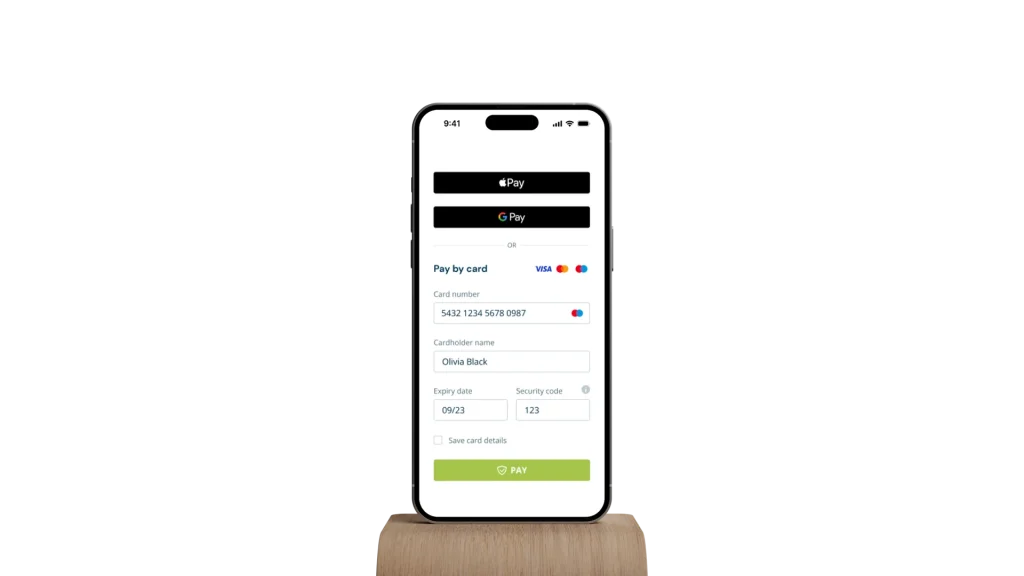
FINTECH
FinTech Platform for Invoicing and Secure Transactions
A fintech platform that safeguards online payments using encryption, MFA, and AI-driven fraud detection.
Additional Info
Core Tech:
- .NET microservices
- Angular 8
- PostgreSQL
- Multi-Factor Authentication (MFA)
- End-to-End Encryption
- AI-based Fraud Detection
LOGISTICS & AUTOMOTIVE
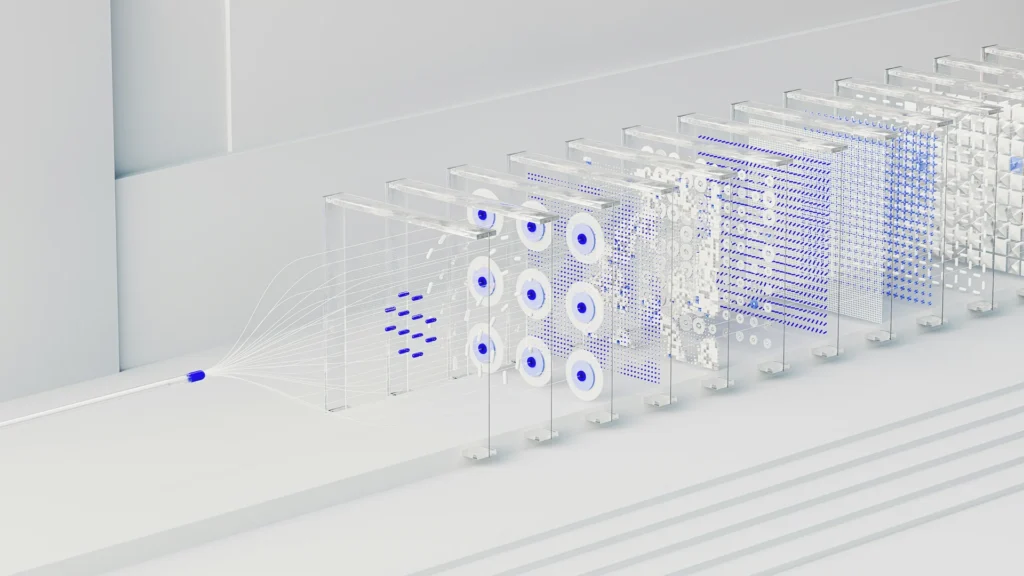
AI-Charged: How We Cut Migration Planning Time by 70%
Devox utilized its AI Solution Accelerator™ to automate dependency mapping, identify hazardous modules, and test migration waves before they went live. The outcome was a 70% reduction in the time needed to prepare for modernization.
Additional Info
Core Tech:
- .NET 8
- Azure
- Angular
- PostgreSQL
- TensorFlow
- Azure Cognitive Services
Country:
 USA
USA



 Germany
Testimonials
Testimonials



 Sweden
The solutions they’re providing is helping our business run more smoothly. We’ve been able to make quick developments with them, meeting our product vision within the timeline we set up. Listen to them because they can give strong advice about how to build good products.
Carl-Fredrik Linné
Tech Lead at
CURE Media


 United States
We are a software startup and using Devox allowed us to get an MVP to market faster and less cost than trying to build and fund an R&D team initially. Communication was excellent with Devox. This is a top notch firm.
Darrin Lipscomb
CEO, Founder at
Ferretly



 Australia
Their level of understanding, detail, and work ethic was great. We had 2 designers, 2 developers, PM and QA specialist. I am extremely satisfied with the end deliverables. Devox Software was always on time during the process.
Daniel Bertuccio
Marketing Manager at
Eurolinx


 Australia
We get great satisfaction working with them. They help us produce a product we’re happy with as co-founders. The feedback we got from customers was really great, too. Customers get what we do and we feel like we’re really reaching our target market.
Trent Allan
CTO, Co-founder at
Active Place


 United Kingdom
I’m blown up with the level of professionalism that’s been shown, as well as the welcoming nature and the social aspects. Devox Software is really on the ball technically.
Andy Morrey
Managing Director at Magma Trading



 Switzerland
Great job! We met the deadlines and brought happiness to our customers. Communication was perfect. Quick response. No problems with anything during the project. Their experienced team and perfect communication offer the best mix of quality and rates.
Vadim Ivanenko
COO at
Optherium


 United States
The project continues to be a success. As an early-stage company, we're continuously iterating to find product success. Devox has been quick and effective at iterating alongside us. I'm happy with the team, their responsiveness, and their output.


 Sweden
We hired the Devox team for a complicated (unusual interaction) UX/UI assignment. The team managed the project well both for initial time estimates and also weekly follow-ups throughout delivery. Overall, efficient work with a nice professional team.
John Boman
Product Manager at
Lexplore



 Canada
Their intuition about the product and their willingness to try new approaches and show them to our team as alternatives to our set course were impressive. The Devox team makes it incredibly easy to work with, and their ability to manage our team and set expectations was outstanding.
Tamas Pataky
Head of Product at
Stromcore



 Estonia
Devox is a team of exepctional talent and responsible executives. All of the talent we outstaffed from the company were experts in their fields and delivered quality work. They also take full ownership to what they deliver to you. If you work with Devox you will get actual results and you can rest assured that the result will procude value.
Stan Sadokov
Product Lead at
Multilogin


 United Kingdom
The work that the team has done on our project has been nothing short of incredible – it has surpassed all expectations I had and really is something I could only have dreamt of finding. Team is hard working, dedicated, personable and passionate. I have worked with people literally all over the world both in business and as freelancer, and people from Devox Software are 1 in a million.
Mark Lamb
Technical Director at M3 Network Limited
Insights
Our Experts' Insights
AI & ML
AI Solutions
Legacy Modernization
Minimal Viable AI: How to Integrate Small‐Scale AI Features into Existing Products

AI & ML
AI Solutions
Workflow Management
Preparing Your Enterprise for AI: AI Readiness Assessment Framework

AI & ML
AI Solutions
Industry Trends
Logistics
The AI Revolution in Retail: Transforming the Shopping Experience
FAQ
Frequently Asked Questions
-
How do you validate the exact ROI before we commit to a full deployment?
We present your buying committee with a clear financial model during the initial discovery phase. Our team defines the required hardware, target metrics, and total cost of ownership upfront so stakeholders understand the investment needed to move from proof of concept to enterprise deployment.
By setting financial guardrails early, you maintain budget control at each stage. Each phase moves forward only when the business case is clear and measurable.
-
How do you ensure the model maintains accuracy on the actual factory floor?
We design computer vision models for real industrial environments, not controlled lab conditions. During validation, we test the system against the same factors your facility deals with every day, including changing light, glare, motion, and residue on the lenses.
Once the system is live, our MLOps pipeline monitors model health and triggers retraining when conditions change. That helps maintain accuracy through seasonal variation, process updates, and other shifts in the operating environment.
-
How do we build these systems when we have limited labeled data?
We build the full data pipeline for you. Our team handles the entire process of gathering, cleaning, and annotating your visual data. We supplement your existing data with synthetic data to improve coverage across operational edge cases.
This strategy builds accurate models, even when the initial data volume is limited. The system learns the full spectrum of your product variables right from the start.
-
How does the vision system interface with our existing ERP and MES platforms?
We build integration middleware that works with the protocols your ERP and MES platforms already support. The vision system can read and write data within the environments your operators already use.
This approach preserves your current software stack and supports reliable data flow across the facility. The AI layer extends your existing infrastructure without disrupting day-to-day operations.
-
How do you protect sensitive operational data and align with US security frameworks?
We deploy the system at the edge so sensitive operational data remains within your private network. Processing video locally on the device reduces exposure and gives you stronger control over proprietary information. Our engineering approach aligns with U.S. security frameworks, including SOC 2 Type II, NIST CSF 2.0, and relevant SEC requirements.
-
How do you protect sensitive visual data?
We process footage on edge devices inside your network, so raw video stays on site. Faces and license plates can be masked before any frame is stored. Our security practices follow SOC 2 and NIST CSF 2.0 as reference frameworks, and data handling is adapted to your internal compliance requirements.
Book a call
Want to Achieve Your Goals? Book Your Call Now!
Contact Us
We Fix, Transform, and Skyrocket Your Software.
Tell us where your system needs help — we’ll show you how to move forward with clarity and speed. From architecture to launch — we’re your engineering partner.
Book your free consultation. We’ll help you move faster, and smarter.
Let's Discuss Your Project!
Share the details of your project – like scope or business challenges. Our team will carefully study them and then we’ll figure out the next move together.
Thank You for Contacting Us!
We appreciate you reaching out. Your message has been received, and a member of our team will get back to you within 24 hours.
In the meantime, feel free to follow our social.
Thank You for Subscribing!
Welcome to the Devox Software community! We're excited to have you on board. You'll now receive the latest industry insights, company news, and exclusive updates straight to your inbox.