
Legacy last-mile delivery software relies on static planning. A route is calculated once at the start of the day, with dispatch assignments made on fixed rules. If anything changes after that, manual rerouting is required. That’s why accuracy leaves much to be desired, with ETA accuracy in the 80-85% range over 60-minute windows. That’s ok at low volume, but at scale, at higher delivery density and fleet size, problems snowball.
AI last-mile delivery software is another thing. Rather than optimizing routes once and hoping the plan holds, AI-native platforms continuously evaluate live operational data, including traffic conditions, driver locations, weather, order priority, vehicle capacity, historical delivery patterns, and customer behavior, to make dispatch decisions.
This article describes the exact approach and battle-tested recommendations in logistics software development to modernize legacy dispatch system without a major overhaul and on the go while integrating AI features in the system (and processes) core. Let us move from “AI-powered” claims to the real value the modernization brings.
Key Takeaways
- Legacy last-mile dispatch software breaks down at scale and without AI because it relies on static planning rules and manual triage.
- Most current AI-enabled last-mile platforms are legacy systems with an AI module bolted on top, which is ineffective.
- The real modernization approach is to incrementally upgrade systems and processes.
- AI-native systems can reach 95%+ accuracy across more than 180 real-time variables.
- Last-mile delivery accounts for roughly 30-35% of total transportation cost, which is exactly why even modest accuracy and efficiency gains here have an outsized effect on margin.
Bolt-on AI vs. AI-Native: Where Does the Value Lie?
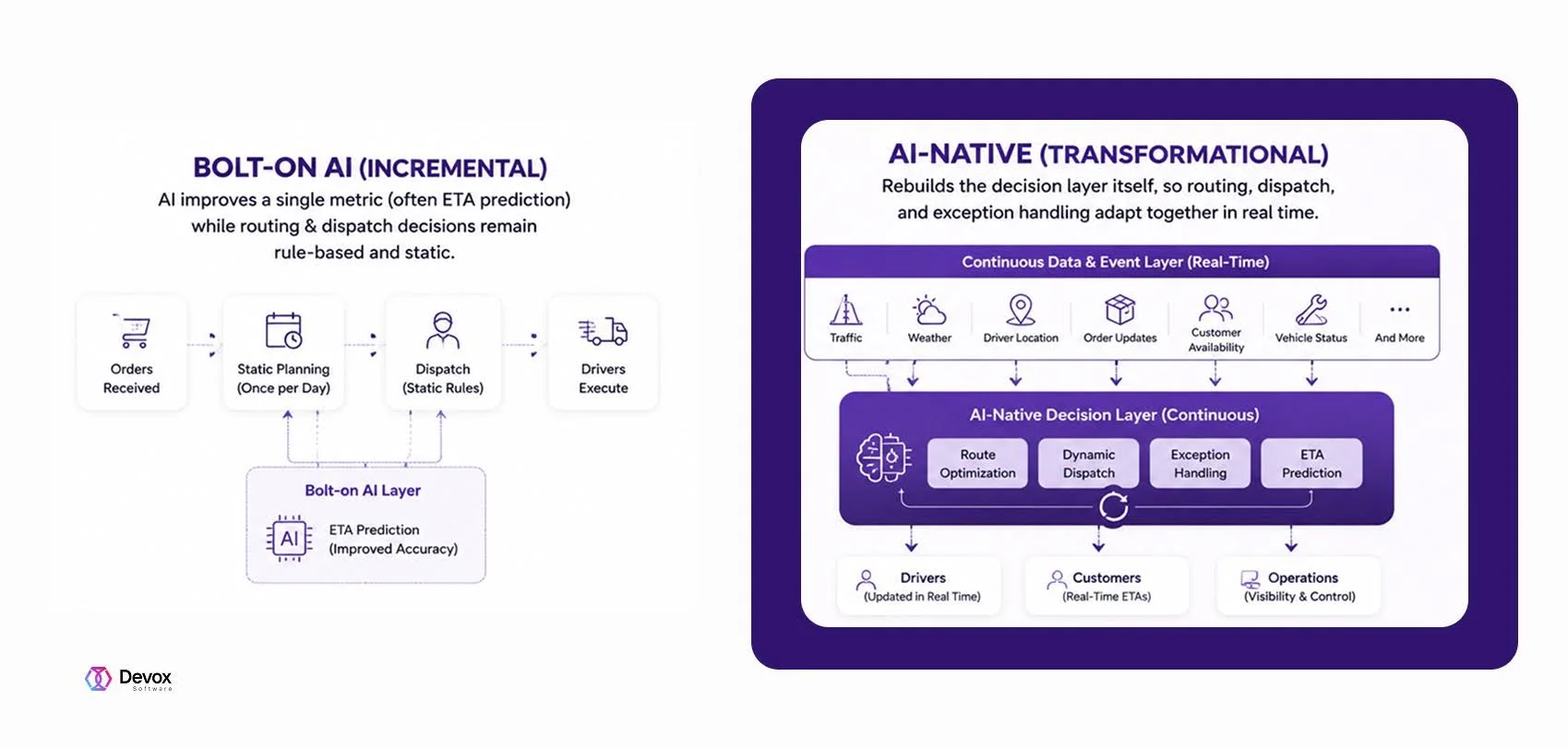
When we talk about an AI-native last-mile platform, we don’t mean a feature added to one screen. To drive the impact, it should be embedded across the processes of planning, dispatch, exception handling, and decisions so that the same continuously updated model governs the structure.
From a practical POV, the difference pops up immediately once volume or complexity increases:
- Bolt-on AI improves a single metric (often ETA prediction) while routing and dispatch decisions remain rule-based and static. It’s faster and cheaper to implement, and it can be the right call for companies that need a quick accuracy improvement and aren’t ready for a structural change.
- AI-native core rebuilds the decision layer itself. Simply put, the routing, dispatch, and exception handling all adapt together in real time. Yes, it costs more and takes longer to implement, but it’s the only path that scales cleanly as delivery volume, SLA complexity, and fleet size grow.
So which to choose? How should a logistics or delivery operations team actually decide? A few criteria make the problem when modernizing a legacy routing system:
- How many constraints does your current system actually see?
If you’re operating with a handful of static rules and your accuracy gap is mostly about ETA precision, a bolt-on improvement may close the gap cheaply.
- Is the exception-handling process still manual?
If dispatchers are routinely overriding the system by phone or spreadsheet, that’s a sign that the core planning logic is the real bottleneck.
- What’s your growth strategy?
If stop density, SLA windows, or fleet size are expected to grow significantly within a year or two, the bolt-on is ineffective. The rebuild, in this particular case, is the more durable investment.
- Can your current architecture even support real-time data ingestion?
Many legacy systems were never designed to take in continuous live signals. If the underlying architecture can’t support that, no amount of bolted-on AI changes the ceiling.
If you decided to modernize legacy dispatch system, let’s get to the next stop and check what you need to know before you start.
Chasing AI-Native: Routing, ETAs, Dispatch, Exceptions
Replacing the traditional rule-based decision layer with AI development services changes how the entire operation works. Operations are automatically triggered by every new event, such as traffic congestion, a late order, vehicle breakdown, failed delivery, or driver delay. Let’s review some examples:
- ETA accuracy. AI last-mile delivery software continuously recalculates arrival times using more real-time variables, including live traffic, weather, driver location, stop sequence, customer availability, vehicle capacity, historical stop durations, and fleet utilization. As a result, modern platforms can achieve higher ETA accuracy within 15-minute delivery windows.
- Intelligent dispatch. Rather than assigning routes once and leaving them fixed, an AI-native dispatch continuously rebalances and reroutes as conditions change. Adding stops between drivers mid-shift, absorbing late-added orders without a full manual re-plan, and adjusting for real-time capacity changes across the fleet.
- Exception handling. In legacy systems, exceptions almost always require a human to intervene. AI-native systems, on the other hand, resolve a meaningful share of these automatically, rerouting around the issue, reassigning the stop, or adjusting downstream ETAs. They escalate to a human only when the exception requires judgment.
- Constraint handling. AI route optimization and delivery forecasting can manage numerous hard and soft constraints simultaneously, which is beyond what most legacy systems were built to handle.
Taken together, instead of relying on dispatchers to solve problems after they occur, AI last-mile delivery software prevents many disruptions before they affect customers or delivery performance.
Disruption-Free Modernization Path
The biggest objection when it comes to modernize legacy dispatch system is operational: “we can’t afford to break what’s running.” That’s a legitimate concern, but good news: it’s also avoidable with the right sequencing. We often recommend a phased migration path that generally looks like this:
- Data-Readiness Audit. Assess what data actually exists and in what state. It could be historical delivery records, telematics and GPS feeds, WMS/OMS order data, and ELD compliance logs. Last-mile delivery management software performance strongly depends on data quality and continuity, so this step determines what’s realistically achievable and on what timeline.
- Baseline Comparison. Run the new AI-native logic in parallel or in shadow mode against the existing legacy system and on real operational data. This way, you can compare accuracy and efficiency in practice.
- Gradual Rollout. Migrating one by one: region, depot, or delivery team is the best option we recommend for our clients. If something needs adjustment, dispatchers can gradually adapt.
- Integration. A legacy routing system modernization has to plug into the Warehouse Management System (WMS) and Order Management System (OMS) that generate orders and the Electronic Logging Device (ELD) systems that track compliance.
- Production Cutover. After the AI platform consistently outperforms the legacy system during the pilot, progressively migrate remaining regions until all dispatch operations are managed by the new platform.
As a result, you modernize without service interruption while continuously optimizing routes, scaling with business growth, and supporting future automation initiatives.
Architecture of an AI Last-Mile Delivery Software
Unlike traditional dispatch platforms with a monolithic routing engine, AI-native last-mile delivery software incorporates a set of interconnected services that continuously exchange operational events. Each layer has a clearly defined responsibility, while the AI decision engine coordinates optimization across the entire platform. Let’s review them.
Real-Time Data Layer
The AI-native last-mile platform continuously ingests information from internal enterprise systems and external data providers, including GPS and telematics feeds; traffic and weather services; Warehouse Management Systems (WMS); Order Management Systems (OMS); Electronic Logging Device (ELD) platforms; customer notifications; and IoT sensors.
Rather than processing information in scheduled batches, the platform streams every operational event into the platform as soon as it occurs. As a result, the system grants a live operational view of everything you need to know to carry out effective operations.
Planning Layer
The planning layer generates the initial delivery schedule before vehicles leave the depot. Instead of relying solely on fixed business rules, it combines historical delivery patterns, demand forecasts, and machine learning models to optimize routes. The assessment includes more than 50 operational constraints, such as delivery time windows, vehicle capacity, driver schedules, loading sequences, road restrictions, and service priorities.
As a result, drivers begin the day with routes that are already optimized for expected operating conditions.
AI Decision Layer
The AI decision layer continuously evaluates hundreds of operational signals, including traffic congestion, vehicle locations, customer availability, weather conditions, delivery progress, and fleet capacity. This way, it determines whether the current plan is optimal or not.
Moreover, if conditions change, the engine recommends or automatically executes a better course of action. As a result, routing, dispatch, ETA prediction, and resource allocation remain synchronized with real-world conditions no matter what.
Dispatch Layer
The dispatch layer converts optimization decisions into operational actions. In particular, it assigns deliveries to drivers, inserts urgent orders into active routes, redistributes workloads between vehicles, and communicates updated instructions through driver applications and dispatcher dashboards.
Exception Management Layer
Failed delivery attempts, blocked addresses, vehicle breakdowns, customer cancellations, and traffic incidents, if they occur, are detected automatically and evaluated by predefined business policies and AI models. Routine exceptions resolve automatically, while complex situations escalate to dispatchers with recommended actions.
How the Layers Work Together
Unlike legacy systems that execute a single routing calculation at the start of the day, an AI-native last-mile platform continuously exchanges operational events across every layer.
For instance, a traffic incident, delayed pickup, customer reschedule, or vehicle breakdown immediately flows from the data layer to the AI decision engine. The dispatch layer then updates driver assignments, recalculates ETAs, and notifies customers automatically.
As a result, this event-driven architecture transforms dispatch from a static planning exercise into a continuously optimized operational system that scales efficiently as delivery volume, fleet size, and service complexity grow.
Conclusion
Legacy last-mile delivery software was designed for predictable operations where routes were planned once and executed with minimal change. Today’s logistics environment is fundamentally different. Therefore, modernizing a legacy dispatch system is about rebuilding the decision layer that coordinates across processes with real-time operational data.
The question is where AI last-mile delivery software creates the highest value. Companies that treat AI as the operational decision engine build logistics platforms that continue to improve as they process more data and scale alongside business growth.
Devox Software has already delivered several similar projects. With our legacy TMS and fleet systems modernization services, we’ve helped logistics companies modernize legacy TMS, dispatch, and fleet management platforms by introducing AI-driven routing, real-time dispatch optimization, predictive ETA forecasting, and event-driven architectures without disrupting daily operations. Whether you’re planning a targeted AI upgrade or a complete AI-native transformation, our logistics architects can help you define the right modernization strategy and deliver measurable business results with minimal operational risk.
Frequently Asked Questions
-
Should I add AI to my legacy dispatch system, or rebuild it as AI-native?
The choice on the approach whether to modernize legacy dispatch system or rebuild it from scratch depends on your constraint count and growth trajectory. If your system runs on a small number of static rules and the main gap is ETA accuracy, a bolt-on AI module can close that gap quickly.
However, if you expect significant growth, a full AI-native rebuild tends to be the more durable investment. Devox Software consults on both cases. Let’s make a short discovery call to assess your system’s potential.
-
How do I modernize a routing system without disrupting current operations?
To modernize a routing system is something different from to modernize legacy dispatch system. For this purpose, run the new system in shadow mode alongside the legacy system first, establish a baseline comparison on real data, then roll out region by region or team by team rather than doing a single full cutover.
-
What does AI-native last-mile modernization actually cost compared to a bolt-on upgrade?
A bolt-on AI module is indeed cheaper and faster to implement, but it addresses a narrower problem in general. On the other hand, an AI-native rebuild costs more and takes longer because it replaces the core planning and dispatch logic, but it scales further and avoids the need for a second modernization effort later.
-
Does AI-native modernization require replacing my WMS or OMS?
No. Modernization at the routing and dispatch layer is designed to integrate with existing WMS, OMS, and ELD systems into one holistic ecosystem rather than replace them. The integration with these systems of record is part of the migration path that every last-mile routing software development vendor can assist with.
-
How long does a last-mile modernization migration typically take?
It varies by fleet size and data readiness, but a phased approach, including audit, baseline, regional rollout, and full cutover. It is generally measured in months rather than weeks, with the data-readiness audit often determining the realistic timeline more than the technology itself.
-
What's the single biggest constraint that legacy systems are missing?
Real-time adaptability, for sure. Legacy systems plan once and treat that plan as fixed. While AI last-mile delivery software continuously recalculates based on live, changing conditions. This is the core capability that drives the accuracy and dispatch improvements.
-
Is last-mile modernization worth it if delivery volume is relatively stable?
Last-mile routing software development represents roughly 30-35% of total transportation costs. Accuracy and efficiency gains here bring a larger absolute financial impact, which is why it’s often the highest-leverage place to modernize first. Our business analyst team can help you with the assessment. Let’s make a brief discovery call to learn more.