



Traditionally, this matchmaking of a load carrier ran on interpersonal communication and analog tools: phone calls and emails. Dispatchers could spend 4 hours a day calling carriers to fill loads and still didn’t get an optimal result. Up to a third of truck miles were driven empty. How much does it cost in terms of wasted fuel, maintenance, and opportunity lost?
Freight load matching software is another thing. To cut to the chase, this article is nothing less than the architecture and development walkthrough. At Devox Software, we had a chance to work with similar projects and are now ready to describe real experiences.
We show the real component map, the data flow, the matching-engine design, the integration surface, and the multi-tenant scaling decisions. Why this, not that. With it, you save time in development and get the solution that really delivers value.
Key Takeaways
- Digital freight matching pairs an available shipment with the carrier best suited to the lane, equipment, capacity, timing, price, and reliability instead of a dispatcher working via phone.
- The load matching algorithm architecture has five core blocks: load/carrier data, the matching engine, the marketplace/booking layer, real-time tracking, and billing, wired together and in the existing ecosystem.
- The matching engine is the heart of the product. It scores every carrier-load pair, combining rules with an ML-ranked shortlist of workable offers.
- Integrations make or break it. A serious platform connects to DAT and Truckstop load boards, ELD/telematics feeds, rate APIs, and mapping.
- Loosely coupled on Docker/Kubernetes, a tenant-isolation model, and queues/event streaming to absorb peaks, multi-tenant SaaS with microservices enable scaling.
Mapping Capabilities Before You Design Load Board Architecture
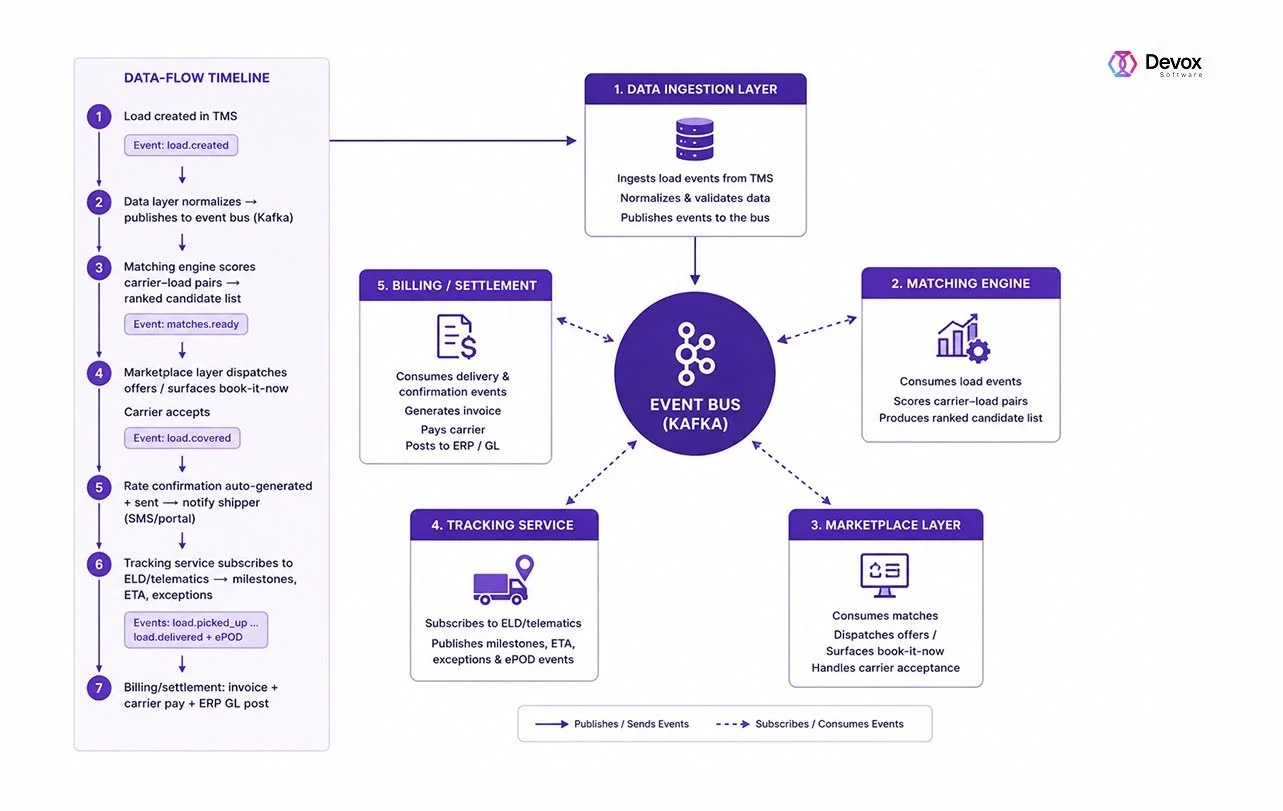
Before actually designing architecture, you need a clear picture of the capabilities the system must support. At a high level, a digital freight matching platform decomposes into five functional blocks, connected by an event backbone so that a state change in one ripples instantly to the others.
Each block is a candidate microservice that can be scaled and deployed independently, and microservices architecture breaks the system into loosely coupled services like rate shopping, route optimization, carrier booking, document generation, and analytics- whatever you need. They can be updated independently, so when the rating engine needs more compute during RFP season, only that service scales up.
- Load and Carrier Data. You need records for loads (origin, destination, weight, dimensions, temperature, etc.) and carriers (equipment, lanes run, hours-of-service availability, location, performance history, etc.). This layer carries a canonical data model for the core entities through manual entry, CSV upload, email parsing, and automatic sync from the TMS. Simply put, it’s a basis for the work of other services.
- Matching Engine. This layer consumes load and carrier data and scores every viable pair in the form of a ranked candidate list.
- Marketplace. Based on the previous layer, the marketplace makes deals based on matches: offer dispatch, bidding, book-it-now, negotiation, and automatic rate-confirmation generation. In a typical flow, the rate confirmation is generated and sent to the carrier with the detailed load information.
- Real-Time Tracking. GPS/ELD tracking, milestone updates (EDI 214 or API status events), ETA prediction, and exception alerts are provided from pickup to delivery.
- Billing and Settlement. All data concerning carrier payment, shipper invoicing, and freight-bill audit with freight costs are posted to the ERP automatically.
But how does data flow from service to service within load board architecture? Every system in the stack exposes a REST or GraphQL API with webhook capability, and the core services publish events (load created, tendered, picked up, and delivered) rather than waiting to be polled.
That’s what lets a carrier-accept event simultaneously update the load status, notify the shipper, stage inventory, and flag the carrier as available for the next match. But let’s concentrate on one thing at a time.
The Matching Engine: How Carrier–Load Scoring Actually Works
The matching engine is the intellectual core of the platform. Conceptually, its job is to take a load and produce a ranked list of carriers, each with a score representing how good the match is. The problem lies in how to prepare features that feed that scoring.
Machine learning algorithms can evaluate hundreds of variables, starting from current truck location, driver hours-of-service availability, historical lane performance, fuel costs, and deadhead distance to real-time spot rates. AI matching engines make assessments almost instantly, in under 3 seconds, which is far faster than a human can produce.
Variables
But how do advanced systems predict carrier behavior? Several metrics come in:
- Booking Likelihood. Algorithms score every carrier–load pair by looking at past acceptance patterns, seasonal demand, lane density, and carrier constraints.
- Lead Time to Pickup. If perishable goods remain unbooked before their scheduled pickup, they have to be rescheduled quickly. Lead time as a feature captures this dynamic.
- Repeat-Booking Affinity. Many carriers prioritize familiarity, so the engine assesses geographical similarity between a given load and a carrier’s previous bookings.
- Length-of-Haul Preference. An engine can assign a preference score to each candidate load based on its length of haul.
Only after we take care of metrics and evaluation principles can we discuss AI models for load board architecture.
Models
The active model inverts traditional approaches. Instead of carriers searching for loads, loads now find the right carrier. Framed precisely, this task is a learning-to-rank problem over carrier–load pairs, not a search problem.
For an uncovered load ℓ, the engine generates candidate carriers {c₁…cₙ} that survive the hard-constraint filter, computes a feature vector x(ℓ, cᵢ) for each pair, and produces a score s(ℓ, cᵢ) used to rank them. The training target is typically the historical outcome of an offered pair (booked/not booked), and ideally booked-and-delivered-on-time as a second label. This way, the objective is to estimate P(book | ℓ, c) (and optionally P(on-time | book, ℓ, c)) calibrated well enough that the ranked list reflects the true acceptance probability.
Model choice follows the data shape. Freight features are high-cardinality, sparse, and non-linear (carrier ID, lane pair, equipment class, time-of-day buckets), which is why gradient-boosted decision trees (XGBoost or LightGBM) are the workhorse in this case. They handle mixed categorical/numeric features and missing values without heavy preprocessing and consistently outperform a logistic-regression baseline on this data.
Furthermore, where the business cares about the ordering of offers rather than absolute probability, a pairwise or listwise objective (LambdaMART or XGBoost) optimizes NDCG/MAP over the candidate set directly. Repeat-booking affinity and lane-similarity features are often computed separately and fed in as engineered inputs rather than learned end to end.
Quality Scoring and Fairness
Scoring must also protect service levels; that’s why we add carrier quality scoring as a parameter in the prioritization rating system. When all other factors are equal, matching algorithms prioritize sending offers to carriers with higher quality scores.
Moreover, a rating system and evaluation process should be transparent to carriers to manage expectations and empower them to influence their ratings. Opaque scoring breeds distrust and pushes capable carriers off the platform.
Preference Capture
Another feature we add into the design is a system capable of asking, not assuming. The first step invites carriers to define their preferences, ensuring that we do not lose this data. It’s then processed by AI algorithms to identify the highest probability of interest for each carrier over time.
By the way, the engine also improves continuously. DFM algorithms learn from user behavior and refine recommendations over time. So if a carrier consistently hauls flatbed loads in the Southeast, they start seeing more of those opportunities.
The Payoff
When the engine works, the results don’t hesitate to show up. Generally, it’s expected that platforms using AI-powered matching gain empty-mile reductions of 10–15% through basic algorithmic optimization. Our engineering teams have measured concrete funnel lifts. In one production A/B test, we observed an overall increase of 3% in bookings.
How to Build a Load-Matching Platform: Load Board Architecture
A load-matching platform is, at its heart, a system that reacts to state changes, and every one of those transitions needs to ripple through the system instantly. What does it point to? Exactly, event-driven microservices architecture.
Why Microservices
Microservices architecture breaks the system into independent, loosely coupled services (rate shopping, route optimization, carrier booking, document generation, and analytics). Each runs as a separate service that can be updated, scaled, and debugged independently.
The practical benefit is targeted scaling: when your rating engine needs more compute during RFP season, only that service scales up. Production load boards have been built exactly this way, allowing independent development and deployment of components while ensuring system resilience and performance under high workloads.
Why Event-Driven
Event-driven processing replaces batch operations with real-time freight matching architecture data streams: instead of importing tracking updates every 15 minutes, cloud-native platforms process carrier events as they happen for true real-time visibility and proactive exception management.
Batch cycles ran on schedules disconnected from operational reality, for example, every four hours. It’s too rare to tell a dispatcher that a carrier had suspended service to a specific zone at 10 AM.
A concrete event flow illustrates the model. Total latency: under 60 seconds, with zero manual handoff and zero data re-entry.
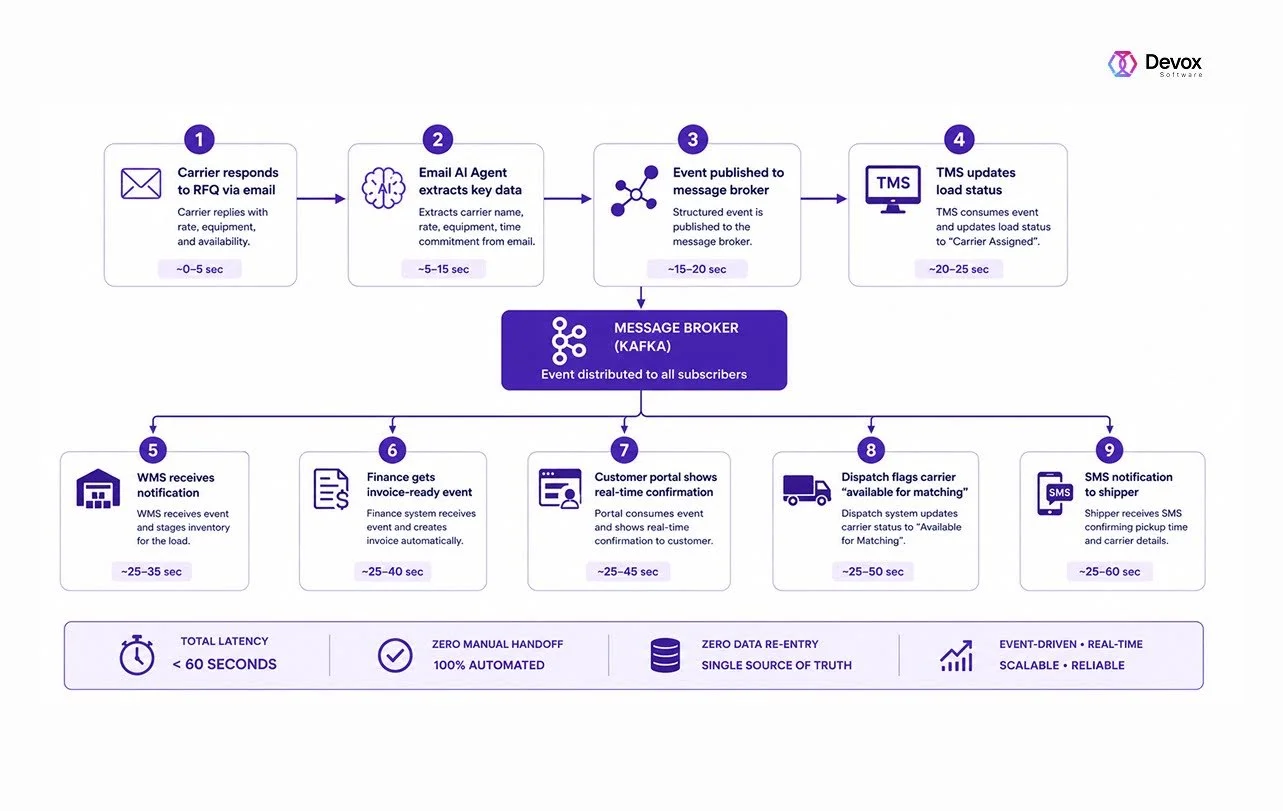
To make this work, every system in your stack must expose a REST or GraphQL API with real-time webhook capabilities, and your TMS can’t be a black box. It has to publish events such as load created, load tendered, load picked up, and load delivered. A foundational early-phase task is to define the canonical data model for core entities and select a message broker platform such as AWS SNS/SQS, Kafka, or a managed service.
Streaming
Kafka’s throughput and ordering guarantees enable ingesting data from multiple sources, storing it in a distributed, fault-tolerant manner, and making it available for real-time processing. In particular, it can handle millions of events per second for durability across the system.
To transform raw event streams into matching signals, stream processing engines such as Apache Flink and Kafka Streams support exactly-once semantics, while Flink is suited to complex event processing, windowing, and joins across multiple streams.
Processed state typically lands in databases that provide queryable snapshots of the current system state for downstream applications.
Interfaces and Engagement
WebSockets open a two-way interactive communication session between the user’s browser and a server, enabling the browser to receive messages and reducing latency.
However, scaling WebSockets isn’t as simple with a higher number of server instances. With multiple backend instances behind a load balancer, we can’t be sure that the backend instance to which the frontend is connected via WebSocket is the one actually executing the requested task.
What is the solution? To bridge the gap with the Pub/Sub design pattern using Kafka so that all backend instances receive and re-send the information needed. So the frontend that opened the WebSocket connection is served the information it was waiting for.
Integration Layer
A TMS sounds like a list of features, but it’s actually a list of integrations across three layers. Direct API connections handle modern, cloud-native systems; middleware or iPaaS bridges legacy on-premise platforms without native API support; and event-driven webhooks serve systems with push notifications. Each connection needs a clearly defined data contract between systems.
API vs. EDI (Spoiler: You Need Both)
EDI (Electronic Data Interchange) is the most common and easily recognizable technology used in TMS. It relies on shared data among systems, triggering an action between multiple systems via X12 or EDIFACT formats.
APIs, on the other hand, are the faster, more flexible modern path. With cloud-based solutions, an API allows transportation management systems to transmit data in less than a second.
However, in reality, we still need EDI. A common hybrid strategy splits the workload by purpose: live, decision-driving data travels via API, while audit-critical records that make more sense as documents stay on EDI. For partners who can’t change, a middleware gateway takes in an API call and quietly converts it to X12 or EDIFACT and back again so every partner sees its preferred format.
Multi-tenant SaaS and Scaling
If you’re building one platform serving many brokerages, multi-tenancy is an architectural decision you make early and rarely get to reverse cleanly. There are three isolation models, and mature platforms increasingly land on the third:
- Pool. All tenants share resources, isolated logically by a tenant_id on every row. Most efficient and operationally simplest (one schema, one migration set), but isolation now depends entirely on application code. The standard mitigation is Postgres row-level security, which pushes the tenant filter into the database so a forgotten WHERE tenant_id = ? fails closed instead of leaking.
- Silo. Each tenant gets dedicated resources (separate database, sometimes separate account). Strongest isolation and simplest compliance story; highest operational cost because migrations fan out across many stores. Appropriate for high-value enterprise contracts with strict data residency or audit requirements.
- Bridge. The hybrid is the most common pattern for B2B SaaS spanning SMB to enterprise. Pool the long tail of standard tenants on shared infrastructure and silo the few large or regulated ones onto isolated schemas or dedicated databases. It optimizes unit economics for the volume segment while meeting enterprise procurement requirements.
Whatever model you pick, every inbound request must resolve to a specific tenant before any application logic executes; that tenant context determines which database to connect to (bridge), which RLS policy to activate (pool), or which environment to route to (silo).
AI: Predictive Matching and Empty-Miles Reduction
AI is what turns a competent matching tool into a differentiator via 3 concrete places:
- Predictive matching. Beyond scoring current pairs, ML forecasts booking likelihood and demand, so the platform suggests the best places for carriers to find their next shipment, reducing empty kilometers.
- Empty-miles reduction. This is the headline ROI. Platforms using AI-powered matching report empty-mile reductions of 10–15% through basic algorithmic optimization, with network-level optimization showing far higher potential.
- Fraud prevention. AI-powered identity verification platforms scrutinize carrier authority, insurance status, safety records, and behavioral patterns in real time, up to a 97–98% reduction in double-brokering incidents.
Our freight brokerage software development with AI development services enables brokers to automate carrier matching, accelerate load execution, and optimize every stage of the freight lifecycle.
How to Build a Freight Load Board: Compliance and Fraud Prevention
Carrier verification is now a core platform capability, especially when considering the increasing data on fraud and hackers’ attacks, along with a growing list of losses. It helps to avoid double brokering and other tactics that keep evolving.
At minimum, the platform should automate the checks a diligent broker would perform manually. Verify the MC number and confirm that the company name, address, and authority status match those on the rate confirmation. It should also verify a carrier’s authority through the FMCSA database to confirm authenticity and evaluate the carrier’s safety rating, insurance coverage, and overall compliance.
We also add behavioral red flags like frequent changes of driver information or insurers and so on. As a result, it helps to reduce double brokering incidents up to 97% among verified carriers.
Freight Marketplace Development: From MVP to Full-Scale Platform
Building a platform of this complexity is a multi-phase journey. It requires preparation and research, so a pragmatic path includes them as phase 0 before the development starts.
- Discovery. Identify business needs and map the current state of systems and processes: integrations, data flows, the canonical data model for core entities, and the integration framework.
- Development. The first build covers load ingestion, a baseline matching engine, carrier verification against FMCSA, and a real-time dispatcher view.
- Integration Depth. Expand connectivity in the risk-reducing order. This area is where event-driven plumbing and EDI/API translation emerge.
- Intelligence. Layer in the machine-learning matching engine, preference capture, quality scoring, and continuous learning from booking outcomes.
- Scale and optimize. Tune latency budgets, add fallback routing, expand the carrier network, and close the analytics loop so every completed load improves the next match.
Treat the modernization of any legacy system as staged and reversible. The pattern that works is to validate changes safely and release incrementally rather than attempting a single cutover; the operation has to keep running while you rebuild it.
Conclusion
A custom load-matching platform is 5 subsystems held together by an event backbone, so the quality of the product lives in how well they’re separated and wired, where the sequencing matters as much as the architecture does. The teams that ship successfully start narrow with load ingestion and a baseline scorer to prove value, then layer in integration depth and the ML ranker in staged, rollback-safe releases.
That path gets a working product in front of users in a quarter rather than a year, and it lets the matching model improve on real booking data instead of assumptions. Whether you’re modernizing a legacy TMS, shipping a digital freight product, or adding an intelligent matching engine to an operation that already runs, Devox Software offers freight management systems development with the event-driven architecture behind it.
Frequently Asked Questions
-
What is the difference between a load board and a load-matching platform?
A load board architecture is passive. Brokers post freight and wait for carriers to search and call. While a load-matching platform is active, it scores every viable carrier against each load and surfaces the best fits automatically.
-
How does the matching algorithm actually choose a carrier?
It estimates, for each carrier–load pair, the probability that the carrier will book and deliver well, then ranks accordingly. Algorithms score the booking likelihood of every carrier–load pair by looking at past acceptance patterns, seasonal demand, lane density, and carrier constraints. Additional features include lead time to pickup, repeat-booking affinity, length-of-haul preference, deadhead distance, and a carrier quality score that protects service levels.
-
Why event-driven architecture instead of a traditional database-driven app?
Because the business is a stream of state changes that must propagate instantly. Event-driven processing replaces batch operations with real-time data streams; instead of importing tracking updates every 15 minutes, platforms process carrier events as they happen, enabling true real-time visibility and proactive exception management.
-
Do I still need EDI if I build modern APIs?
For the foreseeable future, yes. While EDI leads in TMS deployment, API connectivity is increasing, but it’s unlikely that APIs will fully replace EDI as the standard means of connection in the next several years. Most platforms run a hybrid, with a middleware gateway translating between API and X12/EDIFACT for partners who can’t change.
-
How does the platform prevent double brokering and fraud?
By making verification continuous and behavioral rather than a one-time onboarding step. The platform automates FMCSA authority and bond checks, monitors red-flag behaviors, and applies AI verification. AI-powered route optimization & TMS modernization scrutinize carrier authority, insurance status, safety records, and behavioral patterns in real time, achieving up to a 97% reduction in double brokering incidents among verified carriers.
-
Should I build a custom platform or buy off-the-shelf software?
Custom is justified when packaged products genuinely don’t fit. Custom development makes sense only when you have genuinely reviewed the leading options, and none of them fit your actual workflows. If your differentiation is your matching logic or a unique workflow, build it.


![How To Hire Web Developers? [Q&A 2022]](https://devoxsoftware.com/wp-content/webp-express/webp-images/doc-root/wp-content/uploads/2020/08/pawel-czerwinski-qMHrn-QiCw-unsplash-1024x683.jpg.webp)