


- BSW & RTE Configuration. We configure the Basic Software and Runtime Environment in ARXML, from the COM stack and NvM to OS tasks and signal routing. We verify every memory parameter and interface before RTE generation, so conflicts don’t surface at the HiL stage and block testing for weeks.
- Signal-to-Service Transformation. We replace hard-coded signal paths with a service-oriented model via SOME/IP, wrapping legacy CAN signals into discoverable services. This modularizes communication and sets the foundation for more flexible, granular software management.
- ECU Firmware Development. We write and customize firmware for QNX, FreeRTOS, and Zephyr to meet strict real-time requirements for critical firmware components. We select the RTOS based on the node class: lightweight Zephyr for zonal controllers and QNX for safety-critical domains.
- Diagnostics Stack Integration. We implement UDS diagnostic stacks over classic transport and DoIP for IP diagnostics via Automotive Ethernet. We configure diagnostic sessions, security, and DTC management so cloud servers and dealer equipment can centrally access any ECU.

OTA Update Software Development for Automotive
-
ELIMINATE RECALL RISKS WITH OTA
Resolve anomalies during simulation to ensure field readiness and minimize costly recalls.
-
SCALE ACROSS YOUR FLEET
Orchestrate complex update campaigns for millions of vehicles, ensuring reliable, high-speed delivery of firmware and features.
-
SECURE EVERY OTA UPDATE
Protect firmware integrity with end-to-end cryptographic verification, ensuring every OTA packet is tamper-proof.
Why choose Devox Software?
What We Offer
Proactive Defect Prevention:
We identify and resolve software anomalies during simulation to eliminate recall risk and protect OEM margins.
ADAS Synchronization:
We integrate sensor fusion with strict timing budgets to keep sensor fusion inside its timing budget.
Efficient Update Delivery:
Using binary diffing, we reduce update package sizes significantly.
Fault-Tolerant Updates:
We design update resiliency into the firmware lifecycle, ensuring vehicles maintain uptime and can autonomously revert to a safe state if any installation issue is detected.
Optimized Energy Management:
We optimize AUTOSAR network algorithms to ensure efficient OTA monitoring during dormancy, maintaining vehicle battery health.
Asynchronous Updates:
We utilize asynchronous data writing to inactive memory partitions, enabling continuous system operation during updates.
What We Deliver
Services We Provide
We architect high-reliability software-defined vehicle OTA solutions and deliver comprehensive Automotive Software Engineering Services, enabling automotive organizations to deploy software, firmware, and configuration changes across vehicle fleets.
-
Embedded AUTOSAR Systems Engineering
-
Secure ECU Firmware Lifecycle
- Custom Flash Bootloader Design. We build the microprogram that runs first on power-up and drives the entire update cycle: putting the ECU into programming mode via UDS 0x27, erasing the target blocks, and writing the new binary. The bootloader logic is tailored to the specific microcontroller and its memory map, not adapted from a generic template.
- Dual-Bank (A/B) Partitioning. We lay out memory so a new update is written to the inactive background bank while the running version stays live. To keep the vehicle ready to fall back to working firmware, we switch to the new image only after verification passes.
- Rollback and Fault-Tolerant Mechanisms. To remove the main FOTA risk of turning a control unit into a brick if power drops mid-flash, we embed an automatic rollback to the previous version whenever an install fails or an image doesn’t validate on boot.
- Cryptographic Signature Verification. The bootloader verifies the cryptographic signature of every binary before it touches memory, using keys stored in a hardware security module (HSM). An ECU will not accept an unsigned or tampered image, even if it arrives in the right format.
- Flash Memory and UDS Session Orchestration. We implement the full UDS stack for flashing, including security access (0x27), block writes, and checksum validation, and we tune flash handling around its erase-write cycles. Sessions are managed to ensure that long FOTA flows do not drop midstream or prematurely wear out the memory.
-
OTA Platform Engineering
- End-to-End OTA Backend. We build the server-side that orchestrates updates across a fleet: campaign management, vehicle targeting, and the delivery pipeline from cloud to car.
- Delta Update Generation. We generate differential patches that ship only the changed bytes between the car’s version and the new one, instead of the full firmware image. This sharply cuts file sizes, saving cellular bandwidth and shortening flash-write time across millions of vehicles.
- Staged Rollout. We run staged rollouts: pilot groups first, then wider waves, with telemetry feeding back at each step. If failure rates climb, we can pause or roll back a campaign before a bad update spreads across the fleet.
- SOTA. We handle the software-over-the-air path for infotainment and connectivity features through connected vehicle software management, where updates deploy as standalone apps without touching safety-critical ECUs. This keeps user-facing features current on their cadence, separate from the slower FOTA cycle.
- FOTA Session Resilience. We manage firmware-over-the-air sessions so that ECU flashes can survive common session interruptions. Instead of restarting, we resume updates from where they left off.
-
Uptane-Secured Automotive Cybersecurity
- Uptane Dual-Repository Setup. We stand up both halves of the Uptane framework: the Image Repository signing target metadata with offline keys and the Director Repository signing per-vehicle install instructions online. Splitting the roles this way means a stolen online key can’t forge legitimate firmware, since the image-signing keys never sit on the network.
- HSM Key Management. We anchor signing and verification keys in a hardware security module and tie them into the boot chain, so trust starts in silicon rather than in software.
- Version Downgrade Defense. We use Uptane’s timestamp and snapshot roles to block malicious update attacks so a vehicle can’t be tricked into accepting an old, vulnerable image. This approach directly addresses NHTSA guidance on protection against version-downgrade attacks.
- Threat Modeling and MitM Defenses. We model the attack surface across OTA servers, transport, and the install path, then harden it against man-in-the-middle and insider threats with mutual authentication and encrypted channels. The work maps to ISO/SAE 21434, so the analysis doubles as evidence for the security case.
- Per-ECU Image Encryption. We encrypt update images individually for each target ECU through the Director, so an intercepted package is useless without the matching vehicle’s keys.
-
Zonal E/E Architecture Migration
- Domain-to-Zonal Redesign. We regroup ECUs by physical location in the vehicle — front-left, rear-right, and so on — rather than by function, with local zonal controllers acting as I/O hubs for nearby sensors and actuators. The central computer handles decision logic and update management, so the topology is OTA-ready from day one.
- Central HPC Integration. We integrate the high-performance compute platform that the zones report into, consolidating what used to be spread across 70-100 separate ECUs onto a few powerful nodes. We decouple application logic from the underlying hardware so features can evolve without re-spinning the silicon.
- Zone Controller Development. We build the zonal controllers themselves: the firmware and I/O handling that turn raw sensor and actuator lines into clean service interfaces for the central computer.
- Power and Network Topology Orchestration. We lay out how power and data are distributed across zones, pairing the compute consolidation with a backbone that can actually carry the traffic. The zonal split is planned alongside the Ethernet network, so neither the wiring nor the bandwidth becomes the next bottleneck.
-
Automotive Ethernet and TSN Architecture
- Ethernet Backbone Design. We design the Automotive Ethernet backbone that carries high-bandwidth traffic legacy buses can’t handle, such as sensor data and multi-gigabyte FOTA payloads. The backbone becomes the core network connecting zonal controllers and central compute.
- Time-Sensitive Networking (TSN). We configure TSN so safety-critical signals get deterministic latency and priority on the wire: emergency braking jumps ahead of an OTA download or an audio stream. Traffic shaping and scheduling are tuned so the network holds its guarantees even at peak load.
- SOME/IP Service Layer. We implement SOME/IP as the service-oriented middleware that lets software components find each other and exchange services over IP instead of fixed signal wiring. Service discovery and serialization are set up so new functions plug into the network without rewiring the data paths.
- DoIP Diagnostics Gateway. We build the Diagnostics-over-IP gateway that lets cloud servers and dealer equipment reach any ECU through high-speed IP links. This technology is what makes centralized flashing fast: memory programming runs over Ethernet rather than crawling across a legacy diagnostic bus.
- Gateway Routing and Traffic Orchestration. We develop the central gateway logic that routes between Ethernet, CAN, and the zones, keeping OTA traffic, ADAS data, and diagnostics in their own lanes. Bandwidth is allocated so a large firmware download never starves a safety function of the throughput it needs.
-
Functional Safety Engineering
- Hazard Analysis and ASIL Classification. We run hazard analysis and risk assessment to assign each function an ASIL level, from B to D, before locking any architecture.
- Requirements Traceability. We enforce end-to-end traceability from safety goal to requirement to code to test using our TEATRA methodology, so every line maps back to its reason for existence.
- Shift-Left Safety Verification. We pull safety verification and OTA engineering under UN R156 requirements to the front of the cycle instead of bolting it on at the end, catching violations during development rather than at final integration. Building the evidence as we go prevents a last-minute certification rush before SOP.
- Safety Mechanism Implementation. We implement safety mechanisms under ASIL D requirements, including redundancy and memory protection, on critical paths.
- ASPICE-Aligned Development and Documentation. We run development against an ASPICE-conforming process, producing the work products and reviews assessors expect at each stage. We generate documentation as a byproduct of how we build, so it reflects the real system rather than being reconstructed after the fact.
-
AI-Augmented AUTOSAR Configuration
- ARXML Generation Copilot. We build generative AI agents trained on AUTOSAR schemas that draft baseline ARXML configurations from the intended design. Instead of hand-writing millions of interdependent lines, engineers start with a generated baseline and refine it, taking the grind out of the most error-prone part of the work.
- Dependency Conflict Detection. We run automated checks that surface interface and dependency conflicts before RTE generation, not after they’ve already broken the build. Catching a problematic memory parameter or a mismatched interface up front keeps it from blocking SiL/HiL testing for weeks downstream.
- Predictive CI/CD Integration. We apply ML to CI/CD logs to flag CPU and memory bottlenecks early in the pipeline, when they’re cheap to fix. Patterns that used to show up only at integration now get caught while the code is still moving through the build.
- Auto-Generated Test Scaffolding. We generate test cases and harness scaffolding from the configuration itself, so verification coverage tracks the design instead of lagging behind it. Engineers spend their time on the challenging test scenarios rather than wiring up boilerplate.
- SDLC Acceleration. We fold these agents into the delivery flow to compress the development lifecycle, significantly narrowing the gap between a code change and validated integration.
-
SOA-Driven Legacy Modernization
- Legacy ECU Assessment. We map the existing ECU fleet, including functions, wiring, and dependencies, before anything moves. That inventory lets us decide what gets consolidated onto central compute and what stays where it is, instead of migrating blind.
- Classic-to-Adaptive Migration. We transition functions from OSEK/VDX to POSIX-based Adaptive environments, segregating hard real-time microcontroller logic from dynamic central compute applications.
- Monolith-to-Microservices Refactoring. We break monolithic ECU software into service-oriented components that communicate over SOME/IP and can be updated independently. This is what turns a frozen, all-or-nothing flash into apps that deploy on their own cadence without touching the rest of the node.
- Phased Migration Without SOP Risk. We stage the move so legacy and modernized systems run side by side, retiring old hardware only once its replacement is proven. The phasing follows the 4-7 year vehicle cycle, so modernization fits the program timeline rather than fighting it.

Logistics
Cloud Infrastructure Modernization for a European Postal Service
A web app with over 5 million users needed an urgent legacy modernization, with thousands of shipments processed daily, performance, scalability, and security couldn’t be left to chance.
Additional Info
Core Tech:
- Jenkins
- Groovy
- Bash
- Grafana InfluxDB
- Salesforce
Country:
 Europe

FINTECH
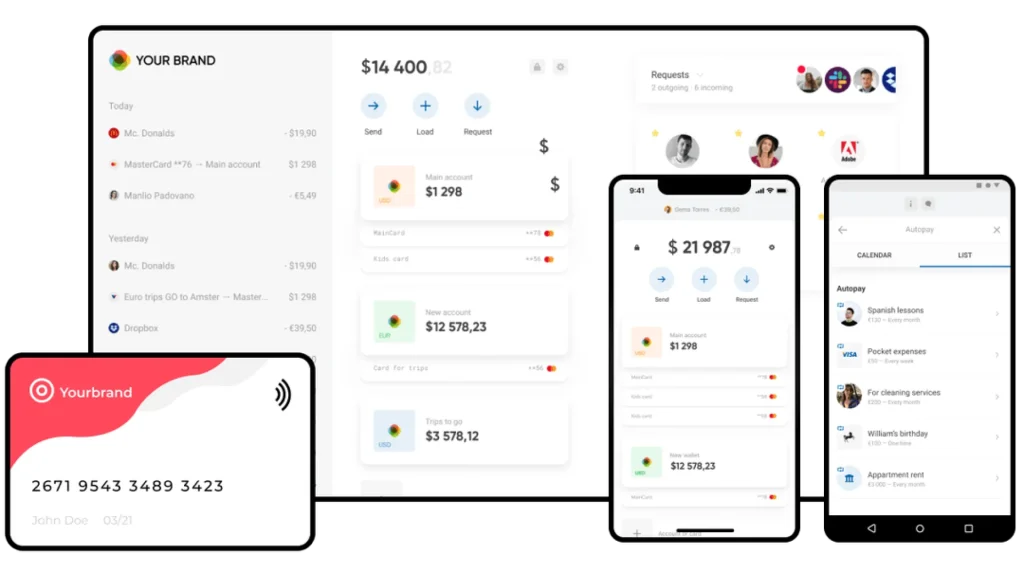
Web3 PaaS Ecosystem for Next-Gen NeoBanking, RegTech, and Secure Data Vaulting
A blockchain-powered PaaS ecosystem enabling financial providers to launch custom neobanking solutions with secure infrastructure.
Additional Info
Core Tech:
- Blockchain
- .NET
- Node.js
- AWS
- Docker
- PostgreSQL
- React Native
Country:
 USA
USA


 Germany
Testimonials
Testimonials



 Sweden
The solutions they’re providing is helping our business run more smoothly. We’ve been able to make quick developments with them, meeting our product vision within the timeline we set up. Listen to them because they can give strong advice about how to build good products.
Carl-Fredrik Linné
Tech Lead at
CURE Media

 United States
We are a software startup and using Devox allowed us to get an MVP to market faster and less cost than trying to build and fund an R&D team initially. Communication was excellent with Devox. This is a top notch firm.
Darrin Lipscomb
CEO, Founder at
Ferretly



 Australia
Their level of understanding, detail, and work ethic was great. We had 2 designers, 2 developers, PM and QA specialist. I am extremely satisfied with the end deliverables. Devox Software was always on time during the process.
Daniel Bertuccio
Marketing Manager at
Eurolinx
 Australia
We get great satisfaction working with them. They help us produce a product we’re happy with as co-founders. The feedback we got from customers was really great, too. Customers get what we do and we feel like we’re really reaching our target market.
Trent Allan
CTO, Co-founder at
Active Place


 United Kingdom
I’m blown up with the level of professionalism that’s been shown, as well as the welcoming nature and the social aspects. Devox Software is really on the ball technically.
Andy Morrey
Managing Director at Magma Trading



 Switzerland
Great job! We met the deadlines and brought happiness to our customers. Communication was perfect. Quick response. No problems with anything during the project. Their experienced team and perfect communication offer the best mix of quality and rates.
Vadim Ivanenko
COO at
Optherium

 United States
The project continues to be a success. As an early-stage company, we're continuously iterating to find product success. Devox has been quick and effective at iterating alongside us. I'm happy with the team, their responsiveness, and their output.


 Sweden
We hired the Devox team for a complicated (unusual interaction) UX/UI assignment. The team managed the project well both for initial time estimates and also weekly follow-ups throughout delivery. Overall, efficient work with a nice professional team.
John Boman
Product Manager at
Lexplore



 Canada
Their intuition about the product and their willingness to try new approaches and show them to our team as alternatives to our set course were impressive. The Devox team makes it incredibly easy to work with, and their ability to manage our team and set expectations was outstanding.
Tamas Pataky
Head of Product at
Stromcore



 Estonia
Devox is a team of exepctional talent and responsible executives. All of the talent we outstaffed from the company were experts in their fields and delivered quality work. They also take full ownership to what they deliver to you. If you work with Devox you will get actual results and you can rest assured that the result will procude value.
Stan Sadokov
Product Lead at
Multilogin

 United Kingdom
The work that the team has done on our project has been nothing short of incredible – it has surpassed all expectations I had and really is something I could only have dreamt of finding. Team is hard working, dedicated, personable and passionate. I have worked with people literally all over the world both in business and as freelancer, and people from Devox Software are 1 in a million.
Mark Lamb
Technical Director at M3 Network Limited
Insights
Our Experts' Insights

AI & ML
Automotive
Legacy Modernization
Logistics
Steps from Legacy TMS to AI-Orchestrated Supply Chains
Automotive
Software Development
AutoMobility Advisors and Devox Software Empower Automotive Clients with Cutting-Edge Technology Together

Automotive
Legacy Modernization
Software Development
Legacy TMS Systems in Automotive Logistics: Hidden Costs and Modern Alternatives
FAQ
Frequently Asked Questions
-
How does your automotive expertise differ from a general software vendor?
The gap that bites most OEMs isn’t coding ability: it’s the clash of timelines. A typical software vendor lives in two-week Agile sprints and rapid PoCs, while a vehicle program runs four to seven years from RFQ to SOP. Code written without that context often looks fine in a demo, then falls apart at integration because it fails to meet real-time and safety certification requirements. By the time anyone notices, the program is already late.
We work the other way around. Our engineers come from the embedded and AUTOSAR world, so hardware constraints, safety levels, and certification gates are inputs from day one, not surprises at the end. We can move fast where speed helps (tooling, configuration, and CI/CD) without breaking the discipline the rest of the program depends on. The goal isn’t to be the fastest vendor; it’s to be on schedule and certifiable when SOP arrives. Related to this, teams often explore our AI Transformation Services.
-
How do you prevent critical failures during safety-critical ECU updates?
Safety engineering offers no absolute guarantee; it relies on defense in depth, and that’s what we build. An ECU never just overwrites its running code: the flash bootloader puts it into programming mode, authenticates the cryptographic signature of the new binary against keys held in an HSM, and only then writes to memory. It physically rejects an unsigned or tampered image, regardless of how it’s delivered. On top of that, A/B partitioning writes the update to an inactive memory bank while the working version stays live, so the car always has a known-good firmware to fall back to.
If anything goes wrong mid-install, such as a session interruption, the bootloader automatically rolls back to the previous version, which removes the bricking risk entirely. Layered above the device, the Uptane framework blocks the malicious update attacks that try to trick the car into accepting an old, vulnerable image. No single failure or single compromised key is enough to push a harmful update onto a safety-critical ECU, and that’s the standard NHTSA now effectively expects.
-
How do you streamline the AUTOSAR Classic to Adaptive migration process?
The Classic-to-Adaptive chasm is where a lot of programs quietly stall. The two platforms are genuinely different worlds: Classic is C on OSEK/VDX with static, compile-time configuration optimized for ASIL D; Adaptive is C++ on POSIX systems like QNX or Linux, running dynamic apps on HPC nodes. Merging them into one zonal architecture means re-architecting legacy signal architectures into service-oriented ones, and the manual ARXML configuration alone can block SiL/HiL testing for weeks when one parameter is off.
Real help means taking that integration burden off your team, not adding another set of hands to it. We make split decisions: what has to stay hard real-time on a microcontroller versus what belongs in dynamic apps on a central computer, and we wrap legacy CAN signals as SOME/IP services so functions can update independently. We also tackle the ARXML grind directly with AI agents trained on AUTOSAR schemas that draft the baseline configuration and flag dependency conflicts before RTE generation, so conflicts surface in minutes instead of at the HiL bench.
-
Is the transition to Automotive Ethernet as disruptive as we anticipate?
The pressure is real: CAN, LIN, and FlexRay simply can’t carry the data from high-res cameras, radar, and lidar, let alone push multi-gigabyte firmware images in any reasonable time. Automotive Ethernet is the industry’s answer, and the part that makes it work for safety is Time-Sensitive Networking. TSN lets us give emergency braking deterministic priority on the wire while an OTA download or an audio stream waits its turn, so adding bandwidth-hungry features doesn’t compromise the signals that keep the car safe.
The migration is significant, but you can avoid disruption by planning it as one move rather than three. We design the Ethernet backbone, the SOME/IP service layer, and the DoIP diagnostics path together with the zonal split, so wiring and bandwidth are solved at the same time instead of one becoming the next bottleneck. DoIP, in particular, makes centralized flashing fast: memory programming runs over high-speed IP instead of crawling across a legacy bus, directly shortening update times that frustrate customers and cause dropped sessions.
-
How do you prevent vendor lock-in and ensure long-term system independence?
Lock-in fear is rational, and we build protection against it into our architecture, not into a contract clause. The whole thrust of the work, including decoupling application logic from hardware, wrapping functions as SOME/IP services, and migrating monoliths into independent microservices, produces a system of modular, compliant components rather than a black box only we understand. Because it’s built on AUTOSAR, Uptane, ISO 24089, and the other open standards the industry already audits against, what we deliver is legible to your team and to any other qualified vendor.
The deeper protection is the audit trail and traceability we hand over. When every requirement maps to code and test, and every update is recorded end to end, the knowledge lives in the artifacts rather than in our heads. You can bring work back in-house or move it elsewhere without reverse-engineering a mystery, which is exactly where a well-run program should be. A strong partner should never create dependency. For the complete scope, visit our automotive software engineering.
Book a call
Want to Achieve Your Goals? Book Your Call Now!
Contact Us
We Fix, Transform, and Skyrocket Your Software.
Tell us where your system needs help — we’ll show you how to move forward with clarity and speed. From architecture to launch — we’re your engineering partner.
Book your free consultation. We’ll help you move faster, and smarter.
Let's Discuss Your Project!
Share the details of your project – like scope or business challenges. Our team will carefully study them and then we’ll figure out the next move together.
Thank You for Contacting Us!
We appreciate you reaching out. Your message has been received, and a member of our team will get back to you within 24 hours.
In the meantime, feel free to follow our social.
Thank You for Subscribing!
Welcome to the Devox Software community! We're excited to have you on board. You'll now receive the latest industry insights, company news, and exclusive updates straight to your inbox.