


- Agent Workflow Design. We build each agent as a LangGraph graph with a step limit, so a task either finishes or goes to a person instead of looping. For .NET and SAP environments, we use Microsoft Semantic Kernel.
- Test Sets From Past Cases. Before development, we turn cases your team already handled correctly into a test set. The workflow has to pass it before it goes live, and again before every release.
- MCP Tool Access. Agents reach your systems through MCP gateways mapped to your existing roles. Each agent gets only the tools it needs, and every call is logged.
- Cost-Aware Execution. Sorting, formatting, and validation steps run as Python scripts in a sandbox. Large models handle only the steps that need reasoning, which keeps cost per task predictable.
- Read-Only Rollout. Agents start on live data without write access. They get permission to change records once their results meet the criteria agreed with you.

AI Workflow Automation Services
-
STOP AGENT LOOPS IN PRODUCTION
Agents that hand a task back and forth burn tokens and never finish it. Put each agent on a LangGraph graph with a step limit, and send anything that hits the limit to a person. -
GET AGENTS THROUGH SECURITY REVIEW
Connect agents to your systems through MCP gateways that use your existing roles. Each agent gets only the tools it needs, and every call goes to the audit log. -
CUT THE TOKEN BILL
Most steps in an agent workflow are sorting and formatting. Run those as Python scripts in a sandbox and keep frontier models for the steps that need reasoning.
Why choose Devox Software?
How We Get Agents to Production
Tests Come First
Before building the agents, we collect past cases your team handled correctly and turn them into a test set. The system has to pass it before it goes live.
Rules Where Possible, AI Where Needed
Stable steps run on rules. Unstructured documents and ambiguous cases go to AI with a confidence threshold, and anything below it routes to a reviewer.
Read-Only at Launch
At first, agents work on live data with no permission to change anything. They get write access once their results match the criteria we agreed on with you.
Built for .NET and SAP Too
LangGraph is our default. For companies on .NET and SAP, we use Microsoft Semantic Kernel, as we did on an SAP automation project.
What We Deliver
Services We Provide
-
Agentic Workflow Development
-
Workflow Automation Maturity Assessment
- Automation Readiness Scoring. Our team maps your processes using event logs, workflow histories, and throughput metrics to score automation readiness and identify the highest-value starting points.
- Automation Feasibility. Our team evaluates each process against rule-based criteria, cognitive-automation suitability, and compliance constraints to determine what we can automate safely and effectively. You avoid wasted investment by receiving a feasibility matrix that separates low-risk rule automation from flows requiring AI, validation checks, or human approvals.
- ROI Modeling. We model ROI using cost-to-serve data, FTE hours reclaimed, error-reduction potential, and infrastructure savings from workflow redesign and straight-through processing. To support realistic planning, you receive conservative payback ranges that show expected savings, operational uplift, and the financial impact of each automation scenario.
- Prioritized Automation Roadmap. Our team builds a phased roadmap using quick-win identification, dependency mapping, and compliance-ready workflow design to guide your automation rollout. The roadmap puts quick wins before strategic processes and aligns every step with governance and audit requirements.
-
Process Mining
- Event Log Analysis. Our team analyze workflow event logs, approval histories, and exception records to reconstruct how your processes actually run across systems and your in-house team. You receive a searchable execution map that shows real process paths, hidden steps, and operational patterns missing from documentation.
- Process Discovery. We build visual models that compare how a process is supposed to run with how it actually runs, so deviations are easy to spot.
- Process Deviation Detection. Our team detects bottlenecks using throughput metrics, rework loops, delay clusters, and SLA breaches to quantify where time and money are being lost.
- Conformance Checking. We run conformance checks using SLA adherence data, compliance controls, and audit-ready workflow logs to measure how closely execution aligns with required standards. You’ll see a compliance scorecard that highlights violations, risky deviations, and steps requiring stronger controls or redesigned approval paths.
- Optimization Recommendations. We turn findings from event logs, process variants, and exception trends into specific redesigns, each with its expected effect on cycle time.
-
End-to-End Business Process Automation (BPA)
- Order‑to‑Cash Automation. Our team automate the full quote-to-invoice-to-collection cycle using cross-system orchestration, compliance-ready controls, and redesigned flows that eliminate manual rework and delays. You get a streamlined O2C process that reduces exceptions, shortens cycle times, and keeps every step audit-ready.
- Procure-to-Pay Automation. We automate requisition-to-PO-to-payment using secure ERP connectors, validation checks, and workflow logic that enforces approvals, segregation of duties, and SLA adherence. You gain a cleaner P2P process with reduced bottlenecks, consistent compliance, and reliable data flow across procurement, finance, and vendor systems.
- Hire-to-Retire Automation. Our team streamlines onboarding, payroll, and offboarding using structured workflow design, automated controls, and exception handling aligned with HR, IT, and finance requirements. You get a unified H2R lifecycle with less administrative work, predictable handoffs, fewer errors, and complete visibility into every employee-related action.
- Workflow Redesign. Our team redesign workflows using process-mining insights, SLA data, exception trends, and compliance controls to resolve structural issues before automating anything. Designed to prevent “automating the broken flow,” this approach results in cleaner, faster, and more resilient processes that deliver measurable impact once automation is applied.
-
Intelligent Automation
- Rule-based RPA. We deploy rule‑based RPA for invoice processing, data entry, and reconciliation using stable logic that mirrors your existing controls and approval paths.
- Cognitive Automation. We implement cognitive automation using AI and OCR to extract, classify, and validate unstructured documents with audit-ready precision.
- Bot Deployment. We configure attended bots for employee‑assisted tasks and unattended bots for back‑office execution, each running with the right permissions and operational boundaries.
- Bot Lifecycle Management. We manage bot versioning, monitoring, and maintenance through structured workflows, performance KPIs, and exception logs.
-
AI-Enhanced Workflow Orchestration
- AI Decision Nodes. We embed AI decision nodes that evaluate context, data quality, and workflow rules to choose the correct branch without slowing execution.
- Dynamic Routing. We design dynamic routing that assigns tasks based on context, workload, SLA pressure, and compliance requirements rather than static rules.
- Exception Handling. We implement exception handling that auto-resolves routine issues and escalates only the cases that genuinely require human review.
- Straight‑Through Processing. We enable straight-through processing by removing unnecessary approvals, validating data automatically, and enforcing controls directly inside the workflow.
- Human Review Gates. We add human review gates at the exact points where judgment, compliance, or risk oversight is required, supported by full audit trails.
-
Low-Code Workflow Platform Development
- Platform Configuration. We configure platforms like Power Automate, Appian, and UiPath using secure connectors, governance settings, and workflow standards aligned with your operational controls.
- Custom Platform Extensions. We develop custom connectors and reusable components that extend platform reach into ERP, CRM, and legacy systems without compromising security or auditability. Your workflows can connect to the systems that matter, including legacy platforms and tools with limited vendor support.
- Citizen‑Developer Enablement. We enable citizen developers with templates, guardrails, and structured training that let them build safely without creating compliance risks or workflow sprawl.
- Citizen Developer Governance. We establish governance using a Center of Excellence model, standards, permissions, and monitoring to keep business-built workflows controlled and audit-ready.
- Custom Workflow Solutions. We design custom workflow solutions for cases where off‑the‑shelf logic doesn’t fit, using platform extensibility and compliance‑aligned patterns.
-
Enterprise Workflow Integration
- iPaaS Implementation. We implement an iPaaS foundation that standardizes integrations, enforces governance, and connects ERP, CRM, and finance systems into a single automation-ready layer.
- Legacy‑to‑SaaS Connectors. We create connectors that safely bridge legacy systems into modern SaaS platforms without rewriting business logic or breaking compliance controls.
- Event‑Driven Architecture. We design event‑driven workflows that respond to real‑time triggers, async updates, and system events instead of relying on scheduled jobs or manual intervention.
- API Workflow Design. We build secure, reusable API workflow components that enforce authentication, validation, and data-handling rules across every integration touchpoint.
- Data Synchronization. We use governed pipelines to synchronize and transform data, ensuring accuracy, consistency, and traceability across all connected systems.
-
Workflow Operations
- Process Dashboards. We build real-time dashboards that track throughput, cycle time, SLA adherence, and exception trends using governed workflow event data.
- Workflow Health Monitoring. We apply AIOps techniques to detect anomalies, surface early failure signals, and trigger alerts before workflows degrade or stall. Your automation environment stays quiet when workflows run normally and alerts the team when something starts to drift.
- Compliance Controls. We enforce compliance controls and generate audit‑ready trails using SOC 2–aligned logging, approval histories, and versioned workflow changes.
- Access Governance. We implement security and access governance using permissions, secrets management, and workflow-level controls that prevent unauthorized actions.
- Continuous Optimization. We establish a continuous improvement loop that measures performance, identifies optimization opportunities, and redeploys updated workflows with controlled governance.
-
Adaptive Hyperautomation
- Intelligent Automation Stack. We assemble an intelligent automation stack that layers RPA, AI, OCR, workflow engines, and governed controls into a single, coordinated execution system.
- Governed Self-Tuning Workflows. We enable self-tuning workflows that adjust routing, thresholds, and validation logic using controlled feedback loops that meet compliance and audit requirements.
- Agent-Assisted Automation. We introduce agent-assisted automation, where AI agents add context, recommendations, and exception triage to workflows while keeping the governed process logic unchanged.
- Enterprise Scaling Framework. We build a scaling framework that moves you from pilot automations to an enterprise-wide program using standards, governance, reusable components, and platform-level controls.
Benefits
What Changes After Launch
01
Clear criteria for go-live
You know in advance what the system has to pass before it can write to production. The test results come to your team for review.
02
One review for your security team
All agent access goes through one gateway mapped to your roles. Legacy databases keep their schemas, and every read and write is logged.
03
Token spend you can plan
Routine steps run as scripts, so cost per task depends on the few steps that need a large model. That makes the monthly budget possible to estimate.
04
Room to change course
Agents, connectors and tests are separate parts. You can add an agent or switch models and keep the rest as it is.

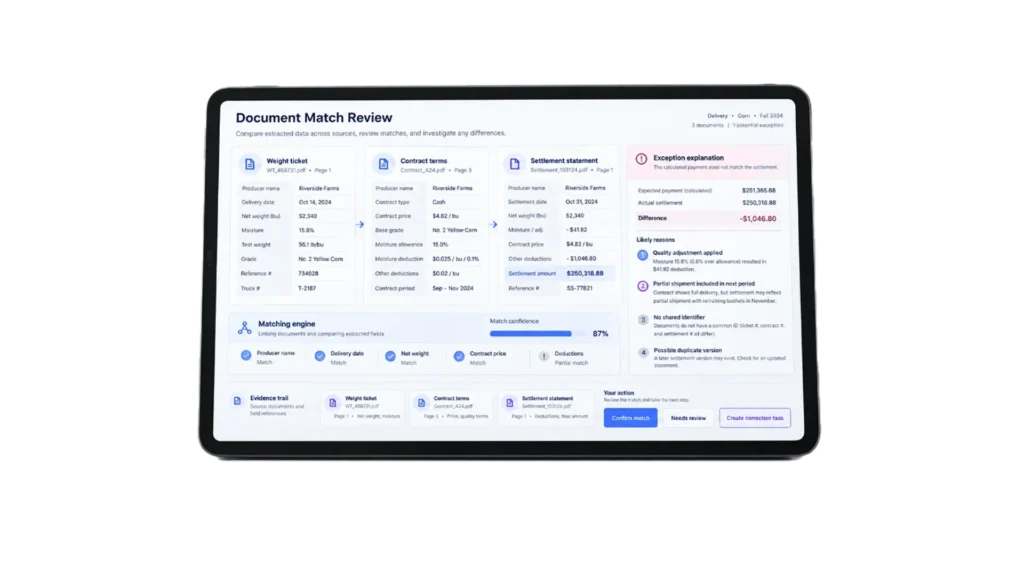
AI
Agentic AI System for Producer Settlement Reconciliation
An agentic reconciliation layer automated matching across weight tickets, contracts, and settlement records, cut manual effort by ~70%, and kept deterministic payout calculations within the client’s existing accounting environment.
Additional Info
Core Tech:
- Python
- OpenAI
- PostgreSQL
- AWS

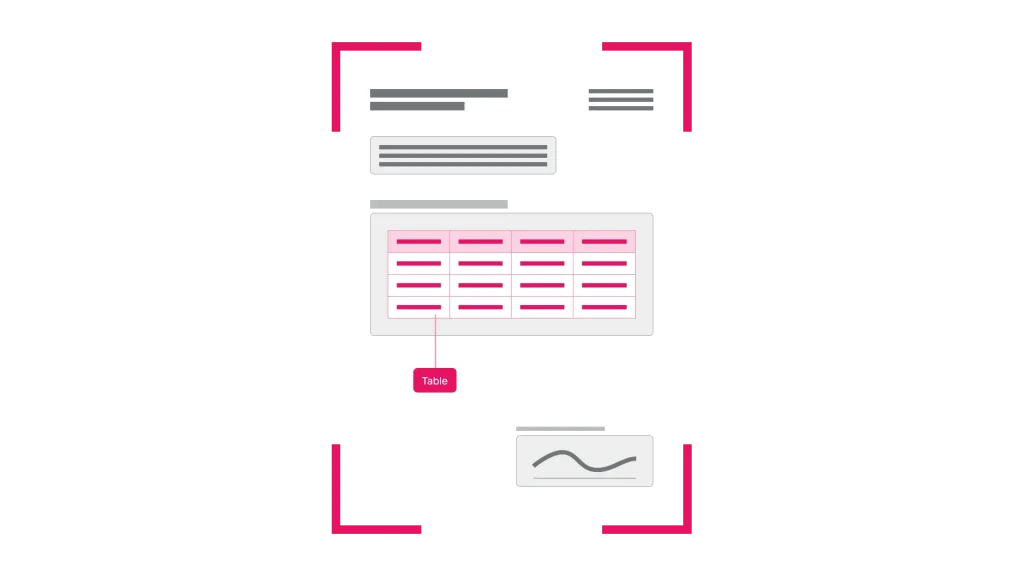
WORKFLOW MANAGEMENT
AI-Driven Intelligent Automation Engine for Multicountry Export Certification
A modular, AI-powered platform that automates the generation of export certificates by extracting structured data from multi-format documents and rendering country-specific outputs.
Additional Info
Core Tech:
- React
- FastAPI
- Python
- Google Gemini API
- pytesseract
- PostgreSQL
- Docker
- AWS/Azure/GCP Cloud Services
Country:
 Germany


LOGISTICS & AUTOMOTIVE
Intelligent Automation for Global Logistics Platform
From a 30-year-old monolith to an AI-driven logistics platform: how Devox slashed shipment costs by 30% while accelerating operations
Additional Info
Core Tech:
- .NET 7 microservices
- SQL Server
- Docker & Kubernetes
- Azure DevOps CI/CD
- Azure API Management
- Python
- Apache Kafka
- Azure Data Factory
- Prometheus/Grafana
Country:
 USA
Testimonials
Testimonials



 Sweden
The solutions they’re providing is helping our business run more smoothly. We’ve been able to make quick developments with them, meeting our product vision within the timeline we set up. Listen to them because they can give strong advice about how to build good products.
Carl-Fredrik Linné
Tech Lead at
CURE Media


 United States
We are a software startup and using Devox allowed us to get an MVP to market faster and less cost than trying to build and fund an R&D team initially. Communication was excellent with Devox. This is a top notch firm.
Darrin Lipscomb
CEO, Founder at
Ferretly



 Australia
Their level of understanding, detail, and work ethic was great. We had 2 designers, 2 developers, PM and QA specialist. I am extremely satisfied with the end deliverables. Devox Software was always on time during the process.
Daniel Bertuccio
Marketing Manager at
Eurolinx


 Australia
We get great satisfaction working with them. They help us produce a product we’re happy with as co-founders. The feedback we got from customers was really great, too. Customers get what we do and we feel like we’re really reaching our target market.
Trent Allan
CTO, Co-founder at
Active Place



 United Kingdom
I’m blown up with the level of professionalism that’s been shown, as well as the welcoming nature and the social aspects. Devox Software is really on the ball technically.
Andy Morrey
Managing Director at Magma Trading



 Switzerland
Great job! We met the deadlines and brought happiness to our customers. Communication was perfect. Quick response. No problems with anything during the project. Their experienced team and perfect communication offer the best mix of quality and rates.
Vadim Ivanenko
COO at
Optherium


 United States
The project continues to be a success. As an early-stage company, we're continuously iterating to find product success. Devox has been quick and effective at iterating alongside us. I'm happy with the team, their responsiveness, and their output.


 Sweden
We hired the Devox team for a complicated (unusual interaction) UX/UI assignment. The team managed the project well both for initial time estimates and also weekly follow-ups throughout delivery. Overall, efficient work with a nice professional team.
John Boman
Product Manager at
Lexplore



 Canada
Their intuition about the product and their willingness to try new approaches and show them to our team as alternatives to our set course were impressive. The Devox team makes it incredibly easy to work with, and their ability to manage our team and set expectations was outstanding.
Tamas Pataky
Head of Product at
Stromcore



 Estonia
Devox is a team of exepctional talent and responsible executives. All of the talent we outstaffed from the company were experts in their fields and delivered quality work. They also take full ownership to what they deliver to you. If you work with Devox you will get actual results and you can rest assured that the result will procude value.
Stan Sadokov
Product Lead at
Multilogin


 United Kingdom
The work that the team has done on our project has been nothing short of incredible – it has surpassed all expectations I had and really is something I could only have dreamt of finding. Team is hard working, dedicated, personable and passionate. I have worked with people literally all over the world both in business and as freelancer, and people from Devox Software are 1 in a million.
Mark Lamb
Technical Director at M3 Network Limited
Insights
Our Experts' Insights

AI & ML
AI Solutions
Business Optimization
Legacy Modernization
Best AI Tools to Accelerate Software Development


AI & ML
AI Solutions
Legacy Modernization
AI-Assisted Software Development: The Ultimate Practical Guide
FAQ
Frequently Asked Questions
-
How do you connect legacy systems with cloud applications?
We build integration layers that connect cloud applications to your existing systems in a way that works with your current architecture. That typically includes event-driven design and secure enterprise API gateways. Our engineers map legacy data structures so modern applications and core systems can work together reliably, keeping critical transaction platforms stable while adding automation where it improves efficiency.
Where a legacy system cannot expose the data a workflow needs, we modernize only that part, without rewriting the rest.
-
How do you enforce secure data governance?
Security controls are designed into each workflow from the start. We use SOC 2, NIST CSF 2.0 and Zero Trust Architecture as reference frameworks. Each automated step has role-based and attribute-based access controls, so only approved users and services can act on it, and every action is logged.
-
How do your workflows handle exceptions?
We build exception-handling steps into each workflow so that if a data anomaly occurs or a third-party API times out, we can isolate the affected transaction while the rest of the workflow continues. We also add human approval points where appropriate, giving your team clear oversight of automated operations.
-
How do you control AI decisions?
We take a structured approach to AI governance and align our systems with frameworks such as NIST AI RMF 1.0 and ISO/IEC 42001:2023. Each AI component operates within defined policies and controls so it behaves more like a governed decision-support tool than an unconstrained decision-maker.
For higher-risk steps such as payment approvals or vendor onboarding, AI helps analyze unstructured data and surface recommendations. Final decisions remain with qualified team members so material outcomes receive appropriate human review.
-
When do we need AI agents instead of RPA?
RPA works for steps that follow the same rules every time, such as copying data between systems or reconciling fixed formats. Agents fit steps that require reading unstructured documents, handling exceptions, or choosing between options. Most workflows we build combine both: rules for the stable steps and agents for the rest.
Book a call
Want to Achieve Your Goals? Book Your Call Now!
Having trouble booking? Open the booking page.
Contact Us
We Fix, Transform, and Skyrocket Your Software.
Tell us where your system needs help — we’ll show you how to move forward with clarity and speed. From architecture to launch — we’re your engineering partner.
Book your free consultation. We’ll help you move faster, and smarter.
Let's Discuss Your Project!
Share the details of your project – like scope or business challenges. Our team will carefully study them and then we’ll figure out the next move together.
Thank You for Contacting Us!
We appreciate you reaching out. Your message has been received, and a member of our team will get back to you within 24 hours.
In the meantime, feel free to follow our social.
Thank You for Subscribing!
Welcome to the Devox Software community! We're excited to have you on board. You'll now receive the latest industry insights, company news, and exclusive updates straight to your inbox.