


- UN R156 OTA Infrastructure Support. To support compliance, so compliance doesn’t force a mid-program redesign.
- Differential Update Engine. Our delta-only transmission reduces bandwidth up to 60%.
- Resilient Deployment Orchestration. Staged rollout control via defined groups, with automatic rollbacks triggered if stability metrics drift, ensures fleet uptime without manual intervention.

SDV Software Development for Automotive
-
BUILT AROUND YOUR SOP DATE
Our engineers come from embedded and AUTOSAR programs. We plan around your ASIL targets and R155/R156 gates, so integration doesn’t surface surprises months before production. -
PROVEN IN AUTOMOTIVE VALIDATION
For a vehicle manufacturer, we built a simulation environment for eCall and telematics testing that cut validation time by 40% and reached a 99.9% success rate in hazard scenarios. -
YOU OWN EVERYTHING WE BUILD
Code, architecture documentation and requirement-to-test traceability are yours from the first commit. Take it in-house at SOP or keep scaling with us.
What We Deliver
Services We Provide
-
OTA Deployment Lifecycle Engineering
-
Automotive Cybersecurity Compliance Engineering
- Threat Analysis and Risk Assessment (TARA). We audit architectures using ISO/SAE 21434 methodologies.
- Zero-Trust Network Architecture. We enforce Zero-Trust across all intra-node traffic. Independent ECU authentication, Deep Packet Inspection, and VLAN isolation lock down safety-critical systems against domain compromise.
- Secure OTA & Cryptographic Key Management. We implement end-to-end HSM-backed encryption for all cloud-to-vehicle data channels.
- Automotive VSOC Operations. Real-time fleet health monitoring, where automated response workflows cut anomaly localization from hours to minutes.
-
Connected Vehicle Telematics Ecosystem
- Real-Time Telematics Data Pipeline. We build a streaming infrastructure based on Apache Kafka or AWS Kinesis that processes millions of events per second from connected vehicles. The architecture scales horizontally across the entire fleet.
- Unified Vehicle Data Architecture. Unifies disparate streams from various sensors and telematics units into a single schema and stores them in a structured data lake. This ensures engineering, analytics, and product teams work from the same source of truth.
- Predictive Maintenance ML Models. Delivery of machine learning models for predictive component failure, derived from accumulated telematics data.
- Telematics Platform Optimization. We profile queries, review the indexing strategy, and optimize database configuration for real-world telematics platform load patterns.
-
Automotive AI for ADAS and Maintenance
- ADAS Computer Vision Development. We develop Computer Vision models for object detection, lane recognition, and distance estimation, optimized for specific SoCs. For a leading vehicle manufacturer, we built a simulation environment for telematics and emergency call validation that reduced testing time by 40% and achieved a 99.9% success rate in hazard scenarios.
- Safety-Oriented AI Engineering. Each AI system component includes a documentation package aligned with ISO 26262 principles: safety requirements, safety goals, verification reports, and a traceability matrix to support production release readiness.
- Edge AI Optimization & Deployment. AI models are optimized to run directly on-board the vehicle through quantization, pruning, and compilation for the target chip. This is critical for ADAS functions where cloud round-trip latency is unacceptable; decisions must be made on the device in milliseconds.
- AI Validation in Digital Twin Environment. Before deployment on real hardware, models are tested in a cloud-based digital twin that simulates vehicle behavior in thousands of scenarios simultaneously. This reduces the number of physical test drives, accelerates iterations, and lets you cover edge cases that are hard to reproduce on the road.
-
Automotive Middleware and Integration
- AUTOSAR Adaptive Platform Integration. We develop and configure middleware based on AUTOSAR Adaptive, a standard that allows running dynamic services on high-performance computers alongside classic AUTOSAR components. This enables OEMs to gradually migrate from legacy architecture.
- Zonal Architecture Migration Design. To a centralized zonal model with domain controllers, our team designs the transition from a decentralized architecture.
- Automotive Ethernet & VLAN Configuration. You will receive automotive Ethernet as a single communication bus instead of heterogeneous vehicle networks. Setting up VLAN isolation and Deep Packet Inspection reduces vehicle weight and secures the network foundation.
- Cloud-to-Vehicle API Layer Development. We build a standardized API layer between onboard systems and OEM cloud services for telematics transmission, receiving OTA updates, and two-way data exchange with mobile apps. A single API, instead of point-to-point integrations from various Tier-1 suppliers, eliminates the patchwork stack and returns architectural control to the OEM.
- Mixed-Criticality Hypervisor Integration. We configure a hypervisor for simultaneous execution of systems with different criticality levels on a single hardware platform: safety-critical functions (braking, steering) are isolated from infotainment and connectivity services.
-
Cloud-Native SDV and Digital Twin Framework
- Cloud-Native SDV Development. Meeting automotive quality standards, we deploy a fully cloud-native development environment based on containerization. Engineers can develop, test, and integrate software components regardless of physical hardware availability, shortening the overall development cycle by months.
- Digital Twin Modeling and Simulation. We model the full SDV software architecture to run thousands of parallel test scenarios. This validates ECU and sensor behavior in virtual environments months before physical prototypes exist.
- Software Reuse Architecture. We design the platform architecture so that software components can be written once and deployed across different vehicle models without rewriting them.
Working Together
How an SDV Program Actually Runs With Us

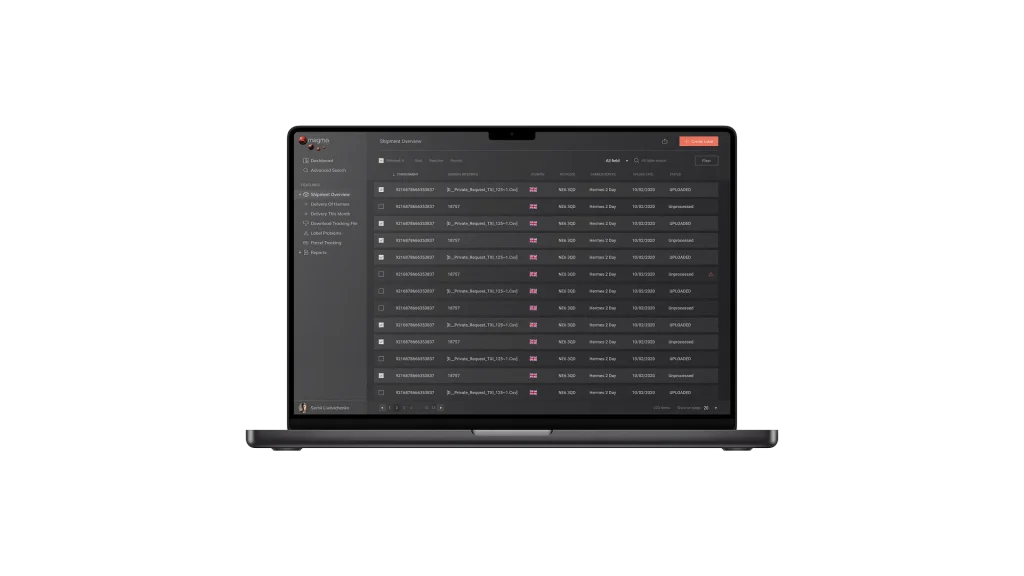
Logistics
Scalable, AI-Powered TMS to Drive Market Expansion for a Logistics Company
A logistics multi-module platform that helps manage parcel tracking, intelligent routing, barcode generation, and returns.
Additional Info
Core Tech:
- Node.js
- React.js
- PostgreSQL
- AWS Cloud Infrastructure
- NetworkX
Country:
 United Kingdom

WORKFLOW MANAGEMENT
Enterprise-Scale AI Survey Engine for HR SaaS
Enterprise-scale AI survey engine for an HR SaaS platform enabling multilingual, real-time sentiment analysis, adaptive questionnaires, and actionable insights for workforce engagement.
Additional Info
Core Tech:
- React 18
- Node.js 20 (NestJS)
- GraphQL
- PostgreSQL 16
- Redis
- Apache Kafka
- OpenAI GPT-4.5 (fine-tuned)
- Hugging Face Transformers
- spaCy
- AWS ECS Fargate
Country:
 USA
USA

FINTECH
Next-Gen IRS 1040 Tax Filing Platform for Individuals & CPAs
Full-cycle SaaS solution for the U.S. tax market, built by Devox Software to streamline IRS Form 1040 filing for individuals and CPA firms.
Additional Info
Core Tech:
- .NET Core
- Node.js
- React
- TypeScript
- PostgreSQL
- AWS
- IRS MeF API
- AES-256
Country:
USA
Testimonials
Testimonials



 Sweden
The solutions they’re providing is helping our business run more smoothly. We’ve been able to make quick developments with them, meeting our product vision within the timeline we set up. Listen to them because they can give strong advice about how to build good products.
Carl-Fredrik Linné
Tech Lead at
CURE Media


 United States
We are a software startup and using Devox allowed us to get an MVP to market faster and less cost than trying to build and fund an R&D team initially. Communication was excellent with Devox. This is a top notch firm.
Darrin Lipscomb
CEO, Founder at
Ferretly



 Australia
Their level of understanding, detail, and work ethic was great. We had 2 designers, 2 developers, PM and QA specialist. I am extremely satisfied with the end deliverables. Devox Software was always on time during the process.
Daniel Bertuccio
Marketing Manager at
Eurolinx
 Australia
We get great satisfaction working with them. They help us produce a product we’re happy with as co-founders. The feedback we got from customers was really great, too. Customers get what we do and we feel like we’re really reaching our target market.
Trent Allan
CTO, Co-founder at
Active Place

 United Kingdom
I’m blown up with the level of professionalism that’s been shown, as well as the welcoming nature and the social aspects. Devox Software is really on the ball technically.
Andy Morrey
Managing Director at Magma Trading



 Switzerland
Great job! We met the deadlines and brought happiness to our customers. Communication was perfect. Quick response. No problems with anything during the project. Their experienced team and perfect communication offer the best mix of quality and rates.
Vadim Ivanenko
COO at
Optherium


 United States
The project continues to be a success. As an early-stage company, we're continuously iterating to find product success. Devox has been quick and effective at iterating alongside us. I'm happy with the team, their responsiveness, and their output.


 Sweden
We hired the Devox team for a complicated (unusual interaction) UX/UI assignment. The team managed the project well both for initial time estimates and also weekly follow-ups throughout delivery. Overall, efficient work with a nice professional team.
John Boman
Product Manager at
Lexplore



 Canada
Their intuition about the product and their willingness to try new approaches and show them to our team as alternatives to our set course were impressive. The Devox team makes it incredibly easy to work with, and their ability to manage our team and set expectations was outstanding.
Tamas Pataky
Head of Product at
Stromcore



 Estonia
Devox is a team of exepctional talent and responsible executives. All of the talent we outstaffed from the company were experts in their fields and delivered quality work. They also take full ownership to what they deliver to you. If you work with Devox you will get actual results and you can rest assured that the result will procude value.
Stan Sadokov
Product Lead at
Multilogin

 United Kingdom
The work that the team has done on our project has been nothing short of incredible – it has surpassed all expectations I had and really is something I could only have dreamt of finding. Team is hard working, dedicated, personable and passionate. I have worked with people literally all over the world both in business and as freelancer, and people from Devox Software are 1 in a million.
Mark Lamb
Technical Director at M3 Network Limited
Insights
Our Experts' Insights
Automotive
Software Development
AutoMobility Advisors and Devox Software Empower Automotive Clients with Cutting-Edge Technology Together

Automotive
Legacy Modernization
Software Development
Legacy TMS Systems in Automotive Logistics: Hidden Costs and Modern Alternatives

FAQ
Frequently Asked Questions
-
How is your automotive expertise different from a general software vendor?
One of the biggest challenges OEMs face isn’t coding ability — it’s the clash of timelines. A typical software vendor lives in two-week Agile sprints and rapid PoCs, while a vehicle program runs four to seven years from RFQ to SOP. Code written for SDV Software Automotive without that context looks fine in a demo, then falls apart at integration, where it must meet real-time and safety-certification requirements. Our engineers come from the embedded and AUTOSAR world, so they treat hardware constraints, ASIL levels, and certification gates as inputs from day one, not surprises at the end.
-
How do you handle the AUTOSAR Classic-to-Adaptive migration?
Classic and Adaptive platforms require distinct architectural strategies: Classic uses static C on OSEK/VDX, while Adaptive runs dynamic C++ on POSIX-compliant QNX or Linux. Our software-defined vehicle engineering team manages this transition by re-architecting fixed signals into service-oriented SOME/IP paths. We isolate hard real-time requirements from dynamic apps, enabling independent function updates without total code rewrites.
-
How do you keep safety-critical functions isolated from infotainment and connectivity?
There’s no single setting that does this—it’s architecture. Mixed-criticality functions run on a hypervisor that isolates safety-critical domains (braking and steering) from infotainment and connectivity on the same hardware, so a fault in a multimedia service is contained rather than free to reach a safety function. On the network side, zonal segmentation, VLAN isolation, and deterministic TSN scheduling keep critical signals in their lane, so a bandwidth-hungry OTA download or media stream never starves emergency braking of the throughput it needs.
-
Is OTA actually worth it, or is it just a way to skip dealer visits?
The value of OTA isn’t only that it can fix a defect remotely—it’s that it can fix it across the fleet without the customer having to cooperate, which is where the recall economics shift. Many OEMs struggle with update completion rates: owners ignore a patch when there’s no visible problem, leaving cars on the road with open issues. That’s what we design against: staged rollouts with telemetry, sessions that resume after interruption instead of failing, automatic rollback if metrics drift, and a delivery pipeline built to actually land updates rather than just offer them.
For the complete scope, visit our automotive software engineering.
-
How do you prevent vendor lock-in?
We eliminate vendor lock-in by decoupling application logic from hardware. Using SOME/IP services and microservices ensures your system remains modular and standards-compliant. You own the code, the audit trail, and the documentation.
-
How is AI used in development without compromising safety rigor?
AI accelerates the engineering — it doesn’t replace the rigor. The standards and the verification gates stay exactly where they are; what changes is the manual, error-prone work feeding into them. AI tooling drafts baseline configurations and flags dependency conflicts early, before they block SiL/HiL testing downstream. AI doesn’t make safety decisions unsupervised, and we don’t put it there: a human engineer owns every ASIL classification, every safety mechanism, and every sign-off. The verification chain and the traceability that certification depends on remain fully human-owned.
You can also dive deeper into our AI Transformation Services.
Book a call
Want to Achieve Your Goals? Book Your Call Now!
Contact Us
We Fix, Transform, and Skyrocket Your Software.
Tell us where your system needs help — we’ll show you how to move forward with clarity and speed. From architecture to launch — we’re your engineering partner.
Book your free consultation. We’ll help you move faster, and smarter.
Let's Discuss Your Project!
Share the details of your project – like scope or business challenges. Our team will carefully study them and then we’ll figure out the next move together.
Thank You for Contacting Us!
We appreciate you reaching out. Your message has been received, and a member of our team will get back to you within 24 hours.
In the meantime, feel free to follow our social.
Thank You for Subscribing!
Welcome to the Devox Software community! We're excited to have you on board. You'll now receive the latest industry insights, company news, and exclusive updates straight to your inbox.