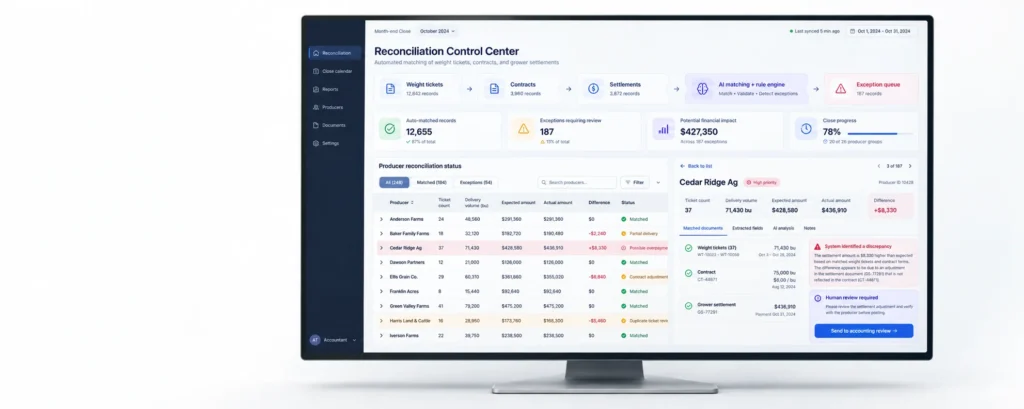
Integrate and manage all core aspects of your business in a single omnichannel solution, ensuring smooth operations across your enterprise. Devox can develop a system that centralizes production, supply chain, inventory, and order management data into one cohesive platform, enhancing decision-making and operational efficiency.
Manufacturing Software Development Services
-
ALIGN SOFTWARE TO OPERATIONS
Capture workflows from order to shipment and build MES/ERP/SCM/QMS extensions that mirror how lines actually run. Raise throughput and OEE while cutting scrap and changeover time.
-
CONNECT EVERYTHING ONCE
Link PLCs, scanners, robots, and enterprise apps through secure APIs and a Unified Namespace. Gain real-time traceability and instant master-data sync.
-
SHIP FEATURES WITHOUT DISRUPTION
Validate changes in a digital twin and release in staged, rollback-safe deployments with automated tests. Keep production online and shorten time-to-value.
Why Devox Software
Devox Software delivers US-based manufacturing software development services, engineering AI-native architectures that accelerate production cycles. We transition industrial operations toward predictive intelligence. By integrating multi-agent systems and unified namespace frameworks with core ERP and MES platforms, we guarantee real-time data synchronization across your factory floor. Our solutions secure operational continuity, optimize supply chains, and maximize asset utilization for modern industrial enterprises.
With engineering leadership and a solution architect in the lead, we help our customers figure out how they want to modernize their business: Do they want to integrate new components, carve out a new part of the operation, or replace a few key elements? Request a free manufacturing systems audit to identify the right way for your operations today, and gain a competitive advantage with our precise expertise and innovative AI Accelerator approach, which will save your resources by 30% to 50%.
Challenges We Overcome
- Modernize
- Build
- Innovate
Any risk to the line?
Production stays solid and on track across all our sites because we make sure to lock in the MES-ERP-SCADA connections upfront, and then we modernize in small bites.
Are ops flying blind?
We sort that out by putting clear ownership of data, and then we add in BI and AI, so everybody is looking at the same set of numbers.
Stuck in pilot mode?
We move from pilot to full-scale rollout by replicating validated processes across sites, guided by reference architectures, automated testing, and disciplined multi-site coordination.
Great tool, wrong system?
We design integration first: clear APIs, event flows, and data contracts that respect manufacturing systems and operations.
Built for one site?
We engineer our solutions to perform reliably across multi-plant, near-market, and regional manufacturing setups with well-governed configurations.
Five versions of truth?
We define a single, consistent production data model. That way, BI, analytics, and AI are all working with the same, trustworthy, production-grade metrics.
AI ready, data not?
Models learn from validated production signals because we stabilize the data layer first, aligning events, batch, and serial traceability.
Works in test, scary in ops?
We deploy through shadow mode, exception handling, and decision-support patterns, validating side-by-side with live workflows.
Does the model drift?
We build feedback loops between operators, systems, and models so AI can adapt to changing production routes.
Manufacturing Software Development Services We Provide
Manufacturing software covers a wide range of systems, each designed to support different operational needs. Based on your goals, Devox builds custom manufacturing solutions tailored to your operations.
-
Enterprise Resource Planning (ERP) Systems
-
Manufacturing Execution Systems (MES)
Gain real-time visibility into your manufacturing floor. We can design MES that tracks the entire production process, from raw materials to finished goods, ensuring that operations are efficient and compliant with industry standards. Monitor production metrics, improve workflow management, and maintain high-quality standards, all while reducing waste and minimizing downtime.
-
Supply Chain Management (SCM) Software
Optimize every stage of your supply chain, reducing operational cost and quickening delivery. We can build a custom SCM that enhances procurement, production, distribution, and logistics processes, allowing you to respond swiftly to market changes and customer demands.
-
Product Lifecycle Management (PLM) Software
We design PLM systems to manage the entire lifecycle of your products—from initial concept and engineering design to manufacturing and end-of-life. Our PLM solutions ensure seamless collaboration across teams, reduce time-to-market, and enhance product quality. By integrating design and manufacturing processes, we help you maintain competitive advantage through innovation and efficiency.
-
Inventory Management Systems
Inventory management software provides complete control over your stock levels, orders, sales, and deliveries. We will develop a custom system to help you reduce excess inventory, prevent stockouts, and optimize order fulfillment. With real-time inventory tracking, you can make informed decisions, improve customer satisfaction, and minimize operational costs.
-
Quality Management Systems (QMS)
QMS software ensures your products consistently meet industry standards and regulations. Our engineers will build systems that monitor quality at every production stage, from raw materials to finished goods. Facilitate continuous improvement, comply with regulatory requirements more easily, and reduce the risk of costly product recalls or defects.
-
Production Planning and Scheduling
Get all the necessary tools to optimize your production schedules and resource allocation. You’ll be able to plan and manage production workflows efficiently, ensuring that resources are utilized effectively and deadlines are met. Reduce the risk of human error and adapt quickly to changes in demand or production capacity.
-
MES & SCADA Integration
Build and integrate custom MES on top of the SCADA and control systems manufacturers already have (Siemens WinCC, GE iFIX, Wonderware, Ignition, and Tulip on the automation side; SAP MES, Oracle EAM, and IBM Maximo on the enterprise side) connected through OPC UA, MQTT, and ISA-95-aligned data models rather than proprietary point-to-point links that break every time a line changes. That matters because point-to-point integrations are exactly what turns a “simple” line change into a multi-week outage: every new sensor or PLC firmware update becomes a separate custom fix instead of a configuration change against a shared data model.
Typical scope includes:
- Work-order dispatch and real-time OEE (Overall Equipment Effectiveness) tracking
- Genealogy and batch/lot traceability for regulated industries
- Downtime and scrap capture wired directly into quality and maintenance systems, not a separate spreadsheet
- Multi-plant standardization onto a single MES data model, so a line manager in one plant and a corporate analyst looking at five plants are reading the same numbers
Deployment timelines for a full MES rollout typically run a few months to a year depending on plant count and legacy system condition, see our MES development page for a detailed breakdown of scope and process.
-
Predictive Maintenance & IIoT
Our predictive maintenance builds connect legacy and modern machines alike through OPC UA, MQTT 5.0, Modbus/TCP, PROFINET, and EtherNet/IP, streaming sensor data through Kafka or Apache NiFi into InfluxDB, with dashboards in Grafana or Power BI and forecasting models built on Spark Streaming or Flink. We favor explainable ML (SHAP, LIME, Integrated Gradients) over black-box scoring, because maintenance teams need to know why a model flagged an asset, not just that it did, a technician who doesn’t trust the “why” will override the alert, and the whole program loses value.
Predictions are wired directly into your existing CMMS, SAP, Oracle EAM, or IBM Maximo, so a flagged risk becomes a work order automatically instead of an email someone has to notice and act on manually. That integration step is where most in-house predictive maintenance pilots stall: the model works in a demo, but nobody built the path from “prediction” to “technician’s task list,” so the insight never reaches the floor. Full details, including our edge-to-cloud IIoT connectivity work, are on the predictive maintenance page and the edge-IIoT automation page.
-
Quality Control AI & Computer Vision
We build QMS platforms wired directly to live MES, IoT, and supplier data so quality holds and non-conformances are visible the moment they occur, plus computer vision models trained to catch subtle, high-variance, or rare defects that are difficult to spot by eye at line speed — and that don’t get fatigued on hour ten of a shift the way a human inspector does. Our quality engagements are built to align with the standards your customers or auditors actually require, ISO 9001:2015, IATF 16949 (automotive), ISO 13485 (medical device), AS9100D (aerospace), and IRIS (rail), plus the newer governance layer around AI itself (ISO/IEC 42001, GAMP 5, 21 CFR Part 11 where validated software is required), which matters increasingly as quality teams start putting AI models directly into inspection and audit workflows that regulators will eventually ask about.
See the QMS platform page and the computer vision quality control page for more.
-
Warehouse Management Systems (WMS)
Let us build the WMS solutions to optimize your warehouse operations. We’ll provide real-time inventory tracking, streamline picking and packing processes, and improve shipping accuracy. Reduce errors, speed up order fulfillment, and improve overall warehouse efficiency without additional effort but by design.
-
Maintenance Management Software
We build maintenance systems that connect equipment condition, service history, work orders, spare parts, and technician workflows. When maintenance needs to move beyond fixed schedules, our predictive maintenance system development uses machine and historical data to identify failure risks and help teams intervene earlier.
-
Human-Machine Interface (HMI) Software
Our HMI solutions provide intuitive interfaces for operators to interact with machines and control manufacturing processes. We design user-friendly HMI software that simplifies machine operation, enhances safety, and improves productivity. With clear, responsive interfaces, your operators can manage complex processes with ease and confidence.
-
Environmental Health and Safety (EHS) Systems
Ensure your manufacturing operations are safe, compliant, and environmentally responsible. We can tune up the solution to manage and track all aspects of health, safety, and environmental compliance, from incident reporting and risk assessments to audits and regulatory submissions. You’ll facilitate real-time monitoring of safety metrics, getting a chance to take proactive measures and maintain a culture of safety and sustainability in your warehouse or manufacturing facility.
-
Smart Factory Enablement
Build the Unified Namespace layer (OPC UA, MQTT/Sparkplug B, Modbus, PROFINET, EtherNet/IP) that makes cross-plant analytics possible in the first place, with a hardened, read-only extraction path from control systems and validated write-back only where closed-loop automation is explicitly required, so PLC logic stability isn’t put at risk just to get data out for a dashboard. For manufacturers running multiple plants on different control-system generations, this is usually the highest-leverage single project available, because every downstream initiative depends on this layer existing first. Read more on the smart factory enablement page.
-
Production and Workflow Monitoring and Automation Apps
We build applications that give operators and production teams real-time visibility into line status, bottlenecks, quality events, and workflow exceptions. These systems can become the operational layer for broader smart factory enablement, connecting plant data with analytics, automation, and faster decision-making.
-
ERP/MRP Modernization
We work with SAP S/4HANA Cloud, Microsoft Dynamics 365 Finance & SCM, NetSuite, Siemens Opcenter, Plex, Epicor Kinetic, Infor CSI, and AVEVA, integrated through MuleSoft, Boomi, or Azure Integration Services so that scheduling, quality, and maintenance data move in sync rather than requiring nightly batch reconciliation that leaves planners working off numbers that are already twelve hours stale. Modernization here doesn’t have to mean a full platform migration.
On the supply chain side, cloud-native SCM gives mid-sized manufacturers AI-driven demand forecasting and dynamic routing, which supports leaner inventory without risking stockouts on critical raw materials, a particularly live concern for manufacturers managing tariff exposure or reshoring production and needing supply chain software that can replan quickly when a sourcing assumption changes. Full scope is on the MES/ERP modernization page.
Benefits of Our Manufacturing Software Development
At Devox, we believe manufacturing software delivers the most value when it is built around a company’s specific operations. Why so? Let’s get into it.
-
Your Enterprise’s Needs Exclusively
Solve operational challenges with software built around your processes, with every feature designed to support the way your business runs. Unlike off-the-shelf solutions, custom software is built to fit your exact specifications, ensuring that every feature and function align perfectly with your business goals.
-
Complete Technical Excellence
Manufacturing software must support data management, security, quality control, and regulatory compliance. Custom development helps you optimize production performance, protect sensitive data, and maintain consistent quality standards.
-
Seamless Adaptability, Easy Integration
Custom manufacturing software offers seamless adaptability by integrating effortlessly with your existing systems and scaling alongside your business growth. This ensures smooth data flow, eliminates silos, and keeps your operations agile and responsive to industry changes, all while maintaining efficiency and minimizing errors.
-
Maximize the Return on Your Investment
While the initial investment in custom software may be higher than purchasing off-the-shelf solutions, the long-term benefits often outweigh the costs. Custom software reduces inefficiencies, minimizes downtime, and enhances productivity, leading to significant cost savings over time.
-
Competitive Advantage
Enhance your unique strengths with the power of customization Devox can grant in terms of tailored development. Custom manufacturing software helps you strengthen your competitive edge and respond to market changes faster.
Modernizing an App’s Legacy Infrastructure for an Insurance Company
Devox Software modernized a U.S. insurance company’s legacy infrastructure, migrating to AWS and Azure, automating workflows, and enabling secure, scalable growth for over 2 million users.
Additional Info
- AWS
- Azure
- Kubernetes
- ECS
- Terraform
- Vault
- Flux
- Datadog
- Wiz
- Grafana
USA
How the U.S. Wealth Management Firm Built Secure RAG for Sensitive Client Data
Devox Software helped a U.S. wealth management firm build a secure RAG system for working with sensitive financial data while preserving access controls and source traceability.
Additional Info
- Python
- FastAPI
- Azure OpenAI
- LangChain
- PostgreSQL
- Microsoft Entra ID
- OAuth 2.0 / OIDC
- Docker
USA

MVP 1.0 in Production as ERP Rebuild for a U.S. Construction Company.
From tech dating back to the 90s, the US-based construction company has leaped to a comprehensive ERP platform automating and streamlining all internal workflows.
Additional Info
- Java Spring Boot
- React
USA
Testimonials
Our Experts' Insights
FAQ
-
What Is Manufacturing Software Development?
Manufacturing software development covers the systems that plan, run, monitor, and improve production. This includes MES, ERP and SCM extensions, SCADA integrations, maintenance platforms, quality systems, industrial data infrastructure, and plant analytics.

When existing applications or integrations have become difficult to change, our broader legacy modernization services address the underlying code, architecture, infrastructure, and delivery risks while keeping critical operations running.
- The manufacturing software stack has layers: SCADA controls equipment, MES manages production execution, ERP manages the business.
- Unplanned downtime is the cost baseline every manufacturing system is judged agains.
- Plant-safe delivery means staged rollouts, parallel runs, and zero line-stopping cutovers.
- Typical engagements: integrations from $40K; custom MES modules $100K–$400K (confirm with sales).
-
Who remains complete ownership of a modernized, AI-ready architecture?
We deliver complete ownership of a modernized, AI-ready architecture. Your team receives fully documented source code, proprietary predictive analytics models, and an integrated Unified Namespace infrastructure. We conduct comprehensive knowledge-transfer sessions, empowering your engineers to operate, scale, and maximize the value of your new digital ecosystem independently.
-
Which ERP, MES, and controls stacks have you worked with hands-on, and where did you own the integration end-to-end?
First, we look for a reliable operational foundation: time-series data that’s properly timestamped, consistently measured, and tagged with stable names that don’t change week to week. We also need a clear picture of your factory’s hierarchy, with sites, areas, lines, and machines all neatly mapped out and linked to your work centers. We also need identifiers that link everything across systems — order IDs, material IDs, and batch or serial numbers where applicable. On top of that stable base, we need a few key events that give us a glimpse of what’s really going on on the shop floor — state changes, orders starting and stopping, materials held back for not meeting specs, or scrapped and reworked — all of it. And a bit of context to help explain why things are varying in the first place: recipes, routing steps, tooling, shift changes, and environmental factors when they come into play. Once all that is in place, analytics become far more reliable, since every KPI traces back to the same events and consistent definitions.
As for AI, that comes down to how easy it is to get the data into a state where the models can actually learn from it. That means linking key outcomes (defect types, yield loss, downtime categories) to the exact conditions that caused them — at the right level of detail, whether that’s a machine cycle, operation, batch, or order. We also need to be able to check on the quality of the data, and make sure the models are staying on top of any changes that come up (like new recipes, new materials, or equipment going down). This gives you a path from trusted reporting that makes sense to automation that does too — explainable features, audit trails that work, and monitoring that tells you when the models need a refresh rather than when the process itself needs tweaking.
-
What data do you need on day one for analytics and AI to deliver real operational value?
We don’t need perfectly clean data to get started — that comes later. What we focus on first are key performance indicators that show what happened and why — such as spikes in scrap rates or production line downtime, along with the conditions that led to them.
For AI, the main enabler is label-ready historical data with lineage:
- outcomes such as defects,
- yield loss,
- unplanned downtime,
- late orders,
- or maintenance results, tied to when they occurred and linked to the conditions that preceded them at the right granularity.
If timestamps don’t align or event ownership isn’t clear, even the most polished analytics will fail to earn operators’ and engineers’ trust. They just won’t have any trust in it whatsoever. And right from the start, we also need to get some visibility into the stability of the process: are sensors drifting off or is some calibration or process change causing problems, and if so, what? We need to be able to spot all that so our models don’t get quietly degrading as the plant evolves. Once that foundation is in place, scaling becomes a natural progression — not a risky leap.
-
At the end of the engagement, what exactly do we walk away with?
That includes a clear architectural vision, a blueprint for how components interact, and fully functional interfaces each with version control, ownership, and governance rules to keep future changes in check. Every interface is backed up by automated tests to check its performance and integration, which run automatically as part of your build and deployment pipeline, as well as a reliable procedure for deploying updates and rolling them back if needed. This ensures deployments behave consistently across all environments.
One way or another, you get assurance that things are getting done right — in the form of measurable milestones and operational responsibility. Each slice comes with clear success criteria, traceability from business goals to performance indicators, and defined Service Level Objectives for availability, response time, and data freshness — all configured in the monitoring system from day one. Your team will be fully equipped to run, troubleshoot, and expand the platform as it grows into new areas.
-
What security protocols protect industrial control systems (ICS) during cloud migration?
We treat your operational data as your most valuable asset. During cloud transitions, we architect robust Zero Trust environments and implement strict network segmentation between your IT and OT networks. By enforcing end-to-end encryption and role-based access controls, we maintain the absolute integrity of your intellectual property and guarantee continuous compliance with stringent industrial cybersecurity standards.
-
How do cloud-based supply chain management (SCM) systems benefit mid-sized manufacturers?
Cloud-native SCM platforms provide mid-sized manufacturers with the logistical agility of industry giants. We design these systems to process global supply variables instantly. By incorporating AI-driven demand forecasting and dynamic routing, these platforms empower your procurement teams to maintain lean inventories while ensuring raw materials arrive exactly when your production lines require them.
-
Which technologies ensure seamless integration between ERP and shop floor machines?
We bridge the physical and digital domains utilizing a Unified Namespace (UNS) architecture. Our engineers deploy lightweight edge nodes and industrial communication protocols like OPC UA and MQTT. This setup creates a central hub where all data streams converge securely. This guarantees your operations managers and floor technicians always share the exact same real-time insights to drive production forward.
-
How does AI integration enhance predictive maintenance in manufacturing?
Think of AI as giving your maintenance team advanced foresight. Moving beyond rigid service schedules, we deploy machine learning models that analyze thermal, acoustic, and vibration telemetry in real-time. This intelligence accurately predicts the Remaining Useful Life (RUL) of your critical components. By scheduling maintenance precisely when components require attention, we maximize your asset utilization and keep your production lines running continuously.
-
What is the timeline for modernizing legacy manufacturing software?
The timeline depends on the number of systems involved, the condition of the codebase, and how tightly the software is connected to live production. We usually begin with a focused assessment, then modernize in controlled increments around the plant’s operating schedule.
Our approach to AI-powered software modernization for manufacturing uses AI-assisted analysis and test generation to support engineers as they uncover dependencies, protect existing behavior, and prepare smaller production-safe releases. Early improvements can often reach production within the first few months, while larger multi-system programs continue in phases.
-
How do custom Manufacturing Execution Systems (MES) improve factory floor efficiency?
Every factory floor operates with its own unique rhythm. A custom MES respects that rhythm while elevating it. We engineer these systems to act as the central nervous system of your facility, translating high-level ERP goals directly into floor-level actions. By capturing live machine data, a custom MES empowers your operators to maximize Overall Equipment Effectiveness (OEE), instantly adapt scheduling, and guarantee consistent product quality across every shift.
-
How much does it cost to deploy production-ready Generative AI in 2026 without risking enterprise data leakage?
The biggest productivity losses in modern manufacturing don’t happen inside your core software—they happen in the blind spots between your systems.
Most industrial enterprises already have mature tools running their floor and their back office: an ERP for finance, an MES for routing, and SCADA monitoring the machines. The real operational bottleneck is data silos. When these layers can’t talk to each other in real time, you lose end-to-end traceability, accurate OEE (Overall Equipment Effectiveness) tracking, and predictive maintenance capabilities.
Attempting to rip and replace these mission-critical systems is a multi-million dollar gamble that risks production downtime. Instead, successful plant digitalization relies on connecting the ISA-95 automation stack seamlessly.
Here is how the core manufacturing layers divide responsibilities—and the exact operational questions each one answers:
System Layer What it does Typical buyer question it answers SCADA Control (Level 2) Monitors and controls equipment in real time What is happening on the line right now? MES Execution (Level 3) Manages orders, routing, traceability, OEE What should each line produce, and did it? ERP Business (Level 4) Planning, inventory, finance, orders What should the plant produce this month? CMMS Maintenance Work orders, spares, maintenance schedules What needs fixing, and when? Historian / UNS Data Time-series storage and unified data namespace One source of truth for all plant data Custom development usually lives in the gaps between these systems – integrations, traceability across layers, and analytics that no single vendor covers. That is where we work: connecting the stack without replacing what already runs the plant.
-
Why Devox Software vs. in-house team or another vendor?
The table below is meant to make that comparison concrete rather than asking you to take our word for where we fit.
In-house team Generalist software vendor Devox Software OT/IT domain depth Deep on your plant, but stretched thin across every new initiative Ships fast, but usually learns ISA-95, OPC UA, and SCADA vendor quirks on your dime Comes in already fluent in the stacks manufacturers run: SAP, Siemens, Ignition, Rockwell-based controls Security posture for ICS Depends on internal maturity Varies widely, rarely audited ISO 9001 / ISO 27001 aligned, Zero Trust and IT/OT segmentation built into delivery Risk to live production Low institutional risk, but slower and resource-constrained Higher Staged, rollback-safe releases validated in a digital twin before touching a line Time to first value Slowed by competing internal priorities Fast start, but integration debt often surfaces later Assessment-first scoping means early wins typically land within months, not a full replatform cycle What you own at the end Whatever institutional knowledge stays with the team Varies by contract Documented source code, architecture, tests, and defined SLAs The honest tradeoff: an in-house team knows your plant better than anyone on day one, and a generalist vendor can be cheaper for a narrowly scoped project that doesn’t touch operational technology. Devox Software is the right fit specifically when the initiative touches OT and IT at the same time.
-
How long does SCADA-to-MES or SCADA-to-cloud integration take?
Afocused integration project typically takes a few months; a full MES or Unified Namespace rollout across multiple plants can run six to twelve months. Timelines depend most on legacy system condition and how many control-layer variants you’re standardizing across, a single modern SCADA vendor across all plants moves much faster than five plants on five different generations of controls.
Want to Achieve Your Goals? Book Your Call Now!
We Fix, Transform, and Skyrocket Your Software.
Tell us where your system needs help — we’ll show you how to move forward with clarity and speed. From architecture to launch — we’re your engineering partner.
Book your free consultation. We’ll help you move faster, and smarter.
Let's Discuss Your Project!
Share the details of your project – like scope or business challenges. Our team will carefully study them and then we’ll figure out the next move together.
Thank You for Contacting Us!
We appreciate you reaching out. Your message has been received, and a member of our team will get back to you within 24 hours.
In the meantime, feel free to follow our social.
Thank You for Subscribing!
Welcome to the Devox Software community! We're excited to have you on board. You'll now receive the latest industry insights, company news, and exclusive updates straight to your inbox.