From tech dating back to the 90s, the US-based construction company has leaped to a comprehensive ERP platform automating and streamlining all internal workflows.

About the client
A US-based construction company with more than 20 years of experience and enterprise-level clients, partnered with Devox Software to modernize its proprietary ERP ecosystem.
About
the Product:
The original platform dated back to 1998 and consisted of disconnected legacy components, including a corporate web portal and heavily customized internal tools based on legacy technologies like Delphi, FoxPro, Visual Basic, WinForms, or early .NET desktop architectures.
Over time, the system became increasingly difficult to maintain, impossible to scale efficiently, and unable to support modern automation, integrations, or mobile workflows.
To support continued growth, the client needed a full-scale enterprise ERP modernization initiative capable of consolidating multiple business-critical workflows into a single scalable platform.
As a result of complex manufacturing ERP modernization, Devox Software rebuilt the ERP platform using Java Spring Boot and React. We delivered a modern enterprise-grade system accessible across desktop and tablet devices. The modernization program lasted 3.5 years and prepared the client for future automation and AI-powered predictive analytics capabilities.
The new ERP ecosystem unified previously fragmented operational workflows into one centralized platform, including:
Project
Team:
The full team included 2 back-end developers, 1 front-end developer, 1 QA engineer, a part-time project manager, and a part-time business analyst.
Challenges:
“One of the biggest challenges was that there were almost no formal requirements or documentation. We had to reverse-engineer the old system first, understand how the workflows operated, and only then start rebuilding them,” said Kateryna Yakubovska, Head of Development at Devox Software.
The client’s environment introduced multiple modernization challenges typical for complex enterprise ERP migration projects:
Tech
Stack:
To support the long-term results of this complex manufacturing ERP modernization, the platform was rebuilt using Java Spring Boot and React.
Java Spring Boot was selected for scalable backend architecture, enterprise-level API development, strong security and integration capabilities, and reliable performance under growing operational workloads, which are especially important for manufacturing companies.
React, in its turn, enabled responsive user experiences across desktop and tablet devices for improved usability for field and office employees, a modular front-end architecture, and easier future feature expansion.
This technology combination is perfect for manufacturing ERP and custom development, allowing clients to move from rigid legacy workflows to a flexible enterprise-grade ERP ecosystem.
Solution:
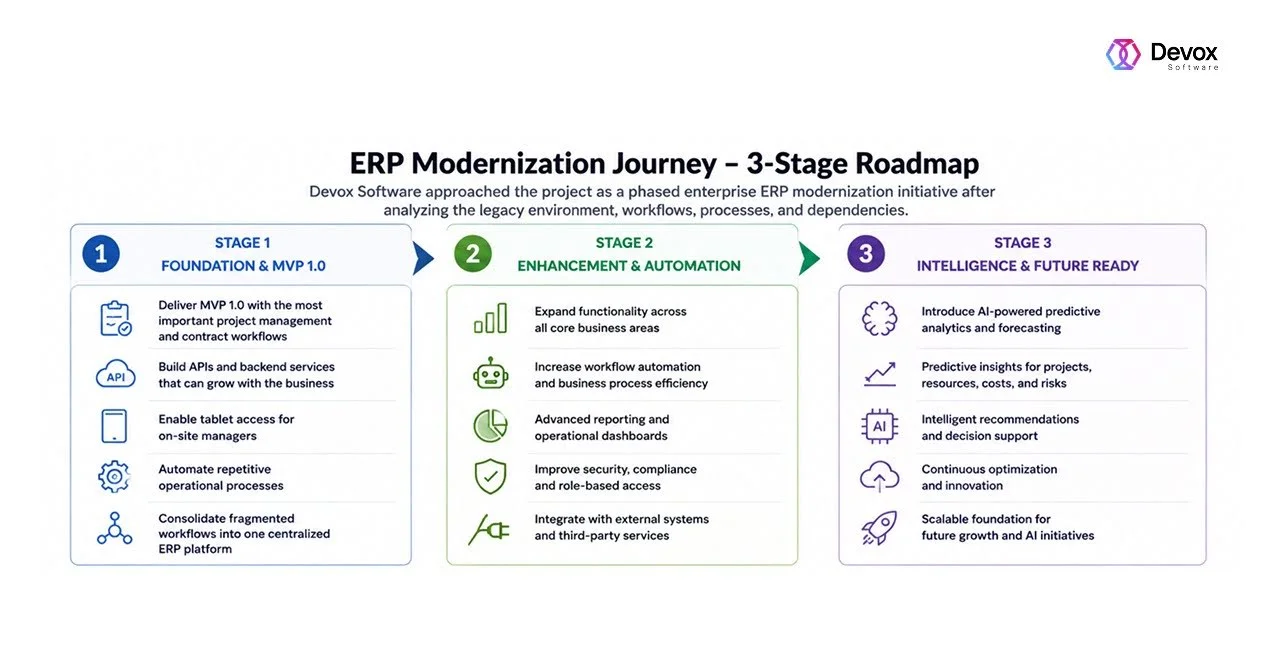 Devox Software approached the project as a phased enterprise ERP modernization initiative. We divided the projects into 3 stages after the team had analyzed the legacy environment, workflows, processes, and dependencies.
The first modernization phase focused on:
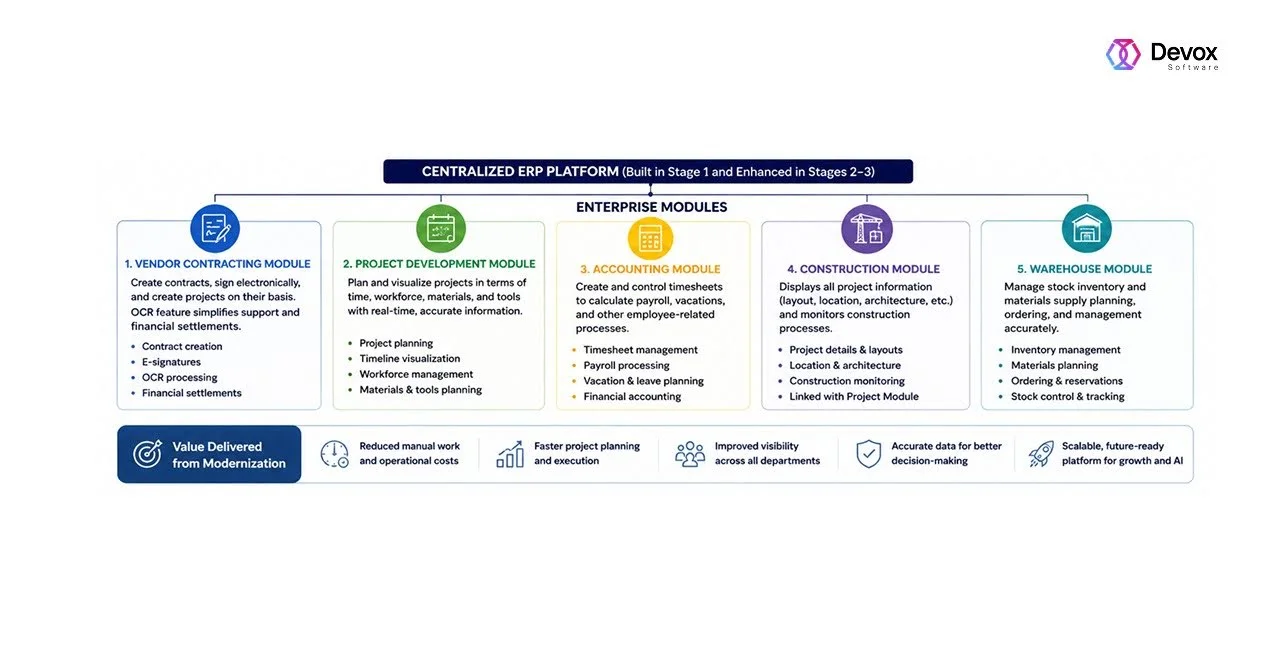
In general, the rebuilt system included several enterprise modules:
Results:
Following Phase One on legacy migration services, the client successfully deployed MVP 1.0 into production, a 1998 to 2025 27-year leap, phase 1 of 3. Key business outcomes included the following:
The legacy modernization initiative transformed a fragmented legacy ERP environment into a scalable enterprise platform capable of supporting long-term business growth and digital transformation.
Sum Up:

| Area | Before Modernization | After Modernization |
| ERP Architecture | Proprietary ERP ecosystem dating back to 1998, with fragmented desktop software and legacy web portals | Unified enterprise ERP platform rebuilt with Java Spring Boot and React |
| Core Technology Approach | Monolithic legacy environment with tightly coupled business logic and undocumented dependencies | Modular, scalable web-based architecture with centralized APIs and modern frontend framework |
| User Experience | Multiple disconnected systems requiring manual switching between tools | Single centralized platform accessible from desktop and tablet devices |
| Workflow Management | Manual operational workflows across contracts, accounting, warehouse, and construction management | Automated workflows with centralized process orchestration |
| Contract Management | Paper-heavy or semi-manual contract handling processes | Digital vendor contracting with e-signatures and OCR-assisted processing |
| Project Planning | Fragmented project coordination with limited real-time visibility | Real-time project visualization across workforce, materials, timelines, and tools |
| Payroll & Accounting | Separate payroll, bookkeeping, vacation tracking, and timesheet processes | Unified accounting and HR workflows inside one ERP ecosystem |
| Warehouse & Supply Coordination | Manual inventory tracking and disconnected materials management | Centralized warehouse, supply planning, reservations, and stock visibility |
This ERP software development project particularly shows how Devox Software helps long-established businesses get beyond the problems that come with using old proprietary systems. We’ve helped the client with the legacy modernization, enabling them to cut their operational costs, support growth, and get ready for long-term digital transformation.
The next stop is the implementation of AI for intelligent services.
Tell us where your system needs help — we’ll show you how to move forward with clarity and speed. From architecture to launch — we’re your engineering partner.
Book your free consultation. We’ll help you move faster, and smarter.
Share the details of your project – like scope or business challenges. Our team will carefully study them and then we’ll figure out the next move together.
We appreciate you reaching out. Your message has been received, and a member of our team will get back to you within 24 hours.
In the meantime, feel free to follow our social.
Welcome to the Devox Software community! We're excited to have you on board. You'll now receive the latest industry insights, company news, and exclusive updates straight to your inbox.