An agentic reconciliation layer automated matching across weight tickets, contracts, and settlement records, cut manual effort by ~70%, and kept deterministic payout calculations within the client’s existing accounting environment.
About the client
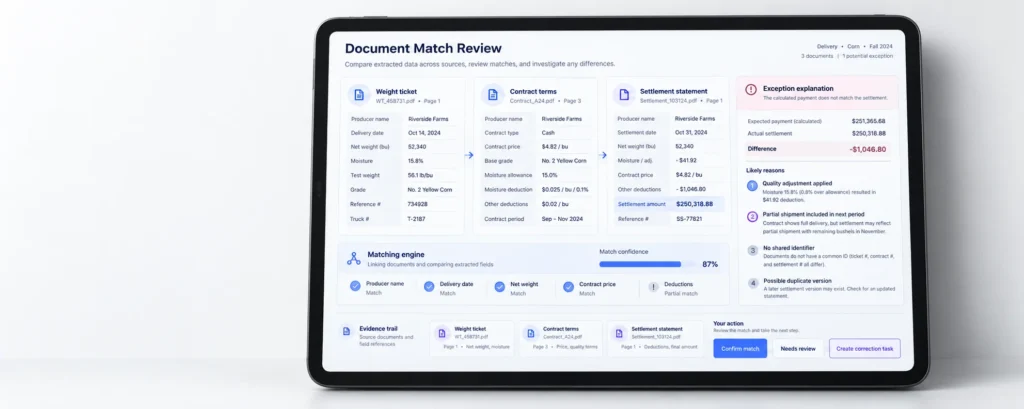
Our client is a mid-market agribusiness that manages financial settlements with agricultural producers. Its finance team reconciles three core sources during monthly close: weight tickets, contracts, and settlement records. Each source reflects a different part of the transaction, so the team must connect them before confirming the final payout. The company wanted to automate this process while keeping its existing accounting environment in place and staying within a limited implementation budget.
Background:
For the Controller, reconciliation had become one of the most time-consuming parts of the monthly close.
One or two employees spent a significant share of the monthly close checking which deliveries belonged to each contract, which quantities had already been settled, and whether the final payout followed the applicable terms. A single contract could cover several deliveries. Settlements could span multiple periods. Adjustments could change the billable quantity or final amount.
The difficulty was distinguishing genuine financial discrepancies from differences caused by valid contract terms, partial settlements, or timing across accounting periods.
The Trigger:
As the workload grew, the Controller needed a faster way to reach verified totals within closing deadlines. The request was straightforward: “identify the discrepancies automatically.”
The Solution:
The architecture separated probabilistic document interpretation from deterministic financial execution. LLM components handled document understanding, ambiguous matching, and explanation generation, while application services executed settlement rules, monetary calculations, validation, and persistence.
The Outcomes:
The clearest outcome was a shift from record-by-record reconciliation to an exception-based review process. Routine matches could move through the workflow automatically, while the Controller’s team focused on cases with genuine financial or documentation-related uncertainty.
Conclusion:
For the Controller, the project’s value came down to control during the monthly close. The system gave the finance team a structured way to connect deliveries with contract terms and settlement records, calculate expected payouts consistently, and investigate only the cases that required judgment.
If your finance team still reconciles deliveries, contracts, and settlements by hand, we can map your matching rules and build a reconciliation layer around your current accounting system.
Tell us where your system needs help — we’ll show you how to move forward with clarity and speed. From architecture to launch — we’re your engineering partner.
Book your free consultation. We’ll help you move faster, and smarter.
Share the details of your project – like scope or business challenges. Our team will carefully study them and then we’ll figure out the next move together.
We appreciate you reaching out. Your message has been received, and a member of our team will get back to you within 24 hours.
In the meantime, feel free to follow our social.
Welcome to the Devox Software community! We're excited to have you on board. You'll now receive the latest industry insights, company news, and exclusive updates straight to your inbox.