


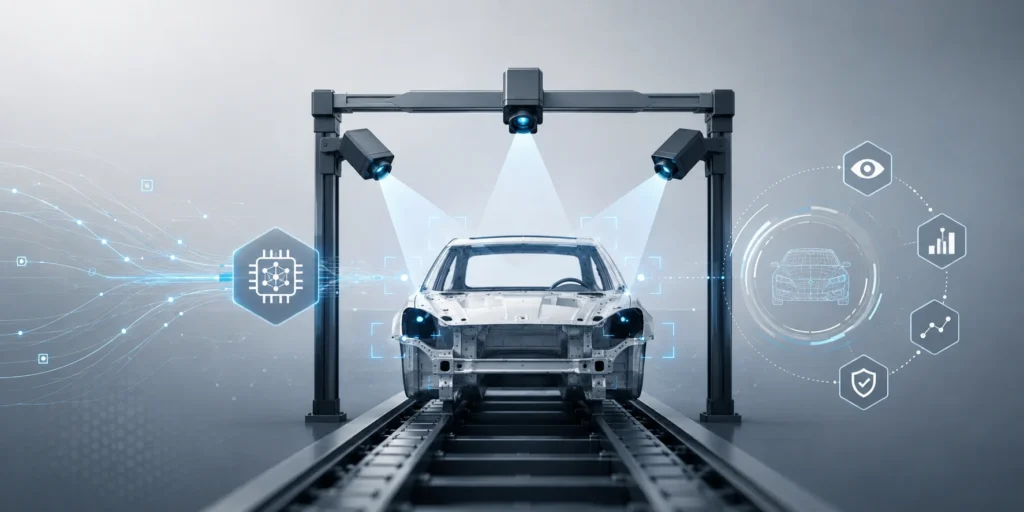
An AI-powered visual inspection system for a Tier-One automotive supplier that enables real-time deviation detection and automated root-cause investigations to reduce scrap and improve process containment.
About the client
Background:
An American Tier-One automotive supplier ran a critical product line at tens of thousands of units per shift, where a single line stop carried six-figure exposure.
The company already had cameras, MES, and telemetry. The data was there, but it reached the quality team too late and in separate systems. By the time someone connected a visual defect to a process change, the line had often produced hundreds more parts.
The company needed a smart system that could catch the deviation, work out what to check next, and pull in any additional data needed to build the first investigation before the operator saw the alert.
For the business, the win meant fewer escapes and faster containment. For the operator, it came down to one practical question: can I see what changed early enough to do something useful during the shift? The alert had to arrive with the first investigation already done. If the answer was not in the image alone, the agent pulled the missing production context before the operator saw it.
The Trigger:
The trigger came from the pressure every automotive supplier knows. OEM expectations kept getting tighter. Critical components moved toward sub-10 PPM targets. Sampling caught problems too late. The team needed to obtain the data earlier and establish a clearer path from the signal to the cause.
The Obstacles:
The first obstacle was trust. After a tool change or a new material batch, the model could get louder, and false alerts made people question the whole system. That noise was expected, not a fault: a short re-validation cycle ran on purpose, and until the new thresholds were confirmed the extra alerts were normal, and the system said as much. Trust came back once the system could, through agentic AI, point to the threshold version and the evidence behind each call.
The team also had to be honest about autonomy. A process correction touches customer obligations, safety rules, and quality ownership. The plant wanted AI that helped people make better calls. The agent could investigate on its own, but it could not change the process on its own. Operators and quality engineers still owned every production decision.
Security shaped the path too. Production images and process parameters had to stay inside the client’s controlled environment. Any solution that moved sensitive production data outside that boundary created friction before the pilot could even start.
Team:
The Approach:
Devox Software came in as an engineering partner. They started with the line, where decisions happened, which screens people trusted, who could change the rules, and what an operator actually did when an alert hit at line speed.
The approach stayed pragmatic and engineering-first:
Engineers still controlled the architecture and the boundaries around it. That is the Devox Software philosophy: use AI where it measurably pays off, and keep every decision that defines the system human-owned.
Technologies:
Python • PyTorch • OpenCV • ONNX Runtime • Docker • Kubernetes • PostgreSQL • Redis • MQTT • OPC UA • REST APIs • Edge AI • Computer Vision • MLOps
The Journey:
The first live deployment ran on one line. Once its thresholds and investigation paths were held under production conditions, the team adapted the system to the second line. The plant team and Devox followed the path of a part through production and looked at the moments where quality risk entered the process.
That walk-through showed where sampling created blind spots and where existing camera views could become useful earlier in the shift. Discovery also captured the OEM SLA and the plant’s current sampling regime, giving the team a baseline for detection time, coverage, and acceptable response.
Telemetry, MES, and QMS had lived in disjointed systems with different owners. They were pulled into one loop, and each source got a named owner, so it was always clear who stood behind the data.
Each manufactured unit received its own ID, which connected the part to the process values active at the moment it was made. Threshold changes were logged with date, author, and reason, so a quality engineer could later replay any verdict with the exact rules the operator saw on the shift. Every classification and every causal link the system proposed was logged, creating a complete path from the original frame to the operator’s decision.
The model classified each unit as normal or deviating and identified the deviation type within the line’s takt time. Each verdict retained the source frame or its hash, together with the model and threshold versions in force at that moment.
A deviation started an investigation rather than ending with a flag. The agent chose what to check next based on the evidence in front of it.
If the image suggested tool wear, it pulled the tool history and looked for similar patterns from earlier runs. If the signal pointed elsewhere, it followed a different path. Each investigation stayed inside the systems and data sources approved by the client.
Instead of showing a bare defect flag, the agent built the first version of the investigation before the operator opened the alert. It checked the production context, followed the strongest signal, and pulled the evidence that supported its conclusion.
The operator saw the affected part, the probable cause, and the first place worth checking. That made the response faster and reduced the guesswork around each alert.
Overall, the solution was built as one controlled loop: a governed data layer, computer vision on the existing cameras, causal analysis, and an advisory interface for the operator, all running inside an enterprise harness. Both training and inference stayed inside the client’s controlled environment. Production frames and process parameters never left that boundary.
The Change:
The shift was visible on the floor. The team moved from waiting on delayed sampling feedback to seeing every unit on the selected line in real time. Drift surfaced within minutes, and the conversation changed from “how much did we miss?” to “what do we do now?” By the time an operator saw the alert, the first investigation steps had already been completed.
The harness blocked access to process set-points and line-stop controls. The system could investigate and advise, while every production change still required human approval. Operators stopped second-guessing the alerts and started acting on them, as the system turned each unit’s data into a clear pass/deviation call on the spot. Better context gave operators confidence and kept them in control.
Outcomes:
7-12 months was the expected payback window, with estimated annual savings of $350K-$1.2M across one or two lines from lower scrap, rework, and avoided OEM claims.
Customer
Voice:
“They paid close attention to both lines to understand how the line actually worked before they built anything and it saved us a lot of back-and-forth later. By the time we rolled it out, a new system fit the way we work instead of forcing us to work around it.”
Thinking about AI inspection? Start by finding out whether your production line is ready for it. Devox Software helps manufacturers connect production data, identify where quality drift begins, and design an AI inspection system that works with the way the line already runs.
Tell us where your system needs help — we’ll show you how to move forward with clarity and speed. From architecture to launch — we’re your engineering partner.
Book your free consultation. We’ll help you move faster, and smarter.
Share the details of your project – like scope or business challenges. Our team will carefully study them and then we’ll figure out the next move together.
We appreciate you reaching out. Your message has been received, and a member of our team will get back to you within 24 hours.
In the meantime, feel free to follow our social.
Welcome to the Devox Software community! We're excited to have you on board. You'll now receive the latest industry insights, company news, and exclusive updates straight to your inbox.


