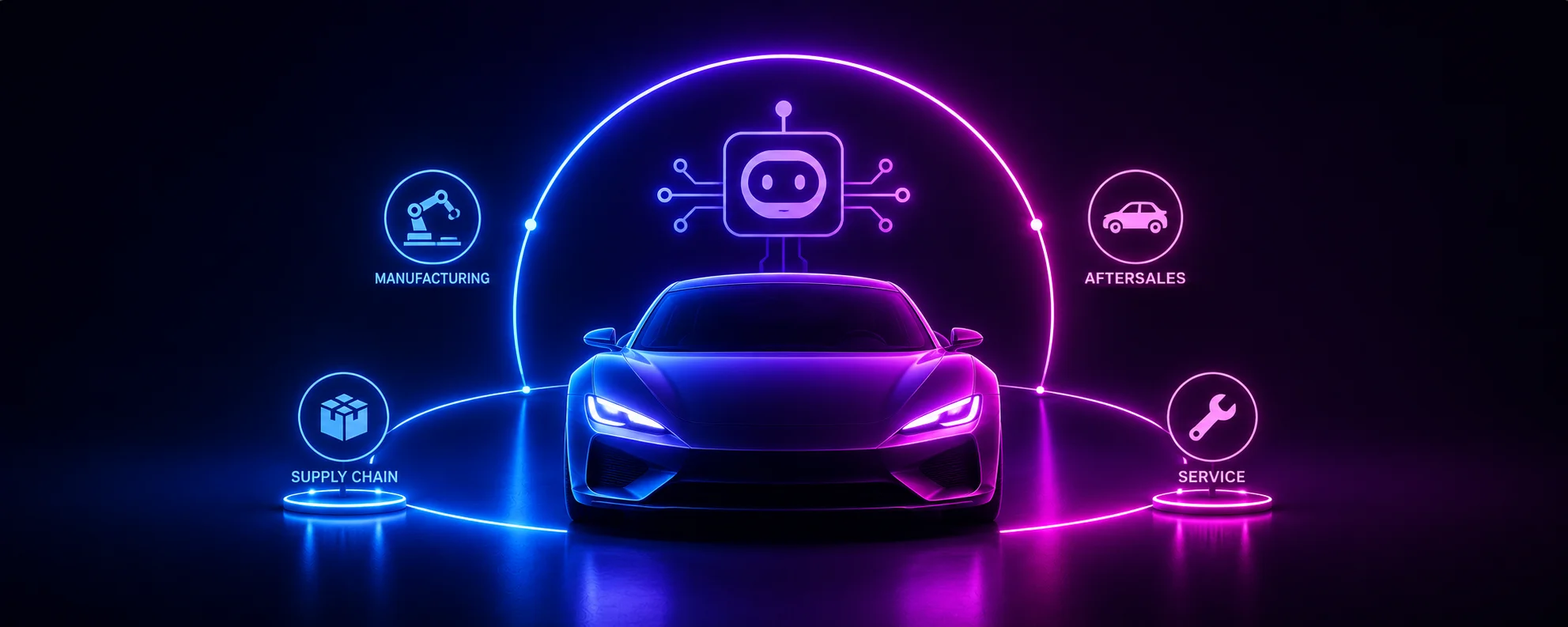
A shortage appears in Tier-3 at 06:12. The build slot is still locked at 09:00. The quality hold is in MES. The dealer already promised Friday. That gap is the product. In 2026, an automotive AI agent is a bounded worker across the plant, supply chain, dealer, and VIN. The SDV stack already emits the signals. The agent earns a write token only when shortage becomes a new slot, a hold becomes a frozen shipment, and telemetry becomes a bay.
The Shift: From Answering Questions to Moving Work
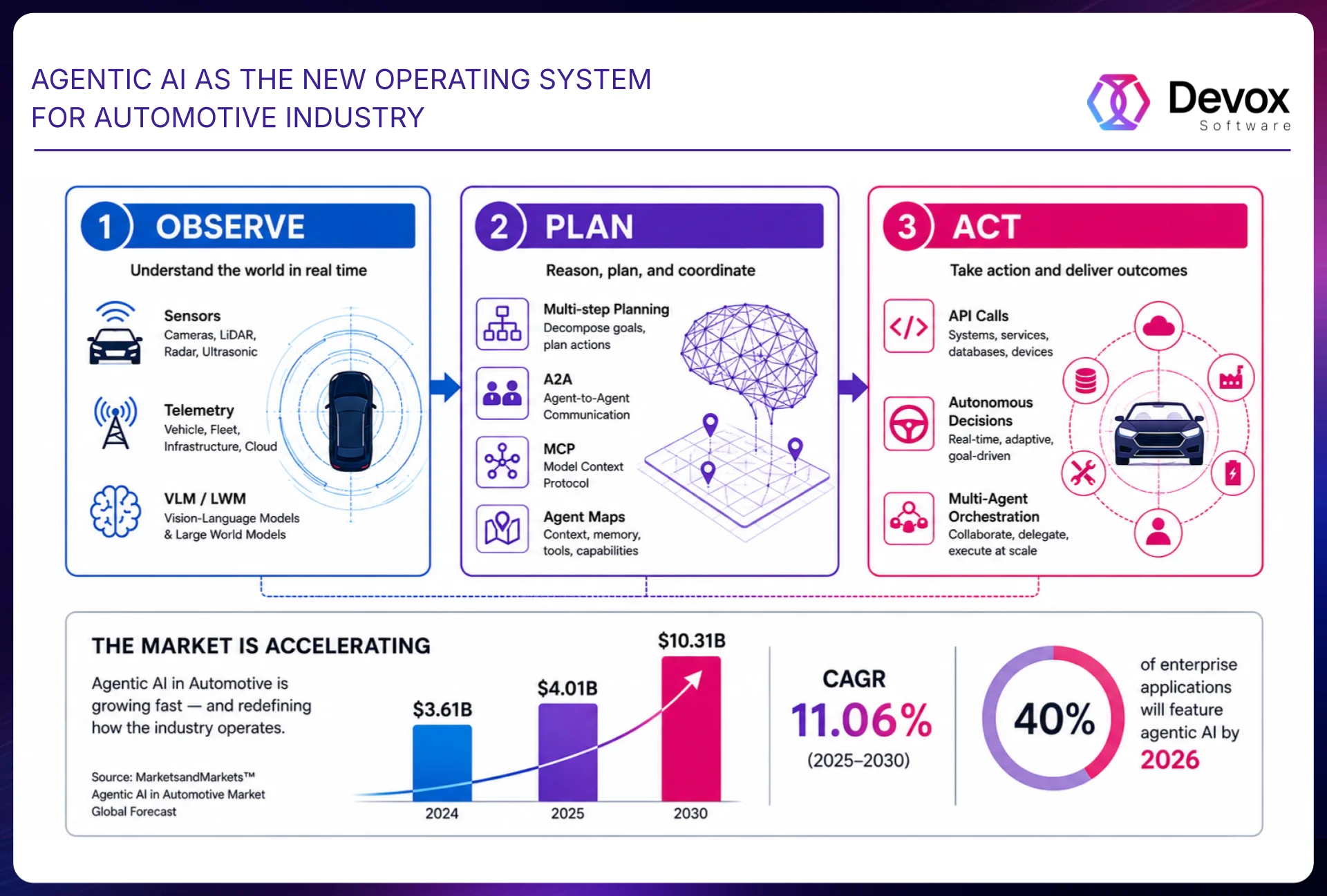
The 2026 shift is execution. Gartner’s April 2026 SCM forecast puts software with agentic capabilities at under $2 billion in 2025 and $53 billion by 2030. Adoption among enterprises that already buy SCM software moves from 5% in 2025 to 60% in 2030. Simple task agents take most of that spend first; multi-step agents follow. Gartner also predicts that 50% of cross-functional SCM solutions will use intelligent agents to autonomously execute decisions by 2030.
McKinsey puts a higher number on the opportunity. For automotive and other advanced industries, agentic AI could generate $450 billion to $650 billion in incremental annual revenue by 2030, equal to a 5-10% revenue uplift, with cost savings of 30-50% through workflow automation and streamlined operations. Treat this as an industry pool from McKinsey’s 2025 advanced-industries work. Score your own P&L on cycle time, OTIF, warranty, and unplanned downtime.
At the same time, the rapid expansion of AI agents across the U.S. market demands rigorous validation to separate genuine operating layers from superficial ‘agent washing’. In practical automotive terms, authentic systems independently resolve supply constraints, carrier exceptions, and dealer claims. Complex automotive environments immediately reveal a software’s true capacity, demanding absolute precision beyond what impressive demos can deliver. The ultimate benchmark requires the agent to execute bounded workflows across unified enterprise ecosystems, spanning manufacturing, logistics, and dealership platforms.
Inside the Automotive Plant
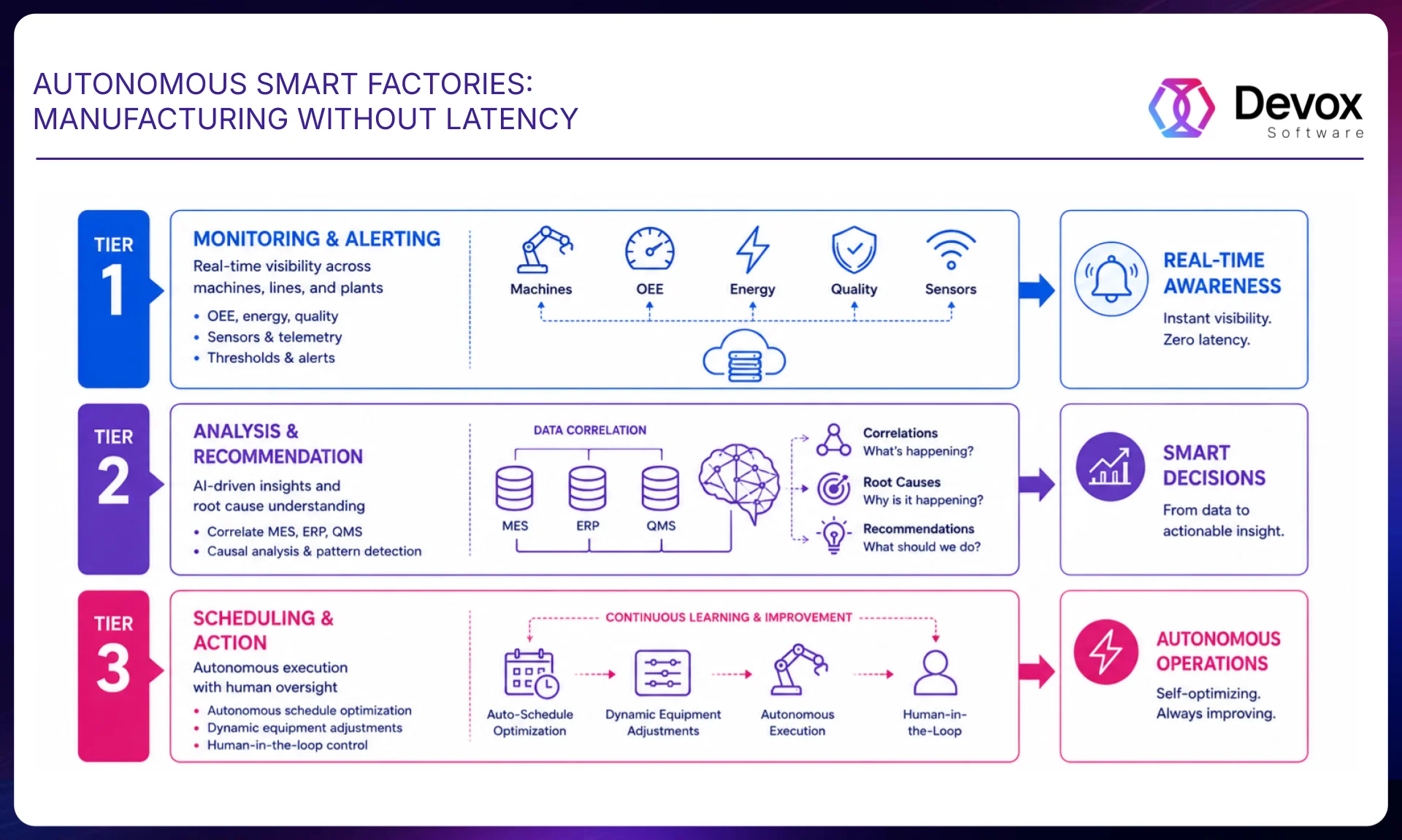
In manufacturing plants, real value occurs when an agent connects production telemetry directly to a correction strategy the moment a deviation is detected. Systems that execute maintenance or process adjustments with minimal latency improve performance.
The Real Value of Speed
Autonomy is the wrong headline. The product is Policy-as-Code: a signed envelope for reorder, maintenance dispatch, and sequence change, plus a hard stop that opens a ticket when confidence or risk crosses the line. That envelope is what moves a demo onto a live line.
An assembly plant already has the signals. Using AI agents for automotive manufacturing and comprehensive production telemetry all provide part of the same picture. The hard part is getting from signal to dispatch before the line incurs a delay penalty.
Market Outlook
IDC’s Manufacturing FutureScape 2026 put a marker on this year: more than 40% of manufacturers that already run a production scheduler were expected to add AI so the plan can start moving on its own. The 2028 marker is larger: 65% of G1000 manufacturers using agents with design and simulation to check a change against requirements before metal moves. Use both as a board checkpoint in H2 2026 — scheduler first, closed-loop design validation next.
The useful pattern is simple. The agent watches live production performance data. Then it connects a deviation to a likely cause: a specific operational deviation. Then it pushes the next step: the required corrective action. This is where bounded autonomy earns its keep. A low-risk reorder or maintenance ticket can move fast, while any critical operational changes go through a human gate with a decision log attached.
The Digital Twin: A Safe Sandbox for Decisions
The digital twin technology gives the agent a place to test decisions before they reach the factory floor.
To avoid tight coupling across these domains, architects are moving toward event-driven designs. Rather than static API calls, we use event brokers to manage communication. When a shortage occurs, a specific shortage event is published, and relevant agents subscribe to it, enabling decoupled, scalable execution. Simultaneously, a hybrid compute stack is essential: edge agents handle low-latency, deterministic decisions on the factory floor, while cloud-based agents tackle heavier predictive analysis.
In automotive, that twin looks like a live model of lines, stations, robots, buffers, takt time, sequencing rules, orders, constraints, and quality signals. Gartner’s manufacturing outlook for 2026 points to semi-autonomous AI agents, software-defined products, and closed-loop Digital Twins reshaping production by 2030. Before the plant feels a sequence change, the agent can test it in the twin.
Bounded Autonomy
Agentic AI also changes the labor model, and the sharpest pressure lands on the training-ground jobs. Gartner reports that 55% of supply chain leaders expect Agentic AI to reduce entry-level hiring needs, 51% expect an overall workforce reduction, and 86% believe new talent-pipeline processes will be required. People stay in the loop, but the loop shifts to higher-level tasks.
The human job moves toward exception handling and judgment. In a plant, that may mean approving a risky maintenance move or sequence change. In a supply chain, it may mean choosing between margin, dealer fill rate, production continuity, and resilience. In aftersales, it may mean stepping in when an automated service recommendation affects customer trust or warranty exposure.
Supply Chain
The auto supply chain already has data. Fragmented supply chain data sources all produce signals. The problem is that they arrive in different places, at different times, for different teams. Every hour between a shortage signal and plant response works against lead time reduction.
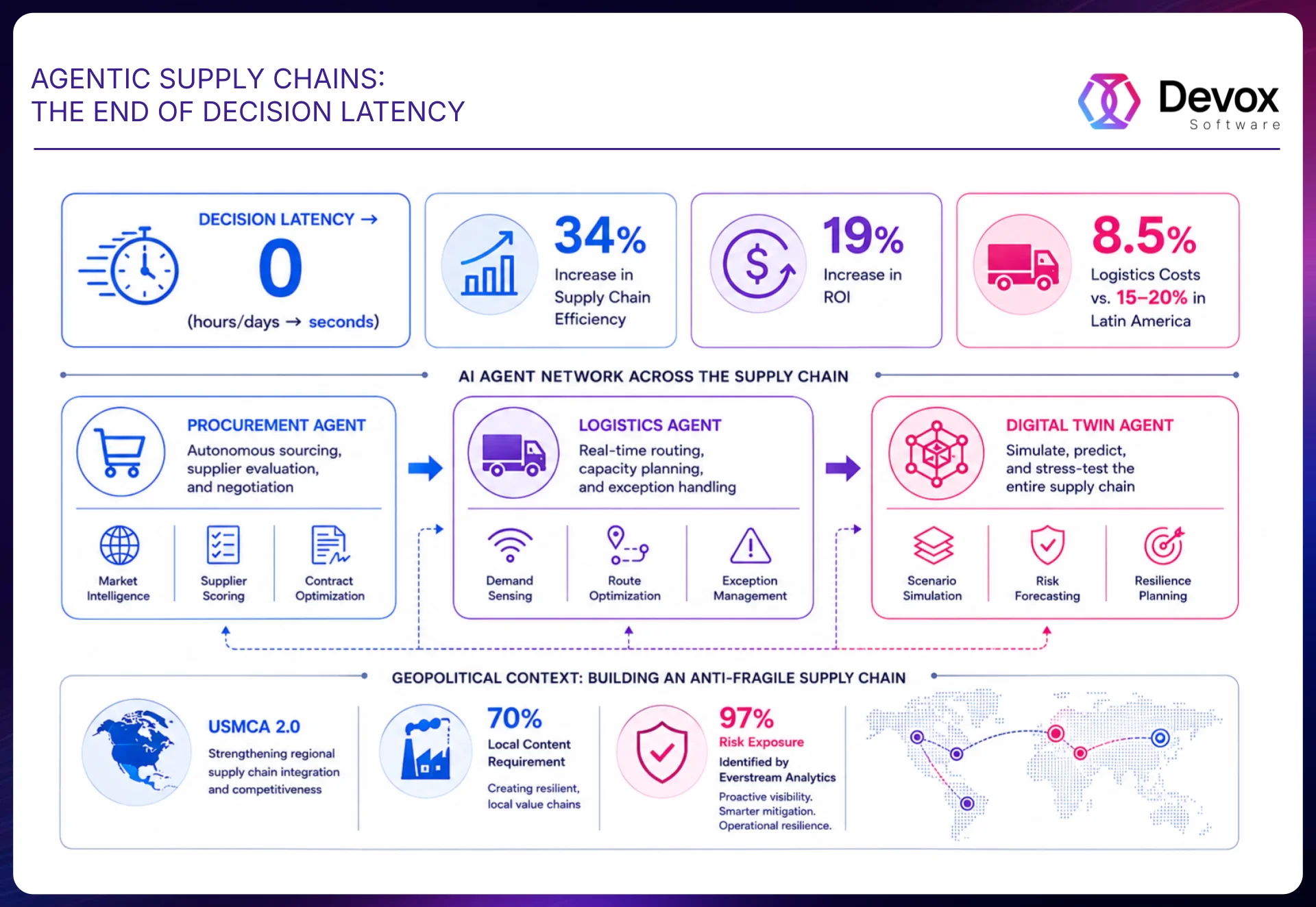
SCMR describes the shift as execution over chat: agents can handle warehouse exceptions and physical movements across the logistics network, including common logistics exceptions, thereby reducing exception cycle time and cost-to-serve while improving OTIF (SCMR, “Execution over chat: How Agentic AI changes supply chain operations,” 19 Feb 2026). The agent moves through the operational steps that usually sit between diagnosis and resolution.
IDC adds an ecosystem view: by 2029, 45% of G2000 companies are expected to adopt agentic AI-driven channel management and orchestration, with projected gains of 20% revenue and 30% partner and customer satisfaction; by 2028, 50% of enterprise supply chains will have n-tier visibility, improving response speed by 25%. For automotive, n-tier visibility is especially relevant because a disruption deep in the supplier base can still stop final assembly.
This scenario is where multi-agent design gets useful. A procurement agent checks supplier capacity. A logistics agent evaluates all relevant supply chain variables to optimize the flow. A planning agent translates these factors into production planning across sites, models, trims, and build slots. A dealer or customer agent updates availability. The point is to make the trade-off while there is still time.
Once multi-site coordination works before the car is built, it naturally carries the car into service.
Aftersales: The VIN Becomes the Workflow
Aftersales may be where customers first feel the impact of automotive aftersales AI agents. A vehicle health agent can watch connected-car telemetry, spot a failure pattern, match the VIN to coverage and parts availability, and coordinate a service slot before the owner ends up on the shoulder waiting for a tow.
The research file highlights Toyota Motor North America’s plan to use Agentic AI workflows for appointment rescheduling and loaner vehicle management in customer service, and notes that mentions of “agentic” on earnings calls rose by more than 3,000% from 2024 to 2025. The use case sounds small until you have a service lane full of customers, limited loaners, technicians booked out, and parts coming from three locations.
McKinsey also points to connected products that can autonomously trigger maintenance actions, making Agentic AI relevant to servitization and aftermarket revenue models. For fleets, this technology becomes especially powerful: fewer unplanned failures, higher uptime, better asset utilization, and less emergency maintenance.
The same VIN-level workflow can become an early warning system for recalls.
Warranty and recall work is full of noise: scattered warranty and service signals. When those signals stay scattered, the OEM sees the pattern late. Agentic systems can connect them earlier.
In practical terms, the agent watches the long tail of service data before scattered cases become an expensive campaign. Warranty and recall agents earn their keep by joining dealer RO text, supplier lots, and connected-vehicle flags before a campaign is priced. Named platforms in this class include Kyndryl AURA and AutoSense.
Dealer compliance is a second surface: advertised price, rebate, doc fee, add-on, consent, and opt-out must match across web, desk, and message. A pricing agent, a consent agent, and an audit agent exist to keep one promise in every channel.
This process is less about a nicer chatbot and more about avoiding the wrong promise in the wrong channel.
Trust Architecture
The control layer around the agent is the real product. In automotive, a workflow can impact critical operational workflows. That makes permissions, escalation, audit trails, and failure modes more important than the demo.
Governance here is implemented as Policy-as-Code rather than static documentation. Critical actions, such as modifying manufacturing parameters or freezing shipments, pass through a guardrail service that validates the action against compliance constraints. If a violation is flagged, the action is blocked and recorded in an immutable audit trail. For high-stakes decisions, we use Human-in-the-Loop patterns: if an agent’s confidence score falls below a set threshold, the system pauses and injects the necessary context into a ticket for human review.
Data governance matters just as much. Agents should act on certified data products rather than unverified data streams. They need clear ownership, quality checks, and lineage so that every important decision can be reconstructed. In regulated or safety-sensitive workflows, a decision trace becomes part of the operating system.
Then comes the compute bill.
Agents are expensive because they loop. They observe, plan, call tools, check results, revise, and act again. One request can become many model calls and system calls. Across plants, dealer rooftops, fleets, connected vehicles, warranty systems, and supplier networks, AI shifts from occasional inference to an ongoing operating cost.
That points toward a hybrid stack. Cloud handles scale. On-premises systems protect plant and regulated workflows. Edge handles low-latency decisions in vehicles, inspection cells, robotics, and service diagnostics. The trick is routing each decision through the most capital-efficient compute layer before latency or infrastructure costs undermine the business case.
Then comes drift.
An agent can keep optimizing and slowly drift away from the business rule it was meant to follow. A logistics agent may chase premium-freight speed while weakening cost control and eroding margin. A service agent may pack the schedule until the loaner and technician capacities are reached. A procurement agent may find savings that weaken a Tier-2 or Tier-3 supplier base.
Guardrails therefore need to be active, measurable, and reviewed. The system should know its permissions, escalation thresholds, source data, and policy boundaries. In automotive, trust comes from seeing how the agent reached a decision, why it acted, and where a human can intervene.
Where to Start: Pick the Messy Workflow
The ideal starting point is a bounded workflow with money attached and a clear escalation path.
Start with one bounded workflow that already has a dollar figure and an escalation owner: shortage-to-reschedule, quality-hold-to-shipment-freeze, or VIN-to-bay. Add the second agent only when the first writes into MES, TMS, or DMS.
Then connect the agents. A scheduling agent becomes more valuable when it integrates across the entire operational ecosystem.
The true value lies in cross-domain handoffs. Consider a quality defect detected on the line: the system executes a cross-domain containment response to prevent defective units from reaching the market. Without this orchestrated visibility, these events remain siloed.
The New Competitive Edge Is the Handoff
We see this in every industry, not just automotive: the highest cost isn’t the technology itself; it’s ‘decision latency.’ The expensive line is decision latency — hours between a shortage signal and a new build slot. A supply-chain agent that cannot write to the plant agent automates a silo. The return sits in the handoff: supplier disruption to sequence, quality signal to containment, VIN to appointment, repair note to warranty pattern, dealer promise to disclosure log.
For most OEMs, this approach is the only viable strategy for scaling agentic AI without losing operational control. Executing these strategies effectively requires deep expertise in automotive software engineering.