Most AI pilots don’t break on demo day. They break a few months after launch, when the model still answers confidently but the data behind it has gone stale. Retrieval-augmented generation (RAG) systems show this most clearly: the model works exactly as designed, while the index feeds it last quarter’s pricing rules.
The same pattern applies to every ML pilot. Moving an AI pilot to production is a decision about whether you control the operational risk and pay the recurring cost of everything around the model. That decision starts with one question: what has the machine learning proof of concept actually proven?
Devox Software has delivered several similar projects on ML development, so we have accumulated our field experience in this brief article to save you time and effort. This guide condenses what we check at each stage.
Signs an AI PoC Is Worth Taking Into Production
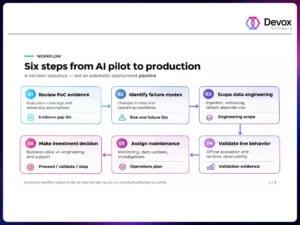
A PoC earns a production budget only when 3 things are true: its evaluation covers the cases that matter, the data work needed to run it is scoped, and its full operating cost is known. Check each one separately.
Offline evaluation covers real use, not demo questions. In machine learning proof of concept projects, the test set is usually written by the same team that built the model, so it proves very little. Build a golden set of 150–300 questions taken from real user requests, run it through an evaluation framework such as DeepEval or Promptfoo, and agree on pass thresholds.
Data ingestion work is scoped and budgeted. Enterprise documents must be cleaned, parsed, chunked, and prepared before retrieval works. In our analysis of 89 production RAG systems, this work took 30–50% of the development budget. If your PoC ran on a hand-picked folder of clean PDFs, assume that share applies to you.
The operating-cost model includes people, not just infrastructure. Inference and hosting are the visible line items. Monitoring, re-indexing, evaluation runs, and incident response are the ones that blow up budgets built on experimentation costs.
Leadership needs 2 numbers before committing: what the pilot cost is and what the production system will cost every month. An AI pilot project that looks cheap usually looks that way because the second number is missing.
Resolving Data and Engineering Dependencies
A RAG application stays accurate only if 3 components work: an ingestion pipeline, document versioning, and index refresh. A PoC rarely needs any of them, because its document set never changes. Production needs all 3, because business records change every week.
- Data Ingestion Pipelines. The ingestion pipeline decides how source content reaches the retrieval system: which sources are connected, how files are parsed and chunked, how duplicates and access permissions are handled, and so on. Testing a model on a fixed set of prepared documents tells you nothing about any of this.
- Document Versioning. Versioning records which version of each source document is in the index: a document ID, a version number or hash, and the ingestion timestamp. Without it, you can’t tell whether an answer came from the current policy or the one it replaced. When the indexed version stops matching the authoritative source, the model answers from superseded information, and nothing in the logs flags it.
- Index Refresh. An index refresh workflow re-embeds updated content and deletes obsolete chunks. For this, set a freshness target per source, for example re-indexing policy and pricing documents within 24 hours of a change, and alert when it’s missed. Together, these mechanisms prevent context rot: indexed information drifting away from the current state of the business.
Versioning identifies the source content represented in the index. Synchronization maintains consistency with operational information. Index refresh prevents superseded context from remaining available for retrieval. For a RAG-based PoC to production transition, these mechanisms represent implementation work that may not have been necessary during the experiment.
How to Verify AI Performance Before Expanding Production Usage
You need 2 kinds of evidence. Offline evaluation tests behavior under conditions you define. Runtime observability shows behavior under conditions you don’t control. Neither is enough on its own.
Put evaluation in the release pipeline. Run the golden set in CI/CD on every change to prompts, models, retrieval settings, or chunking. Block the release if scores drop below the agreed thresholds. DeepEval and Promptfoo both support this. Evaluation stops being a one-time PoC exercise and becomes a release gate. It still proves only that the system works on your test set, not on everything users will ask.
Run in shadow before you scale. Send real traffic to the new system for 2–4 weeks without showing its answers to users. Compare its outputs with the current process or with expert answers. Then open it to a small share of users (5–10%), and expand only while quality, latency, and cost per request hold steady.
Instrument production from day one. Observability platforms such as LangSmith, Braintrust and Arize Phoenix trace every request: the question, the retrieved documents, the prompt, the answer, latency and cost. This is how you catch what offline tests can’t, such as a RAG application answering fluently from an index.
Use LLM-as-a-judge, but calibrate it. A second language model can score answers for faithfulness to sources and relevance at a scale no human team can match. Before you trust it, compare its scores with human labels on at least 100 samples and check that they agree. Keep humans reviewing a small sample, around 1–2% of production answers, every week.
Each of these layers costs engineering time and tooling. That cost is part of the production investment. Put it in the business case instead of discovering it after launch.
Monitoring After Production Deployment
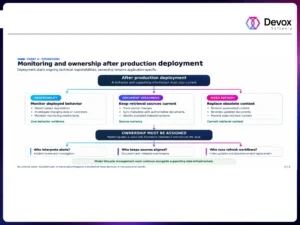
After deployment, someone has to watch the system and keep its data current. For RAG systems, that means observability, document versioning, and index maintenance, and each one needs a named owner.
Monitoring exists because production AI degrades quietly. The system stays up, responds in under 2 seconds, and gets steadily less accurate as data and usage change. At a minimum, track these and set an alert threshold for each:
- answer quality scores from your evaluator
- retrieval hit rate
- share of answers with no supporting source
- user feedback (thumbs-down, escalations)
- latency and cost per request
Dashboards don’t fix anything; people do. Assign owners:
- Source data owner (business side): confirms which documents are authoritative and flags changes.
- AI/ML engineer: maintains evaluation sets, thresholds and prompts, and investigates quality drops.
- Platform/on-call engineer: owns pipelines, index refresh jobs, uptime and incidents.
Content maintenance follows the same logic. If a source document is corrected but the index isn’t refreshed, the application keeps serving the old version. Because availability is unaffected, nobody notices until a user acts on a wrong answer. This is also why model lifecycle management should be considered alongside the maintenance of supporting data infrastructure. Devox Software’s model lifecycle management service is relevant to organizations assessing the ongoing requirements of deployed ML systems.
For AI agent applications, the broader transition from use-case design to operational deployment is also addressed in Devox Software’s building an AI agent system from use case to production.
Bonus for Leadership: How to Decide Whether Further Production Investment Is Justified
Expect production data infrastructure to be one of the largest items in the implementation budget. For RAG applications, it covers cleaning sources, building ingestion pipelines, versioning documents, and refreshing indexes. Split the estimate into 2:
- One-off costs: remaining development, data pipelines, evaluation setup, integration.
- Recurring costs: infrastructure, monitoring, re-indexing, evaluation runs, on-call and incident response.
Recurring costs continue for as long as the system runs, and they usually decide the total cost of ownership. The financial question is this: does the expected business value cover the full operating commitment, not just the cost of building the model? So organize the evidence around 4 questions:
- Model evaluation: Which behaviors have been tested against agreed thresholds, and which haven’t?
- Production data infrastructure: Which ingestion, versioning, and refresh components already run, and which still need to be built?
- Runtime validation: What do shadow runs or limited rollouts show about behavior on real traffic?
- Operating commitments: What will infrastructure and engineering cost every month after launch?
Every “we don’t know” is a gap in the business case. Then choose one of three paths:
- Proceed when the remaining scope, operating requirements and monthly cost are known, and the business case still holds.
- Extend validation or redesign when the use case is promising but quality, data infrastructure or cost assumptions are unverified. Time-box this phase (for example, 4–6 weeks) and set explicit exit criteria.
- Stop when the expected value doesn’t cover the engineering effort, operating cost, or remaining risk. Typical triggers: quality still misses the threshold after a second validation cycle, or cost per request exceeds value per request.
Technical feasibility is not investment approval. This framework keeps these two separate.
Why AI Pilots Fail
Many report the success: the retrieval pipeline runs, the model responds; however, the answers are wrong because the information behind them is out of date. This is one of the main reasons why AI pilots fail after launch. Here’s our practical case. A calculation rule changes in the company’s transactional system, but the indexed document describing that rule isn’t updated. A user asks how the calculation works, and the retrieval system returns the old document, so the model gives a fluent, well-cited, outdated answer. Every technical metric reports success, yet the business rule it describes no longer exists.
This is context rot: indexed information drifting away from the current state of operational data. Uptime doesn’t equal accuracy. A system can run perfectly while its answers decay.
The root cause is architectural. In a RAG system, the model usually doesn’t read live transactional records. It reads a copy: documents processed into a retrieval index at some earlier point. When the source changes and the copy doesn’t, an answer that was correct during the PoC becomes wrong in production, with no change to the model at all.
How to Move from a Successful AI Pilot to a Defensible Production Decision
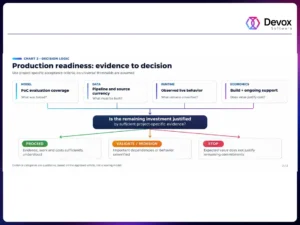
The transition from an AI pilot to production is an engineering and investment decision. A successful PoC establishes what the system can accomplish under tested conditions. Production readiness requires further evidence about operational behavior, supporting infrastructure, maintenance requirements, and cost.
For leadership, the immediate task is to identify which of those requirements have been validated and which still affect the investment decision. That evidence determines whether the appropriate next step is implementation, additional validation, or reconsideration of the initiative. If your AI pilot has demonstrated technical feasibility but its production requirements remain unclear, the next step is to establish what engineering work is necessary before deployment.
Explore Devox Software’s prototype-to-production services to see how the service aligns with your implementation needs and the next stage of your AI initiative. Need to jump from AI pilot to production and results fast? Consult an expert.
Frequently Asked Questions
-
What is the difference between an AI proof of concept and a production-ready AI system?
A proof of concept machine learning model demonstrates whether a model can perform a specific task under defined test conditions. A production-ready system must also operate with live data, integrate with supporting infrastructure, and have mechanisms for monitoring and ongoing maintenance. A successful PoC establishes technical feasibility, not operational readiness.
-
Why do AI pilots fail when moving to production?
AI pilots can encounter problems when the conditions supporting their original results change. In RAG applications, for example, outdated retrieval indexes can cause the system to generate incorrect answers even when the model and application remain functional. Offline evaluations may not detect these problems, making production validation and data maintenance important.
-
What should teams evaluate before moving from PoC to production?
Teams should examine model evaluation results, production data requirements, runtime behavior, and ongoing operating costs. They should also identify which technical dependencies have been validated and which still require implementation. The appropriate acceptance criteria depend on the application rather than a universal readiness threshold.
-
How is production AI monitoring different from PoC testing?
PoC testing evaluates model behavior against predefined datasets and conditions. Production monitoring examines application behavior during operation, when workloads and underlying information may change. Both provide useful evidence, but passing pre-deployment tests does not replace ongoing observability.
-
How should companies estimate the cost of moving an AI pilot to production?
The estimate should include remaining development work, data pipeline implementation, infrastructure, monitoring, and ongoing engineering support. For RAG systems, data preparation and index maintenance can represent additional commitments beyond the original model-development effort. The total cost depends on the application’s architecture and operational requirements.
-
When should a company stop an AI pilot instead of scaling it?
Stopping an AI pilot should remain an option when the expected business value does not justify the remaining engineering work, operating costs, or unresolved risks. If the use case remains promising but critical production requirements are unverified, additional validation or redesign may be more appropriate than immediate deployment.