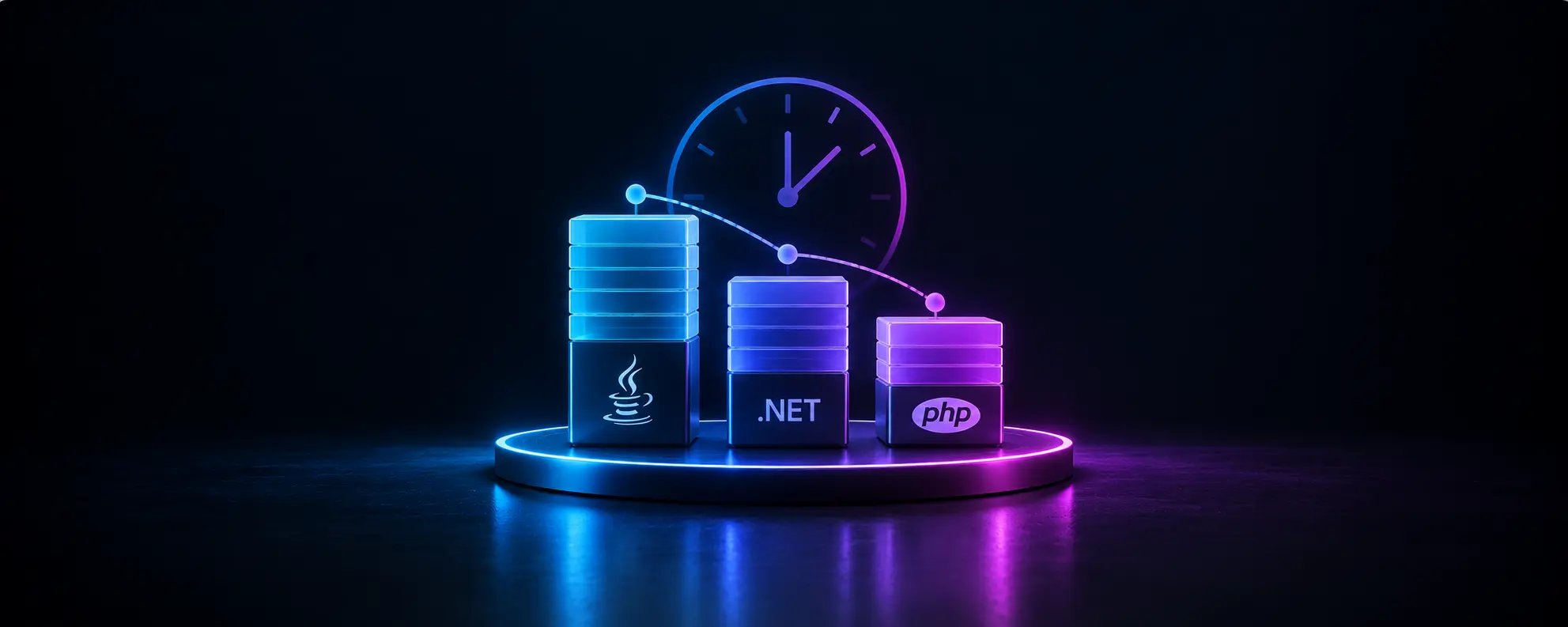


Java, .NET, and PHP estates all face fixed deadlines in 2026 and 2027: .NET 8 and 9 expire in November, Spring Boot 3.x has already left open-source support, and EU vulnerability reporting starts in September. This report maps typical modernization timelines to those deadlines and what AI-assisted delivery measurably contributes.
The winning pattern is simple: break the work into manageable pieces. Teams update systems domain by domain, using functional-equivalence testing to keep production steady while shrinking analysis and redesign cycles. That takes much of the guesswork out of delivery.
Timelines reflect this maturity. Medium-sized Java and .NET applications typically take three to six months to modernize. Large estates typically fall in the six-to-eighteen-month range. PHP systems often follow similar timelines, sometimes faster, depending on how the architecture has grown over time. With the right tooling and delivery discipline, teams can keep portfolio timelines under control.
This report offers a more grounded, achievable view of modernization through 2026 and 2027. Each cycle moves the estate forward without betting the whole system at once.
Stakeholder Concerns
Business Impact & ROI Confidence
Modernized apps on cloud or modern platforms typically achieve faster time-to-market and reduced downtime. For example, analysts find that moving applications to cloud PaaS can increase developer efficiency by up to 25% and reduce downtime by up to 25%. That is where modernization starts paying its way: reduced operational costs, fewer breach incidents, and faster feature delivery. The business case has to put a number on the return. Microsoft recommends planning for break-even within 18-24 months of modernization, with full profitability by 24-36 months. That sequencing matters: early wins get the flywheel moving, medium-term efforts target larger systems, and long-term initiatives deliver most benefits. (Microsoft)
Delivery Risk & Modernization Strategy
Stakeholders (especially non-technical executives) worry about lengthy projects. Phased delivery keeps those risks from piling up at the end. Risk management means prioritizing high-value applications and using phased rollouts and automated testing. Gartner’s TIME model helps rationalize which applications to modernize and how. Incremental modernization, often via the Strangler Fig or continuous-update patterns, further mitigates risk. Instead of a massive “big-bang” rewrite, teams can chip away at the estate one domain at a time and put each improvement into production as it is ready. This means old and new code coexist during the transition, so the system continues operating while modernization proceeds. (Gartner.com, Thoughtworks)
Regulatory Exposure and Reporting Duty
Modernization schedules for anything sold into the EU now have a fixed external deadline. Article 14 of the EU Cyber Resilience Act applies from 11 September 2026. It requires manufacturers of products with digital elements to report actively exploited vulnerabilities and severe security incidents to ENISA and their national CSIRT. The reporting clock is short: an early warning within 24 hours of becoming aware, a full notification within 72 hours, and a final report within 14 days of a corrective measure becoming available. Scope depends on where the product is sold rather than where the company is located, and Article 69(3) extends the duty to every in-scope product already placed on the EU market. A system shipped in 2015 carries the same obligation as one released this year. The formal SBOM mandate arrives later, on 11 December 2027, alongside the remaining conformity requirements. In practice, the September deadline already makes that work necessary, because reporting an exploited third-party component requires an accurate machine-readable inventory of what each product contains. For a 2027 modernization roadmap, dependency inventory is therefore a 2026 problem.
Cost Governance & Financial Predictability
A robust modernization plan also includes FinOps (financial operations) and careful cost forecasting. Teams should build detailed cost-benefit analyses, including lower maintenance costs and potential new revenue streams. Microsoft’s guidelines recommend using predictive cost modeling (FinOps) to control cloud OpEx. Those KPIs tell executives whether the business case holds up. Staging the work gives decision-makers something more useful than reassurance: proof the numbers hold up. (Microsoft.com, Gartner.com)
Modernization Approaches: Big-Bang vs. Continuous
1. Big-Bang Rewrites Rarely Pay Off
Traditional “rip-and-replace” efforts try to rebuild the entire system at once. Requirements drift before the new system ever ships. Gartner explicitly recommends continuous modernization instead: small, rolling increments focused on real business constraints.
Small Releases Keep Risk from Snowballing
Rather than betting everything on a future cutover, teams slice work into small, verifiable steps. The Strangler Fig pattern, which gradually surrounds the legacy system with new components and migrates capabilities over time, embodies this mindset. This approach “acknowledges that modernization is a process of discovery” and delivers features continuously, not at the very end (Microservices.io).
3. Multiple Sources Consistently Report Similar Benefits
ThoughtWorks notes that gradual replacement ensures continuous value delivery throughout the process. Microservices.io highlights that incremental migration shows value early: New services start earning their keep as soon as they reach production. A big-bang rewrite keeps the value locked up until cutover. Iterative validation and real user feedback also prevent the unpleasant surprises that often surface at the end of monolithic rewrites.
4. Functional Equivalence Supports a Safe Cutover
Functional equivalence keeps cutover safe by ensuring the new system produces the same outputs as the old one. Verification tools take much of the cutover risk off the table: “capture & replay” testing in AWS Blu Insights validates behavior against real traffic, Dual Run (Google Cloud) compares mainframe and cloud results in parallel, and Kodesage echoes the same parallel-validation pattern to de-risk the transition.
5. Continuous Modernization Builds Confidence and ROI
Teams show progress in steady cycles instead of waiting years for a rewrite to land.
Each verified slice gives stakeholders something concrete to bank on, demonstrate incremental wins, and guide the organization through a safer, more predictable modernization journey (ThoughtWorks).
AI-DRIVEN ACCELERATION THROUGH 2026 AND 2027
AI is starting to take weeks out of the slowest parts of modernization. Behavioral validation shifts from slow, manual processes to continuous, machine-assisted workflows that raise delivery speed across entire portfolios and keep more work moving in parallel.
Structural Visibility
Structural Visibility
AI-assisted discovery can work with targeted repository context. The useful layer is the tooling around the model: repository access, code indexes, text and semantic search, dependency scanners, and build metadata. The system pulls in the relevant modules as it traces a call path, then engineers validate the relationships it surfaces. That saves engineers from spending the first several weeks simply figuring out where a change will travel. That can compress discovery substantially while keeping the generated dependency graph subject to architectural validation.
Automated Refactoring
The useful part is repetition. Once the team approves a transformation pattern, automation can apply the same change across hundreds of similar files while engineers focus on the exceptions.
Behavioral Assurance
Models compare outputs between legacy and modernized components under identical conditions. A generated refactor is not the unit of progress; an accepted behavior change is. Keep the change only when the evidence agrees. This is the modernization equivalent of execution-based evaluation: the code is judged by what it does when it runs, not by how plausible the diff looks.
Intelligent Sequencing
The result is a roadmap the business can actually budget and staff against. Dependency data shows which modules can move independently and which ones will drag half the estate with them. That lets teams start with work that can actually reach production instead of choosing projects by age or visibility alone.
Compressed Iterations
Developers can zero in on risky configuration before they burn time fixing the wrong thing. A bad dependency assumption found on day two costs far less than the same discovery after six weeks of refactoring.
High-Velocity Delivery
Discovery gets faster. Repeatable refactoring moves to automation. Testing runs continuously. Planning starts from actual dependency data. Together, they move the bottleneck to reviewing the decisions that still need human judgment.
Measured Returns
The measured effect of AI on delivery is uneven, and legacy modernization falls at the more difficult end of the spectrum. DORA’s report on the ROI of AI-assisted software development describes adoption as a J-curve, with an initial negative return before value appears, and says a positive return depends on the surrounding system more than the tools. Research from Stanford cited in that report puts productivity gains at 35-40% on simple greenfield tasks and at 10% or less on complex legacy code. For modernization, that is the number worth budgeting against. Discovery absorbs the gains well. Undocumented legacy logic benefits far less from these productivity gains. Programs that build AI-driven productivity gains into the schedule while holding review capacity flat tend to move the bottleneck into code review instead of removing it.
For modernization, that means benchmarking the workflow rather than the model. Measure how long it takes to move from assessment to an accepted change. A stronger model that produces twice as many patches only counts as an acceleration when the review queue stays under control. The useful number is time to verified change.
Timelines by Technology Stack
Java Applications
Modernization timelines vary widely with application size, complexity, and chosen methods. Benchmarks are scarce, but both industry guidance and case examples give rough ranges. Critically, automation and AI-assisted tools are compressing these timelines. Java is ubiquitous in enterprise legacy systems. A recent analysis suggests that with modern tools, a mid-sized Java monolith often can be modernized in 3-6 months, whereas a large portfolio of applications (phased) might take 12-18 months (legacyleap.ai).
These figures assume use of automated dependency mapping and refactoring tools. For example, IBM reported shortening one legacy Java system modernization from 12 weeks down to 3-4 weeks by using code analysis tools (ibm.com). Modern Java frameworks (Spring Boot, Jakarta EE) and cloud platforms offer cross-platform portability that can speed up rehosting or refactoring. Challenges include outdated libraries (e.g., EJB, Struts) and massive codebases. Automation can help migrate older constructs (e.g., replacing javax.* with jakarta.*) and discover hidden dependencies.
The Java baseline has moved twice since these ranges were first published. Virtual threads have been in production since Java 21, and Java 25 became the current LTS in September 2025. The more immediate constraint now comes from the framework layer. Spring Boot 3.5 was the final 3.x branch and left open-source support on 30 June 2026, with 3.5.16 as its last free patch, so any service still on 3.x runs unpatched unless the organization holds a commercial subscription. The upgrade target is Spring Boot 4.1 rather than 4.0: the 4.0 support window closes on 31 December 2026, while 4.1 runs to 31 July 2027. Spring Boot 4 retains Java 17 as the minimum version while updating the surrounding platform baselines. Jakarta EE 11 requires Servlet 6.1, which in practice means Tomcat 11 or Jetty 12.1, and it removes Undertow support outright. Every API deprecated during 3.x is gone. Practitioner estimates for a 3.5-to-4.x move land around 200-500 hours per service estate across roughly 83 platform-level changes. Put that 200–500-hour estimate next to the 3–6 month benchmark, because framework EOL increasingly sets the clock.
.NET Applications
Legacy .NET apps (for example, .NET Framework) typically run on Windows servers and often use rich Microsoft technologies (WinForms, WCF, ASP.NET MVC).
Moving to modern .NET (8 and 10) often involves upgrading to cross-platform, cloud-friendly frameworks. While explicit survey data are limited, industry guidance suggests a similar scale to Java: small apps might modernize in a few weeks to a few months, medium apps in 3-6 months, and large portfolios in 6-18 months. For instance, one vendor notes “small apps in 6-12 weeks; medium 3-6 months; large 6-18 months” for .NET migrations.
.NET’s strong tooling (Visual Studio Upgrade Assistant, Azure Migrate) and abundant cloud support are advantages. However, challenges include Windows-specific dependencies and the need to modernize or replace outdated UI frameworks such as Web Forms and WPF. Windows-only GUIs or COM components may require rewriting or replacement. .NET modernization also often intersects with database and deployment changes (e.g., from SQL Server to Azure SQL or containers). In large enterprises, migration is typically staged by subsystem, with teams using automated refactoring to convert legacy .NET APIs to .NET Core equivalents and leveraging Azure cloud migration services.
The .NET estate has a fixed end date. .NET 8 and .NET 9 both reach end of support on 10 November 2026, an alignment created when Microsoft extended standard-term support from 18 to 24 months. Teams that stayed on LTS and those that followed the shorter release cycle now face the same deadline. The migration target is .NET 10, released in November 2025 and supported through November 2028, with .NET 11 shipping the same week the older releases expire. .NET Framework 4.8 follows a different model. Its support is tied to the Windows release it ships with rather than a published end-of-life date, which lets .NET Framework estates stay in place longer while modern .NET releases face fixed support deadlines. That changes the math on every .NET timeline. The 6-18 month range for a large portfolio holds only if the clock started well before November 2026. Portfolios starting now must choose between a compressed upgrade to .NET 10 and a period of running without security patches, and the business case should price that trade-off at the assessment stage.
PHP Applications
PHP powers many web applications, including custom frameworks like Laravel. Modernization often means upgrading PHP 5.x, 7.x, or early 8.x code to PHP 8.4 or 8.5, or replatforming to a framework (Laravel/Symfony) and moving to container/cloud hosting.
Compared to Java/.NET, PHP monoliths tend to be simpler (often <100k LOC), so timelines can be shorter for small apps. For a simple PHP site or microservice, modernization (rewrite or refactor) might take a few weeks to a few months. For larger PHP systems (many tens of thousands of lines), projects might span 6-18 months. (As one example case study notes, refactoring a 100k+ LOC PHP monolith took ~12-18 months.)
Key challenges include PHP’s dynamic typing (which can make code analysis harder) and outdated libraries (e.g., migrating from old CMS or framework versions). Frameworks like Laravel, along with tools such as Rector and Composer, streamline and speed up upgrades. Advantages: PHP workloads are typically stateless web apps, so containerization is straightforward; the developer community is large; and performance considerations are generally easier than heavy enterprise apps.
The minimum practical PHP version has moved up again. PHP 8.1 stopped receiving updates on 31 December 2025, and PHP 8.2 reaches end of life on 31 December 2026 after two years in security-only mode. The supported targets are PHP 8.4, whose security window runs to December 2028, and PHP 8.5, released in November 2025 with security support through December 2029. An upgrade to 8.2 or 8.3 buys twelve to twenty-four months before the same work repeats, which makes PHP 8.4 the practical minimum for any program extending beyond a single quarter. For a 100k+ LOC monolith with a 12-18 month timeline, the target version chosen at kickoff determines whether the estate remains on a supported version when the program ends or is already in a security-only branch.
Tools and Techniques for Modernization
A variety of specialized tools and platforms have emerged to assist modernization. These include validation tools to test new systems against the old. Notable examples include:
Agentic Upgrade Automation
The tooling category that has changed most since 2024 is agent-driven upgrade automation. GitHub Copilot modernization reached general availability for Java and .NET in September 2025 and now covers C++ as well. It splits into two layers: a CLI modernization agent that runs assessment and planning across multiple applications at once, and an IDE layer where developers execute the transformations, from dependency migration through containerization to deployment on Azure. That separation matters: assessment, modification, execution, and verification are different steps in the agent loop, and each one can fail independently. Customer results show the upper end. One IoT company cut manual migration effort on a Java estate by roughly 67%. A banking migration from .NET to Java reported a 55% efficiency gain against a 37% cost reduction. The assessment produces a written plan with commits organized by phase, so the architect can still approve it.
Integration & Migration Hubs
AWS Migration Hub (AWS) and Azure Migrate (Microsoft) orchestrate workload movement across apps. They take much of the coordination off the team’s plate, even when the code stays largely untouched.
Automated Refactoring & Rewrite
Tools automate much of the language conversion. Velocity (Mobilize.Net) translates VB6, PowerBuilder, and WinForms to .NET/Blazor with 90%+ automation. Mainframe Rewrite (Google Cloud) assists COBOL→Java/C# transformations. .NET Upgrade Assistant (Microsoft) and AWS ProServ Modernization (AWS) shorten migration cycles by automating predictable refactoring.
AI-Assisted Code Comprehension
New platforms shrink reverse-engineering time. CodeConcise (ThoughtWorks) blends LLMs with code graphs to summarize architectures. Mechanical Orchard (Mechanical Orchard) incrementally rewrites mainframe code into modern languages, refining outputs until they match legacy behavior.
Assessment & Analysis
AI-driven scanners can quickly map legacy estates. Google Cloud’s MAT (Google Cloud) analyzes COBOL/PL/I and generates dependency graphs and modernization plans. IBM Transformation Advisor (IBM) and AWS Application Discovery (AWS) estimate migration effort, while CAST Highlight/Imaging surfaces technical debt and blockers early.
Toolchains in Combination
Enterprise teams combine tools based on each system’s architecture: MAT for inventory, automated rewrite for core logic, Dual Run for validation, CAST for refactoring planning; or in .NET, analyzers, translators, and Azure DevOps pipelines.
Managing Risk and Measuring ROI
For cost projection, total cost of ownership (TCO) models help frame modernization costs realistically. Many teams see sizable multi-year savings once legacy systems move to cloud-native platforms, driven by higher developer throughput. The numbers vary by estate. The accounting principle is simple: price the run-rate savings into the case.
Modernization also needs the right expectations. It’s as much organizational change as technical work, and some legacy systems will always remain. Visible releases keep the program transparent throughout the modernization cycle. Over time, those steps compound into a fully modern platform, ideally before the legacy stack forces your hand.
- Phased/Micro-Services Approach: Break large systems into smaller domains or services. Use patterns like the strangler fig to replace slices of functionality step by step (thoughtworks.com). Each phase is a mini-project with its own timeline and deliverables. This limits the impact of any single failure and provides early business value (e.g., migrating a single reporting module can immediately reduce operational costs).
- Pilot and Proof of Concept: Begin with a non-critical or representative subsystem as a pilot. A pilot surfaces ugly surprises early and gives stakeholders something real to evaluate.
- Continuous Verification: Embed testing early. Build automated tests (unit and integration) against the legacy system before rewriting, so you can apply them to the new code. Use data-driven or behavior-driven testing: record inputs/outputs of key jobs over past months and use those as validation benchmarks. Characterization tests catch drift before it slips through. (cloud.google.com).
- Risk Registers and Contingency: Identify major risks up-front, such as third-party dependencies. Maintain a risk register and mitigation plans (e.g., “if critical legacy library not supported, plan to rewrite those modules”). Allocate contingency in budget/time (industry practice often reserves 20-30% of effort for unknowns). Regular executive reviews should update on risk status.
- Governance and Metrics: Use a formal framework (like FinOps) to track spending against forecasts(learn.microsoft.com). Define ROI metrics: e.g., decreased maintenance cost, fewer security incidents, or faster deployment velocity. Gartner suggests mapping modernization efforts to business KPIs (like reduced business downtime cost or increased customer engagement).
- Stakeholder Communication: Keep business leaders in the loop with demos of migrated features. Show partial results (e.g., new UI module) and articulate cost savings. Document assumptions versus actuals (e.g., “we expected 30% code compaction; actual was 25%” and explain variances).
Conclusions and Recommendations
Application modernization is now a mainstream initiative, but its success hinges on balancing business and technical needs. For decision-makers worried about long timelines and high risk, the key is to use the right strategy and tools to break large modernization efforts into manageable pieces. Benchmarking experience suggests that with automation and AI:
- Mid-size enterprise apps often take months to modernize, especially if approached incrementally.
- Large systems can still take a year or more. Phased delivery starts returning value long before the final cutover.
- Cloud-native and AI-driven tools can significantly shorten testing and analysis phases.
Continuous modernization patterns (e.g., strangler fig) dramatically reduce risk and improve ROI by delivering value early.
The playbook is straightforward: perform a thorough assessment (technical and business), classify each application using frameworks like TIME, and prioritize by risk/value. Adopt incremental modernization patterns and leverage specialized tools for comprehension and refactoring. Build and track an ROI model (break-even in ~2 years) and use FinOps-like financial rigor to stay on budget.
By following these practices, organizations can make modernization a program executives can budget, sequence, and measure. Modernization becomes a repeatable operating rhythm, with each release reducing the size of the remaining bet. Stakeholders see tangible improvements within months, and by the 2-3 year mark, most legacy risk is eliminated, with the business enjoying improved agility and efficiency (Microsoft.com; Gartner.com).
The Modernization Path 2026
Three forces are shaping the modernization landscape: AI-driven code rewriting, infrastructure automation through IaC, and modular hybrid-cloud architectures that enable stepwise migration away from legacy cores.
- Step 1. Target an 18-24-month break-even and profit growth beginning in year three by building a structured inventory of all Java, .NET, and PHP systems, their dependencies, runtime and security risks, and linking every item to TCO and ROI so every modernization target has a technical reason and a financial one.
- Step 2. Prioritize high-impact systems and retire low-value components that drain capacity by classifying each application with TIME (Tolerate, Invest, Migrate, Eliminate) against value, risk, and effort.
- Step 3. Deliver production value in small, low-risk slices by using strangler-fig and continuous-update flows, with legacy and modern components operating side by side; Each slice stays small enough to ship, verify, and roll back cleanly.
- Step 4. Enable frequent, predictable releases while keeping cloud OpEx tied to realized value by establishing container platforms, IaC, shared APIs, and DevSecOps pipelines as the common backbone, keeping teams focused on application change instead of platform plumbing.
- Step 5. Accelerate modernization to 3-6 months for mid-size systems and 6-18 months for large estates by applying stack-specific modernization tooling, and lock target versions at kickoff, so the finish line lands inside a supported release window.
- Step 6. Prove the new system behaves like the old one before you cut traffic over. Then track telemetry improvements by capturing production behavior from legacy systems and using automated regression suites.
Run modernization as an ongoing program tied to KPI gains like reduced downtime and maintenance effort, with executive reviews that link each release to outcomes.
Book a 45-minute review to assess your Java, .NET, or PHP estate against the September and November 2026 deadlines.