A research and content platform built for a US mid-market B2B software company to help the Head of Content turn complex technical briefs into source-grounded, publish-ready content.
About the client
At a US mid-market B2B software company, Sarah oversaw an established content operation built around a complex product.
Background:
Her team produced technical content for enterprise buyers throughout the sales cycle, working with product and engineering specialists when they needed deeper technical expertise.
She kept a growing library of technical content accurate and ready to publish while coordinating writers, marketers, and technical SMEs. Ideas weren’t the problem. The hard part was backing up what the team wanted to say and keeping enough of the research trail to verify it later.
A single deep-dive article could leave the team with dozens of browser tabs, fragmented notes, and AI outputs, with little traceability back to the sources. By the time a draft reached review, Sarah, was often doing the work twice: first helping the team produce the piece, then reconstructing enough of the research trail to trust what was in it.
Trigger:
The breaking point came during an update to an existing technical article. Several claims were still broadly correct, but the research behind them was scattered across old notes, browser history, AI conversations, and links collected by different people. Updating the article meant rebuilding much of the evidence from scratch, particularly across its 27 externally verifiable claims. Eight linked to sources that had changed or disappeared, six statistics no longer had enough context to confirm what population they referred to, and 13 claims could only be traced back to old AI chats rather than the underlying source.
Obstacles:
The team initially focused on improving search, but each change exposed another bottleneck.
Team:
SME
Involvement:
Technical SMEs were still needed for the hard calls, but the company wanted them reviewing difficult conclusions instead of supplying background the system could gather on its own.
Approach:
The team took the parts of their research process that already worked, made them repeatable, and eliminated manual handoffs.
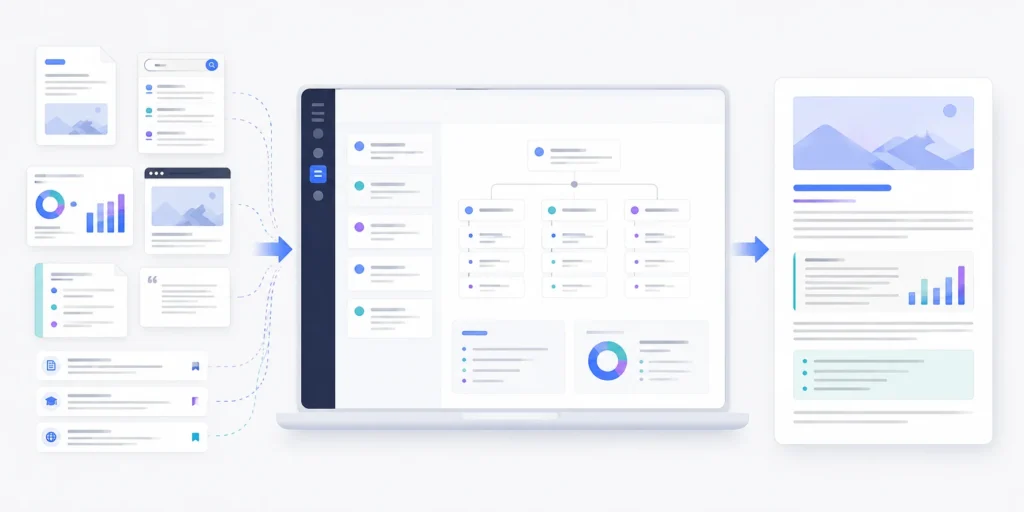
As the team ran into new workflow bottlenecks, the research tool expanded into five user-facing modules: Discovery → Search → Content Creation → Proofreading → Export.
A separate application layer handles orchestration, data, quality checks, analytics, and integrations.
Technologies:
Local and Hosted LLMs • Retrieval-Augmented Generation • Web Search Integration • Query Decomposition • Web Content Retrieval • Prompt Orchestration • Structured Brief Schemas • Source Attribution • Long-Context Processing • Style Guardrails • SEO Analysis • Readability Analysis • CMS/API Integrations • Draft Repository • Analytics • DOCX/PDF/Markdown Export
Rather than relying on the largest hosted model at every step, the platform used smaller local models for classification, query expansion, passage extraction, and style checks, reserving the larger model for synthesis and complex drafting. That left routine work to the cheaper models and used the larger model only when the task needed deeper synthesis.
Journey:
Before research begins, the user defines the audience, goal, and requirements in a shared Brief Schema that stays with the piece through research, drafting, and review.
A technical guide for a CTO can start with a very different research plan than an executive awareness piece, even if both cover the same technology.
The team turned that idea into separate research tracks for market research, competitor intelligence, evidence gathering, and SEO discovery.
The first version was fast but relied too heavily on search-result text, where seemingly convincing statistics could take on a very different meaning once the underlying methodology was examined. While snippets were useful for discovery, they were no substitute for actual evidence. In one test, a SERP snippet appeared to support a 42% adoption claim. Once the system retrieved the full page, the number turned out to describe only respondents from a specific enterprise segment, not the broader market. The finding was downgraded rather than passed into the draft as a general claim.
When the platform finds a promising result, it retrieves the source page and passes only the relevant material into the research pipeline.
The next version swung too far in the opposite direction, giving the model more evidence at the cost of substantially more noise. Relevant passages were competing with navigation, repetition, unrelated sections, and background material. The team changed the pipeline again: retrieve broadly, select evidence narrowly, then reason.
Before source material reaches the model, the platform breaks each research question into narrower searches and filters the retrieved content down to the passages that actually matter. The platform typically inspected 20-40 search results, fetched a smaller set of promising pages, stripped navigation and repeated page furniture, and split the remaining content into passages. A retrieval/reranking step selected only the passages relevant to the research question before passing them to the reasoning model. The research layer retained the top 8-12 passages after reranking, rather than sending entire pages into the generation context.
A research question about local video generation, for example, only needs the passages that discuss hardware, model size, memory, throughput, or deployment requirements, not the entire history of every vendor returned by search.
Separating retrieval from analysis cut context size and made failures easier to trace.
Sources stay attached to each finding, so editors can trace a claim back to the original evidence instead of hunting for it after several AI passes.
The first long-form version generated the article in a single pass, which preserved the brief but led to repetitive sections and weaker source discipline as the context grew. The team changed the workflow so the model first generated an evidence-backed outline, then drafted one section at a time using the shared brief plus only the findings assigned to that section. A claim map constrained section generation, so statistics or competitor claims could only be introduced when the section had an attached evidence object supporting them. A final pass cleaned up transitions and repetition without adding new factual claims.
Editing could make a draft cleaner while quietly changing a factual claim, so the team separated writing from verification. After generation, a separate QA layer extracted factual claims and checked whether claims containing numbers, named products, market assertions, or technical specifications had supporting evidence. Other checks handled readability, terminology consistency, brand rules, and SEO requirements. Unsupported high-risk claims were flagged for review rather than silently rewritten. Early versions of the verifier produced too many false positives on descriptive statements, so the team narrowed verification to claim types that actually required external evidence.
As the workflow grew, the platform maintained a single record for each piece from drafting through publication, including its sources, version history, editorial feedback, and CMS handoff.
Editorial feedback also feeds back into the system’s rules, allowing recurring style corrections to become new guardrails rather than repeated manual fixes. Consistently low template ratings and repeated edits in version history give the team a clear signal that the problem is structural rather than stylistic.
Change:
For Sarah, the biggest change was not faster writing but no longer having to hold the entire research workflow in her head. A piece could move from brief to research to drafting and review without losing the evidence behind it. When an editor questioned a claim, the evidence was still there. When an older article needed updating, the team had a starting point instead of a blank browser window.
Outcomes:
Customer
Voice:
“I’m not a fan of tech that just adds more steps to our day, but this was different. Before, my week was basically just re-doing research that we’d already done three times over. We’d have these great drafts, but I couldn’t trust them because the sources were scattered everywhere. Now, the evidence is right there, attached to every finding. It’s given me a huge peace of mind—my team is finally focusing on the narrative instead of the grunt work of verifying facts. It’s been a total game-changer for my sanity.”
If your team still jumps between separate tools for research, writing, SEO, editing, and publishing, there are probably more manual handoffs you can eliminate.
Devox Software builds AI content platforms that integrate research, writing, review, and publishing into a single workflow.
Tell us where your system needs help — we’ll show you how to move forward with clarity and speed. From architecture to launch — we’re your engineering partner.
Book your free consultation. We’ll help you move faster, and smarter.
Share the details of your project – like scope or business challenges. Our team will carefully study them and then we’ll figure out the next move together.
We appreciate you reaching out. Your message has been received, and a member of our team will get back to you within 24 hours.
In the meantime, feel free to follow our social.
Welcome to the Devox Software community! We're excited to have you on board. You'll now receive the latest industry insights, company news, and exclusive updates straight to your inbox.