
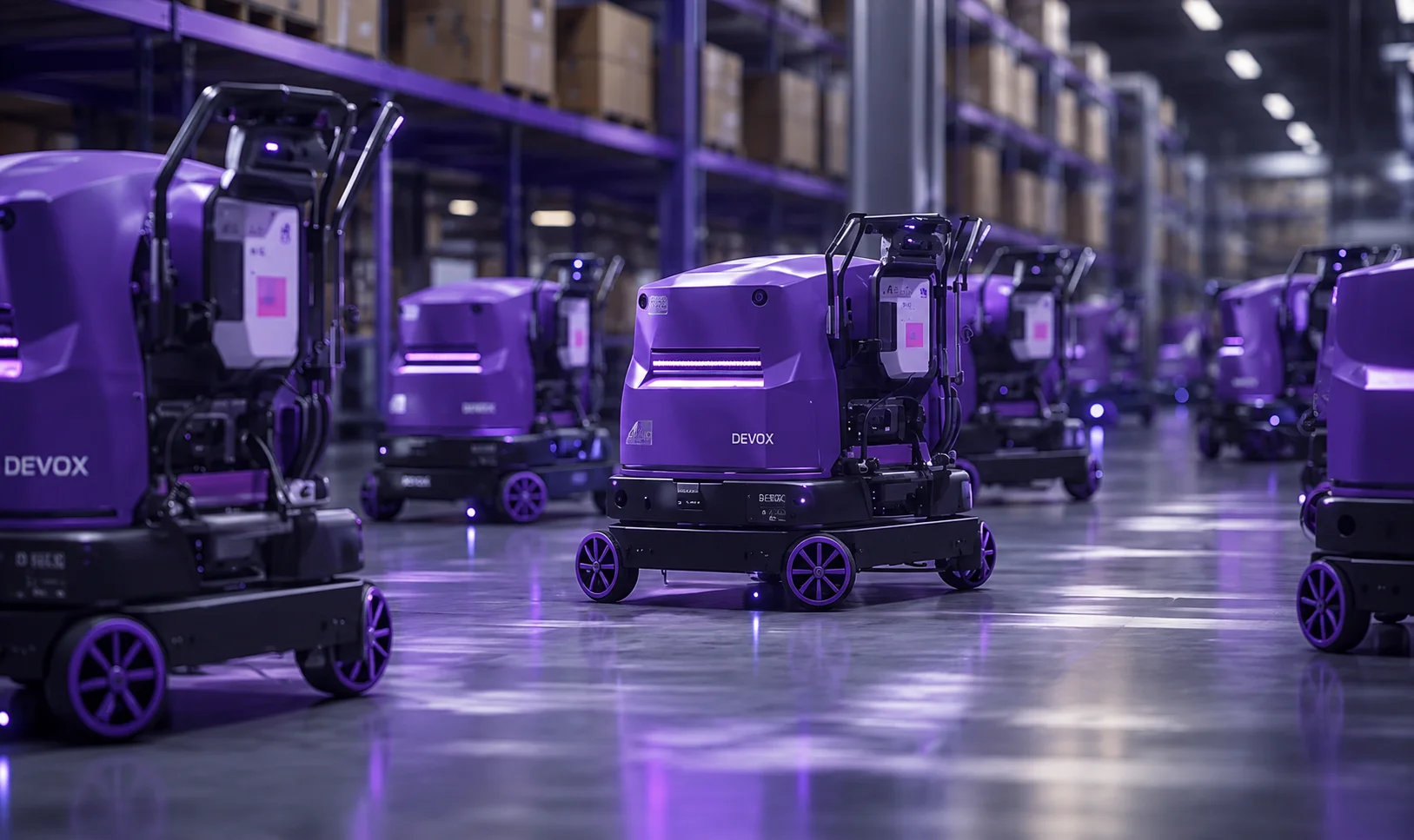
Choosing the right partner is the second biggest decision in any supply chain modernization initiative. The top logistics software development companies deliver more than code; they scale systems with freight volume and integrate with legacy ERP and carrier networks to bring real change for operations. This guide reviews the leading platform vendors and custom-development partners for 2026, with their pros and cons as well as tips on how to pick the one that fits your operation.
The Categorized Shortlist
- Best enterprise full-cycle custom builder: Devox Software
- Best overall execution platform: Manhattan Associates
- Best AI logistics companies: Blue Yonder and Kinaxis
- Best for global freight management companies: CargoWise
- Best if you already run the ERP: SAP, Oracle, Microsoft
At-a-Glance Top Logistics Software Development Companies Comparison
| Company | Core strength | Best for | Delivery model |
| Devox Software | Flexibility, field industry-specific experience | Mid-to-large companies | Development Agency (cloud, edge, etc.) |
| Manhattan Associates | Warehouse, transport and order management | Retail, distribution, 3PLs | Cloud SaaS |
| Blue Yonder | AI/ML supply chain planning and execution | Manufacturing, retail | SaaS on Azure |
| WiseTech Global (CargoWise) | Freight forwarding and customs execution | Forwarders, customs brokers, 3PL/4PL | Cloud, single global database |
| SAP | End-to-end digital supply chain and ERP | Large multinationals on SAP | Cloud |
| Oracle | SCM and Transportation Management (OTM) | Global enterprises on Oracle | Fusion Cloud SCM |
| Kinaxis | Concurrent for supply chain software development companies | Complex, volatile supply chains | SaaS |
| o9 Solutions | AI-native demand and supply planning | Data-rich enterprises | SaaS |
| Infor | Nexus network with WMS | Discrete and process manufacturing | Cloud |
| Microsoft | Dynamics 365 SCM with Fabric | Microsoft-ecosystem enterprises | Cloud |
| IBM | Sterling order & supply chain suite | Large B2B/omnichannel | Hybrid cloud |
How This List Was Built
Every company below was assessed on 3 things that, according to our practice, actually matter to an enterprise buyer: a proven track record at scale, depth of logistics-specific capability based on field experience, and the ability to integrate with the current business systems. The extra services for modernization and AI logistics companies were a plus.
In its structure, the list mixes two distinct categories of top logistics software development companies:
- product vendors that develop and license their own logistics platforms
- custom-development partners that act as tech partners and build custom software.
Furthermore, the list avoids evaluation and rating, as each company is high-tier and suits specific goals and clients. All information is taken from open sources. After considering and labeling everything, we can begin.
The Top Enterprise Logistics Software Companies
The enterprise logistics software market includes a wide range of platforms, all designed to optimize transportation, warehouse operations, fleet management, supply chain visibility, and automation; in other words, they make the lives of logistics companies better. But which fits your business challenges and environment? It’s time to consider logistics software companies.
Below are some of the leading product vendors helping global enterprises improve efficiency, reduce costs, and build more resilient logistics operations.
Manhattan Associates
Manhattan Associates is generally reviewed as the benchmark for supply chain execution software. Its Manhattan Active platform improves warehouse management (WMS), transportation management (TMS), and order management (OMS) to unite the supply chain in one cohesive flow. Moreover, the company presents multiple products for warehouses, labor management, transportation, etc.
The platforms by Manhattan Associates are widely recognized among analysts and users across retail, consumer goods, industrials, and increasingly pharma and energy. They offer a cloud-native, microservices architecture with continuous updates. One of the latest advancements is embedding agentic AI natively inside the platform and a distribution partnership with Shopify.
Best for: Retailers and distributors for world-class warehouse, transport, and order execution.
Watch for: Enterprise-grade cost and implementation scope.
Blue Yonder

Now part of Panasonic, Blue Yonder leads AI-driven supply chain planning and execution, with particular strength in demand forecasting and inventory optimization. The capabilities of Panasonic as a hardware manufacturer let it pair planning software with the sensors, cameras, and edge devices that generate supply chain software development companies data. As a result, integration becomes a smooth process.
Best for: Manufacturers and retailers pursuing AI logistics companies.
Watch for: Implementation complexity and higher initial investment.
CargoWise
CargoWise is WiseTech Global’s flagship platform. Its single-database logistics execution system, common among freight management companies, customs brokers, warehouse operators, and carriers across more than 170 countries, consolidates forwarding, customs and compliance, warehousing, and, of course, transport management. However, a recent shift to a “Value Pack” pricing model put the total cost of ownership into question and deserves careful validation.
Best for: Mid-to-large freight forwarders and 3PL/4PL providers with complex cross-border operations.
Watch for: The learning curve and the new pricing model.
SAP

For logistics software development companies, USA already standardized on SAP, its Digital Supply Chain suite is a natural choice. SAP consistently ranks among the top supply chain planning providers for its end-to-end coverage from planning to finance. The major advantage is a single system of record, so companies unite multiple workflows into one visible system. The logical trade-off of this is the scope and cost typical of large SAP programs.
Best for: Large multinationals already running SAP ERP.
Oracle
Oracle Fusion Cloud SCM with its Oracle Transportation Management (OTM) is a top-3 planning and execution leader across industries; logistics is no exception. The same way as SAP, Oracle is strong in the breadth of solutions offered and tight integration capabilities with its own ERP and database stack. All things considered, this makes it a good choice for enterprises already invested in the Oracle ecosystem.
Best for: Global enterprises standardized on Oracle.
Kinaxis
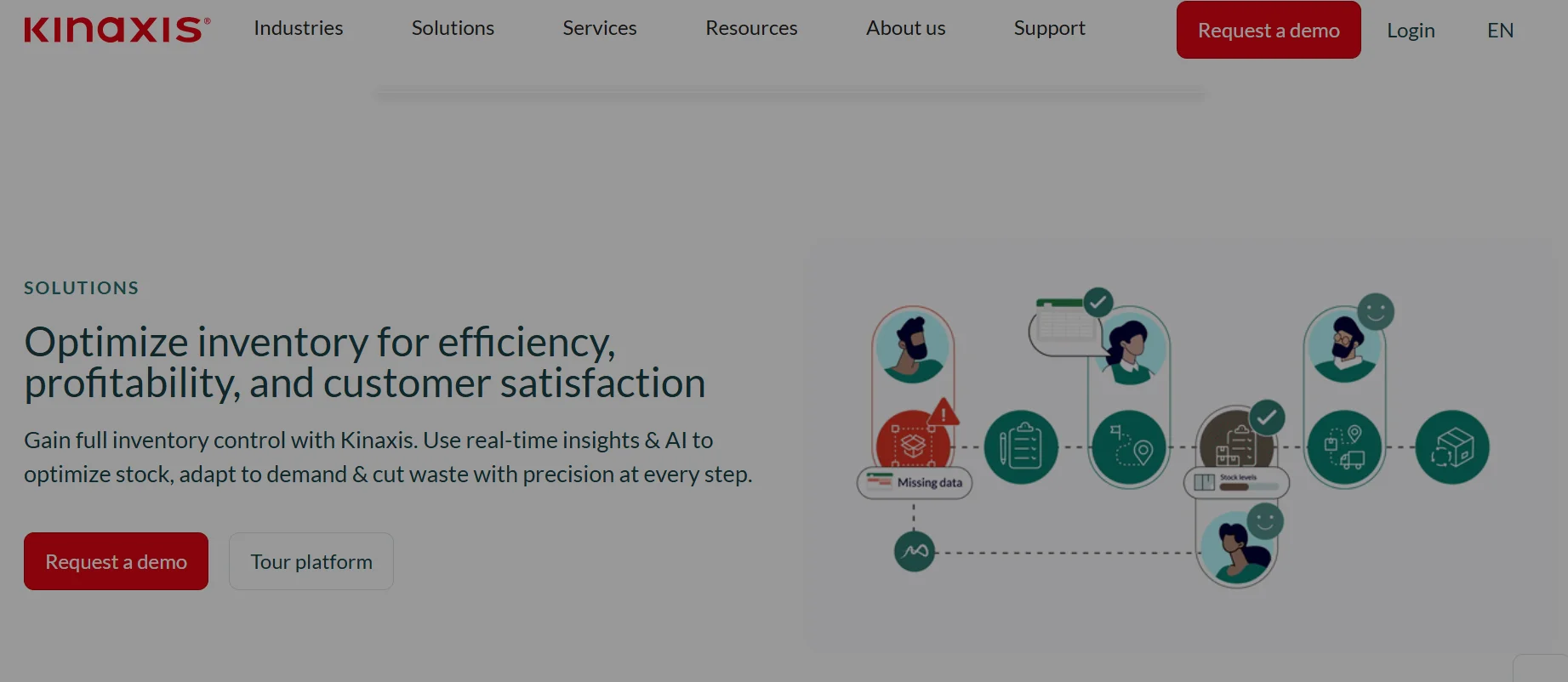
Kinaxis promises to “optimize inventory for efficiency, profitability, and customer satisfaction.” And they deliver it. A specialist in concurrent supply chain planning, which benefits demand, supply, and capacity planning simultaneously, helps to manage complex, volatile supply chains. In other words, it replans quickly when conditions change. It consistently ranks among the overall market leaders in supply chain planning.
Best for: Complex, fast-changing supply chains that need rapid scenario re-planning.
o9 Solutions

o9 markets its platform as a supply chain “Digital Brain,” combining AI-native demand and supply planning with a knowledge graph data model. Although the company addresses multiple niches and industries, it appeals to data-rich enterprises that want machine learning at the center of planning rather than bolted on regardless of the sphere they operate in.
Best for: Data-mature enterprises building an AI-first planning capability.
Infor
Infor pairs industry-specific cloud applications with the Infor Nexus supply chain network and a strong warehouse management offering. Its vertical focus on discrete and process manufacturing makes it a practical alternative to the largest suites for companies that want depth in their industry.
- Best for: Discrete and process manufacturers wanting industry-specific depth.
Microsoft
Microsoft’s Dynamics 365 Supply Chain Management play is an entire ecosystem for logistics software development companies, USA, with demand forecasting, inventory visibility, and manufacturing execution. It combines its main functions with Microsoft Fabric as the data layer and its Copilot. The latter enables natural-language interaction.
The next thing, because Microsoft also supplies the Azure cloud, it’s already a strong fit for enterprises, especially ones that are already committed to the Microsoft stack.
Best for: Enterprises standardized on Azure, Microsoft 365, and Dynamics.
IBM
IBM’s Sterling suite is also one of the main candidates that we can’t help mentioning. It covers order management and B2B supply chain integration and is paired with AI and automation via IBM’s broader technology stack. For this reason, it’s a durable choice for large, complex omnichannel operations, including B2B, for enterprises that only benefit from IBM’s integration heritage.
Best for: Large B2B and omnichannel enterprises for robust order orchestration.
Custom Logistics Software Development Partners
However, not every enterprise, setting aside mid-size companies, needs a licensed platform. Proprietary products fit unique workflows the best, especially when you need to modernize a legacy live system rather than replace it. That’s why logistics software development companies, USA, can be the better route. In this space, vendors divide into two kinds of profiles:
- Global system integrators deliver enterprise-scale logistics and supply chain software backed by AI, automation, and cloud services. But they are built to handle large, multi-region programs.
- Mid-size development companies offer custom logistics builds: transportation management, real-time tracking, route optimization, warehouse systems, and automated dispatch solutions smoothly built into the current client’s ecosystem.
Devox Software is an example in this tier as a US-focused, full-cycle custom software development company with a strong focus on delivery quality. It has a proven track record in a dedicated logistics practice spanning custom transportation management systems (TMS), business management systems for a freight operator, fleet management, and smart automation.
A recurring theme in its work is unifying fragmented systems such as WMS orders, TMS schedules, GPS data, and carrier info into a single platform, alongside modernizing legacy monoliths into cloud-native architectures and adding AI capabilities.
With 100+ engineers, ISO 9001 and ISO/IEC 27001 alignment, and positive verified reviews, it fits mid-market and enterprise teams that want a bespoke build, a legacy modernization, or team augmentation rather than an off-the-shelf platform.
This way, when evaluating any specialist firm, ask for logistics-specific case studies, verifiable client references, relevant certifications (for example, ISO 9001 and ISO 27001), and independent review scores on platforms like Clutch or Gartner Peer Insights. The next section will help you navigate this process from A to Z.
A firm that lists logistics among many industries is certainly a generalist. A firm whose core vertical is logistics technology is much more likely to understand carrier integrations, customs rules, and multi-modal complexity from the start.
How to Choose an Enterprise Logistics Software Development Company
The process of selecting an enterprise logistics software development company requires more than comparing hourly rates, technology stacks, and/or portfolio size. The right partner should understand how logistics operations work in practice, so this section helps you to prove that one is the one.
Criterion 1. Delivery Model
The first fork is deciding whether you need an off-the-shelf platform, a configurable solution, or fully custom logistics software. A ready-made platform works when your workflows are relatively standard, whereas custom software suits your logistics processes with proprietary routing logic, unusual pricing models, complex multimodal operations, specialized customer portals, etc.
At that, the decision does not always have to be strictly build versus buy. Many enterprises use a hybrid model of a core commercial TMS, WMS, or ERP with custom services, integrations, analytics, and AI capabilities around it.
Criterion 2. Logistics-Specific Experience
A generic software portfolio does not prove that logistics software development companies, USA, can handle enterprise logistics complexity. Even a company experienced in parcel delivery may not automatically understand ocean freight documentation and vice versa. Ask for case studies that reflect your business reality:
- Ground, ocean, air, rail, or multimodal transportation
- Freight forwarding and brokerage
- Last-mile delivery
- Fleet and maintenance operations
- Warehouse and yard management
- Carrier onboarding and rate management
- Cross-border shipping and customs processes
- High-volume tracking and event processing
Strong vendors can explain the operational problem, the architecture they implemented, the trade-offs they made, and the measurable business outcome.
Criterion 3. Integration Reality
Enterprise logistics software usually sits between ERP platforms, carrier systems, customer portals, and more. That’s why, before selecting a vendor, confirm how the solution connects with your existing environment: which integrations already exist and which ones require custom development. This information is reviewed in the API documentation.
It is also worth asking how the team handles problems like inconsistent data with duplicate shipment records and so on because in logistics, integration reliability matters as much as feature quality.
Criterion 4. Architecture and Scalability
Ask how the architecture handles peak periods and large tracking volumes, where scaling risks are, and how the system will remain stable under load.
Be cautious when a provider recommends any solution, whether it’s microservices, AI, or event-driven architecture, unless it connects those choices to a real operational requirement. Again, technology should solve a specific business or scalability problem, not simply make the shiny proposal.
Criterion 5. Total Cost of Ownership
Enterprise logistics software usually requires continuous maintenance, integration updates, infrastructure, support, security improvements, and feature development, so the initial cost of development will only grow. Ask for a cost model that includes all possible expenses:
- Discovery and solution design
- Development and testing
- Third-party licensing
- Cloud infrastructure
- Data migration
- Integration work
- Training and rollout
- Maintenance and support
- Change requests
- Security and compliance activities
Plus, test pricing against future growth over the next 3 to 5 years. Some platforms for logistics software development companies, USA, become significantly more expensive as shipment volumes increase.
Criterion 6. Delivery Process
You need to know how a team turns operational requirements into software specifications, as there are many invisible exceptions at the start. A reliable vendor involves real dispatchers, warehouse teams, etc. during discovery. This way, a mature delivery process should include:
- Workflow and system analysis
- Data and integration assessment
- Architecture validation
- UX prototypes
- Incremental releases
- Automated and manual testing
- Performance testing
- User acceptance testing
- Rollback planning
- Documentation and training
Prepare for a phased rollout because for critical systems, it is usually safer than a single large launch.
Criterion 7. Data and AI Capabilities
Many logistics vendors now promote AI logistics companies: optimization, forecasting, automation, and decision support. These capabilities create real value when the underlying data is reliable. Ask:
- what data the proposed AI feature requires
- how model performance will be evaluated
- what happens when confidence is low
The vendor should also explain how human review, audit trails, monitoring, retraining, and fallback logic will work so the model will safely operate in production.
Criterion 8. Post-Go-Live Support
Determine who will support the system after go-live, how, and when. For instance, whether the original development team remains involved or whether the project is transferred to a separate support department. The other vague areas are:
- Technical point of contact
- Support hours and response times
- Maintenance responsibilities
- Change-request pricing
- Knowledge-transfer procedures
Documentation, source-code ownership, architecture records, runbooks, and deployment instructions should be part of the delivery.
Criterion 9. Security and Compliance Effort
We don’t need to explain how much security and compliance are valuable for enterprises. That’s why you need to learn exactly how the vendor handles identity management, encryption, audit logs, access controls, vulnerability management, and incident response. Moreover, security requirements, including
- GDPR
- CCPA and other privacy regulations
- SOC 2 controls
- ISO 27001-aligned practices
- PCI DSS
- Customs and trade-compliance requirements
- Data residency rules
- Customer-specific security standards
should be reflected in the architecture and development process from the beginning.
Criterion 10. Communication and Transparency
To eliminate possible pitfalls, confirm how communication will work across time zones, how decisions will be documented, and how project risks will be reported.
Furthermore, to protect ownership and avoid vendor lock-in, review the contract carefully to confirm ownership of source code, infrastructure configurations, documentation, designs, and data. Your company should always retain access to the code repositories, cloud environments, CI/CD pipelines, technical documentation, and so on.
Choosing the right enterprise logistics software development company comes down to several criteria that define it all. Evaluating each candidate and checking proof records is a larger job to be done to avoid problems throughout the development.
Recapped: The Structured Vendor Evaluation Checklist
The final decision should combine technical, operational, commercial, and organizational criteria rather than relying on the lowest estimate. This list includes them all for an effortless vendor evaluation.
| Evaluation Area | Questions to Ask |
| Logistics expertise | Have they solved similar operational problems? Do they understand your transportation mode, shipment types, service levels, and exception workflows? Can they provide relevant case studies with measurable results? |
| Technical capability | Can they design scalable, secure, integration-heavy systems? Have they handled high transaction volumes, real-time tracking events, complex workflows, and peak-load conditions? |
| Delivery approach | Do they support phased rollout and measurable milestones? How do they manage discovery, prototyping, testing, user acceptance, and rollback planning? |
| Integration readiness | Have they assessed your actual systems and APIs? Which ERP, TMS, WMS, carrier, telematics, customs, and EDI integrations have they delivered before? How do they handle failed syncs, duplicate records, and inconsistent data? |
| Support model | How will legacy data be cleaned, mapped, validated, and transferred? How will historical shipment, customer, carrier, pricing, and invoice data be preserved? |
| Security | Are controls built into the delivery process? How are identity, access, encryption, audit logs, vulnerability management, backups, and incident response handled? |
| Ownership | Will you own the code, data, infrastructure, documentation, and designs? Will your team have direct access to repositories, cloud environments, CI/CD pipelines, credentials, and technical records? Can another team take over the system without major disruption? Are proprietary tools or undocumented components required to operate the platform? |
| Communication | Can they work effectively with operational and technical teams? Who will be your main contact? How often will progress, risks, decisions, and budget changes be reported? |
The Bottom Line
There is no single “best” enterprise logistics software company. The right choice on top logistics software development companies always depends on your operational complexity and trivia. If your requirements closely align with industry best practices, an established logistics platform may offer the fastest path to value.
However, when your operations involve proprietary workflows, legacy modernization, or AI-driven optimization, a custom software development partner seems to deliver significantly greater flexibility and long-term ROI.
Whether you’re replacing a legacy TMS, integrating disconnected logistics platforms, building AI-powered planning capabilities, or developing a custom enterprise logistics solution from scratch, Devox Software will be a reliable tech partner. Talk to our logistics software development team to discuss your modernization roadmap and determine your best fit.
Frequently Asked Questions
-
What is a logistics software development company?
A company that either develops and licenses its own logistics platform (a product vendor like Manhattan Associates or CargoWise) or builds custom logistics software for its clients. It could be a development partner or system integrator. Enterprises often use both: a core platform plus custom extensions to match their unique processes. See the full spectrum of software development services for logistics by Devox Software.
-
Should an enterprise buy a platform or build custom software?
Buy when your processes are standard, and you want speed and proven capability. Build when your operations are unique or when you’re creating a proprietary product. Many enterprises adopt a hybrid: a licensed platform with custom-developed extensions.
-
How long does it take to implement enterprise logistics software?
Implementation timelines vary depending on project scope. A standard SaaS deployment by top logistics software development companies may take 3–6 months, while enterprise-wide implementations with ERP integration, data migration, and custom workflows typically require 9–18 months. Custom logistics software projects are usually delivered incrementally, so you don’t have to disrupt operations and begin using new functionality before the entire platform is complete.
-
Can enterprise logistics software integrate with our existing ERP and WMS?
Yes. Modern enterprise logistics solutions are designed to integrate with ERP, WMS, CRM, accounting platforms, carrier APIs, telematics systems, EDI providers, customs services, and customer portals. Before selecting a vendor, verify which integrations already exist and which require custom development.
-
How important is AI in enterprise logistics software?
AI is becoming a significant competitive advantage, but it should address clearly defined business problems rather than being implemented for its own sake. The highest-value AI in logistics includes demand forecasting, route optimization, ETA prediction, warehouse optimization, carrier selection, predictive maintenance, document processing, fraud detection, and automated exception management.
-
How can we modernize a legacy logistics system without disrupting operations?
Most successful logistics ERP modernization projects use a phased approach instead of replacing the entire system at once. New services are introduced alongside existing applications, integrations are validated in parallel, and functionality is migrated incrementally. This approach minimizes operational risk while allowing the business to continue running throughout the transition.
-
What certifications should a logistics software development company have?
Although requirements vary by industry, reputable development partners often maintain engineering and security standards such as ISO 9001, ISO/IEC 27001, SOC 2, or industry-specific compliance frameworks. Companies working with payment processing, healthcare, or international trade may also require PCI DSS, HIPAA, or customs-related compliance experience.