


If you seek the highest projected ROI for your machine learning use cases only, you might miss extra value. The strongest cases offer measurable operational value, where available data and implementation feasibility support further investment decisions. For manufacturers, when production data is often spread across ERP, MES, equipment historians, and maintenance systems and where an entire ML initiative is a challenge, this is a must.
Devox Software has gathered insights from seven AI use cases in MES modernisation for you to illustrate the range of possible opportunities opened in front of an SMB manufacturer. Identifying them, however, is only the beginning. So where to start?
Operational Decision Is No.1 Factor
A viable ML use case must address a measurable operational problem and produce information that changes a business decision. Before algorithms or technologies, establish what the prediction would improve, who would act on it, and whether ML is necessary. This is how to do it.
- Establish the exact operational KPI that the ML use case must improve as an operational baseline: unplanned downtime, scrap rates, maintenance costs, or production schedule adherence. These metrics establish what the proposed solution must change.
- Specify the prediction and the action it must trigger — what the model would predict and how that output would influence operations. For instance, for predictive maintenance, the prediction might concern the probability of equipment failure within a defined time window. The corresponding action could be a scheduled inspection, a maintenance intervention, or an adjustment to production planning.
- Reject ML candidates where business rules can support the same decision. A problem involving operational data does not automatically require machine learning. Suppose a manufacturer needs to notify operators whenever equipment temperature exceeds a defined safety threshold. If the relevant condition can be expressed reliably through existing rules, conventional monitoring may solve the problem without model development.
Implement ML when useful decisions depend on complex relationships, changing conditions, or patterns that fixed thresholds can’t adequately capture. The objective is to select the appropriate solution, not justify ML adoption.
Connect Predictions to Financial Outcomes
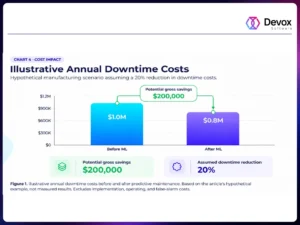
A good business case for machine learning should estimate the operational value that predictions could generate, connecting the dots between the existing cost of the problem, the improvement, and the expense of ML implementation. Let’s break it down.
Step 1. Quantify the Baseline Cost of the Operational Problem
Financial evaluation begins with the cost of the current operating condition. For our example with predictive maintenance, this may involve downtime hours, lost production, overtime, emergency repair expenses, and the cost of replacement components. Note that not every expense is necessarily avoidable. In particular, the earlier you intervene, the less production disruption becomes, without routine maintenance checks or component replacement costs.
A credible baseline should distinguish between costs the proposed solution could influence and those that would remain regardless of its performance.
Step 2. Model How Prediction Accuracy Affects Operational Savings
A model that misses critical failures might not reduce downtime costs substantially. Moreover, a model that generates excessive false alarms triggers unnecessary inspections, maintenance work, or production interruptions, which is no better than traditional methods.
That’s why the business case must consider both outcomes. For illustration, assume a manufacturer records the following annual downtime costs:
| Business-case input | Hypothetical value |
| Unplanned downtime | 200 hours |
| Estimated cost per downtime hour | $5,000 |
| Annual downtime cost | $1,000,000 |
| Assumed avoidable downtime | 20% |
| Potential annual gross savings | $200,000 |
However, note that the $200,000 estimate is not a guaranteed return. It depends on whether failures can be predicted with enough lead time, whether maintenance teams can respond, and whether interventions actually reduce downtime. For instance, false alarms, missed failures, and operating constraints could materially change the result.
That’s why an AI feasibility study should identify which assumptions require validation rather than treating a single savings estimate as proof of economic viability.
Step 3. Include Data Preparation, Integration, and Model Operating Costs
Depending on the use case, implementation may require historical data extraction, cleaning, labeling, model development, infrastructure, application integration, and modifications to operational workflows. Plus, ongoing expenses may include monitoring, infrastructure usage, model maintenance, and support. Take this for a preliminary assessment:
Annual net benefit = Annual realized savings − Annual operating costs
Initial implementation costs must then be evaluated separately against the expected net benefit and investment recovery period. The distinction matters because a model can demonstrate promising predictive performance while requiring expensive integration work before its outputs become useful.
At the discovery stage, precise costs may remain uncertain. So identify the assumptions most likely to change the investment decision, rather than disguising that uncertainty (which is impossible).
A Word for Data Readiness in a High-Value ML Use Case
Now, you have a financially attractive ML application. However, it may still be infeasible when its required training data is inaccessible, incomplete, or unsuitable for the prediction. It’s time to take over data readiness, evaluating it independently of projected ROI. For this purpose, let’s take the following steps:
- Trace required training inputs to ERP, MES, and equipment data sources. Simply put, ERP platforms contain inventory and transaction records, MES platforms capture production execution information, and equipment historians collect machine measurements, while maintenance applications record inspections and repairs. This is why predictive maintenance must be fed from several of these sources.
Record assessment: for example, sensor readings may be available at frequent intervals, while failure events are documented separately in maintenance records. If those events can’t be reliably associated with the preceding equipment conditions, the training dataset may be insufficient even when both systems contain extensive historical information.
- Examine historical coverage, missing records, and target labels. Three characteristics require particular attention:
- Historical coverage: Do the records represent the operating conditions and outcomes the model is expected to encounter?
- Completeness: Are important measurements, events, or time periods missing?
- Target labels: Can the organization identify the outcomes the model must learn to predict?
A manufacturer may have years of equipment telemetry but inconsistent documentation of failure events. This can make it difficult to establish which measurements preceded actual failures and which reflected normal operation. However, when critical records are missing, the appropriate next step may be improving data collection.
2. Identify data access and preparation dependencies that block model development. As a matter of fact, a legacy MES provides limited integration interfaces. For this reason, equipment records may require extraction while maintenance information may be accessible only through periodic exports.
If you prepare a combined dataset by developing connectors, normalizing timestamps, mapping identifiers, and reconciling inconsistent records, these dependencies will improve feasibility and reduce cost.
A valuable ML opportunity with unresolved data dependencies may be worth retaining, but not necessarily developing first, which is invaluable when comparing competing machine learning use cases in manufacturing.
AI Discovery Workshop: Separate Business Value From Implementation Feasibility
A high-value opportunity usually requires extensive preparation, while a smaller initiative with accessible data and manageable dependencies may offer a more practical starting point. So to assess the potential value of ML use cases, use the following techniques.
Use a Common Value–Feasibility Matrix
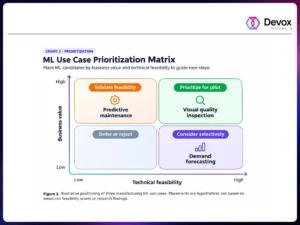
A value-feasibility matrix makes a difference. The business-value dimension considers measurable operational impact, potential financial benefits, and whether the organization can act on the predictions. With this, the feasibility dimension considers data readiness, technical uncertainty, system dependencies, and implementation effort. To sum up, an initial manufacturing shortlist might look like this:
| Machine learning use case | Potential business value | Primary feasibility uncertainty |
| Predictive maintenance | High | Incomplete historical failure records |
| Visual quality inspection | High | Image labeling and inspection workflow integration |
| Demand forecasting | Moderate | Data consistency and forecast integration |
The matrix exposes trade-offs rather than producing an automatic winner. In particular, a candidate offering substantial savings but having weak data foundations may require extra feasibility work before it can compete for pilot funding. And vice versa, another candidate with more modest projected returns may be suitable for immediate validation.
Account for Integration Dependencies
In practice, training a successful model and deploying a useful operational solution are separate engineering challenges. A predictive maintenance model may use available historical data, but production deployment could require additional connections. That’s why the integration assessment should identify which systems provide inputs, how predictions will be delivered, and what operational process will consume them.
Dependencies involving legacy interfaces, fragmented records, or manual operational workflows can increase implementation effort even when model development appears technically straightforward. These constraints affect the prioritization decision before development funding is approved.
Distinguish Pilot-Ready Candidates
Prioritization should produce an actionable shortlist, not simply an ordered collection of ideas. A practical initial classification is as follows:
| Classification | Recommended action |
| Candidate for pilot validation | Define the pilot scope, success criteria, and unresolved assumptions |
| Requires feasibility assessment | Investigate uncertainties that could materially change the investment case |
| Defer | Resolve data, process, or integration prerequisites before reassessment |
| Reject | Remove opportunities whose expected value does not justify their complexity or where simpler solutions are sufficient |
If a use case needs further feasibility work, it doesn’t mean it’s pilot-ready merely because it ranks highly on potential ROI. Similarly, deferring an application does not necessarily mean abandoning it. The decision record should identify which prerequisites must change before the opportunity can be reconsidered.
Focus on Investment Decision, not Getting a Use Case List
Discovery does not need to prove that a production model will succeed. Its main purpose is to define the opportunity and identify the conditions under which additional investment would be justified. That’s why you need to follow a simple framework described here.
Use Standardized Evaluation Cards
Rather than relying on separate presentations from operations, IT, and business stakeholders, decision-makers can review consistent information for each candidate. A useful evaluation record includes:
| Evaluation field | Required information |
| Operational problem | The specific condition or process requiring improvement |
| Business owner | Person accountable for the operational result |
| Target KPI | Metric used to evaluate improvement |
| Prediction target | Output the proposed ML model would generate |
| Operational action | Decision or workflow influenced by the prediction |
| Data sources | Required operational systems and records |
| Expected value | Financial assumptions and potential benefits |
| Technical dependencies | Data, architecture, and integration requirements |
| Unresolved risks | Assumptions requiring further investigation |
The card should state only confirmed facts. For example, a manufacturer may have verified annual downtime costs but an untested assumption about how much downtime predictive maintenance could prevent. If you document both separately, the business case will be more transparent and feasible.
Add Data, Architecture, and Business Assumptions in Assessment
These may involve the suitability of historical data, the ability to produce useful predictions, the availability of integration interfaces, or the operational conditions required to achieve savings. Each material assumption should be linked to a validation activity.
| Unresolved assumption | Validation activity | Investment implication |
| Historical failure records can support model training | Assess event coverage, labels, and associated sensor history | Determines whether the proposed prediction can be tested |
| Maintenance teams can respond to predicted failures | Review scheduling and intervention workflows | Influences achievable operational value |
| Existing MES interfaces support the required integration | Assess interfaces and architectural dependencies | Influences deployment scope and cost |
Architecture discovery may be especially relevant when existing systems have undocumented dependencies. Devox Software’s AI-powered architecture discovery for a legacy monolith offers a related example of architecture-focused investigation, although it should not be interpreted as evidence of a specific ML feasibility methodology.
The assessment should establish what is known, what remains uncertain, and what investigation would resolve the most consequential risks.
Argument for a Go-Defer-Reject Decision
The final output should connect the evidence gathered during discovery to a specific recommendation.
Go: Proceed to a defined pilot or proof of concept when the business objective is measurable, critical prerequisites are sufficiently understood, and the remaining uncertainties can be tested within a controlled scope.
Defer: Address missing data, unresolved integration dependencies, or other prerequisites before committing to model development.
Reject: Do not advance opportunities where the expected benefit is insufficient, the required operational decision is not meaningful, or a simpler solution adequately addresses the problem.
A pilot should test specific assumptions about model performance, operational usability, and technical feasibility. Production investment requires a separate assessment of deployment readiness and ongoing operating requirements. Likewise, a deferred opportunity needs a defined condition for reassessment. Otherwise, it risks remaining indefinitely on the innovation backlog.
Need help with ML use case assessment on your own? We’ve made an ML readiness checklist for operations data and more for you to be prepared for transformations before investing in development. Download our checklist and ensure the measurable results of our ML use cases.
Closing: Prioritize ML Use Cases Before Committing to Development
The objective of ML discovery is to establish which opportunities can create measurable operational value and which are sufficiently feasible to justify the next investment. That requires more than comparing projected ROI. Business outcomes must be connected to prediction requirements, data suitability, implementation dependencies, and the organization’s ability to act on model outputs.
For decision-makers, the result should be a defensible shortlist: opportunities ready for validation, initiatives requiring prerequisite work, and candidates that should not receive development funding. The next investment should resolve a clearly defined uncertainty rather than simply advance the most appealing ML idea.
Have several ML opportunities but no defensible basis for choosing which to pursue? Devox Software’s software project discovery phase provides a starting point for clarifying software requirements, technical dependencies, and project scope before development. Discuss your proposed initiative and determine what needs to be established before committing to implementation.
Book a call
Frequently Asked Questions
-
What is the purpose of an ML and AI discovery workshop?
An ML discovery workshop helps organizations identify and evaluate ML use cases before investing in development. It brings business and technical stakeholders together to define operational problems, assess potential business value, review data availability, and identify implementation constraints. The expected outcome is a shortlist of opportunities with documented assumptions and clear next steps.
-
How do you prioritize ML use cases?
ML use cases should be evaluated against business impact, data readiness, technical feasibility, implementation effort, and operational risk. A value-feasibility matrix helps compare competing opportunities using consistent criteria. The highest-ROI idea is not automatically the best starting point: a use case with accessible data and fewer integration dependencies may be more suitable for an initial pilot.
-
What is the difference between an AI discovery workshop and an AI feasibility study?
An AI discovery workshop focuses on identifying opportunities, defining business requirements, and determining which ML use cases deserve further investigation. An AI feasibility study examines whether a particular solution is technically and operationally viable. It may assess historical data, prediction requirements, system dependencies, and implementation constraints. Discovery helps determine what is worth investigating; feasibility assessment helps establish whether an identified opportunity can realistically move forward.
-
How do you know if your data is ready for machine learning?
ML data readiness depends on more than the amount of information available. Organizations need to assess historical coverage, missing records, data consistency, accessibility, and the availability of target labels for supervised learning. In manufacturing, this often involves connecting information from ERP, MES, equipment sensors, and maintenance systems. An ML use case may need additional data collection or preparation before model development is feasible.
-
How do you build a business case for machine learning?
A business case for machine learning starts with the measurable cost of an operational problem, such as equipment downtime, production scrap, or unnecessary maintenance. It then estimates the improvements that predictive insights could enable and compares their potential financial value against data preparation, development, integration, and ongoing operating costs. The assessment should also consider false predictions and whether employees can act on model outputs.
-
What should an ML discovery process deliver?
ML discovery should produce a documented evaluation of shortlisted ML use cases, including operational KPIs, expected business value, required data, technical dependencies, and unresolved risks. Each candidate should have a recommended next action: proceed to pilot validation, conduct further feasibility work, defer until prerequisites are resolved, or reject the opportunity. These outputs help decision-makers allocate investment based on evidence rather than assumptions.
-
When is a machine learning use case ready for a pilot?
A use case is a reasonable candidate for pilot validation when it addresses a measurable business problem, has an identifiable prediction target, and appears to have sufficient data for testing. Its critical technical dependencies should be understood, and the pilot must have defined success criteria. Pilot readiness does not mean production readiness: the pilot is intended to test whether the model can deliver useful predictions and whether those predictions can support the intended operational outcome.