


Before investing in an ML pilot, there is one obligatory thing: understanding whether the required records are based on reliable data workflows or not. If not, the first obstacles may appear way before model development begins, as manual CSV exports and custom integration scripts, common for legacy systems.
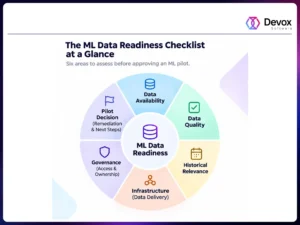
This way, you need to identify these dependencies before building a model. This is exactly we we compiled this machine learning readiness checklist – to help you prepare your ML pilot, even if it’s the first. The checklist examines data availability, ML data quality, infrastructure, governance, and many more. So you’ll identify known barriers, document requirements, and determine what needs further AI readiness assessment before an ML investment decision.
Summary: Successful machine learning projects start with reliable, accessible, and relevant operational data. Before launching an ML pilot, businesses should evaluate data sources, identify quality issues, verify historical coverage, map integration dependencies, and clarify data ownership and access permissions.
Data Flows: Can Your ML Pipeline Access the Operational Records It Needs?
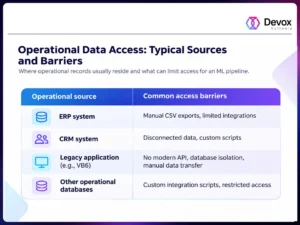
Before building an ML model, establish whether the required operational records can be accessed and delivered to a data processing workflow. It means that present data may already be scattered around ERP, CRM, and legacy apps across industrial data pipelines, but you can’t use it consistently. This is how you can prepare your data in 3 directions.
Operational Records Assessment
Start by identifying where the records from ERP, CRM, and Legacy Data Sources for the intended ML use case reside. The assessment should establish which source systems contain the required records and whether those records can be extracted:
- Identifying the operational systems containing relevant records
- Determining how the required records can be accessed
- Documenting records that are unavailable through existing integrations
The resulting source-system inventory should show data that can be accessed through existing workflows from data that requires additional integration work.
Manual CSV Exports
Older enterprise apps often depend on CSV exports and manual data transfers because their systems cannot communicate directly with modern applications through APIs or webhooks. These workflows become an additional operational dependency and barrier to an ML initiative that’s ehy you need to identify datasets currently transferred through CSV exports, determine which exports depend on manual employee actions, and then document extraction steps.
Custom Integration Scripts
Typically, custom integration scripts give access to isolated operational systems; however, they also add dependencies. Wrapper scripts transfer information between older systems and modern platforms, so the team should establish which scripts are involved and what role they play in extracting or transferring the required records. You need to check the following:
- Custom scripts used to extract operational records
- Source systems and destinations connected by each script
- Integration dependencies that could interrupt data delivery
This way you establish which existing connections can support the intended workflow and which require further technical inspection.
ML Data Quality: Which Data Quality Issues Must Be Resolved Before ML Data Ingestion?
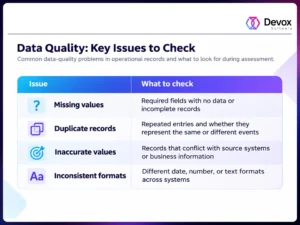
Data quality for machine learning needs to be assessed, that’s true, but not at once. First of all, identify problems in source records to distinguish them from ingestion requirements and document the preparation work to be done. The specific machine learning data quality requirements, however, need to be determined for the intended ML use case rather than assumed from the existence of a dataset. There are 3 ways to do it.
Source Records
Examine source records that need to be corrected or further validated before downstream processing. The assessment should document missing values, formatting inconsistencies, and suspected inaccuracies rather than assuming that the ingestion pipeline will automatically resolve them, including:
- Source records with missing values or fields
- Differences in data formats across operational sources
- Suspected inaccuracies that require validation against source systems
- Issues which have an established correction method
As a result, each identified issue should be associated with the affected dataset and its source system. This provides a basis for scoping preparation work.
Duplicate Records in the Preprocessing Pipeline
Deduplication is an identifiable preprocessing activity, but the appropriate treatment of repeated operational records depends on their meaning within the source system. For example, the assessment must distinguish records that have been duplicated unintentionally from repeated entries that represent separate operational events. So what to do? Use this checklist:
- Determine whether duplicate records have been identified in source datasets
- Identify any existing deduplication steps
- Document datasets that require further duplicate analysis
- Record unresolved questions about which records should be retained
The purpose is to identify duplicate-related preparation requirements, not automatically remove all repeated records.
Source Data Cleaning
Data preparation also implies that you establis the workflow through which operational information enters downstream processing: cleaning, format normalization, preprocessing, and ingestion configuration, and so on. Combining them into one undefined preparation task complicates understanding of the implementation requirements. The assessment distinguishes problems in source records to configure the ingestion process, suc as:
- Documenting cleaning tasks associated with existing source records
- Identifying preprocessing activities that need to occur before ingestion
- Separating source-data corrections from ingestion pipeline development
- Recording dependencies between cleaning activities and downstream data processing
As a result, you can understand the next step: correcting records, developing preprocessing logic, or establishing the ingestion workflow.
Historical Records: Do Historical Records Contain the Evidence for Your Prediction Target?
Historical data readiness checklist depends on whether existing operational records correspond to the outcome a business wants its ML model to predict. For this transparency, establish which historical records are available, whether relevant periods are represented, and whether actual outcomes can be identified because the historical records alone don’t mean they suit a particular prediction task.
Prediction Target Suitability
The first assessment is to connect available historical data to the intended prediction outcome. As operational information is often distributed across different systems, a historical record doesn’t mean it’s relevant merely because it belongs to the same business process. You need to document which records are associated with the intended outcome:
- Define the operational outcome the proposed ML model is intended to predict
- Identify historical records associated with that outcome
- Map those records to their original ERP, CRM, or other operational systems
- Document information required for the intended prediction
This mapping keeps the assessment specific to the proposed ML application instead of treating the entire operational database as a potential training dataset.
Missing Periods in Historical Data Coverage
Records may be unavailable because they remain in separate applications, cannot be retrieved through existing workflows, or were never collected. Each situation requires different follow-up actions as follows:
- Identify the earliest and latest available records for each relevant data source
- Document periods for which operational records cannot be retrieved
- Distinguish inaccessible historical records from records that were never collected
- Identify whether recovering unavailable records would require extra integration work
The deliverable here is a documented view of historical coverage and outstanding gaps. If you see missing periods, reconsider the ML initiative because the specific prediction task depends on the particular historical coverage.
Recorded Historical Prediction Outcomes
A business may have access to past operational activity without knowing where the corresponding outcomes are recorded. Before model development, establish whether these outcomes can be identified and associated with the relevant historical records by identifying:
- Where actual historical outcomes are recorded
- Whether outcome records are accessible through existing systems
- Any missing outcome information
- Unresolved questions about historical records and their corresponding outcomes
The resulting assessment should establish which historical inputs and outcomes are available for technical evaluation. It should not be interpreted as proof that the available data readiness assessment is sufficient to train or validate a model.
Data Infrastructure: Can Existing Data Infrastructure Support Repeatable ML Data Delivery?
Before investing in ML development, identify where data transfers depend on manual operations, legacy integrations, or preprocessing steps that could interfere with repeatable delivery. It could be legacy applications, manual exports, and custom integration scripts may all introduce dependencies that need to be evaluated.
Data Transfers
Document how operational records move from their original systems into downstream processing. Legacy applications rely on database connections and integration mechanisms that were not designed for modern analytics workflows. That’s why the infrastructure assessment should trace the complete transfer path, including the source database, extraction mechanism, intermediate processing steps, and destination. Some advisable actions include:
- Identifying operational databases supplying records for the intended ML use case
- Documenting how records are extracted from each source system
- Mapping intermediate files, scripts, or applications involved in data transfers
- Identifying which parts of the transfer path lack a documented integration mechanism
A documented data flow allows the project team to identify dependencies before deciding whether existing components support the proposed ML workflow.
Manual Handoffs and Custom Scripts
Manual transfers and custom scripts connect legacy applications to downstream systems. However, different extraction mechanisms create different operational dependencies. For example, a scheduled file export and an employee-initiated transfer should not automatically be treated as equivalent. That’s why the business needs to determine which mechanisms are currently used and whether they can provide the records required by the proposed ML application by identifying:
- Extraction tasks that require manual employee actions
- Scheduled exports and their associated source systems
- Custom scripts involved in transferring operational records
- Dependencies on specific applications, scripts, or manual handoffs
- Transfers that require further technical evaluation
Preprocessing Dependencies
Cleaning, format normalization, preprocessing, and ingestion configuration should be examined as separate activities. If records require format normalization before ingestion, for instance, the infrastructure review needs to establish where that activity occurs and which component performs it. Any way, an ingestion tool should not be assumed to resolve every machine learning data quality problem automatically; instead, use these techniques:
- Identify preprocessing activities required before data ingestion
- Document the system or workflow responsible for each preparation step
- Map dependencies between data extraction, cleaning, and ingestion
- Identify preparation activities that have no assigned processing component
- Record infrastructure changes that require further technical evaluation
Separating these dependencies, you distinguish source-system connectivity issues from data preparation and ingestion requirements.
Access: Who Controls Access to and Maintenance of Operational ML Data?
Before operational data is used in an ML project, establish who owns the relevant datasets, who can access them, and who is responsible for maintaining the systems that supply them because unresolved ownership and access requirements should be documented before the organization commits to a pilot.
Permissions and Privacy Controls
A system’s ability to export operational records does not, by itself, establish that those records are approved for use in an ML workflow. The assessment should therefore examine existing access permissions and privacy-related restrictions before datasets are incorporated into downstream processing. For this, act as follows:
- Identify existing permissions governing access to relevant ERP, CRM, and database records
- Document which systems or teams currently have authorized access
- Identify datasets containing information subject to existing privacy restrictions
- Record unresolved authorization requirements for the proposed ML workflow
- Determine which access decisions require review by the responsible data owner or security team
If there are any specific regulatory requirements and privacy controls, use their guidelines. The immediate goal is to identify existing restrictions and unresolved authorization decisions.
Responsibility for Maintaining
The governance assessment should establish who is responsible for maintaining those components. This is particularly relevant where data delivery depends on custom integration scripts, manual transfers, or processing workflows maintained by different teams. So we recommend to identify:
- The team responsible for maintaining each operational data source
- Who maintains data cleaning and preprocessing workflows
- Responsibilities that have not been assigned and establish which unresolved maintenance questions must be addressed before an ML pilot decision
As a result, you get a responsibility map connecting operational data sources with the workflows that supply them. In any case, unresolved ownership, authorization, and maintenance questions should remain visible in the final readiness assessment.
Summing Up: What Must Be Resolved Before the Business Can Decide on an ML Pilot?
Consolidate the findings from their readiness assessments into three categories: access issues, preparation and infrastructure work, and unresolved historical data or governance questions.
- Document Legacy-System Access Barriers. Identify access problems: manual CSV exports, disconnected legacy applications, and custom integration scripts are examples of dependencies worth examining. The resulting access remediation register should connect each identified issue to its source system and affected dataset.
- Separate Data Cleaning Work from Infrastructure Integration Work. Correcting inconsistent records is a different activity from establishing access to an isolated legacy database.
- Record Unverified Historical Data and Governance Requirements. The final check is to identify which readiness questions remain unanswered.
Questions that have not been resolved should remain for further assessment and tracked. The completed assessment can be organized into the following decision record.
| Assessment outcome | What it means | Next action |
| Documented remediation need | A specific data access, preparation, or infrastructure barrier has been identified | Define and evaluate corrective work |
| Further verification required | Historical data suitability, governance, or another readiness condition remains unconfirmed | Obtain the missing evidence before making an approval decision |
| No barrier identified in the assessed area | The review found no outstanding issue within that particular area | Record the finding without treating it as confirmation of overall ML readiness |
The completed checklist should give stakeholders a consolidated record of operational data sources, accessibility constraints, machine learning data quality issues, historical data gaps, infrastructure dependencies, and unresolved governance responsibilities.
The next step is to translate those findings into a scoped technical assessment. Focus on the systems and datasets required for the intended ML use case, document remediation dependencies, and establish the additional evidence needed for a defensible pilot decision.
Explore how our AI readiness framework can help you evaluate data integration and preparation requirements, identify technical constraints, and define the next steps toward an informed ML implementation decision.
Need ML integrations for your apps? Consult an expert
Frequently Asked Questions
-
How do you know if your business data is ready for machine learning?
A readiness assessment should examine six areas: data availability, machine learning data quality, historical coverage, infrastructure, governance, and unresolved implementation requirements. Passing these checks does not automatically guarantee that a dataset is suitable for model training.
-
What data quality for machine learning issues should businesses check before starting an ML project?
Businesses should examine missing values, duplicate records, inaccurate information, and inconsistent data formats. They should also identify which issues originate in source systems and which can be addressed through preprocessing. The significance of each problem depends on the intended ML use case, so a universally acceptable error rate cannot be assumed.
-
How much historical data is needed for machine learning?
There is no universal amount of historical data that guarantees machine learning readiness. Businesses first need to establish whether their records cover the relevant operational periods, correspond to the prediction target, and include the outcomes needed for evaluation. The appropriate dataset size and historical coverage must be determined through use-case-specific technical assessment.
-
Can businesses use data from legacy ERP and CRM systems for machine learning?
Yes, provided the required records can be accessed and prepared for downstream processing. Legacy applications may depend on manual CSV exports, custom integration scripts, or database connections that complicate data extraction. Businesses should map these dependencies and determine whether existing workflows can support the intended ML project before investing in new infrastructure.
-
Does operational data need to be completely clean before starting an ML pilot?
Not necessarily. Businesses should identify known data quality in machine learning problems and determine whether they affect the proposed use case before deciding how to proceed. Some issues may be addressed during preprocessing, while others require corrections in source systems. The decision to proceed should depend on documented technical requirements rather than an assumption that every record must be perfect.
-
What should a machine learning readiness assessment include?
A practical assessment should produce a source-system inventory, documented data-quality issues, historical record coverage, a map of extraction and ingestion workflows, and a register of ownership and access requirements. It should also identify unresolved dependencies and distinguish remediation work from questions requiring further validation. These findings provide a basis for scoping the next stage of an ML initiative.
-
What should a business do if its operational data is not ready for machine learning?
The business should identify the specific barriers before investing further in model development. This may involve resolving access limitations, evaluating cleaning requirements, improving extraction workflows, or clarifying dataset ownership and permissions. The next step is to prioritize these issues against the intended ML use case and establish what additional evidence is needed before approving a pilot.