
Imagine flying an airliner jet using only yesterday’s weather forecast. That’s what running logistics on legacy transportation systems feels like today, navigating volatility with outdated instruments, blind to the turbulence ahead. CTOs already own dashboards. Margin now moves when the platform can restow a load, reprice a slot, or re-cut capacity while the shipment is still in motion.
McKinsey’s data show that while 85% or more of logistics companies see value from digital investments, fragmented systems and poor data quality remain key barriers to achieving real ROI. Up to 19% of logistics costs are attributed to inefficient handoffs between systems and vendors.
The scarce asset is execution authority: a live signal that writes a new plan into TMS and WMS while the window is still open. In this guide, we’ll show CTOs how to build for real-time responsiveness — from streaming architecture to decision logic that adapts on the fly. Every nuance matters, and we break them down: how to expose legacy logic, reduce integration debt, and design operations that move with the market.
What’s at Stake: Risks of Outdated Systems
In logistics, latency compounds. Legacy systems, structured for batch processing, introduce blind spots where real-time visibility should be available. As AI-native competitors use logistics network optimization software to optimize routes mid-transit and reprioritize inventory in-flight, enterprises locked into static platforms are falling behind. Tariffs now sit within landed cost as a standing line item. KPMG’s 2026 tariff work shows 78% of organizations reporting higher COGS. Thomson Reuters finds 72% of trade leaders naming U.S. tariff volatility as the year’s dominant regulatory shock. Treat origin, duty, and contract clauses as inputs the planning engine recalculates on every bid. Visibility is already bought. The remaining gap is decision latency. FedEx’s February 2026 Future of Logistics Intelligence report finds 97% of leaders treating track-and-trace as table stakes. Infios finds that 79% of U.S. supply chain leaders are staking their advantage on execution speed. Gartner’s March 2026 forecast sets the operating target: by 2031, AI will resolve 60% of supply chain disruptions without a human in the loop.
Gartner finds that 76% of supply chain executives are facing more frequent disruptions than three years ago. The scarce asset is hours of response time after the first signal.. In the U.S. alone, inefficient handovers and poor telemetry may generate up to $95 billion in losses annually. Between 13- 19% of logistics costs stem from ‘blind handoffs’ when parties can’t coordinate delivery or operations effectively due to siloed systems. Recent data shows the visibility gap remains acute: only 6% of organizations have full end-to-end supply chain visibility, while 57% of supply chain professionals cite lack of visibility as their top operational challenge. Additionally, 21% of leaders still operate without real-time visibility into supplier disruptions, and 42% say the lack of real-time data is the primary barrier to effective disruption response.
Fragmented legacy ecosystems, built without native data pipelines or sensor integration, cannot provide granular, real-time snapshots. Disconnected systems turn real-time signals into late decisions. The impact goes even further: a lack of real-time visibility prevents proactive intervention. If temperature deviations in a cold chain are detected hours too late or never detected at all, the damage affects not just operations but also reputation. In regulated industries, blind spots can put both certification and customer trust at risk. Beyond compliance and reputation, the absence of real-time optimization exacts an increasing environmental cost. Real-time route optimization and dynamic decisioning can reduce transportation emissions by 20-30%. Samsara’s work with DHL Express cut road accidents 26% in year one and cut accident cost nearly in half. Keep ORION as a heritage benchmark: about 100 million miles, 10 million gallons of fuel, and 100,000 metric tons of CO₂ avoided each year.. AI-driven interventions in logistics consistently reduce fuel consumption by 12–15%, thereby lowering Scope 3 emissions and supporting both cost and ESG objectives.
Integration Debt: Every New Tool Becomes a New Problem
Most logistics tech stacks now use 10+ different digital tools. Yet, over 40% of executives say these solutions take longer than expected to deliver ROI due to data fragmentation and lack of system integration.
Conversely, legacy cores, designed without modularity, resist change. Every new integration requires custom wrappers, point-to-point hacks, and constant monitoring. Over time, such an approach builds “integration debt”: a fragile mesh of adapters, batch scripts, and unscalable middleware. The major risk lies in how quickly these inefficiencies normalize. Within a few years, teams completely absorb these workarounds into their standard operating rhythm. At that point, standard reporting metrics completely obscure the true cost. The cost of this fragmentation is now quantifiable: 67% of enterprises report that ROI from visibility and digital tools has stalled precisely because of continued reliance on fragmented legacy systems. In regulated environments, the same architectural debt also blocks compliance with emerging requirements such as the EU Digital Product Passport, with 27% of executives citing fragmented IT and systems integration as the primary barrier to readiness.
To emphasize, digital twins increasingly sit atop SCM stacks as an optimization layer. On the negative side, older platforms often rely on outdated security mechanisms — unencrypted protocols, monolithic authorization, and unpatched modules. Cloud-native architectures expand the attack surface. Without adaptive security controls, attackers increasingly expose critical operational data.
In practice, though, outdated infrastructures lack the telemetry and resilience to respond quickly or recover fully.
The Cost Curve of Inertia
Operational overhead in legacy-bound environments trends upward. Manual intervention increases as systems struggle to absorb variability.
For legacy-reliant players, what begins as a technical limitation quickly manifests as a margin problem. And in a low-margin industry like logistics, those basis points define the difference between growth and stagnation.
When and What to Modernize
Start with the processes under the most pressure. If critical workflows still rely on manual intervention or batch updates, they limit growth.
#1. Watch for Signal Loss in the Tech Stack
To clarify, legacy platforms often sit in the center of logistics operations, but they weren’t built to emit signals. Can your warehouse system broadcast real-time slotting updates? Can your TMS expose ETA shifts via webhook, not CSV? Event streams are the floor. The 2026 bar is an agent that consumes the event and writes the new plan into TMS and WMS with an audit trail and a rollback path.
If your data architecture processes events only after they’ve settled in a database, you’re making decisions in a stale state. Modern logistics runs on event-driven architecture. Look for silent systems, those that don’t emit events. That’s where modernization delivers exponential visibility.
#2. Every manual workflow points to a process ripe for automation.
I consistently find that manual handoffs involve far more than just the technology itself. They exist right at the intersection of completely isolated systems and teams accustomed to manually bridging the divide. Streamline that workflow, and the conversation instantly shifts: how can this team best reinvest those recovered hours?
Automate through adaptive intelligence:
- Let AI agents capture patterns, refine decisions, and evolve in response to operational nuance.
- Use ML to score and route claims by probability and cost impact.
- Apply NLP to filter, cluster, and escalate inbound messages without human drag.
#3. Prioritize Capabilities
Avoid the trap of system-by-system replatforming. Instead, modernize around capabilities. Want predictive ETAs? Build a real-time event ingestion layer first. Want proactive risk mitigation? Start with a digital twin of your supply chain. Then let that capability tap into existing systems via API or middleware.
#4. When Systems Lock You into Yesterday’s Logic
Still, sometimes the signal is structural: systems that force business users to work around them. If planners use spreadsheets to override your TMS recommendations, or if your WMS requires IT tickets for rule changes, you may find your current systems are no longer enabling agility—they’re limiting it. This is usually the moment when the conversation in the room changes. I’ve sat with COOs who say, “We already know the right decision — the system just won’t let us make it fast enough.” When that happens, you’re no longer talking about technology debt. You’re talking about competitive disadvantage that compounds every single day.
Modern logistics platforms push decision-making closer to operations. If your stack slows that down, it’s time to modernize.
Tech Stack for Future-Proof Logistics
Modern logistics platforms are built to detect change and act on it in real time.
Composable Architecture
Decomposing legacy functions into modular services reduces complexity. Core logistics services operate independently, enabling faster iteration and lower risk. Legacy cores remain stable while adjacent services modernize.
A cloud-native, event-driven architecture provides the flexibility needed to respond to changing demand. It scales automatically and maintains reliability as operational workloads evolve.
Unified Data Fabric
Operational data must converge into a unified data plane. Streaming ETL and real-time validation feed models and dashboards with accurate, current state.
Embedded AI/ML
Intelligence belongs inside the workflow, where it can drive decisions in real time. LLMs generate documents and summaries. Automation at the decision point removes friction and scales execution.
A predictive ETA model must feed dispatch sequencing. Load planning models must adjust to dynamic constraints. Current benchmarks confirm the scale of opportunity: 35% of logistics companies are now actively deploying AI, achieving an average ROI of 190%. AI budgets already exist. BCG’s 2026 logistics survey shows 70% of operators have an AI strategy and 67% have a dedicated budget, with 13% reporting a measurable P&L result. McKinsey’s August 2026 State of AI puts some EBIT contribution at 37% and high performers near 6%. Returns appear once models write decisions back into dispatch, slotting, and inventory. McKinsey research shows AI-enabled distribution operations deliver 5-20% reductions in logistics costs and 20-30% reductions in inventory carrying costs. The bottleneck has moved. Strategy papers are common. P&L appears after the model has written back into the core stack.
API-Powered Integration
Clean, versioned APIs turn core logistics functions into reusable services.
Process Visibility & Digital Twins
Digital twins reflect operational reality. When combined with process mining, they reveal inefficiencies and enable simulations. Teams move from reaction to preemption using real-time visibility.
Organizational Enablement
Platform teams and domain squads own services and ship changes. CI/CD pipelines, observability tooling, and low-code controls give teams control without chaos. Security controls must move as fast as the logistics network they protect.
Roadmap: From Assessment to Impact
To illustrate the concept, strategic modernization in logistics begins with operational truth. Before you change the architecture or the tools, you must first gain clarity. You need to understand where operational friction occurs. This is where process mining comes into play. It maps how operations really run and reveals process inefficiencies.
Prioritize capabilities that generate immediate operational leverage.
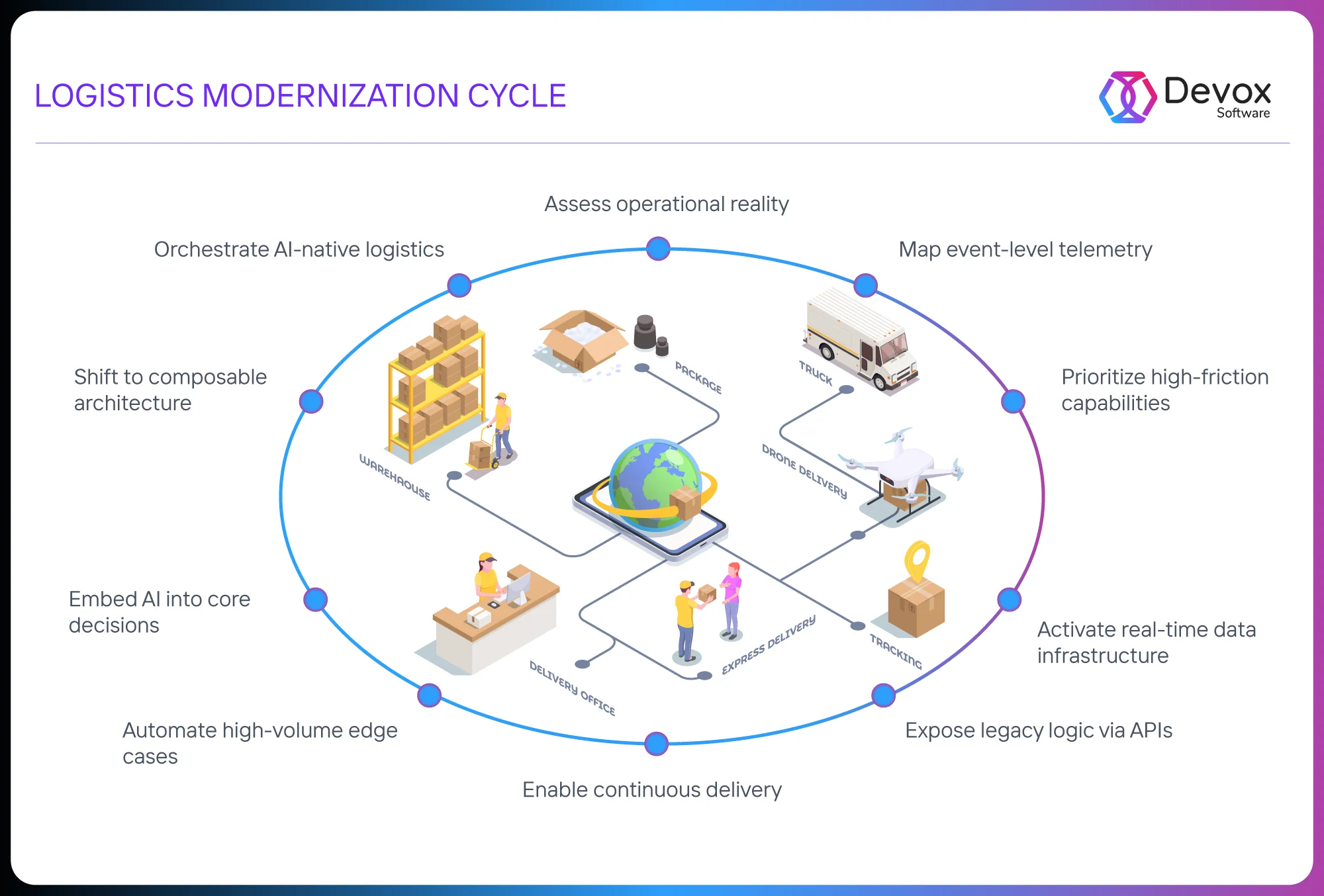
Below is a proven progression of 12 interlinked modernization cycles that logistics leaders follow to achieve measurable operational lift:
- Map Event-Level Telemetry. Capture granular signals across logistics operations to create a unified operational truth.
- Prioritize High-Friction Capabilities. Identify the workflows where latency creates cost, and target them for automation or augmentation.
- Activate Real-Time Data Infrastructure. Build streaming pipelines and shared models that support live-state decision-making.
- Expose Legacy Logic via APIs. Wrap core functions in callable interfaces to enable orchestration across internal and partner systems.
- Introduce Intelligent Automation Agents. Deploy ML agents to automate routine decisions.
- Automate High-Volume Edge Cases. Embed low-code and AI-driven automation in repetitive processes like exception handling or reconciliation.
- Embed AI into Core Decisions. Use ML and LLMs in core logistics decisions.
- Shift to Composable Architecture. Refactor monolithic systems into modular services that scale and evolve independently.
- Enable Continuous Delivery. Empower platform teams to iterate quickly with continuous delivery practices.
- Orchestrate AI-Native Logistics. Let real-time engines coordinate network operations.
- Monetize Operational Intelligence. Turn visibility and precision into revenue — premium service offerings.
A global mid-sized logistics company was under increasing pressure. Legacy TMS and WMS systems were struggling to keep pace with customer expectations, while margin erosion from missed SLAs and manual exception handling was limiting reinvestment. What started as a technical refresh quickly evolved into a strategic modernization program led by the CTO and Head of Operations.
By automating planning and routine operations, the company reduced costs and reinvested the gains in customer-facing capabilities rather than headcount. Instead of ripping out the legacy core, they exposed the business logic via APIs and wrapped it in a composable orchestration layer. This allowed them to integrate new services such as provider portals, forecasting models, and pricing systems without having to rewrite the base. Within a year, they were no longer just “moving freight” but optimizing freight networks.
The logistics department, once a cost center, began to generate new revenue: SLA-supported services, premium fulfillment, and real-time delivery guarantees for first-class customers.
Automation Intelligence: A New Operational Lever
The edge now negotiates and makes decisions using live operational data.
This shift moves contract logic closer to where value is created — at the frontline. Instead of waiting on legal or procurement cycles, dispatch planners see auto-generated supplier options ranked by business value. The negotiation surface becomes dynamic.
The most compelling evidence comes from real-world deployments like DHL’s AI-powered coaching platform. Generative AI is moving into frontline operations. Samsara’s work with DHL shows what that looks like in practice.
. By streaming computer vision alerts and real-time driver telemetry into an AI-powered coaching system, DHL Express reduced road accidents by 26% in the first year and cut total accident costs nearly in half.
The same edge-AI layer identifies idle assets across the network. Sensors expose utilization gaps, with 10-20% of fleets remaining idle for weeks. Redeploying or liquidating this latent capacity releases millions in trapped capital. Gartner predicts that by 2031, AI will resolve 60% of supply chain disruptions without human intervention, enabling increasingly autonomous supply chains.
AI is also moving into frontline negotiation. Pactum shows how automation can improve working capital and supply resilience.
For those who’ve moved procurement to the edge, the returns arrive before the quarter closes.
Harvard Business Review, July 2025, “How AI Is Reshaping Supplier Negotiations”: AI now shapes supplier terms from live capacity, spend, and market context. Treat every contract as a living asset the edge can retune inside agreed guardrails.
Checklist: Are You Ready to Modernize?
Evaluate each dimension against your current state. A company with three or more gap indicators enters a “modernization mandate” zone where competitive risk accelerates.
| Dimension | Readiness questions CTOs should ask | Clear readiness signal | Gap indicator | First action to close the gap |
| Process visibility | Do we see every order-level event and exception in real time? | End-to-end telemetry feeds dashboards and process-mining maps; latency measured in seconds | Blind spots appear in the map; manual status checks persist | Deploy event capture on TMS / WMS and run process-mining discovery |
| Data readiness | Can analytics engines consume unified, high-quality data without rework? | Streaming pipelines deliver clean, schema-governed data to ML feature stores | Multiple CSV hand-offs; data quality fixes happen in Excel | Launch data-profiling sprint; implement real-time validation rules |
| Integration surface | Does every core capability expose a secure API? | External partners call status, pricing, and capacity endpoints through documented interfaces | Point-to-point scripts or EDI only; integration backlogs block customer requests | Wrap legacy logic with REST/GraphQL gateway; publish an internal API catalog |
| AI/automation foundation | Are machine-learning models or bots already driving high-volume decisions? | AI predicts ETAs, assigns dock slots, validates invoices; accuracy tracked in prod | Rule engines dominate; planners override decisions frequently | Stand up pilot model on high-variance lane; embed feedback loop for retraining |
| Security posture | Do zero-trust policies and continuous audits protect every data flow? | Fine-grained RBAC, token-based access, and automated compliance evidence | Legacy VPN tunnels, shared credentials, and limited incident telemetry | Introduce identity federation and real-time log aggregation; run a security drill |
| Change capacity | Can cross-functional squads release platform updates weekly? | CI/CD pipelines, feature flags, and domain-owned microservices support rapid iteration | Quarterly release cycles, centralized change boards slow delivery | Form a platform team, adopt trunk-based development, and deploy feature toggles |
Conclusion
In conclusion, legacy platforms powered global trade for decades—now modernization is turning that legacy into a launchpad. The logistics leaders run architectures that listen, learn, and self-optimize. Data flows in streams, AI acts in milliseconds, and security adapts in real time. Every version that cuts decision latency boosts margins and deepens trust.
Companies that use modern decision intelligence achieve sustained profitability even amid economic turbulence. Legacy systems hold strategic value—make that knowledge visible, useful, and scalable. Organizations treating the initiative strictly as a technology rollout focus entirely on surface-level visibility. You see that financial impact hit the P&L well before it shows up on any architecture diagram.