

By 2026, nearly 9 in 10 organizations report regularly using AI, yet only 39% see real enterprise-level EBIT impact from it. This guide overviews the Gen AI development companies in USA capable of delivering a production-grade, governed system. These are the real firms buyers are actually shortlisting when they search for custom Generative AI solutions, USA.
Although we represent Devox Software’s Generative AI development services, we assessed our company without bias, basing our assessment only on the real track records in the market. We’re open to your evaluation and questions, provided they arise. To proceed and help businesses choose, here is a guide for custom Generative AI solutions, USA, which is not limited to choosing a partner.
Key Points
- Before you proceed with selecting Gen AI development companies in USA, begin with clear goals and specific use cases that can help you guide your AI transformation and generate tasks for a vendor.
- Pick partners with field-proven expertise and strong integration and automation skills, which are not possible without industry-related business knowledge.
- Include continuous monitoring, feedback, and collaboration in the scope for AI systems to deliver lasting value.
How We Built This List: Selection Criteria
Being one of the Gen AI consulting firms, USA, we’ve prepared an editorial ranking, not a paid directory. All data is taken from open web sources; the order of a company listed is irrelevant, as it doesn’t reflect the breadth and depth of proven enterprise delivery and relevance to enterprise LLM work. All things considered, we’ve weighed the following things:
- Proven Delivery Records. At least 5 years of experience in the global software services market with real projects. We’ve checked the evidence of production systems, not demos or slides.
- Cross-industry delivery history. We’ve assessed the experience across regulated domains where governance, integration constraints, and auditability are non-negotiable.
- Engineering Depth. The shortlisted companies host senior teams who own various knowledge fields like architecture, data pipelines, MLOps, and evaluation, all backed by ISO-aligned practices and secure deployment.
We’ve tried to review the points where most enterprise decisions are won or lost in practice. For instance, the experience with RAG as a model in your documents or the mentions of proprietary data governance. As a result, this material shortlists companies showing tangible value for enterprises specifically.
Comparison Table
| Company | Focus | Best for | Engagement model |
| Accenture | End-to-end AI transformation at enterprise scale | Global, multi-year, cross-functional programs | Fixed-fee |
| EPAM Systems | AI-native engineering and GenAI platforms | Production-grade delivery | Dedicated teams |
| LeewayHertz | GenAI orchestration platform | Platform and consulting in regulated sectors | Project-based, dedicated teams |
| N-iX | GenAI consulting and scalable AI engineering | Long-term engineering partnerships | Dedicated teams |
| Turing | AGI infrastructure and enterprise AI systems | Fortune 500 teams | Project-based |
| Master of Code Global | Conversational AI and enterprise chatbots | Customer- and employee-facing assistants | Project-based |
| InData Labs | Data science, RAG, and predictive GenAI | Data-heavy GenAI and analytics use cases | Dedicated teams |
| SoluLab | RAG, document intelligence, and multi-agent copilots | Cross-industry production copilots | Project-based |
| Devox Software | Enterprise LLM integration and secure private-data deployment | Regulated enterprises | Dedicated senior teams, staff augmentation |
| Markovate | Domain-specific agentic AI and fine-tuning | Mid-market, ROI-focused builds | Consulting and building with dedicated teams |
Top Gen AI Development Companies in USA
Here is the list of mainly large, multidisciplinary firms. They are perfect for organization-wide transformations; however, they may be pricey.
Accenture
Brand founded: 2001
HQ: Dublin, Ireland (with US representative office)
Team Size: more than 700k worldwide
Accenture is one of the largest professional firms delivering enterprise generative AI at scale. They pair strategy and data modernization across nearly every industry. For this reason, it is an ideal fit for global enterprises undergoing multi-year, cross-functional transformations; however, it could be overkill for isolated cases and pilots.
Accenture’s differentiator is its extensive end-to-end reach, from boardroom AI strategy to production rollout, supported by strong cloud and data partnerships.
Best for: Global, multi-year transformations
Specializations: Full cycle from AI strategy to deployment
Considerations: Enterprise pricing and pace
EPAM Systems
Brand founded: 1993
HQ: Newtown, Pennsylvania, US
Team Size: More than 60k globally
EPAM is an engineering-first global firm that has repositioned around “AI-native” delivery. Currently, they are building custom production-ready GenAI platforms and production LLM systems. That’s why their clients are enterprises that value deep software engineering and measurable ROI impact over pure consulting services.
Moreover, its differentiator is EPAM DIAL, an open-source GenAI orchestration platform that lets clients assemble agents while keeping strict data governance.
Best for: Production-grade AI delivery
Specializations: AI-native delivery, custom GenAI/LLM, data governance
Considerations: Engineering-first and T&M-heavy
LeewayHertz
Brand founded: 2007
HQ: San Francisco, US (delivery in Gurgaon, India)
Team Size: 180+
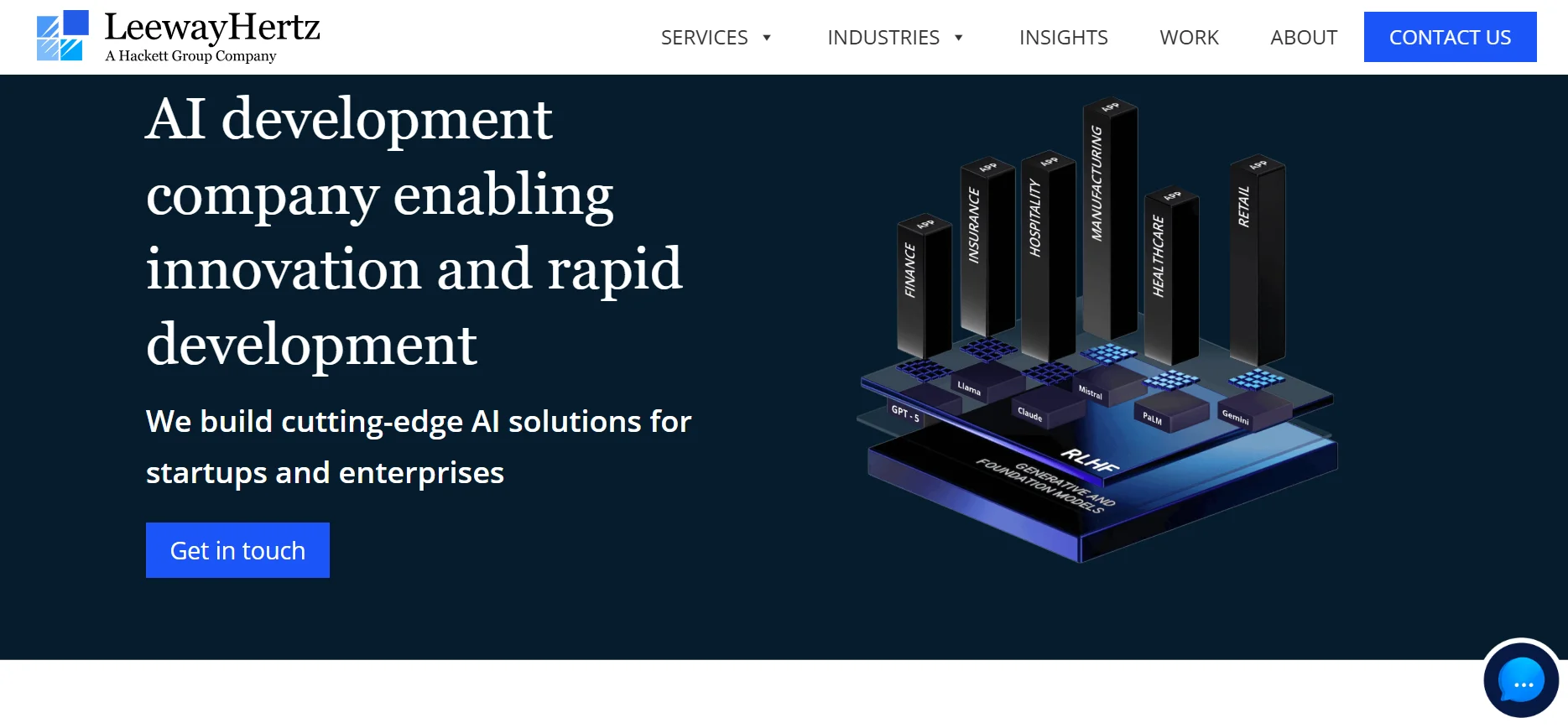
LeewayHertz, from 2024 and now on, is part of NASDAQ-listed The Hackett Group. It’s a Generative AI development company, USA, known for custom LLM applications, AI agents, and its ZBrain orchestration platform, a low-code layer for building, deploying, and governing enterprise AI.
It fits enterprises that want a productized platform paired with consulting, especially in regulated industries like finance, healthcare, and manufacturing. Despite general achievements, ZBrain remains the main differentiator. However, after the transition period passes, who knows what comes next from them?
Best for: GenAI platform
Specializations: ZBrain platform, custom LLM apps, AI agents, RAG, fine-tuning
Considerations: Now integrating into The Hackett Group; enterprise pricing
N-iX
Brand founded: 2002
HQ: Valletta, Malta (originated from Ukraine with representative offices in the US)
Team Size: globally more than 2k
N-iX is a large European-based software-engineering firm whose generative AI practice spans GenAI consulting, RAG development, LLMOps, and enterprise integration. With long track records of delivered projects, it fits organizations seeking a long-term partner that scales teams up and down easily.
Best for: Long-term engineering partnerships
Specializations: GenAI consulting, RAG, LLMOps, enterprise integration, cloud/data
Considerations: Broad services
Turing
Brand founded: 2018
HQ: Palo Alto, California, US
Team Size: 250-999
Turing sits where frontier-model research meets enterprise deployment: one arm feeds data and post-training to leading AI labs, while Turing Intelligence ships enterprise AI systems — fine-tuning curated models on proprietary data and standing up Graph-RAG knowledge systems. It fits Fortune 500 teams wanting lab-grade model expertise in real workflows. Its differentiator is ALAN, its fine-tuning and reinforcement-learning platform, backed by an AI-vetted talent network.
Best for: Fortune 500 wanting lab-grade model expertise
Specializations: Post-training data for frontier labs, Turing Intelligence enterprise AI
Considerations: Enterprise-delivery arm is newer
Top Specialist LLM Integration Firms
Focused, top-rated Generative AI services, USA, that go deep on retrieval, conversational AI, and secure enterprise integration are often a better fit than a global consultancy. If you have a defined use case and are ready to start in no time, this list is for you.
Devox Software
Brand founded: 2018
HQ: Miami, Florida, US (with delivery across Europe)
Team Size: 150+
Devox Software is a US-based engineering partner focused on enterprise LLM development and integration, including RAG systems, autonomous agents, and secure retrieval infrastructure. Under the hood, Devox Software hosts senior engineers keeping architectural ownership and business analysts to fit regulated enterprises in finance, manufacturing, and logistics that need private, auditable LLM deployments.
Devox Software’s main differentiator is a security-first delivery model. Private data deployment is standard for them, backed by internal centers of excellence, including Quality Assurance, Business Analysis, and Project Management offices.
Best for: Regulated enterprises needing secure, private LLM deployment
Specializations: Enterprise LLM development and integration, autonomous agents, RAG systems, and legacy modernization
Considerations: Less brand recognition than the majors
Master of Code Global
Brand founded: 2004
HQ: Toronto, Canada
Team Size: 200+
Master of Code Global is a conversational-AI specialist that has built chatbots, voicebots, and GenAI assistants. It fits companies automating customer support and employee workflows where tone, safety, and channel coverage matter much.
Its differentiator is depth in conversation design plus RAG systems that ground answers in corporate data, delivered under ISO 27001 controls.
Best for: Enterprise conversational AI
Specializations: Chatbots/voicebots
Considerations: Generalist conversational AI vs. deep LLM platform engineering
InData Labs
Brand founded: 2014
HQ: Nicosia, Cyprus (offices in Lithuania and the US)
Team Size: 50+
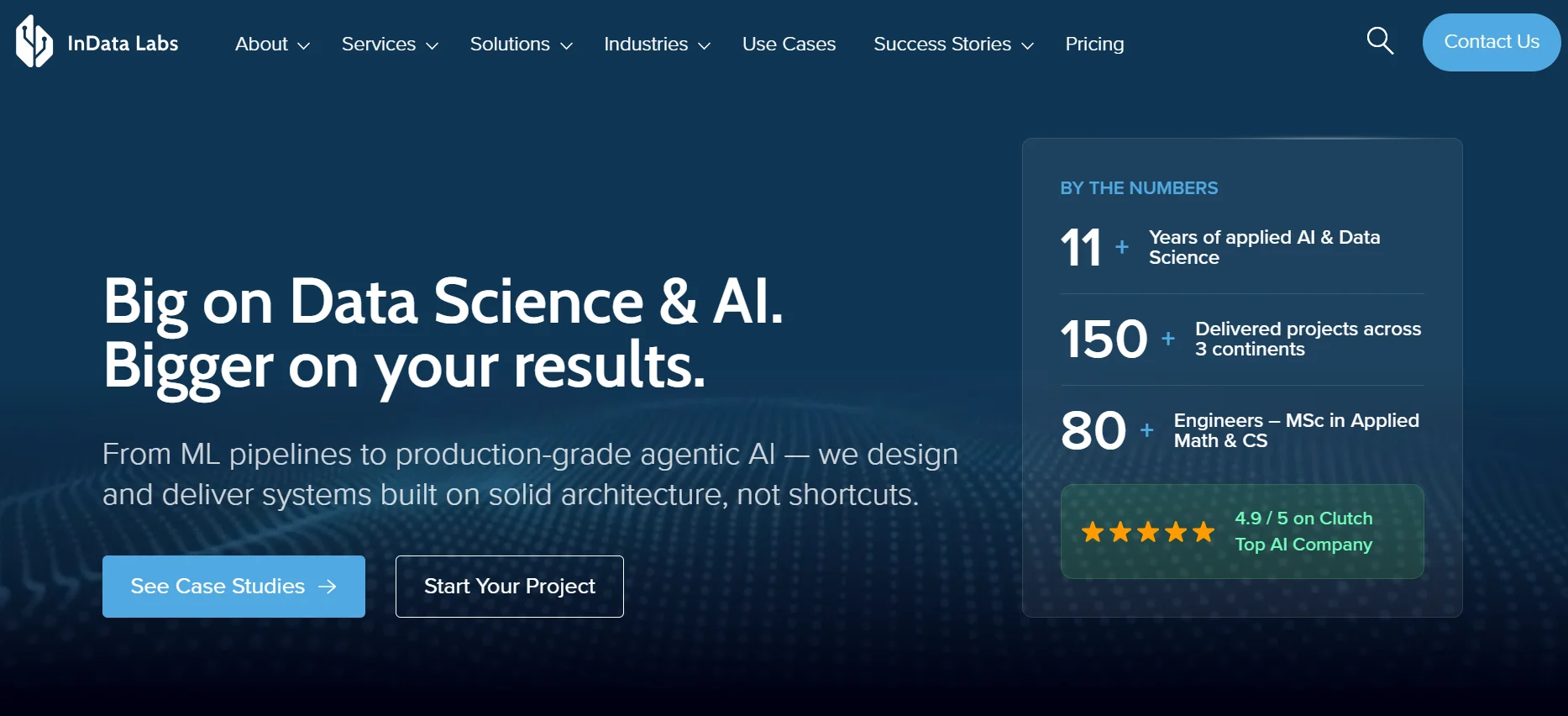
InData Labs is a boutique data-science and AI firm with a full-stack focus. It fits data-heavy use cases where GenAI must sit on solid data foundations, such as forecasting, fraud detection, and document intelligence workflows. They are known for pairing generative features with rigorous ML and MLOps rather than treating them separately.
Best for: Data-heavy GenAI
Specializations: LLMs for predictive analytics, data engineering, CV/OCR
Considerations: Boutique scale
SoluLab
Brand founded: 2014
HQ: Los Angeles, US (delivery in Ahmedabad, India)
Team Size: 200+
SoluLab is a broad AI and software-development company that fits cross-industry buyers who want production systems. SoluLab’s real differentiator is breadth. They build LLM apps, agents, automation, and custom model work under one roof, with governance and cost-optimization frameworks.
Best for: Cross-industry RAG and multi-agent copilots
Specializations: RAG, custom LLM, blockchain, Web3
Considerations: Too broad portfolio, India-centric time zones
Markovate
Brand founded: 2014
HQ: Toronto, Canada (with delivery in San Francisco)
Team Size: 50+
Markovate is a Toronto- and San Francisco-based GenAI firm that fine-tunes LLMs on proprietary data and builds domain-specific agentic systems, copilots, and conversational AI.
Markovate fits mid-market and growth-stage teams that already know which workflow they want to improve and expect measurable ROI. They consult-plus-build with responsible-AI governance on top of that.
Best for: Mid-market/growth, ROI-focused agentic AI
Specializations: LLM fine-tuning on proprietary data, agentic AI, copilots, conversational AI, responsible-AI governance
Considerations: Clear mid-market focus
How to Choose a Vendor: A Roadmap.
Selecting a best Generative AI development company in USA is a strategic decision; that’s why, apart from technical seniority, the right vendor should understand your business niche. As a countermeasure to pitfalls, a structured evaluation reduces implementation risks and ensures the chosen partner can deliver measurable business results.
-
- Step 1. Define Business Objectives. Establish clear success metrics assessing the readiness of your enterprise for AI. Vendors that start with business outcomes instead of technology are more likely to deliver high ROI and lasting value.
- Step 2. Evaluate Technical Expertise. Review the vendor’s experience with enterprise-grade AI systems (RAG, LLM integration, AI agents, MLOps, cloud, ERP, CRM, Microsoft 365, and Salesforce integrations) on production-grade case studies.
- Step 3. Assess Security and Governance. Ensure the vendor offers private or VPC deployments, role-based access control, data encryption, audit logging, and PII protection to comply with relevant industry regulations.
- Step 4. Verify Delivery Methodology. Experienced vendors typically deliver through phased implementation to minimize risk and safeguard value before scaling.
- Step 5. Compare Long-Term Partnership Value. Evaluate whether the vendor provides dedicated engineering teams, long-term support, performance and cost monitoring and optimization, knowledge transfer with documentation and meetings, etc.
Choosing a long-term technology partner often delivers greater value than selecting the lowest-cost Generative AI development company, USA.
Vendor Evaluation Checklist
| Evaluation Area | Questions to Ask |
| Enterprise experience | Have they delivered production AI systems for organizations of similar size? |
| Technical expertise | Can they build RAG, AI agents, and enterprise integrations? |
| Security | Do they support private deployments, encryption, and access controls? |
| Governance | How do they evaluate answer quality and prevent hallucinations? |
| Integration | Can they integrate with our existing enterprise systems? |
| Delivery process | Do they follow a phased implementation methodology? |
| Scalability | Can the solution grow with our business? |
| Support | What happens after production deployment? |
| Cost transparency | Are infrastructure, licensing, and maintenance costs clearly defined? |
| Ownership | Will we own our data, prompts, architecture, and source code? |
For more on AI vendor assessment for CTOs, read this article with a detailed scorecard.
The Bottom Line
The vendors among the best Generative AI development company in USA combine deep engineering expertise with enterprise architecture, governance, security, and industry-specific knowledge. That’s why there is no universally “best” generative AI development company. Each could be the best for your specific needs.
Global consultancies may be the right fit for large-scale transformation programs, while specialized AI engineering firms often provide greater flexibility and senior technical expertise. The key is to evaluate your needs and potential partners to forecast possible outcomes.
Devox Software prioritizes long-term partnership value over short-term implementation costs. We build AI capabilities that continue delivering competitive advantages well beyond the initial deployment, whether we build from scratch, modernize existing systems, or integrate AI on top of current systems.
Frequently Asked Questions
-
Which companies build enterprise LLM solutions?
All Gen AI consulting firms, USA, in this guide build production LLM systems. Global engineering partners such as EPAM and N-iX handle large, integration-heavy programs; specialists like SoluLab and Devox Software build RAG pipelines, copilots, and retrieval infrastructure tied into existing enterprise systems. The practical filter is always what you need and at what point you want to get.
-
Who helps enterprises deploy LLMs securely?
Look for custom Generative AI solutions, USA, with private, on-prem, or VPC deployment; retrieval grounding to reduce hallucination; and governance controls.
EPAM, N-iX, and Devox Software are examples. Plus, the latter treats private-data deployment as the default for regulated engagements and measures answer faithfulness before release. Always confirm where your data is processed and who can access it.
-
What is the best Generative AI development company in USA?
Again, it depends on the brief.
US-headquartered or US-based options in this guide include Accenture, EPAM, SoluLab, Devox Software, Turing, and Markovate. Among these, the largest transformations are offered by Accenture and EPAM with the deepest benches. Devox Software is a strong fit with secure, senior-engineer-led LLM integration on a mid-market or enterprise budget.
-
RAG or fine-tuning — which should an enterprise choose?
Start with RAG. Retrieval-augmented generation grounds a model in your own documents, is faster and cheaper to stand up, keeps answers current, and is easier to audit (which matters for regulated data).
Fine-tuning changes the model’s behavior or style and pays off for narrow, high-volume, well-defined tasks. Many production systems combine both. A reliable partner will recommend based on your data and use case rather than defaulting to one approach.
-
How long does it take to implement a generative AI solution?
Even the best Gen AI development companies in USA offer some timelines that depend on the maturity of your data environment and the project scope. For instance, an internal productivity assistant can often be delivered within 8 to 12 weeks if data access and infrastructure are already in place.
Broader enterprise implementations that involve integration, security validation, governance setup, and user rollout typically require 4 to 9 months. Moreover, projects involving custom model fine-tuning, complex RAG architectures, or cross-department deployment may even extend beyond that.