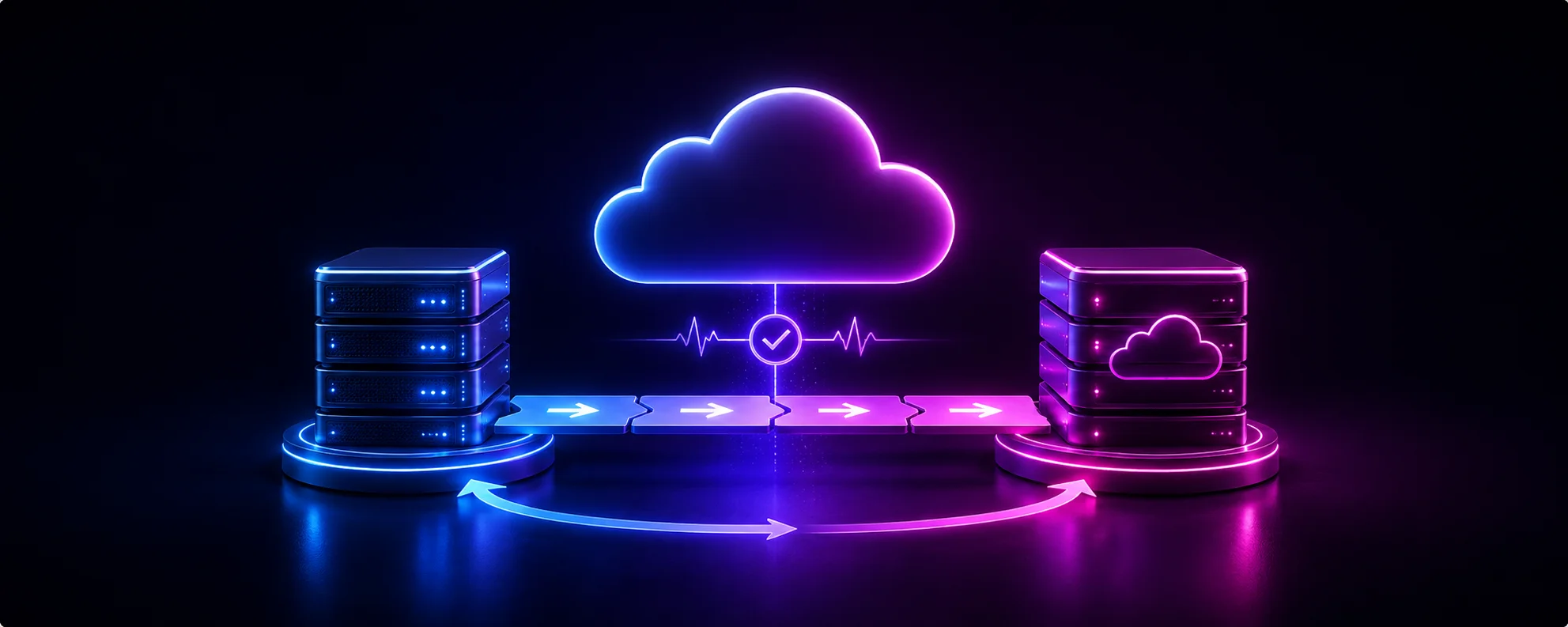
During a migration, checkout, claims, or tax filing must continue to run. That is why zero downtime matters: even a short interruption after cutover can mean failed transactions and cleanup. Rather than treating cutover as a technical milestone, I would run environments in parallel and agree on a parity threshold before traffic moves. For the board, the risk is concrete: how many minutes did the revenue journey actually stay available? Pick the journey that matters — checkout, premium booking, tax submission — and define parity around that. What has changed is that more of this loop can now be orchestrated by agents, while engineers still define the intent, limits, and human approval points.
Treat Migration as the Start of Modernization
In 2026, cloud transformation has moved past one-time migration projects. Organizations now treat migration as the starting point of continuous modernization. Agentic systems are taking on more of the orchestration work. After go-live, the same orchestration layer can continue into optimization and remediation. Large enterprises increasingly operate across multiple clouds and hybrid environments, while sovereign cloud placement grows under regulatory and geopolitical pressure.
Multi-cloud interoperability continues to improve through direct interconnects between major providers. Zero-downtime patterns now rely on parallel validation and agent-orchestrated traffic shifts. Sovereign cloud spend is rising sharply as organizations place regulated workloads closer to jurisdiction requirements.
Agentic platforms can now orchestrate much more of the migration loop, from discovery and wave planning through validation and post-migration operations. The same agents can investigate and remediate anomalies within predefined guardrails.
Give Every Migration Agent a Job and a Limit
One agent discovers the estate and builds the dependency map. Another plans migration waves around residency requirements and blast radius. A validation agent compares the two environments while they run side by side. A cutover agent moves traffic in controlled steps. A FinOps agent can act on cost, but only inside a policy that someone has approved.
People still set the boundaries that matter: the journey SLO, wave and error budgets, data-residency limits, and the spending threshold for human approval.
The underlying plumbing is already showing up across the major platforms. AWS is connecting modernization workflows through Transform and Bedrock AgentCore. Microsoft is building modernization agents into Azure. Google is doing similar work around Gemini and Migration Center.
Toyota Motor North America used AWS Transform on more than 40 million lines of COBOL. AWS reported a roughly 75% reduction in discovery and planning time and a 50% faster modernization effort.
Google introduced AI Quick Assessments in Migration Center on August 24, 2026. The idea is pretty straightforward: feed it inventory or billing data, and it returns a target bill of materials, a TCO range, and the assumptions Finance can challenge in the same meeting.
| Trend | Impact on Migration | Business Advantage |
| Agentic AI Orchestration | Autonomous migration orchestration | Shorter cycles, lower coordination overhead |
| Continuous Modernization | Post-cutover agents continue refactoring and optimization | Less backlog waiting for the next migration program |
| Sovereign + Hybrid Placement | Workloads placed by workload requirements | More control over where regulated workloads run |
| Agentic FinOps | Agents detect and execute cost actions under policy | Cost actions happen closer to the event instead of waiting for the monthly review |
Mainframe, VMware, and large .NET estates usually deserve their own migration queue. Some systems only need to keep running reliably, so rehosting is enough. Others need to participate in new workflows after go-live — such as quoting, scoring, claims, or other customer-facing processes — and are better candidates for refactoring.
I would put the revenue-critical systems into dual run first, move the workloads that actually differentiate the business next, and let the rest modernize on a longer timeline.
That is also the pattern we use for zero-downtime migration work at Devox: the wave plan and cutover criteria are agreed before anything touches production.
Run the Migration Around Parity Gates
Prove the Migration Is Safe Before Cutover
Map the Estate and Its Dependencies
The first step is to inventory all workloads, integrations, and dependencies in the environment. If one dependency is missing from that map, you usually find it at the worst possible time — during testing or cutover. Cloud discovery tools expose dependencies and compatibility issues before they become migration problems. Agentic tools can now significantly shorten that discovery work by automatically building the first dependency map and giving engineers something concrete to validate.
Before anyone starts sizing the landing zone, I would split the estate into three groups: what can run in a global public cloud, what needs an in-region sovereign environment, and what has to stay where it is. That one decision flows into the migration waves, network design, and even where the control plane is allowed to operate.
What This Looks Like in Large Estates
Thomson Reuters has used AWS modernization tooling on roughly 1.5 million lines of .NET code per month. AWS reports roughly 30% lower Windows-to-Linux modernization costs and about half of identified technical debt retired.
Air Canada used AWS Transform custom to migrate Lambda workloads from Node.js 16 to 20 within days, reporting a 90% success rate and an 80% reduction in expected project time and cost.
Choose What to Rehost, Replatform, or Refactor
With visibility established, the next step is to choose how to migrate. Most organizations use some combination of the three migration approaches
Once you have the estate mapped, the choice is usually pretty practical. Stable systems with little business differentiation can often be rehosted. If the application can benefit from managed services without a major rewrite, replatforming may be enough. Refactoring is where I would spend the extra effort only when the application needs to participate in new workflows or performance really matters.
Regardless of the approach, define rollback procedures and data-integrity checkpoints for each phase.
Price the Risk Before You Move the Wave
I would also test the failure scenarios before anyone signs off on the wave. What happens if latency spikes mid-transfer? What if a dependency fails under load? Use a cloud cost modeling tool to forecast the total cost of ownership across 12 to 24 months post-migration.
TCO still matters, but it becomes much more credible when Finance can trace it back to an actual migration wave and the business journeys that were proven in a dual run.
Instead of only showing a large 12- or 24-month number, price each migration wave in terms of the business journeys that have been proven in dual run. Include the cost of the agents doing discovery, validation, and cutover as a separate line item.
That is also where agentic FinOps starts to matter, because the cost anomaly can become an operational event instead of something Finance finds in a monthly report.
The model should also include the failures that are easy to miss during planning. Maybe a batch job talks to an undocumented data store at 2:00 a.m. Maybe a sovereign-region design adds enough network latency to break the checkout SLO.
For each of those cases, the rollback path should already be understood and costed. By the time that wave reaches the budget conversation, I would want those failure cases and rollback costs already reflected in the model.
Set Approval Gates Before Cutover
Before cutover, decide who is watching the migration in real time and what each person is expected to act on. Human approval belongs at the points where a decision can materially affect the business’s risk. Between those points, the team should be monitoring a small set of live metrics: whether the environments still match, how much error budget remains, how much of the wave budget has been spent, and how far the new environment has drifted from the baseline.
Phase 2: Migration
Cloud Environment Setup
Build the target environment the way you expect to operate it after migration, not as a temporary staging area. That means setting up infrastructure and access controls in code from the beginning: network rules, IAM, keys, tagging, and deployment through GitOps. If some workloads need to remain under a sovereign operating model, give them a separate control plane and key-management path from the start.
For regulated workloads, sovereignty changes the operating model as much as the hosting location. So the contract should be specific about where the control plane runs, where the data can move, and who is allowed to access it.
Data Synchronization
During a BNPL platform expansion, we ran parallel validation across five blue-green releases. The platform stayed available throughout, kept credit decisions under 300 ms, and reduced AWS spend by roughly a third. The critical lesson was treating cutover as a business event rather than a purely technical deployment.
We applied a similar pattern in a realtor collaboration project, running the legacy and new services side by side while maintaining live synchronization. The same approach scales to larger monolithic and mainframe estates: keep both paths live, compare transaction outcomes, and delay cutover until every difference is fully understood.
Cut over only after business results have remained within the agreed-upon parity limits for the full observation window. The validator should be checking outcomes, event order, financial totals, and retry behavior. Give mainframe migrations a longer observation window, and assign every remaining difference to a named owner before retiring the old path.
Continuous Deployment Tactics
Deployment requires careful orchestration and a clear rollback strategy. Choose the model that aligns with your risk tolerance:
- Blue-Green Deployment: Run two identical environments in parallel: the blue production environment and the green release environment. Once validation completes, reroute traffic instantly via load balancers. If any anomaly occurs, revert within seconds.
- Canary Deployment: Divert a small fraction of traffic to the new setup first. Verify system health before increasing traffic.
- Rolling Deployment: Update servers gradually, one instance or zone at a time, maintaining service continuity throughout.
Agentic tooling can now automate more of that traffic movement, but engineers still own the thresholds and rollback rules. The agent can advance traffic weights and revert when a limit is breached, as long as it stays inside those predefined boundaries.
After each step, watch latency, saturation, error rate, and parity between the two environments. If one of those measures exceeds the agreed limit, traffic reverts to the previous environment, and the failure is recorded for investigation.
If the same problem keeps recurring, or the affected journey is regulated or otherwise high-risk, that is where I would stop the automation and bring a person back into the loop.
Traffic Redirection and DNS Management
Bring DNS and traffic routing into the deployment plan from the start. Lower TTL only on the records that will actually change, move traffic in controlled steps, and check the journey SLO after each increase. If a sovereign region has a separate failover path, give it its own runbook.
That separation matters because a technically successful cutover can still become an operational problem the next morning if nobody ever tested the failover path.
Phase 3: Optimization
Govern Every Agent Before It Can Act
Give every agent a registry entry that defines its job, tools, spending limit, and permitted blast radius. If no one can say who owns that registry entry, the agent is already too loosely governed. Its decisions should go into the same audit trail used for infrastructure and identity changes.
It also helps to separate agent spend from normal compute spend. Inference, retries, and multi-agent workflows can add up quickly, especially during a difficult migration.
Set those limits before the first migration wave starts.
Performance Check
Verify critical application flows under realistic workloads. Use checksums to verify data accuracy and simulate user traffic to ensure the new environment performs as promised.
Agentic FinOps
Cutover should mark the start of continuous cost control, not the end of migration spending. Review cycles move from monthly reports to near-real-time action with human approval gates for higher-impact changes. There are really two cost curves to watch after migration: infrastructure and agents.
During a difficult cutover, agent usage can increase quickly due to repeated analysis, retries, and tool calls. Review cost per transaction and cost per migration wave at day 14 and day 30, alongside the usual idle-resource and utilization reports.
FinOps agents across AWS, Azure, and Google Cloud are increasingly able to act directly at the billing and optimization layer. Use them first on the obvious items: unused replicas, poor commitment coverage, and resources that were left behind after migration.
Review utilization at days 14 and 30, then tune the configuration accordingly.
Security and Compliance Reinforcement
After cutover, the bigger security risk is drift. IAM broadens, temporary access sticks around, and an agent may keep permissions that only made sense during the migration.
That’s why I would move policy-as-code with the deployment definition, so access controls are versioned and audited. For a US tax-filing SaaS handling sensitive data at scale, we engineered a SOC-2-ready, encrypted-by-default architecture that used that same pattern of strict RBAC and clear audit trails.
I would keep that agent-change evidence in the same hypercare record as the infrastructure and identity changes, so the audit story stays in one place.
Decommissioning Legacy Infrastructure
This final step frees resources and closes attack surfaces. Document every change. Once the final dependency is gone, retire the old environment.
Move what remains into the standard platform workflow. One of our logistics projects is a useful example of what comes after that point. Once a 30-year-old platform had been modernized, the next cycle introduced an AI-driven decision engine that automated operational handoffs and optimized routing and carrier decisions in real time. The modernization cut cost per shipment by 30%, reduced manual interventions by 70%, accelerated quote-to-booking by 50%, and delivered zero unplanned downtime.
The modernization backlog is now the on-ramp for the AI roadmap. Boards fund the move when the first new capability after go-live has a date and an owner.
At that point, modernization stops being a one-off program and becomes normal platform work.
Conclusion: Leadership in Motion
The practical shift is that more of the migration can now run continuously, but only after the team has made the boundaries explicit. Engineers still decide what has to stay available, how much error and spend the wave can tolerate, where data is allowed to live, and when a person has to step back in. Once those rules are clear, the agents can handle more of the repetitive work without turning every application move into a new migration program.
That’s basically the model behind our AI Solution Accelerator™: define the guardrails first, keep actions auditable, and automate only within boundaries the team already understands.
Frequently Asked Questions
-
How can a CTO maintain full control and confidence during a zero-downtime migration?
Control isn’t about watching over every commit — it’s about designing visibility into the system. In our approach, transparency starts at the architecture level: every migration slice has its telemetry, automated tests, rollback plan, and performance metrics surfaced through real-time AI dashboards. Instead of static reports, you get live feedback on dependencies, latency, and sync status across both environments.
Confidence comes from iteration, not luck. Each module moves through controlled “slices”—discover, refactor, validate, and deploy—with governance and privacy guardrails embedded at every layer. This rhythm allows you to modernize while staying operational, so your engineering team keeps building while infrastructure quietly evolves underneath. It’s visibility you can trust because it’s engineered, not improvised.
-
What makes our AI-assisted approach ideal for database migration with zero downtime, especially when compared to traditional methods?
AI-assisted migration achieves zero downtime by replacing static planning with intelligent adaptability. Traditional migrations rely on manual decisions and fixed scripts, but our framework blends AI-driven code understanding with semantic dependency mapping to detect risks before human eyes can. Automated impact analysis reveals critical paths and rollback boundaries, ensuring no change happens in the dark.
Every transformation step is verified through generated test coverage and governed by live privacy checks. This dual-layer automation and compliance turns modernization into a controlled scientific process, not a gamble with production uptime.
-
How does Devox minimize human error during complex refactors?
Automation where precision matters most — code intelligence, testing, and deployment. Using our AI Solution Accelerator™, developers refactor within IDEs guided by agent feedback—each modification triggers an automated validation suite and infrastructure checks via CI/CD pipelines.
The safest modernization happens when human judgment meets machine consistency. Automation handles repetition, humans stay in the decision loop, and together they eliminate fatigue-driven mistakes.
-
How do we integrate zero-downtime migration with cybersecurity requirements?
Security isn’t an afterthought — it’s a track that runs in parallel. Every migration slice is wrapped with just-in-time access, data encryption during replication, and audit trails in CI/CD. These security controls are embedded at the infrastructure level (Terraform, Azure policies), not layered on top.
Because compliance and governance are automated, risk posture improves with each iteration. Migration, in this sense, strengthens your defense surface rather than widening it—security by design, continuity by architecture.
-
How does our iterative delivery model ensure measurable ROI?
ROI comes from continuity. By slicing modernization into measurable modules, we deliver working value every few weeks instead of waiting for a big-bang release. Each slice includes its own performance report—time saved, cost avoided, and stability gained—feeding directly into your business KPIs.
That transparency turns modernization from a sunk cost into a growth mechanism. When stability fuels speed, innovation compounds. Teams reinvest saved capacity into new features, driving up to 300% ROI within the first year.