
Manufacturing runs on its own rhythm. Its vital core relies on the coordinated actions of the factory crew. A technician hears a bearing change before the historian flags it. An operator feels a press drift before the tag moves. The scheduler already reshuffles the slot around that asset. The agent’s job is to put that same judgment on a shared record in time for the next window.
A properly designed agentic architecture builds on the shop-floor expertise, delivers the right context at the right time, and recommends the next step when it matters. In this article, I’ll walk you through practical recommendations for building AI agents for manufacturing, based on lessons learned from real-world manufacturing projects at Devox Software.
Start With the Human Problem Before the AI
The best manufacturing AI agent projects begin on the shop floor, beside the people who live with the issue every shift. Human professional judgment remains invaluable; take the quality engineer who has seen the same defect trend often enough to know it deserves a root-cause conversation. A custom AI agent earns its place when it helps those people spot trouble sooner and act with more confidence.
These shop-floor AI agents strengthen their judgment by presenting relevant operational data when the line needs a decision. That matters because most plants are brownfield sites: older machines, newer cells, mixed OEMs, patched controls, tribal knowledge, and spreadsheets that started as “temporary” and somehow became part of the production system. The real job is to connect what already runs the plant without annoying the crew.
So, here is my team’s practical version: eight steps to build a manufacturing AI agent system that can move from use case to production.
Step 1. Finding the Painful Problem
In manufacturing, as in multiple sectors, profound changes consistently grow from acute business challenges. The core value of finding the painful problem lies in targeting high-impact operational losses that the model can solve later.
Maybe CNC #7 overheats every other week. Maybe a filler loses two hours every time there is a flavor changeover. Maybe scrap creeps up on one product family, and nobody catches it until final inspection. That is where the story begins.
A good first use case has three qualities: it hurts, it happens often enough to measure, and the data needed to understand it is at least partly available.
The agent’s job is to watch those breadcrumbs in near real time and compare today’s run against normal operating conditions. AI spots, sees, and notices. After that, it links this shift to a failure-mode maintenance issue observed a few months ago.
Then it does something useful when the agent says, “Bearing 3’s vibration is up 40% against the baseline on Line 2. The risk of failure is increasing. Inspect during the next PM window, or check the MRO crib for the spare bearing.” And that is the difference between just a dashboard and an agent: a dashboard waits for a human to interpret it, while an agent turns signals into a recommended next step.
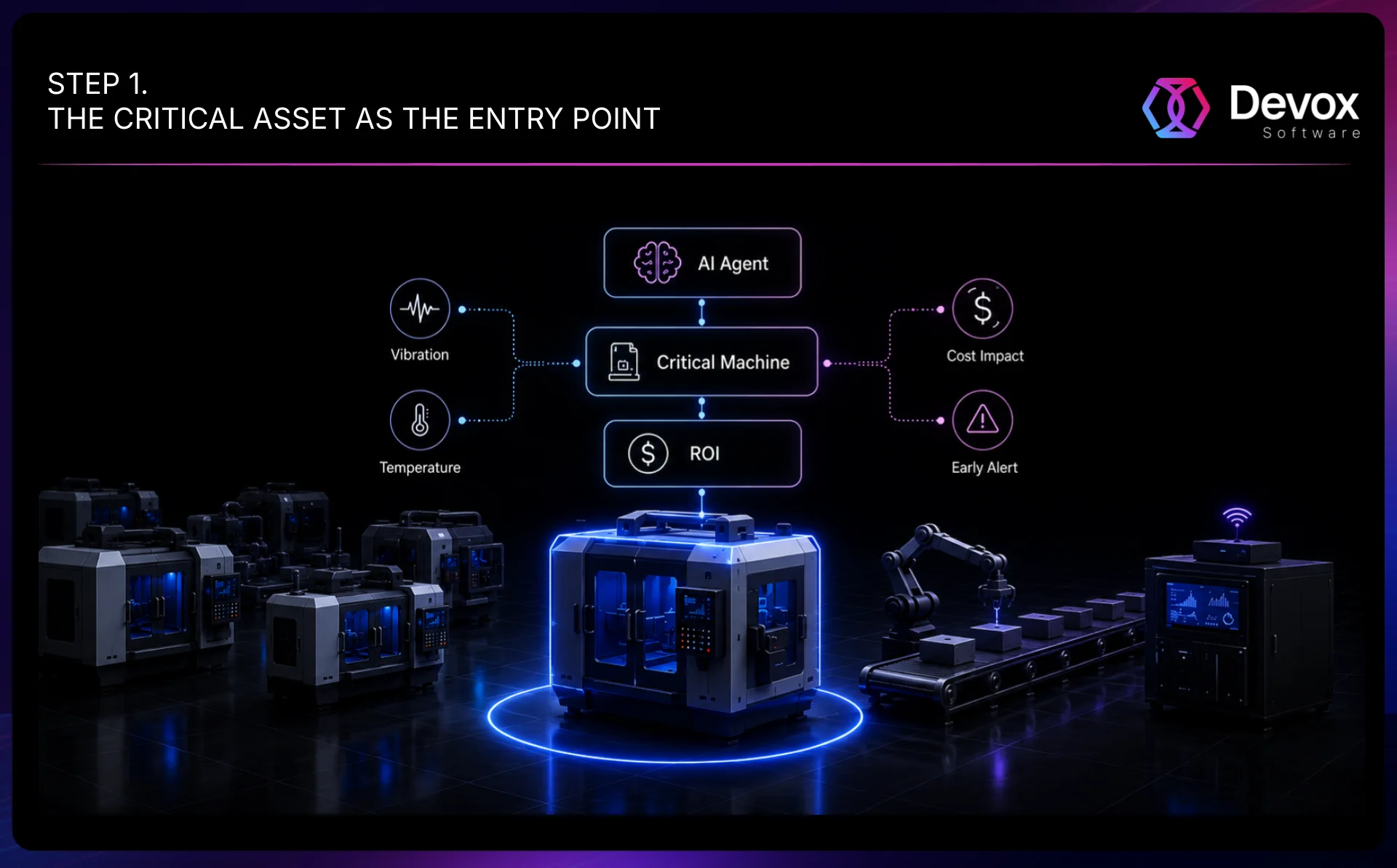
In practice, that first case usually falls into one of four plant buckets: predictive maintenance, inline quality, production scheduling, or energy and process optimization—each representing high-impact agentic AI in manufacturing use cases. Predictive maintenance is often the easiest starting point because the pain is visible and the data trail is usually there.
Quality agents need vision plus the station genealogy. Scheduling agents need live MES/ERP constraints. Energy agents need process context so a load cut leaves OEE intact. Pick one bucket for the first build.
Step 2. Defining Success Before Writing Code
So write it down. If the agent works, what changes? Pick the core operational KPIs that matter to plant leadership and finance.
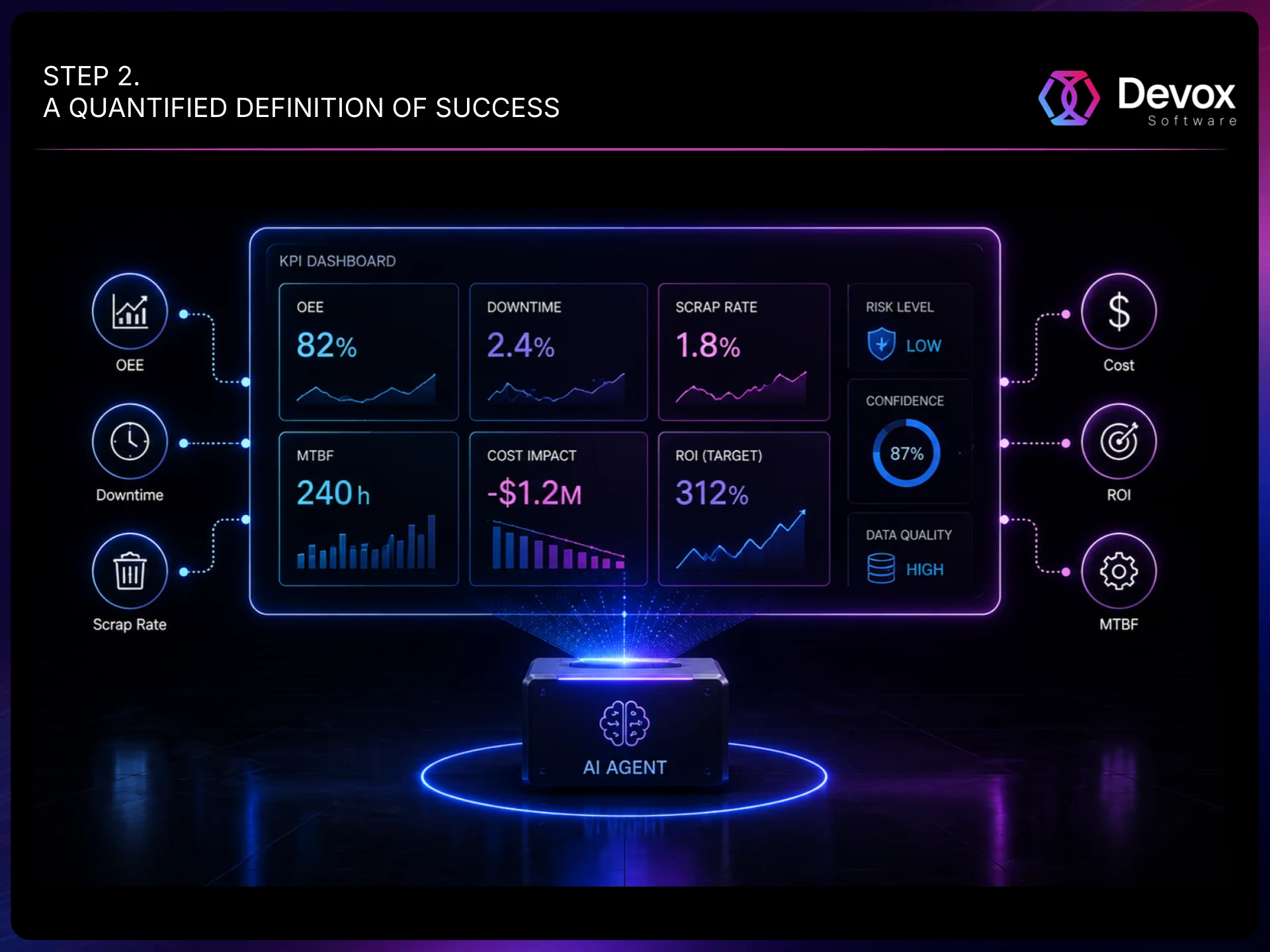
Bring maintenance, operations, quality, IT/OT, and finance into the same conversation early. Keep it small: the people who can answer the awkward questions:
- What does this downtime cost per hour?
- Which tags do we trust?
- Which reason codes are garbage?
- What would the supervisor actually do if the agent warned us at 2:17 a.m.?
The business case should be simple enough to explain in a corridor: “If we prevent two failures a quarter, the investment pays for itself.” A use case that needs a 42-slide deck to defend its value may need sharpening before the build begins.
Also define risk. What is the agent allowed to do? What needs supervisor approval? What happens if the historian feed drops or the edge gateway loses connection? The answers matter because manufacturing is live production.
Finally, a useful success definition should include leading and lagging indicators:
- Leading indicators might include various engagement and precision metrics.
- Lagging indicators might include core production outcomes.
Step 3. Designing the Architecture Around the Real Plant
The manufacturing AI agent architecture has to survive on the real factory floor — so assume the system of record will be messy. Most plants run a mix of modern platforms, legacy controls, and equipment that still makes good parts even if it has never heard of Industry 4.0. The smart move is a controlled integration layer that gives the agent visibility while keeping the line stable.
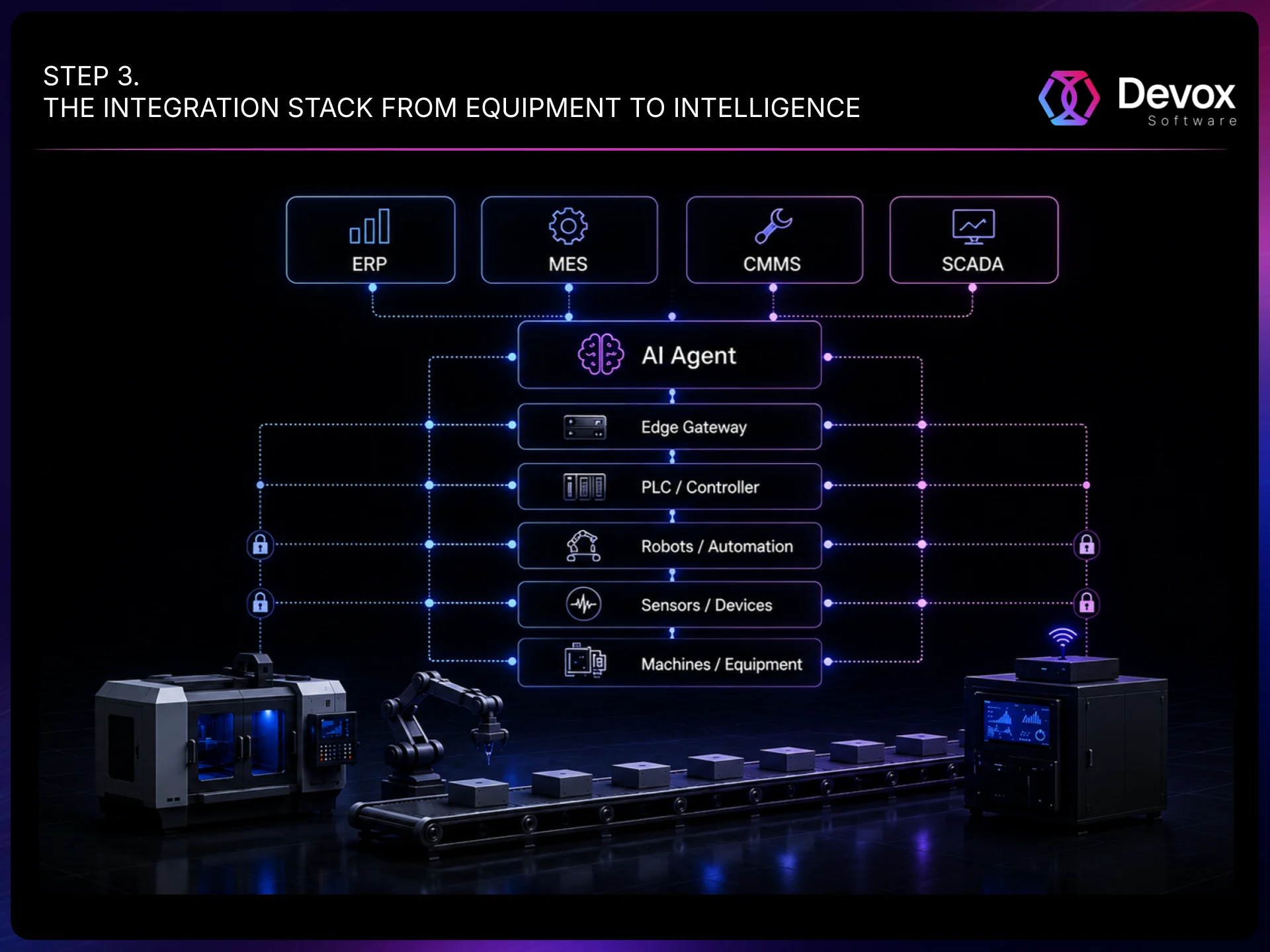
First, decide what runs at the edge and what runs in the cloud:
- Time-sensitive checks belong close to the machine.
- More in-depth pattern analysis, model tuning, and historical comparison can reside in the cloud or on a central data platform.
And design for the ordinary failure modes. Wi-Fi drops when a switch gets rebooted or when someone changes a tag name during a controls update. The agent must fail safely, keep collecting what it can, alert locally when needed, and sync when the network is back online. Most importantly, set operational boundaries. In many first deployments, the agent should recommend, check MRO parts, or notify the right lead. Only explicit human approval should allow actions such as stopping a line, changing a recipe, or clearing an alarm.
On a deep technical side, a practical architecture normally has five layers: the equipment layer, the OT data layer, the operations layer, the intelligence layer, and the shop-floor experience layer. To move beyond surface-level connectivity, prioritize a middleware strategy. Whether your architecture relies on an API-first approach, streaming data via protocols like MQTT or OPC UA, or centralizing operations in a data lakehouse, the goal is to decouple the agent from messy underlying protocols. Build an abstraction layer using AI solutions for manufacturing so the agent interacts with standardized events and clean context rather than fluctuating raw tag values.
Step 4. Fixing the Data Plumbing
The agent needs clean, time-stamped, contextual data. That sounds obvious until you discover that three systems use three names for the same asset, one sensor reports every second, another reports once a minute, and the historian has a gap every Friday night because someone still runs a backup job nobody wants to touch.
So the work here is standardization: aligning the various data definitions and historical records across systems. Without that foundation, the attempt to build AI-agent manufacturing operations is just making confident guesses based on plant data.
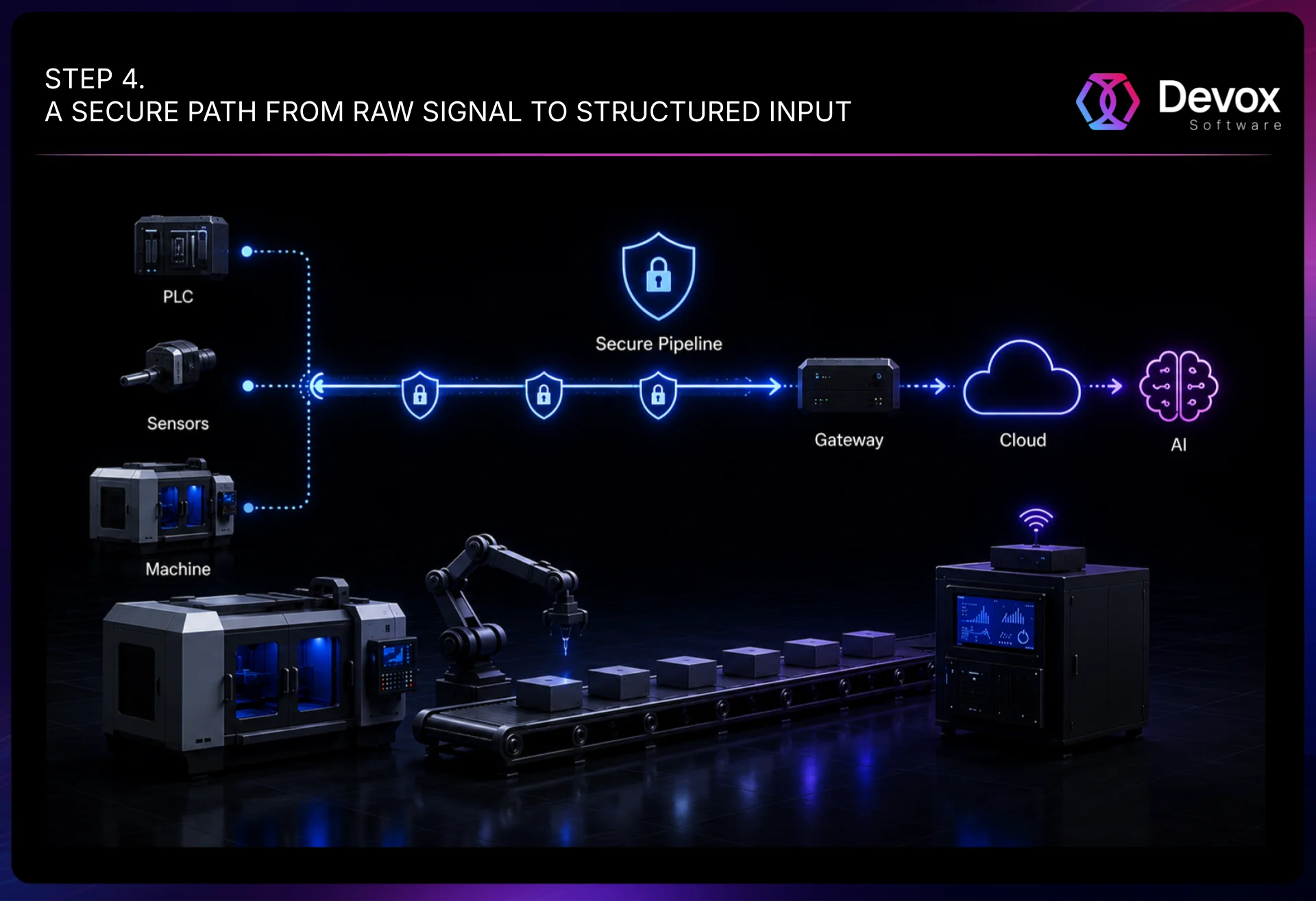
Importantly, security must be integrated from the beginning:
- Use read-only access where possible.
- Segment OT and IT.
- Control credentials.
- Log every action.
- Align the approach with recognized industrial security standards and guidance, such as IEC 62443 and NIST guidance.
The data pipeline also needs a clear asset model. The system must recognize that different system names refer to the same physical unit. It needs a mapping of operational relationships. With that foundation, the agent can reason rather than guess.
Step 5. Giving the Guardrails
Give it approved tools: administrative task automation, SOP retrieval, and communication drafting.
Keep the tools narrow at first. Then add guardrails. The agent should know its specific operational limits and confidence levels. Moreover, one principle has been consistently validated across our engineering work: the best AI agents know when they might be wrong.
Next, test it against historical events. Feed it a range of operational scenarios. Look for reliable behavior: correct alerts, sensible recommendations, clear evidence, and safe boundaries. Just as importantly, this is where you begin capturing tribal knowledge. Ask experienced shop-floor experts what they would look for and turn that into context that the agent can retrieve and reuse. The goal is to make their expertise available when the next person needs it at 2:17 a.m.
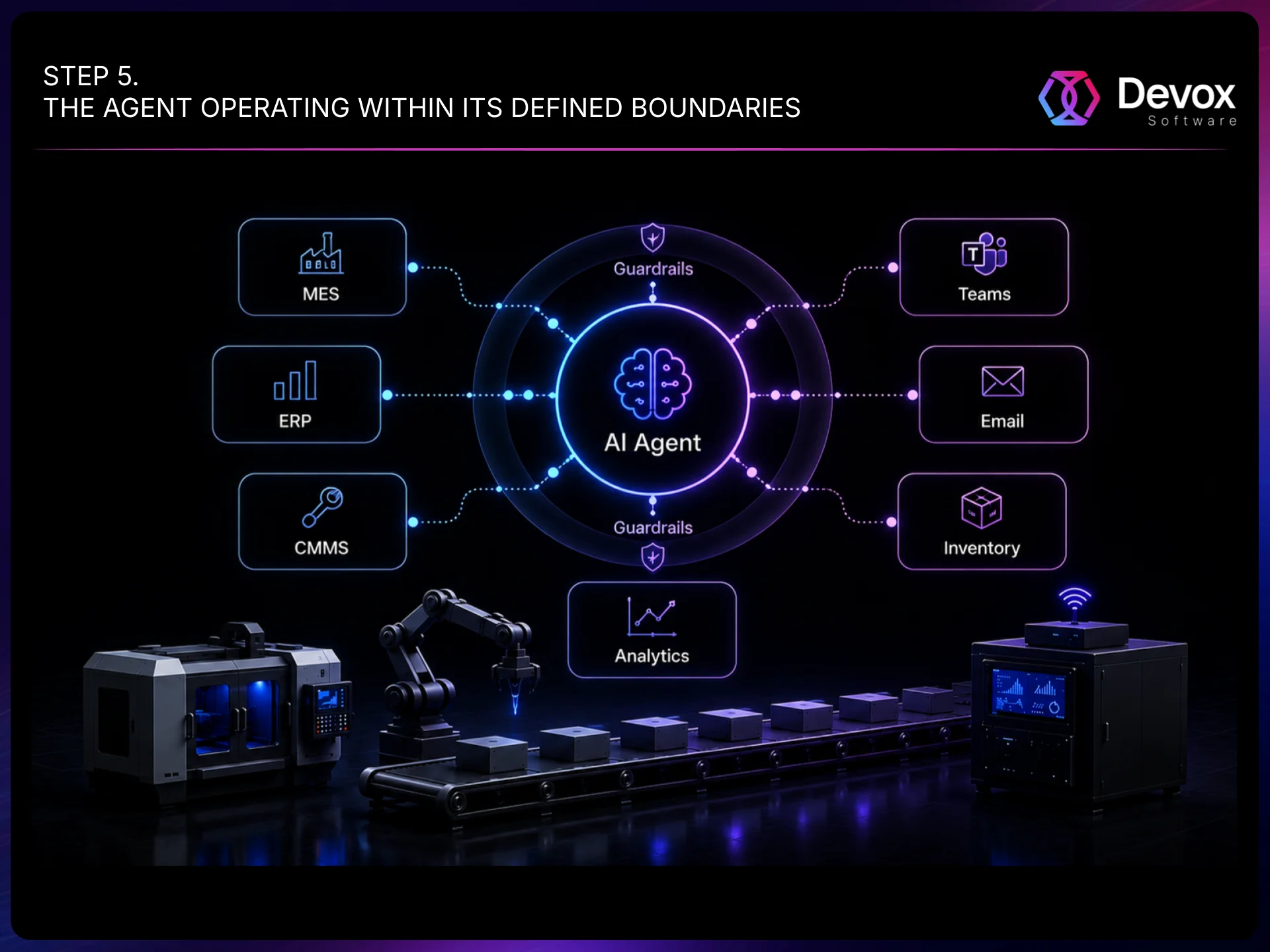
One more thing I’d recommend is: when selecting an architecture, steer clear of the pitfall of creating a monolithic ‘super-agent.’ In complex manufacturing environments, a multi-agent structure is significantly more robust. Orchestrate specialized agents through multi-agent system development—for example, one focused solely on maintenance diagnostics, another on production scheduling, and a third on quality compliance, managed by a central controller. This approach isolates failures. If one agent fails, the others remain operational, which is critical for safety-sensitive manufacturing operations.
Step 6. Piloting It Where People Can See the Difference
Agent production deployment manufacturing results mean something. A successful pilot typically runs for 8-12 weeks. Long enough to see patterns. Track every alert: Was it right? Was it useful? Did it improve core operational KPIs, or simply add more noise to the shift? Bring the shop-floor team into the review.
If they say the alert is obvious, vague, late, or annoying, believe them. They are telling you whether the thing works in their world.
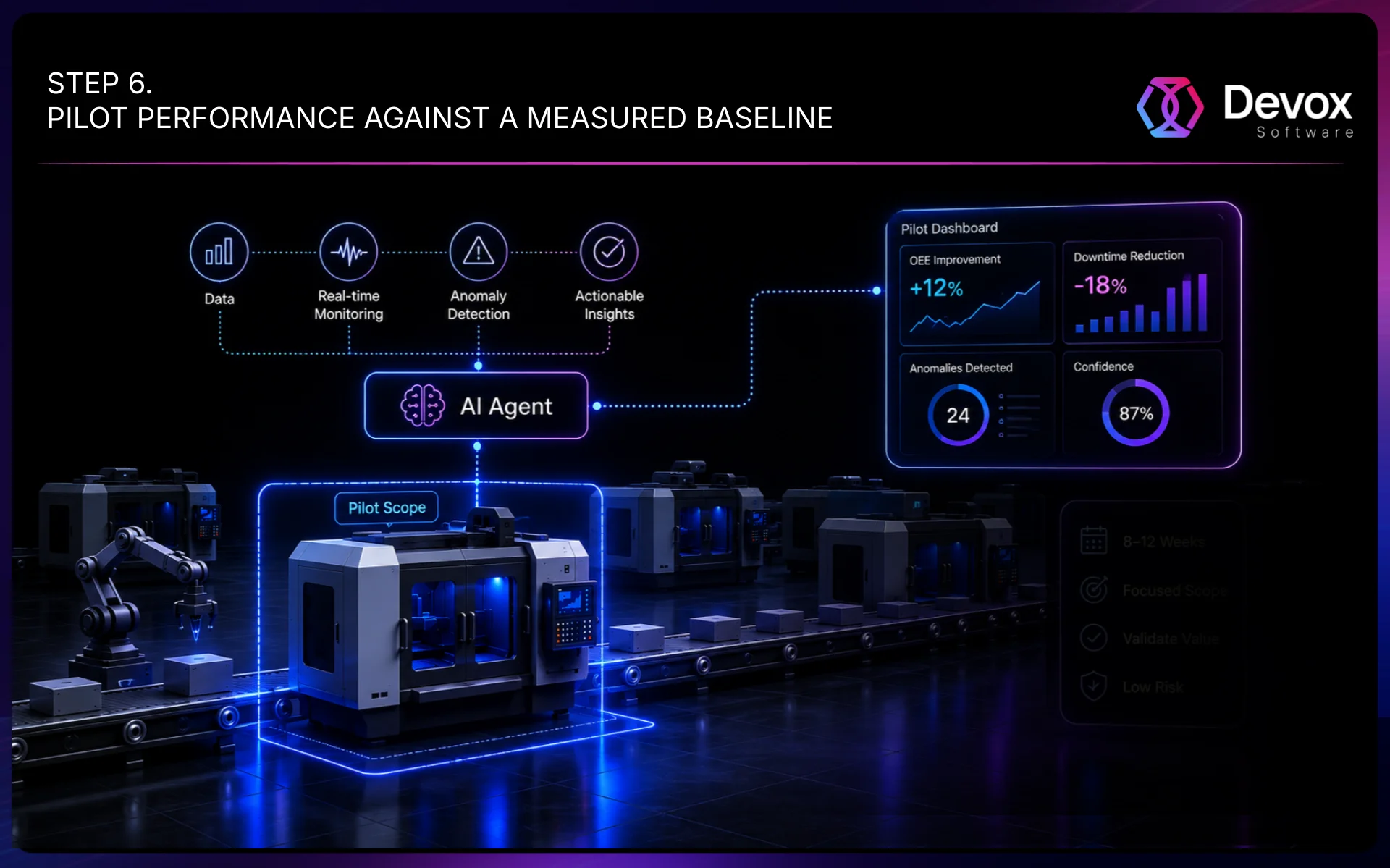
At the end, compare the pilot against the baseline. During the pilot, review the agent as you would a new team member on the floor. Does it give enough context? Does it interrupt at the right time? Does it understand the shifting reality? Does it escalate too quickly or too late? Does it help the technician prepare, or does it create another queue to clear before the tier meeting? While those questions are softer than a KPI dashboard, they ultimately determine adoption.
Keep a pilot scorecard. Track both quantitative performance metrics and qualitative user feedback. Sometimes the model is wrong. Sometimes the recommendation is right, but the plant lacks the resources to act.
This approach reflects how we deliver modernization projects in practice. For example, when helping a nationwide transportation company digitize maintenance operations for a fleet of more than 600 buses, we began by replacing fragmented paper-based workflows, integrating the solution with existing enterprise systems, and building a centralized operational data foundation.
Are you ready to connect your shop-floor reality with a production-ready agent system? We help manufacturing teams execute this exact playbook—from identifying your first bad-actor asset to scaling governance. Ready to build your AI agent system? Explore our custom agentic AI development services
Step 7. Putting It Into Production Like a Real Operational System
Someone must own performance. Someone must review false positives. Someone must approve changes to thresholds, workflows, and model behavior. Someone must be responsible when tag quality drops, an integration fails, or a controls change breaks the data feed.
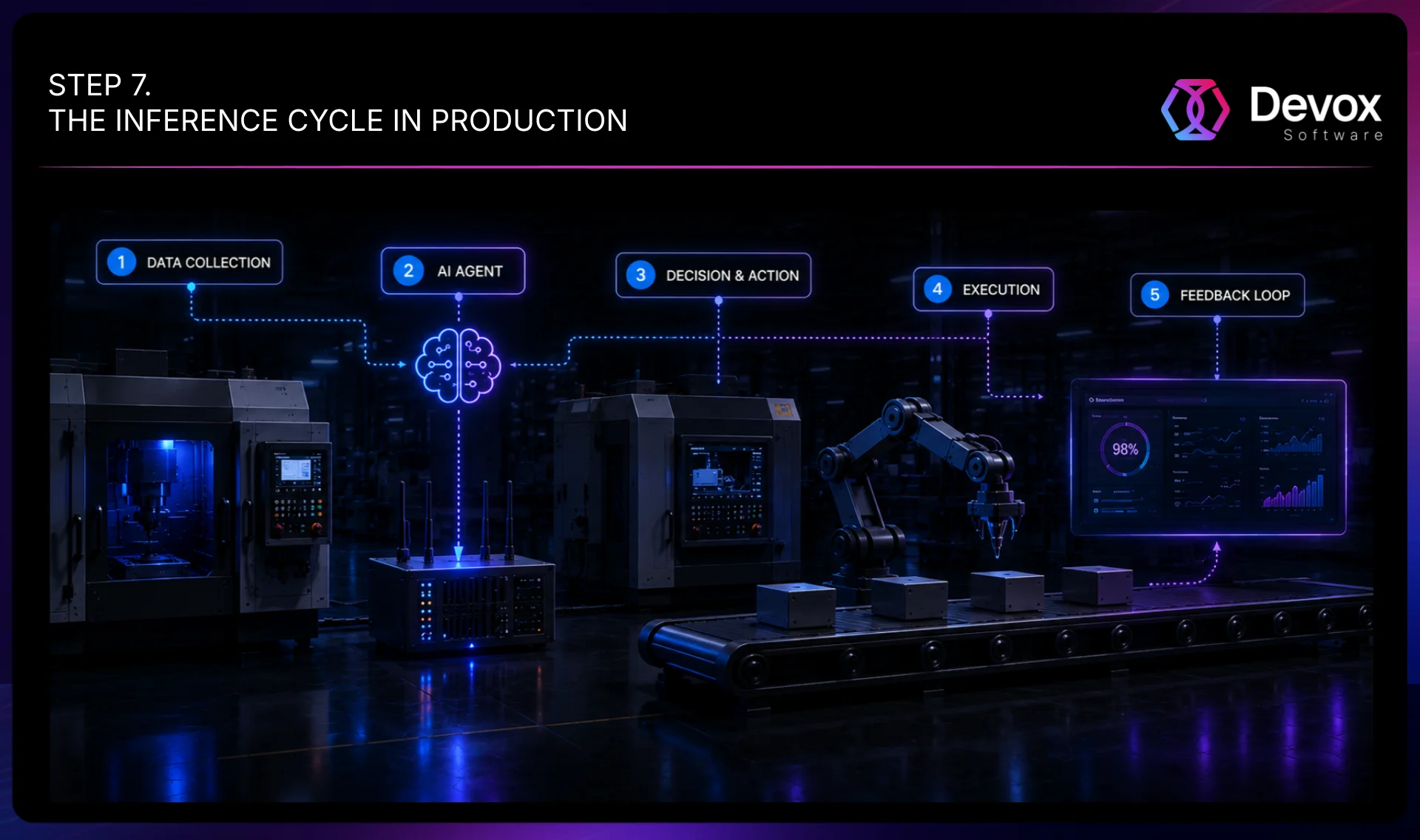
Operational visibility matters. The plant should be able to assess the agent’s health, the freshness of the data, and the distribution of accepted versus rejected recommendations across departments.
Keep the audit trail. Every recommendation should show the evidence behind it: the signal change, the asset history, and the human approval record. That trail is useful for continuous improvement and regulatory compliance.
Security also needs to stay alive. Access should be role-based. OT and IT boundaries should remain clear. Contractor access should be temporary and limited. LOTO, safety interlocks, and validated quality procedures stay in human-controlled workflows. Keep the agent from becoming a clever backdoor into the plant.
This is the unromantic truth: production AI succeeds when governance is boring and dependable. Access controls and logs rarely get applause, but they keep the system trusted.
Production governance should include both model and system monitoring. Watch for various forms of operational drift and strategy changes. Any of those can make yesterday’s model less reliable. Build a cadence for review: weekly during early production, then monthly or quarterly once the system is stable. Let the agent improve under control.
Step 8. Providing the Value, Then Scaling the Pattern
Look at the numbers that define plant performance. Then translate those numbers into dollars so leadership can see the payback clearly.
Also look at the human results. Are staff seeing their knowledge captured and their daily workflows simplified? Are supervisors walking into tier meetings with clearer facts? Those things matter because adoption is as much a trust metric as a technical one.
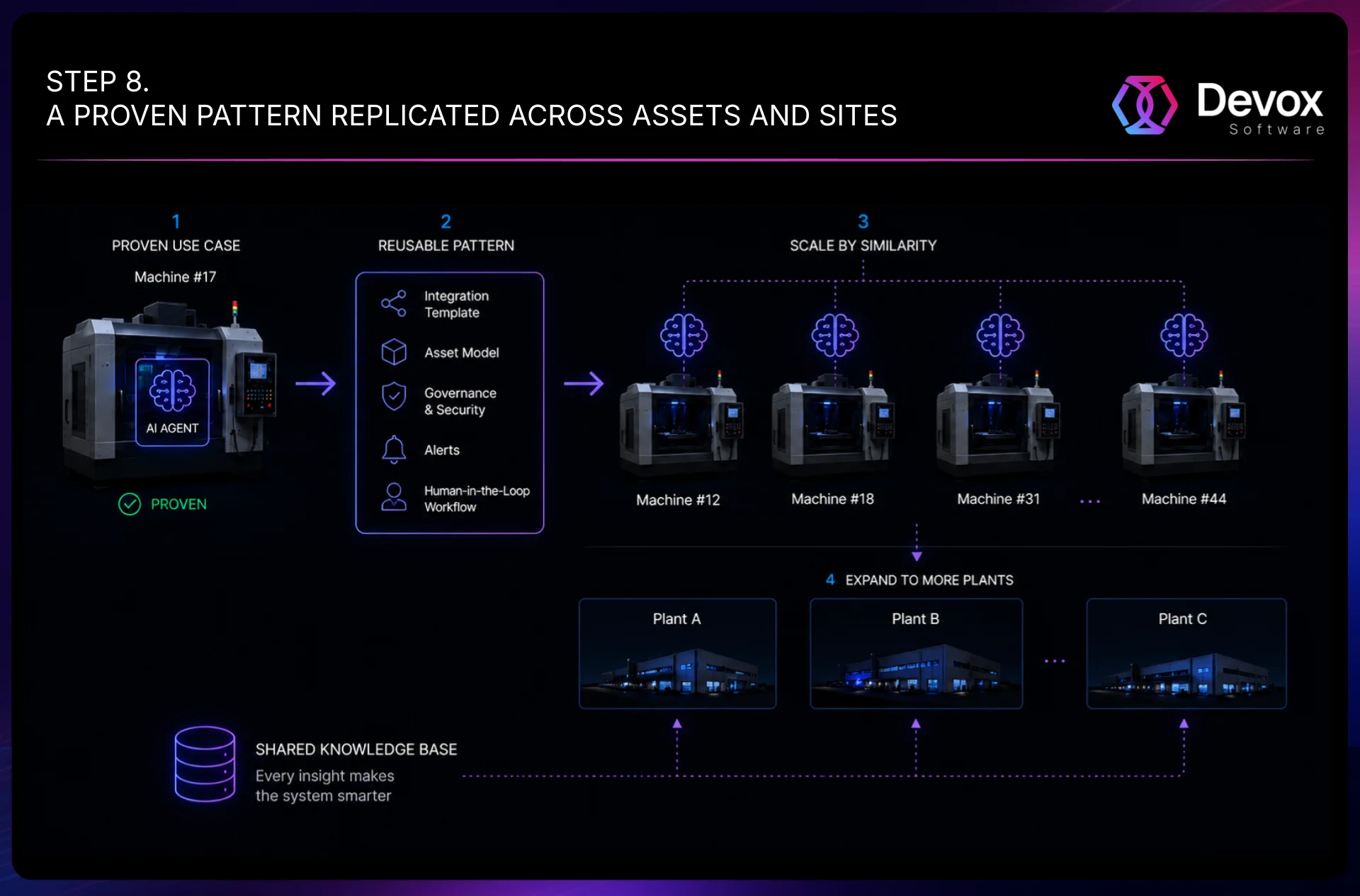
Once one use case proves value, reuse the pattern. The same integration approach, governance model, alert design, and human-in-the-loop workflow can support the next bad-actor asset, the next line, and eventually the next site.
You are building a repeatable operating model: find the painful loss, connect the plant data, give the agent a clear job, keep the crew in control, prove the result, and scale carefully.
The best outcome is a factory with earlier warnings, cleaner context, better shift handoffs, fewer quality surprises, and fewer line-down moments.
Scaling should follow a pattern. Start by standardizing reusable components: integration templates, asset models, and security protocols. Then scale by similarity. If one filler line works, move to the next filler line before jumping to an entirely different process. When one plant proves the model, document what was site-specific and what was reusable before rolling it out to another facility.
The deeper win is cumulative learning. Every piece of operational feedback should make the system smarter, moving closer to the vision of an autonomous AI agents factory. Think practical plant learning, rather than a magical self-driving factory. The plant gets better at preserving expert knowledge and acting before small problems become expensive ones.
ROI: Why Now
By late 2026, the manufacturing question is scale, not first contact. Deloitte’s AI in Manufacturing 2026 survey (140+ plants) found 84% already book measurable value from AI, while only about 20% of use cases run consistently across sites. In the same sample, quality leads at 62%, production at 57%, and logistics at 49%. GenAI and agentic tools sit in the stack for about 40% of respondents; closed-loop physical AI is still the minority at 18%.
Treat downtime claims as a range, not a house number. Published PdM and multi-agent deployments in 2025–26 cluster around 15–30% unplanned-downtime reduction when the agent writes a work order the crew accepts. A 40% cut shows up in selected case write-ups; use it only with the plant name and the baseline attached.
Samsung’s 2030 autonomous-fab target is a horizon, not a 2026 operating model. For a mid-market line, the 2026 pattern is recommend-then-approve: inspect in the next PM window, hold the unit, open the ticket. The primary use cases driving this shift include production scheduling, predictive maintenance, quality control, shop-floor monitoring/anomaly detection, and supply chain optimization.
Write the first case the way the shift will retell it: the asset, the missed window, the recommendation, the approval, the hours recovered. If the agent helps the crew catch the bearing, hold the bad unit, and hand off a clean fact to the tier meeting, the program has a next site.
If you are ready to scale your operations, we specialize in custom agentic AI development.