

In 2026, the digital world is full of information like never before. The most recent IDC Global DataSphere forecast says that the amount of data created and used around the world will reach 393.9 zettabytes by 2028, which is almost three times what it was three years ago. This growth has made document processing the biggest source of operational stress, affecting everything from compliance and supply chain logistics to real-time financial management.
Optical Character Recognition (OCR) used to be the industry standard, but it now struggles to keep up with the wide range and contextual complexity of modern business documents. Standard OCR can slow businesses down as they grow, instead of helping them. Intelligent Document Processing (IDP) fills this gap by using AI and machine learning to do more than just “read” text. It sorts, extracts, and checks data, sending it directly into automated systems with little or no human help.
Our research paper, “Intelligent Document Processing vs. Traditional OCR: Enterprise Requirements in 2026,” examines how these two technologies work differently. As costs of doing business rise and regulations tighten, the choice of document processing framework directly affects a company’s flexibility. This paper uses up-to-date market data to give mid-market and enterprise leaders a strategic plan to update their workflows and meet today’s performance standards.
How IDP Works: More Than Just Basic OCR
The business still runs on paper. The only difference is that they no longer have to slow it down.
Intelligent Document Processing can do more than just turn pictures into words. It uses OCR, AI, machine learning, and natural language processing to identify what a document is, extract key data, validate it against business rules, and send it to the next workflow. Emails, PDFs, invoices, forms, and even handwritten notes become structured inputs that the business can use.
That is the real difference from traditional OCR. OCR reads letters. IDP reads the situation. It can tell if a value is a payment amount, a due date, a policy number, or a clause in a contract. That layer of context makes things more accurate, scalable, and truly automated.
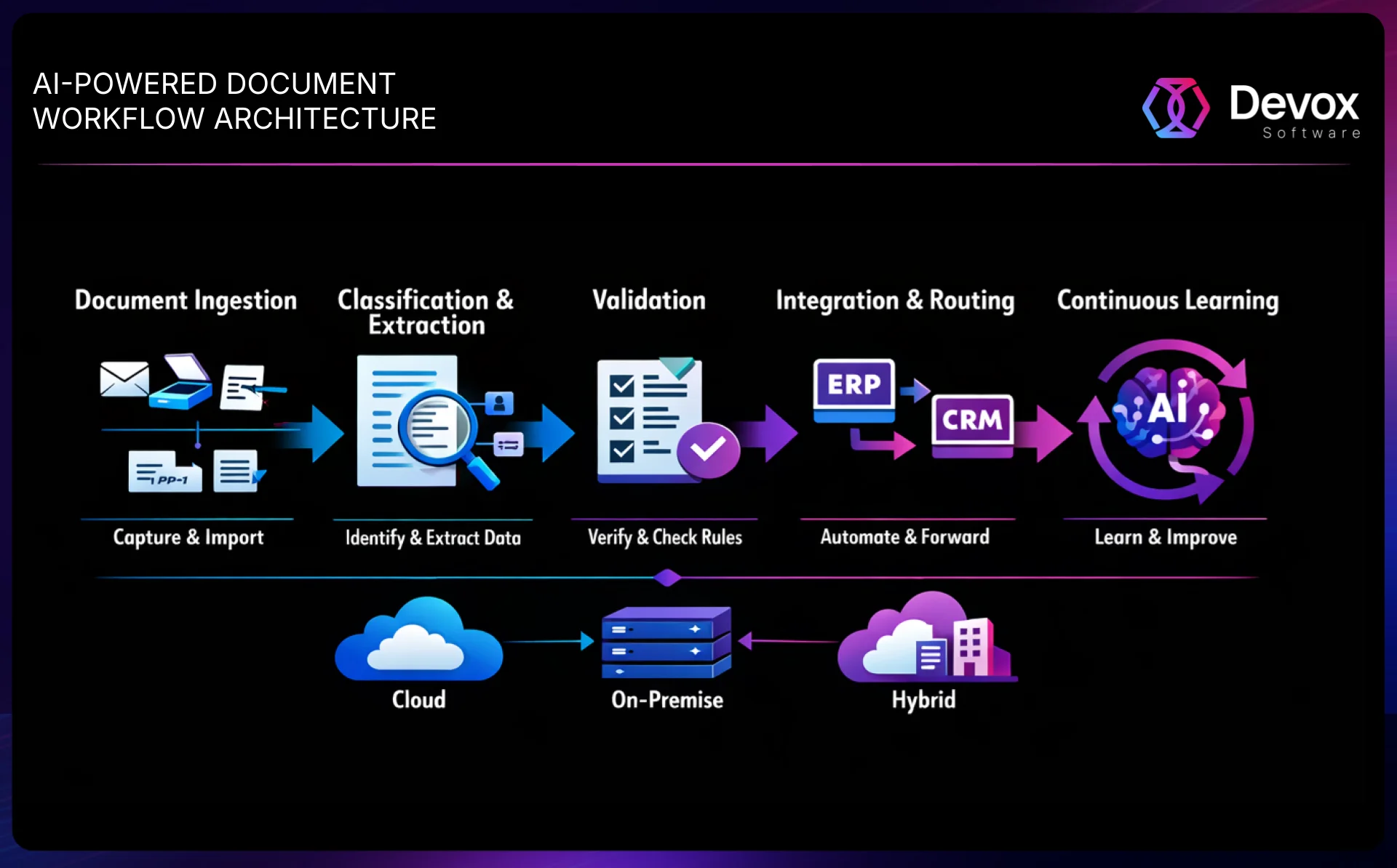
The first step in a typical IDP workflow is to capture and ingest. Documents come in through inboxes, scanners, shared folders, apps, or partner portals. The platform ingests them, fixes poor images, and prepares them for processing, even when the input is messy.
Second is sorting and extracting. The system identifies the document type and extracts the exact fields the process needs, like names, totals, line items, dates, and legal terms.
Next is validation. The system checks the extracted data against business rules, internal records, and linked systems. Clean inputs go forward. Exceptions are flagged for review.
Then, integration and routing turn the data into action. Validated information goes straight into ERP, CRM, finance, claims, or compliance systems, starting the next step without manual re-entry.
The system also gets better over time. When people fix mistakes, the models learn from those mistakes and get better at making future documents more accurate.
Deployment stays flexible. Depending on security, compliance, and integration needs, IDP can be run as SaaS, on-premises, or in a hybrid model.
That’s why IDP is important in real life. It doesn’t just read papers. It turns them into choices and actions, and it speeds up operations.
The Real Business Impact of IDP in 2026
For document-heavy sectors like finance, healthcare, logistics, and compliance, Intelligent Document Processing is no longer just a nice-to-have IT upgrade—it’s a foundational requirement. Recent market data highlights exactly where the ROI is coming from:
- Fixing the Error Rate Problem. Manual data entry and legacy OCR typically hit a wall with complex documents, often resulting in 20% to 30% error rates. IDP, backed by AI validation, consistently pushes accuracy past 95%. Industry surveys support this: 61% of organizations report noticeable gains in data quality and fewer errors after automating. In highly regulated spaces, this accuracy actively prevents costly compliance violations under frameworks like GDPR or the new AI Act, saving companies millions in potential rework and fines.
- Accelerating Throughput and Efficiency. IDP clears out manual bottlenecks, paving the way for “zero-touch” automation. Companies adopting IDP are effectively doubling their processing speeds while cutting manual effort in half, resulting in a 4x jump in overall document throughput. As recent research notes, the technology “helps to extract data from complex documents such as invoices and claims” far faster than human teams, keeping operations moving without friction.
- Driving Hard ROI. The math behind IDP is straightforward: automating data entry drastically cuts labor costs. Even back in 2023, over half of polled companies were already using or evaluating IDP, citing “cost-saving, reductions in cycle time, and an upsurge in productivity.” The financial impact is massive—in the banking sector alone, IDP could unlock up to $1 trillion annually. Now, with generative AI fully integrated into 2026 workflows, those cost savings are scaling faster than ever.
- Scaling for the Unstructured Data Boom. With global data expected to grow tenfold by 2030, manual processing simply cannot keep up. IDP is built to handle petabyte-scale unstructured data, which makes up roughly 90% of all enterprise information. As researchers point out, “Generative AI has increased the focus on data, putting pressure on companies to make substantive shifts. We are already seeing this happen: 65% of organizations now use gen AI in at least one business function, nearly double the 33% adoption rate seen just last year.
- Strengthening Security and Compliance. Beyond speed and cost, IDP creates a fully auditable digital trail. Features like metadata mapping and secure data federation ensure that every document is tracked, verified, and handled according to strict compliance standards. As an added benefit, digitizing these massive workflows directly supports corporate ESG goals by sharply reducing paper waste and the energy footprint of manual processing.
THE 2026 IDP MARKET
The Intelligent Document Processing field is growing quickly. The field is evolving from simple extraction to “agentic automation,” where interconnected AI agents autonomously manage complex workflows. But even with strong investment, execution across the business remains a major challenge.
The Numbers Show the Market:
- Steady Growth: The market has reached Gartner’s predicted $2.09 billion value for 2026 (a 13% CAGR), and more than 100 vendors are in it.
- Rising Budgets: 92% of businesses plan to spend more on AI in the next three years. Highly regulated areas are leading the way, with 65% of financial companies increasing their GenAI spending this cycle.
- Expectations for Revenue: 87% of executives now think that generative AI will lead to real revenue growth within three years.
- The Scaling Gap: Even though they have gotten a lot of money, almost two-thirds of companies have not yet scaled AI across the whole business.
| Benefit | Statistic | Source |
| Market Size | “$2.09 billion by 2026, with a CAGR of 13% from 2021 through 2026.” | gartner.com |
| Error Reduction | “61% of respondents reported benefits related to error reduction and data quality.” | forrester.com |
| Throughput Increase | “Double processing speed with half effort for a fourfold increase in throughput.” | mckinsey.com |
| Adoption | “Over half of companies polled in 2023 are leveraging or exploring IDP.” | forrester.com (via Capgemini insights) |
| Gen AI Usage | “65% of organizations use GenAI in at least one function.” | mckinsey.com |
| Data Growth | “Data volumes expected to increase by more than ten times from 2020 to 2030.” | mckinsey.com |
| Vendor Ecosystem | “Over 100 vendors offering full solutions or components.” | gartner.com |
The Core Trends Redefining Enterprise Document Processing
For enterprise leaders evaluating their tech stacks in 2026, the demands placed on document processing have fundamentally shifted. AI is no longer just an add-on; it is the core engine driving four market-defining trends:
- The Rise of “Agentic” GenAI Workflows. Generative AI is pushing IDP past simple data extraction into the realm of “agentic automation.” Instead of just reading documents, interconnected AI agents now autonomously manage entire end-to-end workflows—from invoice processing to contract analysis. Top CIOs are actively deploying these systems to drive measurable value, which explains why 92% of companies plan to increase their AI investments over the next three years. This shift from reactive processing to proactive decision-making is already showing massive real-world impact, such as reducing human intervention in healthcare volumes by up to 60%.
- Scaling Through “Zero-Touch” Automation. With global enterprise data projected to increase tenfold by 2030, manual processing is a critical bottleneck. The ultimate goal for high-volume, unstructured documents is “zero-touch” automation. The market reflects this urgency: the IDP space is projected to reach Gartner’s $2.09 billion valuation in 2026, growing at a 13% CAGR (from 2021 through 2026) in a crowded landscape of over 100 vendors. Momentum has been building steadily since 2023, when over half of polled companies were already exploring IDP for cost and productivity gains. Now, adoption is accelerating rapidly, with projections indicating that 40% of enterprise applications will feature embedded AI agents by year-end to automate complex supply chain and operational workflows.
- Navigating Strict Compliance and AI Ethics. As adoption scales—with 65% of organizations now using GenAI in at least one function, up from 33% last year—regulatory scrutiny is intensifying. Frameworks like the EU AI Act and GDPR require enterprise IT to have bulletproof, auditable processes. Modern IDP platforms must feature secure data federation to maintain compliance. Furthermore, as AI takes on more responsibility in sectors like manufacturing, mitigating ethical risks and algorithmic bias through responsible frameworks (like FAIR design theories) has become a mandatory operational requirement, not just a legal one.
- The ESG and Energy Equation. While IDP directly supports ESG goals by aggressively cutting down on paper dependency and manual work, the infrastructure powering it is resource-intensive. Electricity use in data centers is on track to reach 1,050 terawatt-hours by 2026, which would rank it fifth globally in energy use. However, the strategic application of AI remains a net positive for sustainability: optimized supply chains and sustainable AI practices are projected to unlock $2.9 trillion in U.S. value by 2030, provided enterprises effectively manage the backend risks of data repurposing.
Forecasts: Growth and Adoption Projections
Projections indicate explosive growth in IDP and AI, but challenges like data readiness persist.
Gartner estimates the IDP market at $2.09 billion by 2026, expanding with over 100 vendors. McKinsey forecasts AI to deliver $1 trillion annually in banking value.
McKinsey reports that 65% of organizations use GenAI, with 87% of executives expecting revenue growth within three years. SCMR/ASCM predicts AI as the 2026 supply chain backbone. The Economist notes 500+ Chinese AI models, signaling global competition.
Challenges Ahead: Two-thirds of respondents say organizations haven’t scaled AI enterprise-wide, per McKinsey. WSJ highlights AI reshaping semiconductors, with supply chains evolving. MIT projects AI’s energy demands will rival those of nations.
- Mid-market firms (100-1,000 employees) need quick ROI via SaaS IDP, while enterprises require scalable, secure integrations.
- For Mid-Market: Start with SaaS IDP for 75% productivity boosts, per HBR. Focus on pilots in finance or HR, scaling to full automation. Invest in upskilling, as SCMR notes frontline AI integration.
- For Enterprise: Adopt custom AI models for petabyte data, integrating with ERP. McKinsey advises agentic AI to unlock $2.9T in value. Prioritize compliance; ASME suggests vision-language models for design. Use AI for M&A, per MISQ on cloud sourcing.
IDP Implementation Roadmap
Integrating Intelligent Document Processing successfully requires a calculated, phased approach, rather than a simple switch. This roadmap breaks down how mid-market and enterprise leaders can practically deploy AI-driven IDP without disrupting core operations.
Whether you are launching an initial pilot or scaling automation across multiple departments, these steps outline how to hit 95%+ accuracy and cut processing times by up to 80%.
Step 1. Select Tool
Compare AI-powered IDP platforms such as Google Document AI, AWS Textract, and UiPath based on scalability, integration, security, cost, and usability. Run proof-of-concept trials with shortlisted vendors before making a final decision.
Step 2. Design Workflow
Map the full document lifecycle from ingestion across channels like email and scans to classification, extraction, validation, and system integration. Add AI for contextual understanding and automation for exception handling to create an efficient workflow.
Step 3. Build and Train
Prepare diverse training datasets that cover document types, formats, and edge cases such as handwritten or multilingual content. Train models iteratively and use human review loops to improve accuracy over time.
Step 4. Test and Optimize
Run unit, integration, and user acceptance testing to measure speed, accuracy, and overall reliability. Refine the models by fixing issues such as false positives and weak performance on unstructured documents before launch.
Step 5. Deploy and Monitor
Start with a pilot rollout to collect feedback and track key KPIs, then expand across the business with training and change support. Monitor throughput and error rates through dashboards and retrain models regularly as document patterns evolve.