


1. Introduction
1.1 Background
In its core, traceability answers narrow manufacturing questions: “Which batch produced this item?” or “Which materials entered that batch?” Disconnected, these questions offer a limited perspective. Modern manufacturing environments demand more than the genealogy of a finished product but also the material origin, suppliers’ portfolio, real production conditions and histories, and so on, all across the product lifecycle. This transition is fueled by tech as much as the business reality.
Firstly, the regulating norms expect the manufacturing and product history to be available in structured and verifiable forms. In particular, the EU Ecodesign for Sustainable Products Regulation establishes the framework for Digital Product Passports, where it states where and how the information must be contained at the model, batch, or item level; who may access it, and how long it must remain available.
Secondly, in 2026 we expect the definitive phase of the EU Carbon Border Adjustment Mechanism to begin, according to which emissions of commercial and operational information become viable for compliance.
Thirdly, some sector-specific traceability requirements continue to mature. For example, in the automotive industry, manufacturers are expected to link incoming component lots, suppliers, production orders, processes, inspections, and shipments according to the IATF 16949 and OEM-specific requirements.
Fourthly, AI enhances traceability data value. As traditional systems retrieve records from the system after an event, AI-enabled software can potentially identify anomalies and deviations and assist specialists in real time.
These trends are fueled by manufacturing data. Identifiable, contextualized, interoperable, historically reconstructable, and trustworthy production data is in the middle of it.
1.2 Problem Statement
Isolated operational objectives are no longer relevant. In 2026, a finished batch can be associated with a production order; however, the complete chain reconstruction is impossible. You can’t tell the origin of the material, storage conditions, etc.
Often, it becomes a problem, more pronounced when it goes to sophisticated supply chains and retail networks. For instance, to investigate who is liable for the materials of inferior quality, you need to check all the supply chain links. The other challenges may occur in situations when supplier identifiers don’t correspond with internal material identifiers or MES timestamps differ from historian timestamps, or quality evidence exists only in PDFs and spreadsheets.
Two major risks are associated with this fragmentation: a compliance fragmentation when the evidence exists but can’t be efficiently reported and an AI fragmentation when manufacturers can’t reliably establish the context despite large volumes of manufacturing data in control.
For this reason, the central research problem examined in this paper is how to structure traceability architecture for the trusted data foundation to support operational genealogy and AI-driven analysis.
1.3 Contributions
This paper makes three practical contributions in traceability in modern manufacturing:
- a 5-layer reference architecture across shop-floor capture, integration, traceability records, AI, and reporting
- a standards and regulatory mapping framework
- a 5-level AI readiness maturity model
The architecture is deliberately technology-agnostic. We don’t recommend a specific cloud provider and/or AI model.
2. Background Notions: The Current State as of 2026
2.1 Traceability in Manufacturing: Now and Back Then
Manufacturing traceability has evolved through several overlapping technological generations. The following table describes and compares the increments of the manufacturing traceability evolution over the years.
Table 1. The comparison of traditional and modern traceability features.
| Dimension | Traditional Traceability | Modern Traceability | Examples |
| Traceability Units | Batch or lot | Batch, lot, serialized item, component, shipment, and individual production event | Then: 5,000 bearings traced to Lot B-204. Now: Bearing SN-18472 is linked to its supplier lot, assembly, machine, process parameters, inspection results, and finished vehicle. |
| Main Records | Papers, batch sheets, inspection forms, physical labels | MES/ERP records, IoT events, digital certificates | Then: An operator signs a paper/digital inspection sheet. Now: MES records the inspection automatically and links the result, timestamp, and measurements. |
| Production Genealogy | Often reconstructed manually after an incident | Built continuously from material, process, equipment, inspection, rework, and shipment events through scanners, PLCs, sensors, RFID, machine vision, etc. | Then: Engineers go into production logs to identify products that may contain a defective component. Now: A genealogy query shows all affected serial numbers with their production histories. |
| Cross-System Integration | Limited | APIs, middleware, event streaming | Then: Supplier data is in ERP, while machine data is in SCADA and inspection results in QMS. Now: ERP supplier lot is linked with MES work order and PLC process data backed by QMS inspection. |
| Supply-Chain Visibility | Inside one plant | Extends across suppliers, manufacturers, distributors, and customers | Then: The manufacturer knows when a material entered its plant and which batch used it. Now: Traceability connects supplier origin with incoming material and its transformation into a finished product and shipment to a customer. |
| Standards | Internal conventions | General ISA-95, OPC UA, GS1 standards, and sector-specific data standards | Then: “Part 348A” is readable inside Factory A only. Now: Standardized identifiers and event structures let exchanging product and process information between sites and systems. |
| Analytics | Historical reports and basic KPIs | Predictive quality, anomaly detection, graph analytics, computer vision, and root-cause analysis | Then: A monthly report shows, for instance, a 2.1% defect rate. Now: analytics can reveal that defects correlate within the link “Supplier Lot X + Machine 7 + a specific process condition.” |
| AI Use | Little or none | Positive | Then: Engineers manually review production records. Now: AI analyzes inspection histories to rank likely causes to support human judgment. |
This comparison mirrors the shift from static documentation to context-specific histories. Earlier methods depended primarily on paper batch records, manually maintained inventory ledgers, and physical labels; however, a batch record often proves that a component could have been used in a product but lacks the complete event history.
RFID, IoT, and serialized identity are other methods that appeared to increase the volume and granularity of manufacturing events. With them, instead of recording only that a batch, manufacturers could potentially record the sequence.
Furthermore, a modern product is not merely associated with attributes. It moves, transforms, passes from one handler to another, becoming a problem for representing supply-chain and product events from a perspective of both manufacturers and regulators. In particular, Electronic Product Code Information Services (EPCIS) directly separates event data from master data.
Another Way: Distributed-Ledger Technology (DLT)
With the rise of blockchain and distributed-ledger architectures, manufacturers introduced yet another model: tamper-evident records can be shared securely among supply-chain participants without any central authority. Although DLT can’t clean inaccurate source data, it has proved its value in multi-party environments. Yet it remains an optional tool rather than a mandatory foundation.
2.2 Regulations and Compliance Outlook
Regulations differ from state to state; however, there are global tendencies with overlapping requirements for product identity, sustainability, safety, and supply-chain due diligence as follows:
- EU Digital Product Passport (DPP). Regulation (EU) 2024/1781, the Ecodesign for Sustainable Products Regulation (ESPR), establishes the DPP framework, according to which DPP information must be suitable for interoperable environments with, for instance, persistent unique product identification. It also specifies open standards to passport information.
Moreover, ESPR doesn’t apply uniformly to every manufactured product, as the regulation only establishes the legal and technical framework for DPP, while the detailed requirements for individual product groups are contained in the subsequent delegated acts.
Consequently, manufacturers should distinguish between the ESPR/DPP framework and the exact data requirements for a particular product group. Particularly, a manufacturer of batteries and a manufacturer of textiles face different timelines and disclosure requirements. From an architecture perspective, flexibility gains even greater importance here as manufacturers need to trace data across existing products, suppliers, processes, and so on instead of just complying with one standard.
- Carbon Border Adjustment Mechanism (CBAM). From January 1, 2026, for manufacturers and importers dealing with covered goods, traceability therefore intersects with emissions accounting. The outstanding challenge is not storing a carbon figure but connecting emissions to operations and facilities (as well as production methods, materials, etc.)
- Supply-chain due diligence. Supply chain due diligence frameworks add liability to track who supplied material and under what circumstances. For instance, the U.S. Uyghur Forced Labor Prevention Act highlights supply-chain mapping and documentation for importers as standard practice. Another act, the EU Corporate Sustainability Due Diligence Directive, is similarly a step toward formalized value-chain due diligence.
- Automotive Traceability. As one of the specific industry examples, IATF 16949 environments demand connecting safety-critical components and production information across complex supplier networks, while OEM-specific requirements add extra obligations.
In all cases, an architectural framework can’t be underestimated, uniting all requirements into a foundation for safe and compliant manufacturing operations.
2.3 Traceability Architectures Variations
In our view, 4 main architectural patterns dominate across modern organizations. They differ primarily in where the authoritative traceability records reside and how events are captured and stored across systems and for further use in analytics and AI.
Centralized ERP/MES Architecture
In a centralized architecture, ERP or MES acts as the principal repository for traceability information. ERP typically provides the business context about the materials, suppliers, and so on, while MES layers up shop-floor information with operators and quality results.
Table 2. The components of centralized ERP/MES architecture.
| Aspect | Centralized ERP/MES Architecture |
| Strengths |
|
| Weaknesses |
|
| Best suited for | Plant-level and lot/batch traceability, where most relevant information already resides in ERP/MES |
| Example | A manufacturer traces Finished Lot F-105 back to Production Order 8821, Material Lots M-21/M-22, the production line, and recorded quality results |
Centralized ERP/MES architecture remains one of the most practical choices for manufacturers whose primary requirement is plant-level or lot-level genealogy. Its main limitation appears in cases beyond transactional manufacturing records, where the need for high-frequency machine data rises.
IoT- and Historian-Centric Architecture
Thanks to IoT- and historian-centric architecture, PLCs, sensors, machines, industrial gateways, SCADA systems, OPC UA servers, and IoT platforms continuously collect information from the shop floor, and this data can be used at much higher temporal resolution than a traditional ERP.
For example, instead of knowing only that Product X was processed on Machine 4, the manufacturer may have second-by-second temperature, pressure, vibration, speed, energy, or torque data for the relevant production window, which are irreplaceable to power further AI capabilities.
Table 3. The components of IoT- and historian-centric architecture.
| Aspect | IoT- and Historian-Centric Architecture |
| Strengths |
|
| Weaknesses |
|
| Best suited for | Process monitoring, predictive quality, condition monitoring, equipment analysis, and high-resolution production history |
Distributed-Ledger Architecture (DLA)
DLA offers a shifted view from a single manufacturer’s database toward a shared or multiple-participant replicated record with selected events written to a ledger. This way, cryptographic mechanisms can detect further alteration and serve as a source of truth for all participants. The biggest drawback is that DLA doesn’t check whether data was correct when originally captured. So in case of mistakes, cryptographic immutability preserves that incorrect information as well.
Table 4. The aspects of Distributed Ledger Architecture (DLA).
| Aspect | Distributed-Ledger Architecture |
| Strengths |
|
| Weaknesses |
|
| Best suited for | Multi-party supply chains where provenance, shared evidence, or tamper detection is particularly important |
Hybrid Event Architecture
A hybrid event architecture combines existing operational systems with an integration and event layer. For instance, ERP remains authoritative for suppliers, orders, and inventory, while MES handles production execution and QMS retains quality records. Additionally, APIs with event streaming and master-data services connect the relevant databases into a single shared environment.
For example, a supplier lot gets an ERP receipt, then it goes to an MES work order with machine event tracking. Further, it’s marked as a serialized product and undergoes QMS inspection. All that remains is to track warehouse shipment and delivery to a customer.
It’s essential to note that this paper adopts the hybrid model as a front-runner, as it allows manufacturers to incrementally modernize traceability without replacing current functional platforms.
Table 5. The aspects of hybrid event architecture.
| Aspect | Hybrid Event Architecture |
| Strengths |
|
| Weaknesses |
|
| Best suited for | Enterprise and multi-site traceability, regulatory reporting, cross-enterprise genealogy |
To sum up, there is no universally “best” architecture. The choice is more about selecting an architecture according to the required scope. ERP/MES-centric systems remain effective for transactional genealogy; IoT-centric systems excel at capturing production conditions; DLA can strengthen multi-party provenance; and hybrid event architectures are the most flexible when it comes to operational traceability, including AI.
2.4 Manufacturing Traceability with AI
AI largely invests in traceability if records contain enough context to transform patterns into signals. 4 main groups are particularly valuable for manufacturers:
- Anomaly detection. AI identifies unusual combinations and flags these events, answering the question “Which products have genealogy patterns statistically similar to previously defective products?”
- Predictive quality. Quality models connect process parameters and genealogy with downstream inspection results through the chain from material, supplier, and machine, via tools and process parameters, to inspection and final quality outcome; however, without that contextual chain, the accuracy may be misleading.
- Computer vision paired with genealogy. Computer vision linked to the corresponding unit or batch becomes one event in the product history.
- Generative AI for traceability investigation. LLMs and retrieval-based systems offer natural-language interfaces for users, accelerating the investigation. In particular, generative AI assists in summaries and draft documentation; however, the final approval should be left to human controls.
2.5 Research Gap
Although existing manufacturing literature and standards address enterprise-control integration, serialization, supply-chain events, and so on, they frequently treat these concerns independently. However, a unified architectural question often remains unattended. How can the same traceability support operational results (genealogy, compliance, cross-enterprise interoperability, and AI analytics)?
A second gap is about maturity assessment. Digitization doesn’t equal AI readiness; this way, mere digital transformation lacks consistent identifiers or governance. Therefore, the following sections contain the proposed reference architecture and maturity model that eliminate these gaps and offer compliance and AI readiness as one high-quality traceability infrastructure.
3. Recommended Traceability Architecture
3.1 Design Requirements
Before any specific recommendations, the preceding analysis shows the necessary architecture requirements for the best effect of the initiative:
- Granular identity. The architecture should support appropriate combinations of identities for materials, batch, serialized items, production orders, equipment, suppliers, facility, and shipment/containers.
- Event-level genealogy. The architecture must reconstruct transformations rather than merely store the current state. A useful event should answer the following questions:
- What object was involved?
- When did the event occur?
- Where did it occur?
- Why did it occur?
- How was it processed?
- Who/what executed or approved it?
- What was the outcome?
- Auditability. Provenance, modification history, timestamps, responsible actors, and evidence relationships must be written in the architecture to ensure compliance.
- Interoperability. In most cases, production requires multiple locations and vendors. That’s why traceability should include vendors’ proprietary identifiers or schemas.
- AI data readiness. As a baseline, the architecture must save context for analytical use, such as labels and metadata for historical and predictive observations.
- Jurisdiction-aware reporting. Compliance outputs should therefore be generated from common traceability information, not remain as independent data silos.
3.2 Reference Architecture Overview
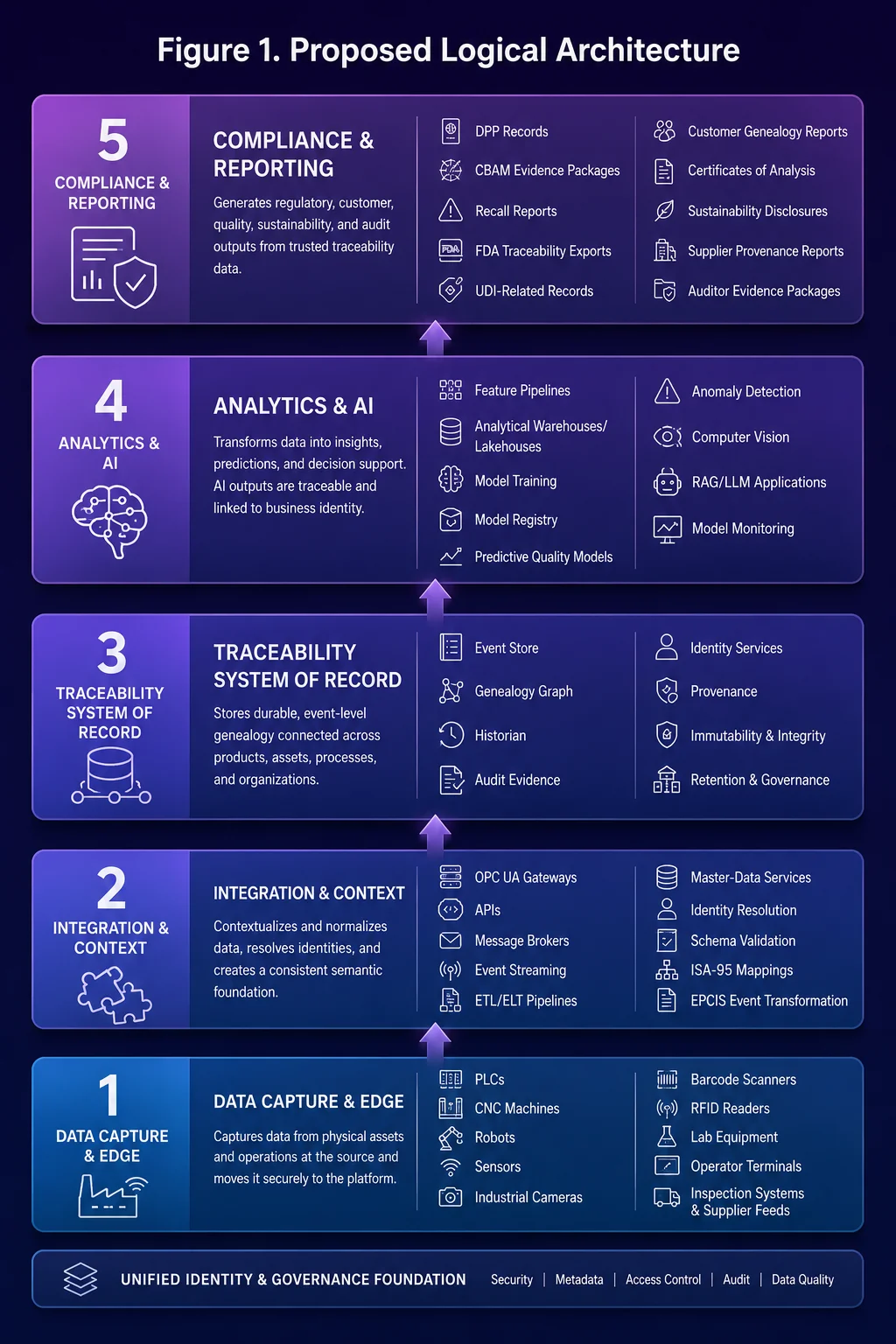
As a result of the aforesaid, the proposed architecture contains several logical layers depending on the traceability scope:
Layer 1. Data Capture and Edge. This layer reflects the physical production reality, adding edge gateways without modern interfaces. It can normalize older industrial protocols without immediate equipment replacement.
Layer 2. Integration and Context. This layer connects raw data to what it means for business. For instance, a temperature reading of 178.4°C means nothing until it’s attached to benchmark studies. Plus, a contextualized observation attaches to a machine, line, serial, lot, etc., providing more meaningful information for traceability evidence.
Layer 3. Traceability System of Record. This layer inserts durable genealogy. The table below describes the components and work principles involved.
Table 6. The components of the Traceability System of Record, Layer 3, in the proposed architecture overview.
| Component | Role | Example |
| OPC UA Gateways | Connect industrial equipment and expose machine data through standardized, structured interfaces | Read temperature, pressure, machine state, and cycle data from PLCs and associate them with Machine M17 |
| APIs | Exchange traceability information between ERP, MES, QMS, WMS, supplier platforms, and external systems | MES retrieves Work Order WO8821 and material information from ERP |
| Message Brokers | Reliably route messages and events between systems without requiring direct point-to-point connections | A completed production cycle generates an event consumed by MES, QMS, and the traceability platform |
| Event Streaming | Processes continuous streams of production and supply chain events, often in near real time | Stream machine events, scans, inspections, and material movements as production occurs. |
| ETL/ELT Pipelines | Extract, transform, normalize, and load historical or batch data from multiple systems | Combine historical ERP orders, MES production records, and QMS inspection results for genealogy analysis. |
| Master-Data Services | Maintain authoritative definitions for products, materials, suppliers, equipment, locations, and other entities | Ensure “M17,” “Machine-17,” and ERP asset “00017” resolve to the same production asset |
| Identity Resolution | Connect identifiers referring to the same physical or business entity across different systems | Link Supplier Lot A91, internal material lot ML-4582, and the corresponding received shipment |
| Schema Validation | Verify that incoming events contain required fields, formats, units, and identifiers before they enter the traceability record | Reject or quarantine a temperature event that lacks a machine ID, timestamp, or valid unit of measurement |
| ISA-95 Mappings | Map data to a consistent manufacturing hierarchy and terminology across enterprise and shop-floor systems | Associate Machine M17 with Heat Treatment Cell 2 to Line 4 to Production Area A to Plant 01 |
| EPCIS Event Transformation | Convert operational data into standardized traceability/visibility events suitable for cross-system or cross-enterprise exchange | Transform a warehouse scan into an EPCIS event describing what product moved, when, where, and why |
Layer 4. Analytics and AI. Mainly, AI applications should reference the identities established in preceding Layers 2 and 3. An AI prediction then becomes traceable based on the correlation between model versioning/input data and prediction and confidence. This way, you add traceability of AI decisions, not vice versa, merely AI bolt-on traceability. The following table gives examples of how components work in the system.
Table 7. The components of AI analytics in Layer 4 of the proposed traceability architecture.
| Component | Role | Example |
| Feature Pipelines | Transform production and traceability records into consistent variables | Convert machine temperature into a feature for a quality-risk model |
| Analytical Warehouses/Lakehouses | Consolidate data for analysis | Combine two years of MES, ERP, QMS, historian, and supplier data to investigate recurring defects |
| Model Training | Uses historical outcomes to develop predictive models | Train a model to predict the probability of a defective component |
| Model Registry | Maintains controlled versions of models | Record that Quality Model v3.4 was approved on a specific date and replaced v3.3 for Production Line 4 |
| Predictive Quality Models | Estimate the likelihood of defects | Flag Serial 009173 as high-risk because its material resembles previous defective units |
| Anomaly Detection | Identifies unusual production, material, supplier, or supply-chain patterns | Detects an unexpected combination of supplier lot and unusually high rework frequency |
| Computer Vision | Analyzes images or video for automated quality inspection | Detects a surface defect |
| RAG/LLM Use Cases | Allows users to query governed manufacturing through natural language | A quality engineer asks, “Which products may have been affected by the Line 3 temperature excursion?” and receives an evidence-linked response |
| Model Monitoring | Tracks model accuracy and drift after deployment | Detects that predictive-quality accuracy has declined |
Layer 5. Compliance and Reporting. This fifth, top layer translates common traceability information into specific evidence products. The next table shows the possible components:
- DPP Records include product identity, materials, sustainability attributes, manufacturer information, lifecycle information, and relevant compliance data
- CBAM Evidence Packages include goods identity, production facility, production quantity, direct/indirect emissions data where applicable, calculation inputs, and source evidence
- Recall Reports include serial numbers, material genealogy, production dates, equipment, inspection results, shipments, and customer/distribution destinations
- FDA Traceability Exports include Traceability Lot Codes, Critical Tracking Events (CTEs), and Key Data Elements (KDEs) with transformation and shipping information
- UDI-Related Records include device identifier, production identifiers, lot/batch, and serial number
- Customer Genealogy Reports include material lots, suppliers where appropriate, production order, manufacturing steps, inspection results, serial numbers, and shipment information
- Certificates of Analysis (CoA) include batch/lot identity, test methods, measured values, specification limits, laboratory results, approval
- Sustainability Disclosures include energy use, emissions, material composition, recycled content, and lifecycle information
- Supplier Provenance Reports include supplier identity, location, material origin, certificates, shipment, and receipt events
- Auditor Evidence Packages include source records, timestamps, approvals, audit logs, calculation methodology, document versions, and data lineage
All layers unite into a unified, evidence-driven architecture. Machine data receives its context and connects to product genealogy, enabling further AI-supported analysis for relevant compliance audits. Importantly, this architecture doesn’t require manufacturers to replace existing legacy systems and equipment; instead, it creates a common traceability layer across them.
Figure 1. Proposed Logical Architecture
3.3 Data Standards and Interoperability
Neither standard should be interpreted as the complete architecture, nor can we propose a complete toolkit. Interoperability emerges from their combination. In particular, OPC UA describes a machine but doesn’t replace genealogy; ISA-95 structures manufacturing context but doesn’t replace product identifiers; EPCIS represents visibility events but doesn’t replace MES execution; DPP defines external information requirements but doesn’t itself capture production events.
For further illustration, the following table represents the possible standards and their roles in the architecture.
Table 8. Standards and their architectural roles
| Standard | Purpose | Architectural role |
| ISA-95/IEC 62264 | Enterprise/manufacturing integration | Defines operational context and boundaries between enterprise and manufacturing functions |
| OPC UA | Industrial interoperability | Connects equipment, control systems, gateways, and software using standardized information models |
| GS1 identifiers | Globally standardized identification | Product, location, logistics, and trading-party identity |
| GS1 EPCIS 2.0 | Visibility/event information | Exchange and query of supply chain and traceability events |
| GS1 Digital Link | Identifier-to-digital-resource connection | Connects product identifiers with online information/services |
| EU DPP framework | Product sustainability and lifecycle information | External compliance/product-information layer |
| ISO 9001 / sector QMS frameworks | Quality-system controls | Identification, controlled records, quality evidence |
| IATF 16949 | Automotive quality management | Automotive production and supplier traceability context |
3.4 Security, Integrity, and Access Control
As traceability creates a gap between security and confidentiality, so supply-chain participants need to prove provenance without exposing sensitive production information. The architecture itself must contain safeguards for this case, for instance, differentiated access as follows:
- Role- and attribute-based authorization. Access may depend on role, product, facility, contractual relationship, etc.
- Tamper evidence. Important events can be protected through event signing, cryptographic hashes, trusted timestamps, etc.
- Data lineage. Every reported value should be traceable back to its origin for an auditor to evaluate not only the final number but also the evidence chain behind it.
- Segregation of operational and external data. External information should be published through controlled APIs or reporting services with explicit schemas and access rules.
4. Compliance Mapping
4.1 Regulatory Drivers Summary
The following table proves that the underlying evidence overlaps. This way, manufacturers should avoid one independent traceability database for each regulation but have many at the same time.
Table 9. Selected regulatory drivers and architectural implications as of August 2026
| Framework | Status | Traceability implication | Layers |
| EU ESPR / Digital Product Passport | Framework in force; detailed requirements depend on product-specific measures | Persistent identity, structured/interoperable product information, controlled access | 2, 3, 5 |
| EU CBAM | The definitive regime applies from Jan. 1, 2026 | Embedded-emissions evidence associated with covered imports and production | 1–3, 5 |
| FDA UDI | Implemented framework | Persistent medical-device identification and production attributes | 2, 3, 5 |
| EU MDR UDI | In force | Device identification and traceability | 2, 3, 5 |
| IATF 16949 with OEM requirements | Current automotive quality framework | Product genealogy and controlled production | 1–3 |
| EU CSDDD | Framework amended; implementation timeline evolving | Value-chain due diligence and supporting evidence | 2, 3, 5 |
4.2 Architecture-to-Requirement Mapping
The main principle is that one traceability record should satisfy multiple downstream requirements. For instance, product identity established in Layer 2 can’t be recreated separately for recalls and so on. Instead, the architecture creates the identity and evidence chain once and exposes the appropriate parts to each compliance or operational use case. The following table connects business requirements and specific architecture components.
Table 10. The connection between business and compliance requirements in the traceability architecture.
| Traceability Capability | Requirement | Architecture Response | Layers | Example |
| Product Identification | Establish persistent identity | Identity resolution and master-data services | Layer 2-3 | Serial 009173 is linked to its product model and genealogy |
| Production Genealogy | Reconstruct which materials, processes, facilities, equipment, and operations | Event capture combined with an event store and genealogy graph | Layer 1-3 | A defective assembly is traced back to the supplier, machine, and inspection with designated treatment |
| Provenance | Establish where materials/products originated and transferred | Supplier master data, shipment, and supporting documents | Layer 2-3 | Raw material is traced from Supplier A via shipment to Plant B for Distributor C |
| Environmental Evidence | Associate emissions and energy consumption with relevant production | Sensor capture, facility and process mapping, calculation rules | Layer 1-5 | Electricity consumption from a production line is associated with the relevant production quantity |
5. AI Readiness Assessment
Instead of training models on isolated MES, ERP, or sensor datasets, manufacturers can use complete production histories connected to their operational context. However, having large volumes of manufacturing data doesn’t automatically turn a factory into an AI-ready one.
AI readiness depends on complete, consistently identified, historically available, granular, and traceable data. The following sections therefore examine the use cases enabled by a mature traceability architecture and the operational capabilities required to deploy them.
5.1 AI Use Cases of Traceability in Manufacturing
The most reliable applications of AI in manufacturing traceability include the following cases:
- Predictive quality scoring. The system combines genealogy and process parameters to estimate the probability of non-conformance before final inspection.
- Supply-chain anomaly detection. Models identify unusual patterns and flag them for further action.
- Root-cause analysis. Graph analytics and machine learning automatically rank correlations between defects and upstream factors for further analysis.
- AI-assisted compliance investigation. A governed LLM interface retrieves relevant records and generates its answer with references to the records.
- Automated draft reporting. Generative AI transforms structured evidence into first-draft narratives for all kinds of reports.
Furthermore, in all cases, human review remains obligatory to some extent, especially where decisions bring potential risks such as regulatory compliance or safety.
5.2 Data Readiness Criteria
Returning to the differences between accuracy and traceability, data requires more than volume. The following requirements should be applied to data to consider it reliable:
- Completeness, as gaps can invalidate otherwise sophisticated analysis
- Identity consistency, whether the same data can be reliably recognized across systems
- Temporal quality proving the precision to reconstruct the sequence
- Context to explain what a sensor measurement or transaction represents
- Outcome labeling for data to be linked to outcomes
- Lineage to trace data to its original record
- Representativeness to confirm the data represents sufficient historical information
- Governance to check who controls data
All considered, we can describe the separate maturity levels for a manufacturing environment before any further action can be taken.
5.3 AI Readiness Maturity Model
This paper proposes the structure of a manufacturing traceability AI readiness maturity model with 5 levels explained in the table below.
Table 11. Manufacturing Traceability AI Readiness Maturity Model.
| Level | State | Data | Architecture | AI capability | Governance |
| 0. Manual | Paper/spreadsheets | Fragmented, manually entered | No common traceability architecture | Research only | Individual ownership |
| 1. Digitized | Key records are electronic | ERP/MES silos | Point integrations | Local analytics | System-specific controls |
| 2. Integrated | Cross-system genealogy | Normalized identities and timestamps | APIs/events | Reliable BI and initial ML | Enterprise data ownership |
| 3. AI-Augmented | Contextual event history | Labeled, lineage-aware datasets | Data and feature pipelines under MLOps | Predictive quality, anomaly detection, AI investigation | Model governance |
| 4. Adaptive with Oversight | Near-real-time closed information loop | Continuously validated data | Event-driven traceability and governed AI | Automated recommendations | Continuous monitoring |
Note that the final goal is not autonomous AI but controlled autonomy with traceable oversight.
5.4 Risks and Governance
Moving AI into production introduces an additional challenge to eliminate risks. This way, the governance should be designed as part of the AI architecture rather than added after deployment. Each major risk should have corresponding control measures that define how to detect and mitigate it.
| Risk | Why It Matters | How to Address It |
| False Correlations | Models may associate defects with a supplier, machine, or process | Validate predictions against engineering knowledge and investigate confounding variables with human confirmation before consequential actions |
| Model Drift | As operating conditions change, historical models become less reliable | Continuously monitor model performance and data distributions with installed drift thresholds. Ground outputs in controlled sources via RAG for model hallucination monitoring |
| Automation Bias | Operators may accept AI recommendations without sufficient independent verification | Display confidence and supporting evidence and require human review for critical decisions |
| Explainability | Regulators, quality teams, or engineers may need to understand why a recommendation was produced | Preserve input features, model version, and relevant evidence |
| Data Leakage | Traceability data may expose supplier-sensitive data | Apply encryption, logging, and least-privilege access |
6. Conclusion
The principal architectural challenge of manufacturing traceability is preserving the identities, relationships, events, semantics, and lineage according to what happened to a product across its lifecycle in reality. Consequently, this paper proposed a 5-layer architecture connecting physical data capture to integration, durable genealogy, AI, and compliance reporting.
The central conclusion proves that both compliance readiness and AI readiness increasingly depend on trustworthy contextualized data. Future research should validate the framework through production deployments and develop quantitative maturity benchmarks with a recommendation framework, as that question may define the next generation of industrial traceability.
References
- European Parliament and Council of the European Union. (2024). Regulation (EU) 2024/1781 establishes a framework for the setting of ecodesign requirements for sustainable products. Official Journal of the European Union.
- European Parliament and Council of the European Union. (2023). Regulation (EU) 2023/956 establishing a carbon border adjustment mechanism. Official Journal of the European Union.
- European Parliament and Council of the European Union. (2017). Regulation (EU) 2017/745 on medical devices. Official Journal of the European Union.
- European Parliament and Council of the European Union. (2024). Directive (EU) 2024/1760 on corporate sustainability due diligence. Official Journal of the European Union.
- European Parliament and Council of the European Union. (2025). Directive (EU) 2025/794 amending the dates of application of certain sustainability reporting and due diligence requirements. Official Journal of the European Union.
- European Commission. (2026). Carbon Border Adjustment Mechanism: Definitive regime.
- GS1. (2022). EPCIS and Core Business Vocabulary (CBV), Version 2.0.
- International Society of Automation. ANSI/ISA-95 / IEC 62264: Enterprise-control system integration.
- OPC Foundation. OPC Unified Architecture specifications and companion specifications.
- International Organization for Standardization. ISO 9001: Quality management systems—Requirements.
- International Automotive Task Force. IATF 16949: Quality management system requirements for automotive production and relevant service parts organizations.
Appendix A. Glossary of Terms and Acronyms
AI — Artificial Intelligence
CBAM — Carbon Border Adjustment Mechanism
CTE — Critical Tracking Event
DLT — Distributed Ledger Technology
DLA — Distributed Ledger Architecture
DPP — Digital Product Passport
EPCIS — Electronic Product Code Information Services
ERP — Enterprise Resource Planning
ESPR — Ecodesign for Sustainable Products Regulation
HITL — Human in the Loop
IoT — Internet of Things
KDE — Key Data Element
LLM — Large Language Model
MDM — Master Data Management
MES — Manufacturing Execution System
MLOps — Machine Learning Operations
OPC UA — OPC Unified Architecture
PLC — Programmable Logic Controller
QMS — Quality Management System
RAG — Retrieval-Augmented Generation
RFID — Radio-Frequency Identification
UDI — Unique Device Identification
WMS — Warehouse Management System
Appendix B. Standards and Regulatory Quick Reference
| Framework | Issuing body | Domain | Primary relevance to traceability | Status considered in this paper |
| ESPR/DPP | EU | Products/sustainability | Digital identity and structured lifecycle/product information | Framework in force |
| CBAM | EU | Carbon/imports | Embedded-emissions evidence | Definitive regime operating in 2026 |
| CSDDD | EU | Supply-chain due diligence | Value-chain risk/evidence | In force; timetable amended |
| ISA-95 / IEC 62264 | ISA/IEC | Manufacturing | Enterprise-control integration | Established standard family |
| OPC UA | OPC Foundation / IEC | Industrial systems | Secure semantic machine/system interoperability | Established and evolving |
| ISO 9001 | ISO | Quality | Quality-management and identification controls | Established QMS standard |
| IATF 16949 | IATF | Automotive | Automotive QMS and traceability | Current automotive QMS framework |