
After 2 years of rapid experimentation with LLMs, enterprises are shifting their focus toward operational efficiency and return on investment. That shift is reflected in spending. In particular, worldwide AI spending is forecasted to reach $2.59 trillion in 2026, which is a 47% increase over the previous year. And, despite the investments, most of that money is not turning into results.
95% of enterprise generative-AI pilots deliver no measurable P&L impact. Moreover, experts expect that more than 40% of agentic-AI projects will be canceled by 2027. That gap between enormous investment (and effort) and thin returns is the whole background of picking a partner.
How to choose the best AI development company in USA for your business? How to safeguard long-term value? How to pick the most promising use case and pass it past the pilot into production? These questions are what this article is about.
This list of AI development companies in USA by Devox Software operating experts is specifically for enterprise buyers. Below you’ll find the top 10 AI development companies in USA, what each one is genuinely best at, a short framework for choosing, and what can go wrong in the process. If you want the underlying capability set first, here’s an article on how to assess your AI-readiness and AI cost breakdown before development starts.
Quick Comparison
| Company | Best For | Enterprise Size | Industries | AI Strength |
| Devox Software | Legacy with AI modernization | Mid-market and Enterprise | Manufacturing, Logistics, Finance | Production AI |
| LeewayHertz | Custom enterprise AI | Enterprise | Multiple | LLM solutions |
| Accenture | Global transformations | Fortune 500 | All | Enterprise strategy |
| IBM | Regulated industries | Enterprise | Banking, Healthcare | Governance |
| Palantir | Operational intelligence | Enterprise | Defense, Manufacturing | AI platforms |
| C3 AI | Enterprise AI platform | Enterprises wanting prebuilt, industrial-scale AI applications | Energy, manufacturing, government | Enterprise AI platform: C3 AI platform with a catalog of prebuilt apps |
| DataRobot | Enterprise AI/ML platform | Regulated enterprises standardizing the full model lifecycle | Financial Services, Insurance, Healthcare, Retail, Manufacturing | AutoML, MLOps, model governance |
| Hatchworks AI | Delivery partner (nearshore) | Mid-market to enterprise teams wanting strategy-first, time-zone-aligned delivery | Healthcare, Financial Services, IT, Non-profit | AI strategy, generative-AI product development, agentic automation, data engineering |
| Simform | Product engineering partner | Embedding AI into web, mobile, and cloud applications | FinTech, Healthcare, Retail, Logistics, Media | AI/ML engineering, generative AI, cloud and product engineering |
| InDataLab | Data-science specialist | Data-science-heavy problems | Retail, Healthcare, Marketing, Logistics, Real Estate | Data science and ML consulting |
How to Keep AI Budgets under Control
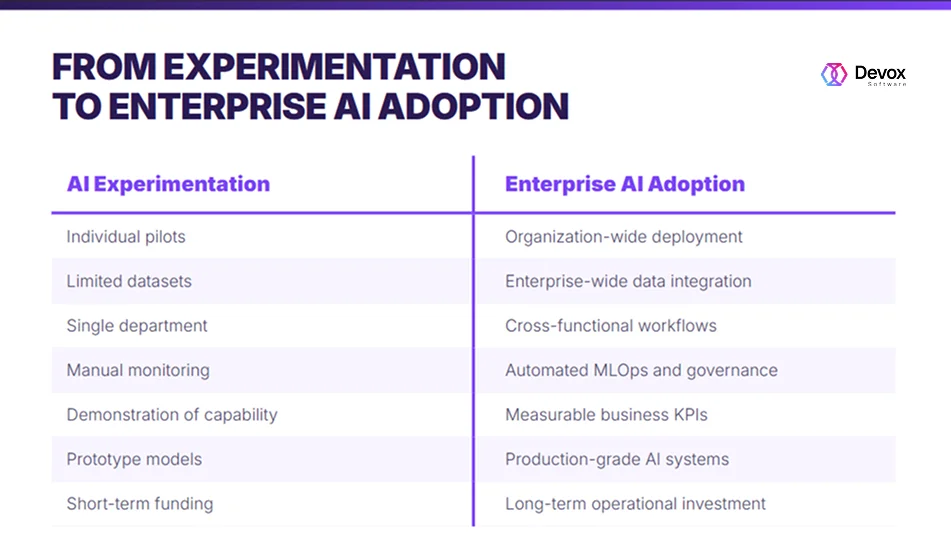
Businesses keep launching chatbots, internal assistants, intelligent workflows, and more with relatively little measurable business value. This way, AI budgets expand due to:
- Competitive Pressure. Delaying AI adoption could leave companies at a structural disadvantage.
- Infrastructure Investments. Data platforms, GPU infrastructure, cloud capacity- you name it receive funding to support multiple future AI initiatives at once.
- Embedded AI. Microsoft, Salesforce, SAP, and Oracle integrate AI capabilities directly into enterprise platforms they offer.
- Operational Efficiency. Businesses increasingly justify investments through productivity gains and reduced manual effort.
Consequently, AI experimentation is often equated with AI transformation. However, in practice, they represent very different levels of organizational maturity. We must move from a technical question “Can AI perform this task?” to a business question: “Can AI reliably improve operations at scale?”
This distinction explains why many impressive demonstrations never become production systems. Building a working AI model is often the easiest part of an enterprise implementation. Integrating it with legacy ERP systems along with other requirements typically represents the reality of project complexity.
For this reason, while looking for the most value-driven AI case, you need to follow a simple decision framework that our LLM specialists always recommend to our clients.
- Start with High-Value Business Cases. Prioritize use cases based on measurable business value, asking questions such as:
- How many manual hours can this eliminate?
- Can it reduce operational costs?
- Will it improve customer experience?
- Does it increase revenue or reduce risk?
- Can success be measured within a few months?
- Choose the Right AI Architecture. The appropriate implementation approach can reduce development costs dramatically. For instance, SaaS AI tools are good for generic productivity tasks, RAG systems are often used for enterprise knowledge search, fine-tuned LLMs are for domain-specific language tasks, while Custom ML models with the highest development cost are best for predictive analytics, computer vision, proprietary IP, etc.
- Control Inference Costs. As LLMs incur costs every time with responses, you need to route simple requests to smaller, less expensive models, limit unnecessary context, or use retrieval to reduce token consumption.
- Build Governance into Every Deployment. Establish governance from day one with approval workflows, security and access controls, human-in-the-loop reviews, monitoring and alerting to monitor AI like any other production system.
- Think Beyond Development Costs. Budget up front for the total cost of ownership (cloud infrastructure, API usage, data storage, MLOps, and LLMOps) so recurring costs are understood early.
All in all, begin with high-value use cases with the right technical architecture, optimize inference costs, and implement governance from the outset. Those will allow you to grasp sustainable business value from your AI investments.
Enterprise AI Spending Trends by Industry
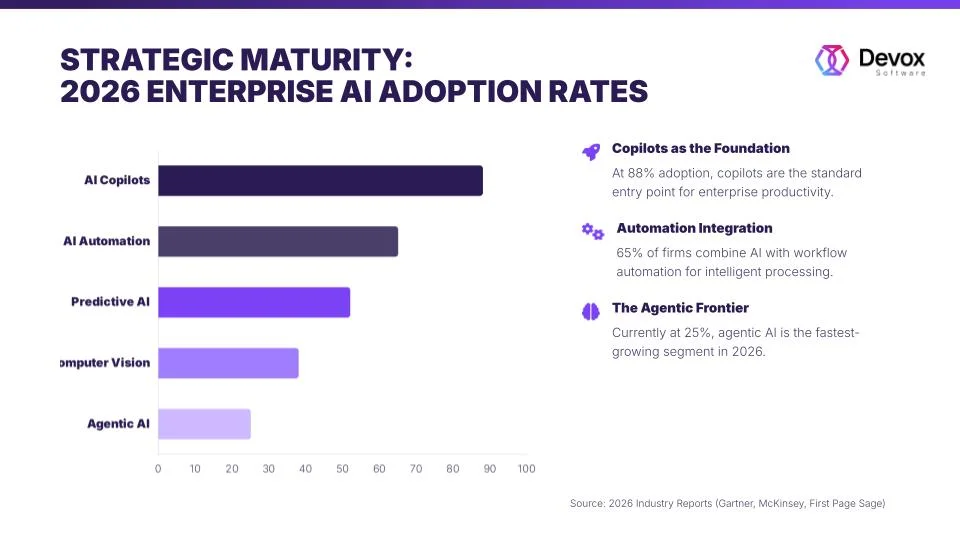
AI investment priorities differ significantly across industries, reflecting variations in regulatory requirements, operational complexity, and available data.
| Industry | AI Use Cases |
| Financial Services | Fraud detection, underwriting, compliance automation, customer service, and risk management. |
| Healthcare | Clinical documentation, medical imaging analysis, patient engagement, scheduling optimization, and administrative automation |
| Manufacturing | Predictive maintenance, quality inspection, production scheduling, supply chain optimization, and computer vision |
| Logistics and Transportation | Route optimization, warehouse automation, demand forecasting, shipment visibility, autonomous decision support, and fleet management |
| Retail and E-commerce | Recommendation engines, inventory forecasting, pricing optimization, customer support automation, visual search, and personalized shopping experiences |
| Energy and Utilities | Predictive AI for asset monitoring, grid optimization, maintenance planning, and demand forecasting |
Across every industry, one trend has become clear: enterprise AI investment is shifting away from isolated generative AI pilots toward production-grade systems. For this purpose, you need a best AI development company in USA to make it quick and reliable.
Top AI Development Companies in USA for 2026
The companies below were selected based on their enterprise AI capabilities, production delivery experience, governance and compliance practices, and more. You can check the methodology below. Now, let’s see the list of AI development companies in USA that promise long-term AI transformation rather than short-term experimentation.
LeewayHertz
HQ: US operations (California) with global delivery
LeewayHertz has already delivered 100+ solutions to ESPN, Shell, P&G, 3M, NASCAR, and Hershey’s among its clients. Its platform ZBrain Builder lets teams stand up custom LLM applications on their own data. Acquired by The Hackett Group in September 2024, the firm now pairs deep consulting reach with generative-AI delivery that suits enterprises with mature technical leadership already in place.
Best for: Fortune-500-scale AI consulting
Core AI Services: Enterprise AI consulting, ZBrain platform
Accenture
HQ: Global
Accenture‘s scale is hard to match, since its data-and-AI practice combines strategy, platform engineering, and organizational change under one roof. The trade-off is what you’d expect from a global consultancy: premium pricing and heavier processes.
Best for: Global enterprises with multi-year AI transformation programs
Core AI Services: AI strategy, generative AI at scale and change management
IBM (WatsonX & IBM Consulting)
HQ: Armonk, NY
IBM leans into the governance and trust that can’t be undermined when it goes to enterprise play. For instance, WatsonX bundles model development, a data store, and governance controls designed for auditability, while IBM Consulting handles implementation. That’s why for banks, insurers, and healthcare, IBM is a natural shortlist entry.
Best for: Regulated enterprises
Core AI Services: The WatsonX platform, IBM Consulting
Palantir Technologies
HQ: Denver, CO
Palantir‘s strength is turning fragmented enterprise data into operational decisions. Their platform, Foundry, integrates messy data across an organization, and AIP wires large language models into that operational fabric with guardrails. This way, it’s a strong fit for defense, government, and large industrial or financial enterprises with serious data-integration challenges.
Best for: High-stakes environments
Core AI Services: Foundry and AIP
C3 AI
HQ: Redwood City, CA
C3 AI’s platform and library of prebuilt enterprise applications shorten time-to-value for common industrial and financial use cases, especially in energy, manufacturing, and government. This way, its clients can move quickly while those needing something highly bespoke may find the platform opinionated.
Best for: Enterprises that want prebuilt, industrial-scale AI applications
Core AI Services: The C3 AI platform plus a catalog of prebuilt apps
DataRobot
HQ: Boston, MA
DataRobot is the go-to for teams that want to industrialize machine learning. Automated model building, deployment, monitoring, and governance are united in one lifecycle platform. Moreover, its model-governance and observability tooling appeals to regulated enterprises that need documented, repeatable ML operations rather than one-off models.
Best for: Regulated enterprises standardizing the full model lifecycle
Core AI Services: AutoML, MLOps, model governance and monitoring
HatchWorks AI
HQ: Atlanta, GA, with nearshore delivery in Latin America
HatchWorks AI insists on discovery and strategy before code. Its nearshore model keeps delivery in overlapping US time zones, and it has a documented track record fitting AI into existing systems for mid-market companies across healthcare, financial services, and IT.
Best for: Mid-market to enterprise teams
Core AI Services: AI strategy, generative-AI product development, agentic automation, data engineering
Simform
HQ: Florida, US, with global engineering teams
Simform is a good fit when the goal is an AI-enabled product rather than a standalone model. Strong on cloud-native delivery and modern stacks, it serves mid-market to enterprise clients that want AI woven into applications customers actually use.
Best for: Embedding AI into web, mobile, and cloud applications
Core AI Services: AI/ML engineering, generative AI, cloud and product engineering
InData Labs
HQ: Florida, US, with global data-science teams
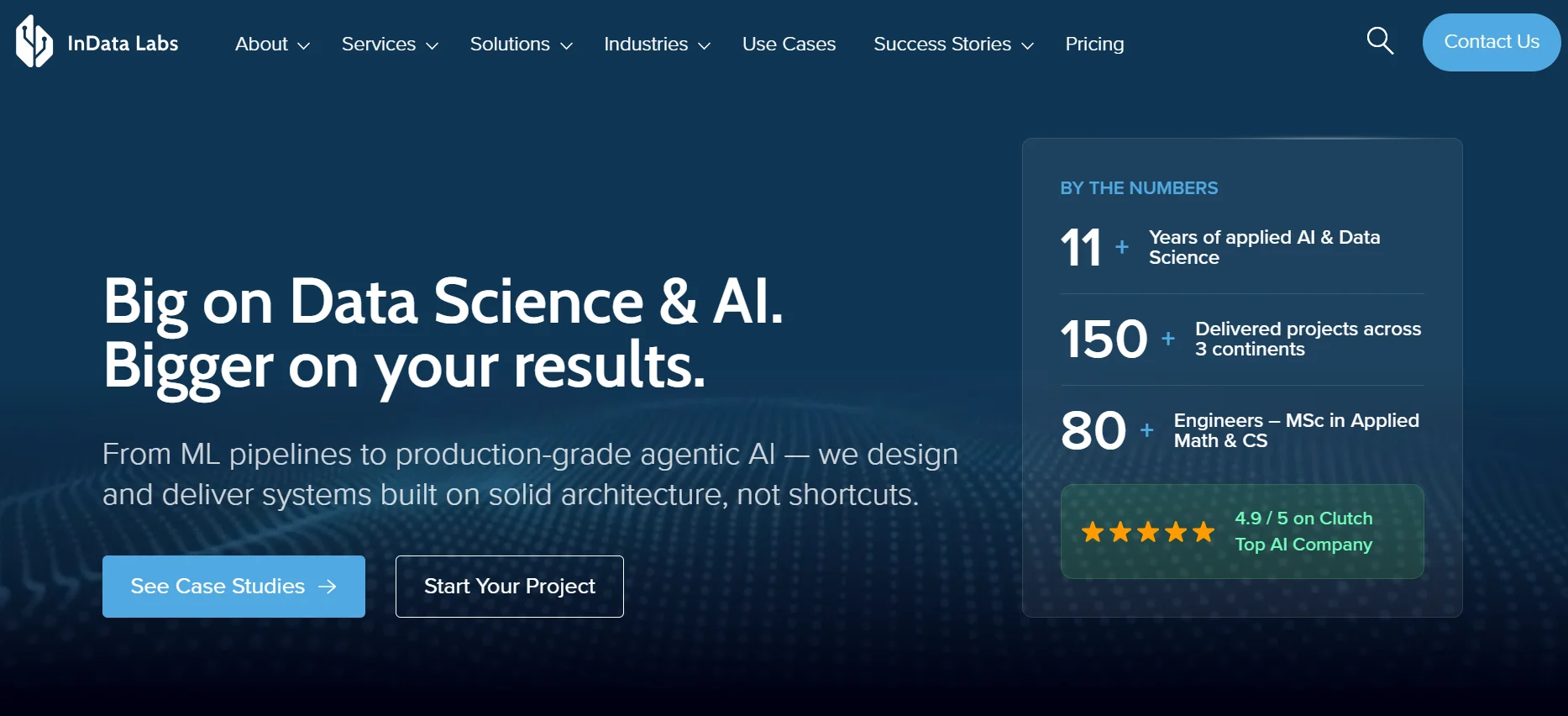
InData Labs is a research-driven choice for organizations whose value sits in the model itself. If your differentiation depends on proprietary models trained on your own data rather than off-the-shelf APIs, it’s a credible specialist partner.
Best for: Data-science-heavy problems (computer vision, predictive analytics, and custom ML)
Core AI Services: Data science and ML consulting
Devox Software
HQ: US-headquartered in Miami, FL
Devox Software‘s differentiator is that every engagement runs through the AI Solution AcceleratorTM, an engineering control layer that defines what an AI system can access, where a human must approve, and what gets checked before anything reaches production. That governance-by-design approach maps directly onto the compliance frameworks enterprises actually get audited against: the EU AI Act, ISO/IEC 42001, NIST AI RMF, SOC 2, HIPAA, GDPR, and model-risk standards like SR 11-7.
Best for: Enterprises and scale-ups that need production-grade AI plus legacy modernization in the same program
Core AI Services: AI development services: GenAI, Agentic AI, custom ML and computer vision with MLOps/LLMOps, AI readiness assessment, AI strategy and architecture
How to Choose an AI Development Partner
We’ve come to the point where selecting becomes a thing, and shortlisting is the easy part. Here is the quickest way to separate the best AI development companies in US from the merely capable.
Start with the build-vs-buy-vs-fine-tune decision and then pressure-test each partner against five questions:
- Show me something you took to production and still operate. Ask about monitoring, drift detection, and retraining.
- How do you handle governance and compliance in my industry? Look for concrete frameworks and human-in-the-loop controls.
- How does this integrate with my legacy systems without breaking them? Isolated environments, phased rollout, rollback plans.
- How do you control inference and infrastructure cost as usage scales? Given that most AI initiatives experience cost overruns in year one, this is not a detail.
As a result, favor vendors that treat AI as an engineering practice with versioned data, CI/CD for models, observability, and governance. However, some challenges may occur. Below are the most common mistakes businesses make when evaluating AI vendors (and how to avoid them).
- Flashy demos are prioritized. Real-world deployment experience is far more valuable than an impressive proof of concept.
- Ignoring AI governance. It becomes critical once AI systems begin making or supporting business decisions.
- Overlooking MLOps and LLMOps capabilities. Production systems require continuous monitoring, retraining, deployment automation, and performance optimization.
- Choosing a vendor without legacy integration experience. AI solutions must work alongside current business systems, even if they are decades old.
- Creating vendor lock-in. Some providers build solutions around proprietary frameworks, closed architectures, or vendor-specific platforms that make future migration difficult and expensive.
- Starting without measurable KPIs. Before development begins, establish measurable objectives such as reduced manual effort, faster processing times, etc.
- Underestimating inference costs. As AI adoption grows, inference costs can become a significant operational expense.
- Failing to verify production experience. Experience delivering AI in real production environments is one of the strongest indicators of future project success.
Evaluating vendors beyond technical demonstrations, organizations significantly reduce project risk and improve the likelihood of achieving sustainable ROI from their AI investments.
How We Assessed the Leading AI Development Firms in US
We’ve scored the leading AI development firms in US on 6 things that have the most value:
- Production track record
- Governance and compliance depth
- Integration with legacy systems
- Delivery model and ownership
- Domain and industry expertise
- Speed and cost to value
A quick disclosure in the spirit of good editorial practice: Devox Software publishes this list, and we’ve placed ourselves in it because we believe our engineering-led, production-first model fits the criteria above. We’ve been transparent about why below, and every other entry is a credible enterprise partner worth shortlisting.
The Bottom Line
The top 10 AI development companies in USA in 2026 fall into 3 broad camps. Global consultancies fit the largest, multi-country transformation programs. Enterprise AI platforms fit organizations that want packaged tooling and prebuilt patterns. While the third group, engineering-led delivery partners, fits teams that want a custom system owned end to end.
Depending on the goals and current systems, you can choose a partner that delivers real value with predictable costs to ensure a long-term initiative. Devox Software knows the difference between an AI experiment and an AI system that is an engineering discipline, as we prove ROI before you commit to a rollout.
Frequently Asked Questions
-
What are the top AI development companies in the USA in 2026?
For enterprise buyers, a strong shortlist includes Devox Software, LeewayHertz, Accenture, IBM, Palantir, C3 AI, DataRobot, HatchWorks AI, Simform, and InData Labs. They span 3 categories: global consultancies, enterprise AI platforms, and engineering-led delivery partners, so the “best” depends on whether you need a large-scale program, packaged tooling, or a custom system built to production.
-
What does an AI development company actually do?
It covers the full engineering lifecycle of a production AI system: use-case discovery, data preparation, model development or LLM integration, deployment, and ongoing monitoring and retraining. A model without the last two stages is a demo, not a system.
-
How much does enterprise AI development cost in 2026?
It depends on the approach. A production-grade proof of concept typically runs $25K–$75K over 4–8 weeks. Beyond that, integrating an LLM with RAG on your own data commonly lands in the tens of thousands to low six figures; fine-tuning and fully custom ML cost more and take longer. US-local ML talent commands a premium, which is why many US enterprises use Central European delivery for a 40–50% cost optimization. The following table shows the differences.
Project Typical Cost Timeline AI Readiness Assessment $10k–25K 2–3 weeks RAG MVP $30k–80K 4–8 weeks AI Copilot $60k–150K 8–14 weeks Agentic Workflow $120k–300K 3–6 months Custom ML Platform $250K 6–12 months -
How long until an enterprise AI project shows value?
A well-scoped pilot on real data should produce measurable results in about 4–6 weeks, tied to a small set of business KPIs. RAG-based knowledge systems often reach production in 4–12 weeks; custom ML programs take longer.
-
How do I choose the best AI development company for my business?
Decide first whether you should buy, integrate with RAG, fine-tune, or build custom. Then evaluate partners on production track record, governance and compliance depth, legacy-system integration, delivery model, domain expertise, and cost-to-value. Ask each one to show something they took to production and still operate today.
-
Why do so many enterprise AI projects fail?
The common causes are weak governance, unclear ROI, and runaway costs. Most enterprise GenAI pilots deliver no measurable P&L impact. The fix is treating AI as an engineering discipline with measurable pilots, governance by design, and a real path from prototype to production.