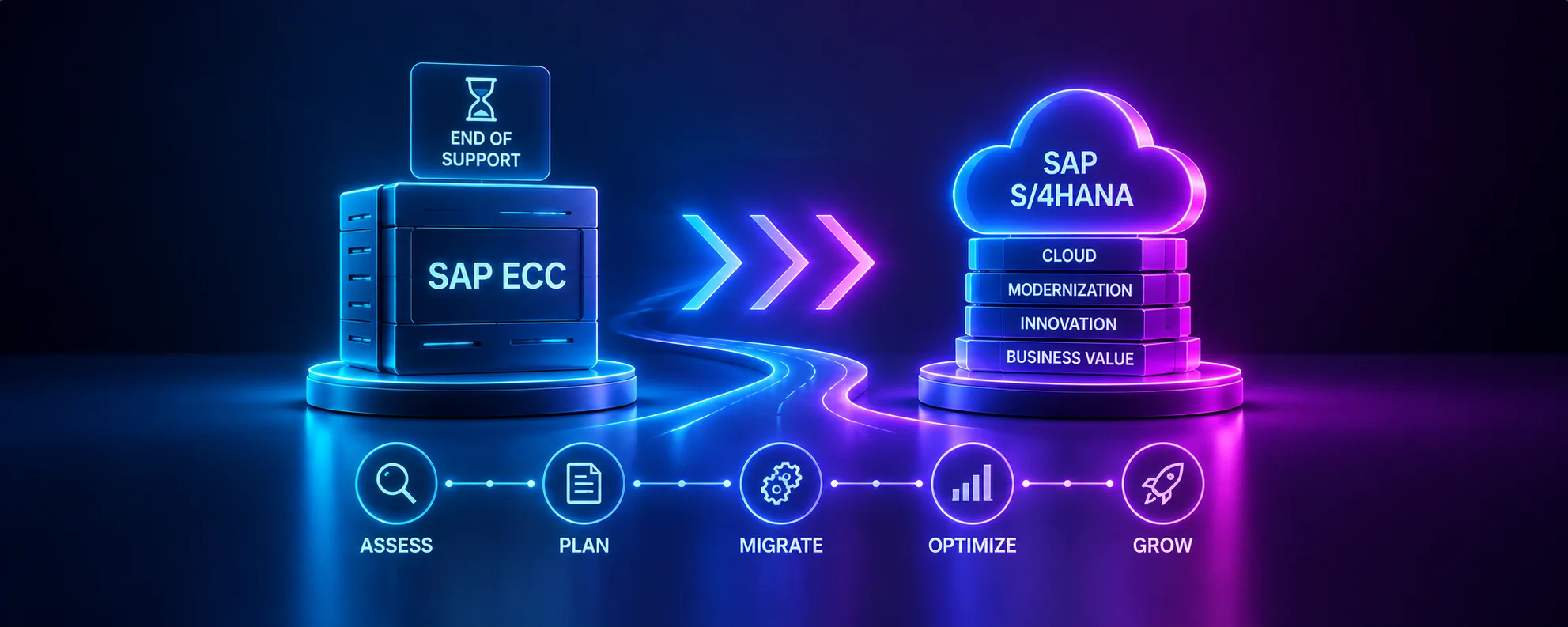
SAP ends mainstream maintenance for SAP ECC 6.0 on December 31, 2027. Extended maintenance runs until the end of 2030 at a two-percentage-point premium over the standard maintenance fee. Every ECC customer faces the SAP ECC end-of-support deadline and now has three options: pay for extended maintenance, switch to third-party support, or migrate to SAP S/4HANA. This guide covers each date, what each option costs, and how Devox Software runs S/4HANA migrations for systems with years of custom Z-code.
What Happens After SAP ECC End of Support
Mainstream maintenance for SAP ECC 6.0 with Enhancement Packages 6, 7, or 8 ends on December 31, 2027. For systems on EHP 0–5, mainstream maintenance already ended on December 31, 2025, and they moved to customer-specific maintenance: SAP still helps with known issues, while new support packages, legal changes, and regular security patches stop. Customers on EHP 6–8 who need more time can order SAP ECC extended maintenance 2030 at a two-percentage-point premium over standard maintenance. SAP advises placing the order by Q3 2027.
After December 31, 2030, every on-premises ECC system moves to customer-specific maintenance, which is why many teams treat 2030 as the practical SAP ECC end of life. The 2033 date belongs to a separate subscription, the SAP ERP private edition transition option. It is a transformation offering, separate from extended maintenance: a company signs a RISE with SAP contract, runs ECC on SAP HANA, and moves the system to SAP’s private cloud before the end of 2030. You can purchase the option from 2028, and it covers 2031 to 2033. Your SAP S/4HANA migration deadline therefore depends on the maintenance path you choose: 2027 on mainstream terms, 2030 with extended maintenance, and 2033 only under a RISE contract.
Three Options After 2027: Extended Maintenance, Third-Party Support, Migration
The SAP ECC 2027 deadline leaves every ECC customer with three paths, each with its own cost and end date.
Path 1: SAP Extended Maintenance Until 2030
The surcharge is two percentage points on your maintenance base. For a company paying 22% of its license value per year, the rate becomes 24%, which adds about 9% to annual maintenance fees.
Extended maintenance is like keeping an old truck on the road after the warranty expires: it still drives, the bills grow every year, and replacement parts get harder to find.
Also check the layers below ECC. SAP maintenance covers the application, while the database and operating system follow their own vendors’ lifecycles. The SAP Product Availability Matrix shows which database releases SAP supports for your ECC version, and many long-running systems need a database upgrade before 2030.
Path 2: Third-Party Maintenance
Providers like Rimini Street offer support for SAP ECC through at least 2040 and advertise savings of up to 50% on annual maintenance fees. It can look financially attractive in the short term. You set the pace of change, without adapting to vendor deadlines.
The trade-off is that you leave SAP’s maintenance contract. The provider delivers its own fixes, tax and legal updates, and security measures, while SAP support packages and the S/4HANA roadmap stay outside your contract. Before you sign, ask how the provider handles legal changes in each country where you operate, and ask SAP what it charges to reinstate maintenance if you migrate later.
Path 3: Migration to SAP S/4HANA
This is the path we recommend for companies that plan to stay with SAP. You get:
- The HANA database at the core (and yes, S/4HANA runs exclusively on it — forget about Oracle or Db2).
- A choice of deployment: on-premise, RISE with SAP private cloud, or SAP public cloud.
- Access to capabilities SAP builds only for S/4HANA, including the Joule AI assistant and embedded analytics.
Migration requires the largest upfront investment of the three options: licenses or a RISE subscription plus implementation services, which depend mostly on the volume of custom code, historical data, integrations, and company codes in scope.
Brownfield, Greenfield, Bluefield: Three Migration Approaches
Once you choose S/4HANA, the next decision is what you take with you before the SAP ECC to S/4HANA migration deadline. That choice affects your budget and timeline more than any migration tool. Three technical approaches exist, and your choice determines whether you turn this investment into value or new technical debt.
- Brownfield (Technical conversion). You convert the existing ECC system to S/4HANA with its configuration, custom code, and full history. It is usually the fastest route, and business processes stay familiar. The trade-off is that every Z-program still in use moves with you and needs remediation for S/4HANA data structures.
- Greenfield (Clean slate). You start from scratch and implement only standard Best Practices. Ideal for architectural purity, but it requires significant business-process changes and extensive user training.
- Bluefield (Selective Data Transition). You build a new S/4HANA system and move selected processes, company codes, and historical data into it. This is a strong option for consolidating several ECC systems into a single S/4HANA instance, or for moving business units in waves when the SAP S/4HANA migration deadline of 2027–2030 leaves too little time for a single cutover.
Our Recommendation: Bluefield With a Clean Core
We recommend a Bluefield approach with strict “Clean Core” discipline. We do not transfer old custom settings to a new cloud environment “as is.” We use SAP Readiness Check and the Custom Code Migration app to analyze the existing code in depth and move back toward standard SAP functionality. If we need customization, we build it “side-by-side” (alongside the core), not inside it.
Clean Core means your S/4HANA system stays as close to SAP standard as possible, so future upgrades install without weeks of rework. Setting clean core rules before the SAP S/4HANA migration deadline of 2027 keeps custom code you plan to retire out of the new system. Custom logic moves to SAP Business Technology Platform and connects to the core through released APIs.
Custom Z-Code Debt: How We Assess It Before Migration
Bluefield and Clean Core both depend on one question: which custom code still earns its place. After ten or fifteen years on ECC, most systems carry Z-programs written by people who have since left, quick fixes that became permanent, and add-ons wired straight into the core. Each new feature takes longer to ship, and each update can break something nobody documented. Here is how we map that code before anyone changes it, using our AI Solution Accelerator™:
- We put AI inside a controlled execution framework instead of giving it free access. We don’t just let a Large Language Model (LLM) read your code. We wrap it in a controlled layer. We use the Language Server Protocol (LSP) for search and build Knowledge Graphs from Abstract Syntax Trees (ASTs). Before AI proposes a single code change, it ‘understands’ the entire architecture: ‘This Z-report reads sales order tables, runs from a custom transaction, and feeds an IDoc to the warehouse system.’ We migrate facts, not assumptions.
- Strict Guardrails and Policy-as-Code. AI receives only the access it needs (role-based access tokens). It cannot modify protected workflows, financial logic, or regulated data-handling paths without human approval. We use a ‘policy-as-code’ approach (similar to OPA): if a change affects a critical module, the system automatically blocks it until a senior engineer completes a manual review.
- Tool-Controlled Execution. AI doesn’t just generate code and hope for the best. We configure deterministic validation hooks in your CI/CD pipeline. AI generates code; ABAP Unit tests, SAP Code Inspector checks, and security scans run automatically. If code coverage < 80% or a scanner finds a vulnerability, the system automatically sends the code back to the AI with a structured error report and requires a fix. The cycle repeats until the code passes every gate.
- A living documentation platform that stays with you. We will capture knowledge held by engineers who have left the company and turn it into documented, searchable information. During the Discovery phase (2–4 weeks), we connect this platform to your source code, your ticketing system, test history, and server logs. From day one, your team receives a search system that provides instant answers with source links: ‘How will this change affect the system?’ And most importantly: this platform remains your property forever, even if you decide to switch vendors.
Every change keeps a full audit trail: which model was used, what prompt was sent, and which engineer approved it.
How We Run the Migration
But strategy is only half the battle. The second half is executing it without stopping the business. That’s where our Migration Intelligence Framework comes in as part of the AI Solution Accelerator™. We do not just “migrate” — we build engineering discipline around this process.
Here is how it works under the hood:
- Full Integration Map Before Cutover. We inventory every interface: IDocs, RFC and BAPI calls, OData services, file transfers, and third-party connections. For non-SAP systems, we add contract tests that run throughout the project, so interface changes surface in testing long before cutover weekend.
- Wave-Based Migration. With Selective Data Transition, you can move company codes or business units in waves: one plant or region goes live on S/4HANA while the rest keeps running on ECC, connected through standard interfaces. Each wave has its own cutover rehearsal and fallback plan.
- Early Database Assessment. We use the SAP Readiness Check and the Simplification Item Check to see which data structures change in S/4HANA, such as customer and vendor master data merging into Business Partner and finance moving to the Universal Journal. Archiving historical data before cutover reduces the HANA memory you pay for.
- Regression Test Suite Based on Real Behavior. Before each migration wave goes live, we create a regression suite based on how your old system actually behaved (not how it was supposed to behave according to 15-year-old documentation). This helps verify feature parity before cutover. We catch gaps before users do.
- Rehearsed Cutover With a Fallback Plan. We rehearse cutover several times on a copy of production data. Where a long outage is unacceptable, SAP’s near-Zero Downtime Technology shrinks the business downtime window to hours. Every cutover has a documented fallback to ECC.
Rehearsed cutovers and early testing shorten hypercare, the period after go-live when the project team stays on call to resolve issues. When you evaluate an SAP ECC to S/4HANA migration partner, ask how long hypercare lasted on its previous projects and what shortened it.
Go-live is the moment the system passes from the project team to the people who use it every day. That handover deserves its own plan.
The Shakedown Phase: User Adoption After Go-Live
You can have an ideal migration architecture, a clean core, and a rehearsed cutover. But if your team in production or in the office cannot work effectively with the new system from day one, the project will fail.
For shop-floor and back-office users, the first weeks on SAP Fiori are the hardest. Fiori apps guide users through a fixed sequence of steps, and people trained on ECC transaction screens lose speed until the new sequence becomes routine.
At Devox Software, we account for this human factor. We do not just “deliver software and leave.” Here is how we support your team through this period:
Cross-Domain Teams Instead of “Throwing Requirements Over the Fence”
Success depends on having cross-domain knowledge. We don’t let the business write requirements in a vacuum, or the IT team code without understanding the context.
We form joint “war rooms.” For example, a product manager with manufacturing domain knowledge and a tech lead collaborate closely. This keeps the implementation focused on what the business needs, not what looks technically impressive.
Living Documentation Platform
The documentation platform from Discovery also serves end users after go-live. When someone asks how a change affects their report, they get an answer with a link to the source.
Agile in ERP: It Is No Longer a Myth
Large-scale S/4HANA programs can also be delivered iteratively using Agile methods. We break down macro-tasks (“epics”) into short, 2-week sprints in Azure DevOps.
Action Plan: Turning Migration Work Into Manageable Azure DevOps Tickets
An ERP migration can feel overwhelming. When we view it as one giant mountain, analysis paralysis sets in. That is why we do not do a “big bang.” We do what we do best: break the project into small, clear, manageable units of work in Azure DevOps.
Here is what our proven delivery process looks like, based on our AI Delivery Model, which runs in four stages:
Discovery (2–4 Weeks to Full Clarity)
Before we write a single line of code, we need to understand what we are working with.
- Is critical system knowledge held by a few people, some of whom have already left? We document it so the project lives in your files.
- What you get: Concrete artifacts that stay with you forever, even if you decide to change vendors or develop the project with an internal team. This includes a Living Documentation Platform, a technical architecture, a risk map with a mitigation plan, and a realistic estimate we can commit to.
If you are comparing SAP ECC to S/4HANA migration partners ahead of the upcoming SAP S/4HANA migration deadline, ask each one what you will own after Discovery: the documentation, the risk map, and the estimate. A partner confident in its process will put those deliverables in writing before you sign the main contract.
Scope & Model (Validation Before Code)
We do not let AI or developers guess. We translate business rules into clear acceptance criteria and map dependencies. We define how each migration wave should behave before we start building. This eliminates the risk of creating new technical debt from day one.
Build & Release (Human-Governed Development)
We break macro-tasks (“epics”) into short, 2-week sprints.
- Instead of waiting 8 months for a release, you see a working version of the system every two weeks.
- We migrate in waves, so one business unit can go live on S/4HANA while others still run on ECC.
- Each wave passes automated quality gates and has a fallback plan.
Learn (Post-Release Cycle)
Work does not end at deployment. We connect observability tools so that production data (errors, usage patterns) automatically guides the next development cycle.
Where to Start Before the 2027 Deadline
If you are planning around the SAP ECC to S/4HANA migration deadline of 2027, keep in mind that extended maintenance buys time until 2030 at a higher fee, and every year of waiting shortens the window for testing and user training. A practical first step is a Fit-to-Standard review: your process owners walk through SAP standard processes and mark each customization as still needed or ready to retire. Book a 90-minute Fit-to-Standard session, and we will show which of your ECC customizations S/4HANA standard already covers.