
The practical approach for demand forecasting machine learning is to start with a defined forecasting problem. Only then should a company decide whether to integrate ML forecasts into its planning systems. Nevertheless, forecasting projects can succeed as experiments but fail to deliver usable results in production.
Devox Software helps logistics and manufacturing clients to get effective time series forecasting in production. This article reveals this experience and shows how to structure AI demand planning to get accurate and reusable results.
When Is ML Demand Forecasting Worth Testing?
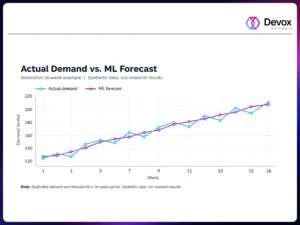
The objective is never to replace traditional forecasting automatically; we want to identify where more flexible predictive models could deliver more value. Depending on the business, demand may be associated with:
- Seasonal purchasing cycles
- Promotional schedules and pricing changes
- Product-specific buying patterns
- Regional or location-based differences
- Calendar events and recurring operating conditions
That’s why ML models can be evaluated for whether they can capture relationships among these variables. However, mere availability of historical data does not guarantee predictable demand. The better question is whether the dataset contains patterns that help predict future demand.
Moreover, the forecast horizon determines how far ahead predictions must extend. Short-term forecasts may incorporate recent demand changes, while longer-horizon forecasts must work with greater uncertainty about future conditions. Define the forecast horizon based on the operational decisions it must support before selecting a modeling approach. For inventory replenishment, the forecast must cover the supplier lead time plus the inventory review period. For production planning, it must account for material procurement, manufacturing lead times, capacity allocation, and scheduling constraints. For example:
| Operational process | Dependency | Required forecast horizon |
|---|---|---|
| Inventory replenishment | 14-day supplier lead time + 7-day inventory review cycle | 21 days |
| International procurement | 60-day supplier lead time + 30-day purchasing cycle | 90 days |
| Production planning | 4 weeks of material procurement + 2 weeks of manufacturing | At least 6 weeks |
| Workforce planning | 2-week shift scheduling cycle | At least 2 weeks |
| Strategic capacity planning | Equipment procurement, installation, and commissioning | 6–18 months |
These dependencies determine not only how far ahead the model must predict but also the required forecast granularity, update frequency, and acceptable level of uncertainty. A model optimized for seven-day demand forecasting may deliver excellent accuracy but provide little operational value if purchasing decisions must be made 30 days in advance.
Last but not least, every ML forecasting initiative needs a baseline representing the current forecasting process: a statistical time-series method, a rules-based calculation, or predictions adjusted by experienced planners. Because without this baseline, a new ML model may not demonstrate any improvement over the existing situation.
What Data Must Be Available Before Building Demand Prediction Models?
As we mentioned above, an ML forecasting model requires historical records that match the intended prediction task and features that will remain available when forecasts are generated. That’s why forecasting data should reflect the level at which business decisions occur.
For example, inventory forecasting for logistics for individual SKUs across multiple warehouses needs product- and location-level demand records. Monthly category totals cannot directly provide the same level of detail. The dataset should preserve consistent:
- Product and location identifiers
- Demand quantities and time periods
- Transaction or reporting timestamps
- Historical coverage for relevant demand patterns
- Distinctions between unavailable records and genuine zero-demand periods
without which the demand forecast accuracy will be doubtful. However, a forecasting model must not depend on information that originates only after the prediction date. Suppose a model predicts demand four weeks ahead. A promotion approved before the forecast is generated may be a valid input. The actual revenue cannot be used to make the earlier prediction.
Furthermore, enterprise forecasting datasets frequently combine information from multiple operational systems, such as ERP, POS, WMS, CRM, and promotional planning platforms. If these sources are joined incorrectly, training records contain mismatched demand and operational conditions. Consider a retailer that combines POS sales transactions, warehouse inventory snapshots, and promotional calendars to train a demand forecasting model.
A product normally sells 100 units per day. On Wednesday, it goes out of stock, and recorded sales fall to 10 units. The warehouse receives a replenishment shipment on Friday. If Wednesday’s sales are joined with Friday’s inventory snapshot, the training dataset shows low demand despite sufficient inventory. The model interprets this as a decline in customer demand rather than a stock availability issue. Consequently, it may recommend smaller replenishment orders, increasing the likelihood of future stockouts.
This example from our practice illustrates how incorrect data integration can create systematic forecasting errors that cannot be resolved simply by choosing a more sophisticated ML algorithm. That’s why data preparation addresses missing observations, duplicate transactions, inconsistent timestamps, changing product identifiers, and delayed source-system updates, so the intended outcome is a dataset that supports reproducible training and evaluation.
Which ML Forecasting Approach Fits the Company’s Demand Patterns?
The most appropriate forecasting model is the one that meets the required prediction horizon and operational constraints while demonstrating reliable performance against simpler alternatives. Algorithm complexity should not be the primary selection criterion.
In particular, recursive forecasting generates a prediction for the next period and uses previous predictions to estimate later periods. It can extend a single-step model across longer horizons, although errors may accumulate.
Direct forecasting generates predictions for specific future horizons without using earlier predictions as substitutes for observed demand.
Multi-output forecasting generates several future predictions together.
A company with the need for a complete eight-week demand forecast should evaluate demand forecasting models over that full horizon rather than select one solely because it performs well on next-day predictions.
Model selection also depends on the structure and availability of the input data. No model family is universally superior, so you need to choose according to your needs.
| Model family | Potential use | Main consideration |
| Statistical time-series models | Established demand patterns with relatively simple historical relationships | Whether a simpler method already meets the target |
| Tree-based ML models | Structured datasets containing demand history and explanatory features | Whether temporal information is represented effectively |
| Neural network forecasting models | Complex forecasting tasks with sufficient relevant training data | Whether additional complexity produces a justified improvement |
Even after that, candidate models should be evaluated using the same forecast horizon, historical periods, and appropriate error metrics. The comparison should answer three questions:
- Does the model improve forecasting performance over the existing method?
- Are improvements consistent across relevant demand segments?
- Does the performance advantage justify the additional implementation and maintenance requirements?
A model with marginally better aggregate demand forecast accuracy may offer little practical advantage if it requires substantial new infrastructure. Similarly, a simpler model may be preferable if it performs consistently and can be maintained with fewer dependencies.
How Can Companies Validate ML Forecasting Performance?
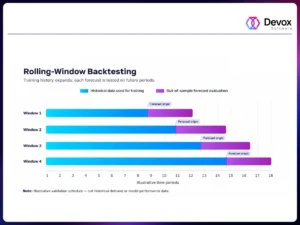
Companies should validate ML forecasting through time-based backtesting, error measurements, and predefined operational acceptance criteria. The evaluation must recreate the information and timing constraints that the model will face after deployment.
A single training and testing split may not reveal how a model behaves across different demand conditions. Rolling-window backtesting evaluates forecasts at multiple historical dates. At each evaluation point, the process uses the data available before that date to predict demand over the required horizon. The predictions are then compared against subsequently observed demand. For example, an evaluation of a four-week forecast can repeatedly generate predictions from different historical starting dates. This helps assess whether performance remains consistent across periods with different demand characteristics.
Backtesting should reproduce the intended production rules, including feature availability, retraining practices, and forecast frequency. Otherwise, the results may not reflect realistic operating conditions.
How to Integrate ML Forecasts into Planning Workflows?
Before integration, define how forecasts are transferred, how planning workflows consume them, and how the entire process is maintained. An ML forecasting pipeline may receive historical demand and operational records from ERP, inventory, or sales forecasting machine learning platforms. A practical integration flow involves:
- Extracting relevant operational records
- Validating and preparing forecasting inputs
- Generating predictions for the required products, locations, and periods
- Delivering forecast outputs through supported system interfaces
- Making predictions available to the relevant planning process
Apart from preserving product identifiers, location identifiers, prediction periods, quantities, and generation timestamps, integration controls must also account for duplicate records, failed transfers, and outdated predictions. This way, the resulting output becomes better.
Furthermore, an inventory planning process may combine predicted demand with available stock and replenishment policies. The difference lies in the fact that forecasting automation generates predictions, but decision automation allows software to initiate or approve operational actions based on those predictions.
That’s why automated purchasing or replenishment decisions require additional controls because incorrect forecasts directly affect inventory and financial commitments. Retraining decisions should respond to observed performance and relevant changes in the data or operating environment. The goal is a repeatable forecasting workflow with clear technical ownership and traceable outputs.
Whether to Pilot, Scale, or Postpone ML Demand Forecasting Framework
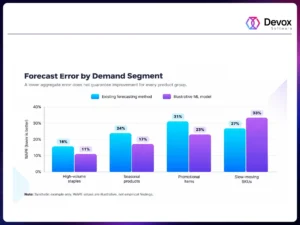
Do the data and use case support meaningful evaluation? Scale it when results and operating conditions meet predefined requirements, and postpone implementation when critical limitations remain unresolved. The final decision should account for predictive performance, system dependencies, ongoing ownership, and total operating costs.
The initial pilot should target a defined forecasting problem with available historical records and a measurable business consequence across selected product categories, warehouses, or locations. The dataset must support the required forecast horizon, historical testing, and relevant explanatory features.
If essential records are incomplete or inconsistent, narrowing the pilot or improving data quality may be more valuable than beginning model development. A limited deployment may be the option when you want to improve a particular product category or operating environment. On the contrary, company-wide deployment should not be assumed to be the natural outcome of every successful pilot.
Production forecasting introduces requirements like automated integrations, data validation, infrastructure, monitoring, incident response, retraining, and ongoing support. This way, initial development costs differ from recurring operating expenses and assign ownership for the forecasting system. That’s why the resulting decision framework has three possible outcomes:
| Decision | Conditions | Recommended next action |
| Pilot | Data and use case are sufficiently defined, but the ML advantage remains unproven | Conduct a limited comparison with predefined acceptance criteria |
| Scale | Performance, operational usefulness, integration feasibility, and cost requirements are satisfied | Expand deployment to justified products, locations, or workflows |
| Postpone | Data gaps, inconsistent model performance, integration barriers, or unfavorable economics remain unresolved | Address the limiting conditions before investing further |
This helps distinguish where to retain existing forecasting methods and where to introduce machine learning selectively, where validation demonstrates a worthwhile advantage.
Conclusion
A successful ML forecasting initiative starts with reliable historical data, clearly defined prediction horizons, and a measurable performance baseline. Companies should compare different forecasting models, validate their accuracy through rolling-window backtesting, and evaluate results.
The most practical approach is to start with a limited pilot, measure improvements against existing forecasting methods, and expand only where the results demonstrate meaningful business benefits, integrating AI into the supply chain and further.
Not sure where to start? Devox Software consults SMBs and enterprises about machine learning for demand forecasting. We deliver reliable, actionable forecasts that improve business decisions at a sustainable cost.
Frequently Asked Questions
-
What is the difference between traditional demand forecasting and ML forecasting?
Traditional forecasting approaches often rely on statistical relationships within historical demand data. ML approaches can also use structured explanatory variables to model more complex relationships. Neither approach is automatically more accurate; performance depends on the data, forecasting problem, and evaluation methodology.
-
Which machine learning algorithm is best for demand forecasting?
There is no universally best algorithm. Tree-based models, neural networks, and statistical forecasting methods should be evaluated against the same demand dataset, forecasting horizon, and performance criteria. The preferred model is the one that meets the business requirements with justified operating complexity. We’ve defined a choice framework above for more details.
-
How much historical data is needed for ML demand forecasting?
The required amount depends on demand frequency, seasonal patterns, prediction horizon, product granularity, and model complexity. Companies should establish whether their available records support both training and realistic historical evaluation rather than rely on a fixed minimum number of months.
-
How is ML demand forecasting accuracy measured?
Common metrics include MAE, RMSE, and WAPE. Each captures different error characteristics. Companies should complement these metrics with bias analysis, demand-segment comparisons, and an assessment of how forecasting errors affect planning decisions.
-
Can ML demand forecasting integrate with existing ERP systems?
Integration is possible when the relevant data and output interfaces are available. The implementation must define how operational data reaches the model, how predictions return to planning systems, and how errors, timestamps, and refresh schedules are handled.
-
How much does implementing ML demand forecasting cost?
Costs depend on data preparation, model development, infrastructure, integrations, evaluation, monitoring, and maintenance. A reliable estimate requires a defined forecasting use case and assessment of existing systems. No general cost range is established by the research supplied for this article.
-
When should a company avoid implementing ML demand forecasting?
Implementation may be premature when historical demand data is unreliable, the forecasting objective is unclear, results do not improve on the existing baseline, or the expected operational value does not justify integration and maintenance requirements.