
Is your automation still clicking buttons or rewriting its logic?
Most enterprises stall at task automation. Bots mimic keystrokes and shave minutes off routines, but AI business automation shifts the focus from faster clicking to smarter thinking.
But not all business process automation advances the business. Real value comes when automation not only accelerates tasks but also transforms how work happens. When BPA redefines what a step actually means, it replaces the old rulebook of operations—predictable, siloed, linear— with a living, learning network.
This article lays out how to build automation that thinks, adapts, and delivers. Launch with clarity, measure what matters, and prove ROI in results.
Core advantages of AI-driven process optimization
What Is AI Business Process Automation? Most companies start with bots that mimic clicks. A few evolve into systems that adapt in real time, without human input. Between those two points lies a curve that defines how AI transforms operations: where are you on the curve? What’s blocking the next jump?
Let’s map it out.
The graphic below shows how AI-powered automation evolves — from simple task bots to fully autonomous enterprises. Where do you think your company fits on this curve?
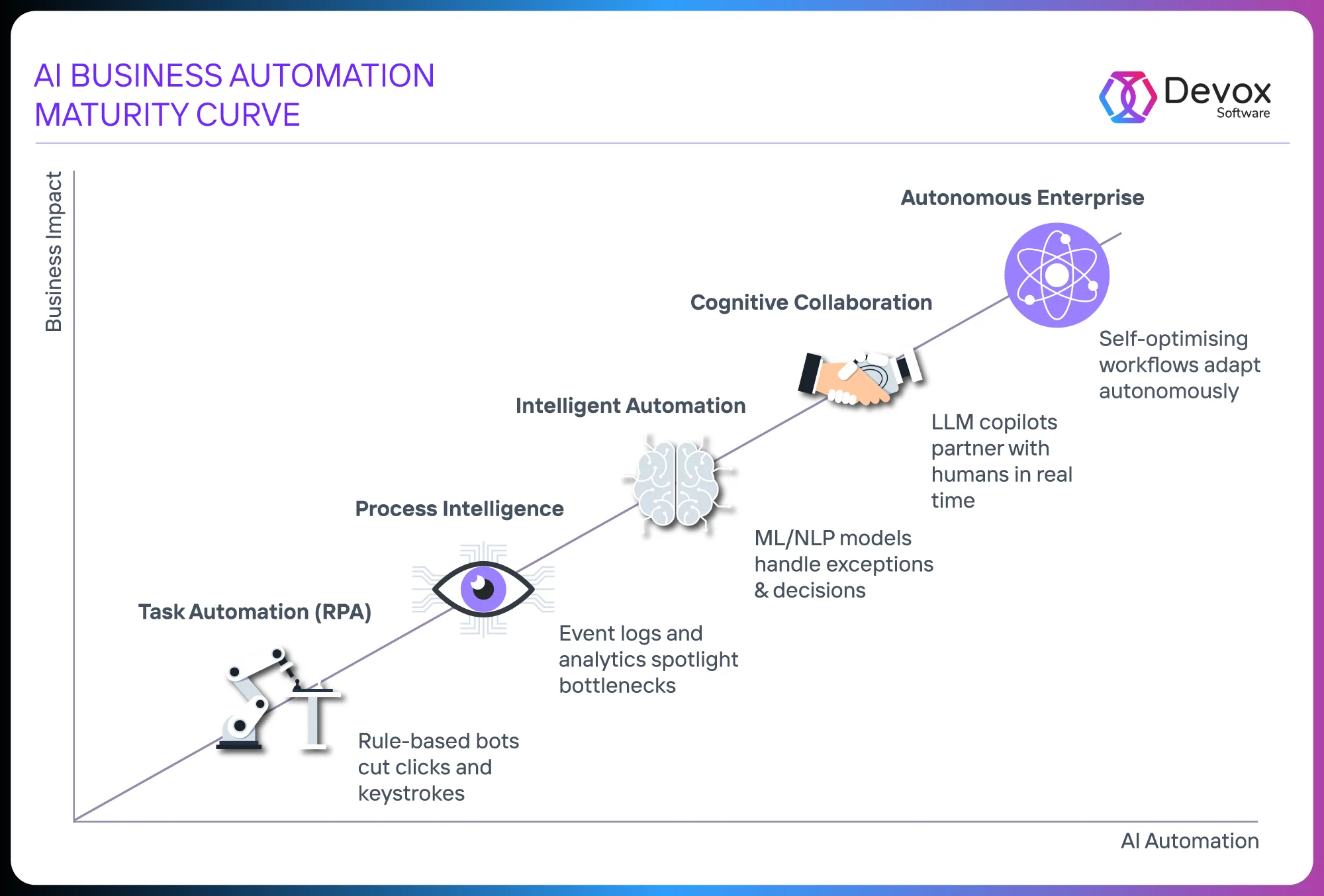
Think of it this way: traditional automation follows a script. AI writes its own. At a high level, utilizing AI for business automation involves integrating machine learning, NLP, and generative models directly into workflows. The result? Processes that:
- Sense what’s happening in real time (from system logs, sensors, or user actions)
- Decide the best action based on predictions or pattern recognition
- Act by triggering tasks, generating documents, or allocating resources
- Learn from the outcome, adjust, and improve with every cycle
Interestingly, business process automation with AI isn’t new. What’s changed is what AI makes possible: decisions in motion. Here are the real gains.
Cycle-Time Compression
Prediction engines now reside within the workflow, not alongside it. When an event fires, AI models respond before the next step begins. For example, at Mars Wrigley Company, line-fill forecasts moved from daily batches to real-time triggers. That shift reduced fulfillment delays and improved on-time delivery scores without increasing headcount.
First-Pass Yield Uplift
Upstream classification catches errors before they reach the systems of record. PepsiCo used invoice classification to cut first-submission rejection rates from 30% to 4%. Rework dropped, and cash flow became more predictable. Accounts payable turned from a blocker into a control point.
Working Capital Release
Inventory and receivables no longer sit idle. For instance, British telecom operator re-engineered its service activation process by using AI to automate business process steps that matched production with verified demand. Lead time dropped from 90 to 30 days. That meant recovering two months of working capital, with no additional labor and no legacy process burden.
Cross-Silo Visibility
AI connects fragmented systems into a unified view of operations. Siemens and Reckitt used process mining to align CRM, ERP, and WMS data. Once every team saw the same sequence of events, manual reconciliations stopped.
Self-Tuning Governance
Every decision generates data. When drift exceeds tolerance, retraining triggers automatically. No waiting for audits. McKinsey’s 2025 benchmark shows the strongest EBIT gains in firms that embedded model refresh into AI governance as a system feature.
Now the real challenge begins.
What changes with agents
Let’s take an invoice that is missing a supplier field. Traditional automation can identify the missing value and stop. Somebody then has to open the purchase order, check the supplier record, decide whether the mismatch is safe to correct, update the invoice, and send it back into the workflow. The difference with an agentic process is that the system can own more of that sequence. It can gather the records, apply the approved checks, correct a low-risk mismatch, and stop only when the case reaches a boundary we defined in advance. That is the change I want to talk about today. Not an AI that has unlimited freedom. A system that can complete more of a business process without removing the controls around it.
I would not treat RPA, machine learning, language models, and agents as competing choices. They do different jobs. Use a rule or RPA when the action is fixed. Use machine learning when the process needs a score or prediction. Use a language model when the system has to interpret unstructured information. The agent coordinates those parts. It tracks the case, decides which approved tool should run next, and stops when the policy requires a person.
In one workflow, the agent may plan the sequence, an ML model may score the risk, an LLM may extract the invoice data, and RPA may post the approved transaction.
At this point, the distinction is simple: the agent owns the sequence but not the policy.
Which Process to Start With
Most automation projects get funded after the problem becomes visible outside the team that owns the process. Accounts payable may tolerate a high rejection rate for months because the rework is contained inside finance. It becomes an executive issue when those delays affect the cash forecast or supplier relationships. A fulfillment problem may look like a warehouse issue until sales begins losing orders because promised delivery dates are no longer reliable. That is why the baseline needs to be expressed in business terms: euros tied up, days added to the cycle, orders delayed, or customers affected. Once the problem is visible in those terms, the team can decide whether automation is worth the investment.
Let’s map it out. This graphic shows increasing levels of process ownership. On the left, automation executes one predefined task. As we move right, the system maintains more context, coordinates more tools, and handles more exceptions. The control requirements increase at the same time. So the goal is not to move every process as far right as possible. The goal is to choose the level of autonomy that the process can support safely.
AI in business processes is not new. What has changed is how much of the process the system can complete before it has to hand the case back to a person. That is where we see the primary operational gains.
Instead of looking for separate benefits, trace how one operational improvement propagates through the process. If an invoice is validated as soon as it enters the workflow, fewer cases are returned later for correction. This increases first-pass completion. If fewer invoices sit in an exception queue waiting for manual intervention, the total approval time falls. If approval time falls, less cash remains stuck in the queue and working capital improves. Finally, because every tool call, decision, and exception is logged, finance and operations can see the same process state instead of reconciling separate reports. They are not four different projects. They are four different ways to measure the impact of fixing the same flow.
What has to be true before the agent acts
Before the agent acts, a few things need to be true. The main path needs to be repeatable. The systems need to identify the same case consistently. Log important events and manual corrections. Every exception needs an owner. And every action available to the agent needs a permission and approval rule.
Stable identifiers may sound like a data issue, but they quickly become an execution issue. The CRM may hold the quoted price, the ERP the financial transaction, and the warehouse a split shipment. If those systems cannot tie back to the same order, the agent is not working with one case. It is trying to reconcile several versions of it. Before the agent acts, the team needs a stable case ID, agreed definitions for the main records, and a history of how those records changed.
Once those records join cleanly, the models start receiving a consistent case. Forecasting becomes more stable because sales and operations are working from the same dates. Anomaly detection produces fewer false positives because the order and invoice describe the same customer and shipment. The improvement comes from cleaner process data, not from making the model more complicated.
One mistake we see is taking the current process as-is and adding an agent on top of it. Some of the handoffs in that process may exist only because a person had to move information from one system to another. Some approvals may be checking conditions the system could verify automatically. And many exception paths are designed to escalate immediately because the existing automation cannot investigate the case. Before building the agent, review which of those steps still need to exist. Process mining can show the current flow, but it does not decide what the future flow should be. The team still has to redesign the process around the actions the agent can safely own.
The diagram shows the intended process. The event log shows the process people are actually running. For automation, the second matters.
What the Logs Show
Process mining reconstructs the workflow from timestamped events. It shows the paths cases actually follow, how long they wait between statuses, and where they return for rework. We use that current-state record for two purposes: to simplify the process before automation and to define the workflow the agent is expected to follow.
To establish the baseline, run the process for one representative week. Record how long each case waits, how often it comes back for correction, how many manual touches it requires, and what value remains in the queue. That gives the team a clear starting point and shows where the largest delay or risk actually sits.
At this point, we may still not know everything. We may not know how much work happens outside the recorded systems. We may not know whether the identifiers join cleanly until we inspect the data. And we may not know which exceptions the agent can own until process, security, and operations review them together. That is what discovery is for. It tells us whether the first build should be an agent, a smaller integration, or a rule change.
From process mining to agentic execution
Once we understand how the process runs today, we write down the part we expect the agent to own. We call that a workflow contract. It is not a legal document. It is the operating definition of the flow: which systems the agent can use, which steps it can complete, which exceptions it can resolve, and where a person has to approve or take over. For the invoice example, the contract may allow the agent to retrieve the purchase order, compare supplier fields, and correct a low-risk mismatch. It may allow the agent to prepare a bank-detail change, but not submit it without approval. After launch, we compare that intended path with the path the agent actually took. If the agent starts repeating calls, taking longer routes, or handling similar cases differently, the logs should make that visible.
Deployment Playbook
Suppose the agent finds a mismatch in a supplier record. Before anything reaches the ERP, the control layer checks three things. Is the agent allowed to change this field? Is the change below the approved risk threshold? Does this transaction require approval? A low-risk correction can go through. A bank-account change stops for review. In both cases, the system records what the agent requested, which policy applied, and what happened next. That is the control plane. The agent can act, but every action still passes through business rules.
- Once those pieces are in place, the build can stay narrow.
- In weeks one and two, confirm the current flow, baseline, business result, and actions the agent may take on its own.
- In weeks three and four, build one execution path, connect only the tools required for that path, and include the main exception route from the start.
- In weeks five and six, run representative cases, measure the business result, and review every action the agent took.
- Six weeks is a useful target when the process is already instrumented, the required systems are accessible, and the first execution path is narrow.
If the team first has to rebuild event logging, reconcile identifiers, or obtain production permissions, that work comes before the agent build.
At the end of the six weeks, the team should have enough evidence to make one of three decisions: move the workflow toward production, correct the process and test again, or stop because the value is not there.
What the result should look like
The result should appear in measures the business already uses: less waiting, less rework, less value sitting in the process, and fewer disagreements about the current state of the case.
AI belongs where the remaining step requires interpretation, prediction, or coordination.
If a rule or a cleaner integration solves the problem, use that instead.
How to measure the agentic process
Classic metrics still matter: cycle time, first-pass completion, rework, and working capital.
For an agentic process, add three checks:
- How many cases were completed without a person?
- How quickly were the remaining exceptions resolved?
- Can the team reconstruct the inputs, tool calls, policy checks, approvals, and final outcome?
Those checks tell us whether the process is faster, more autonomous, and still under control.
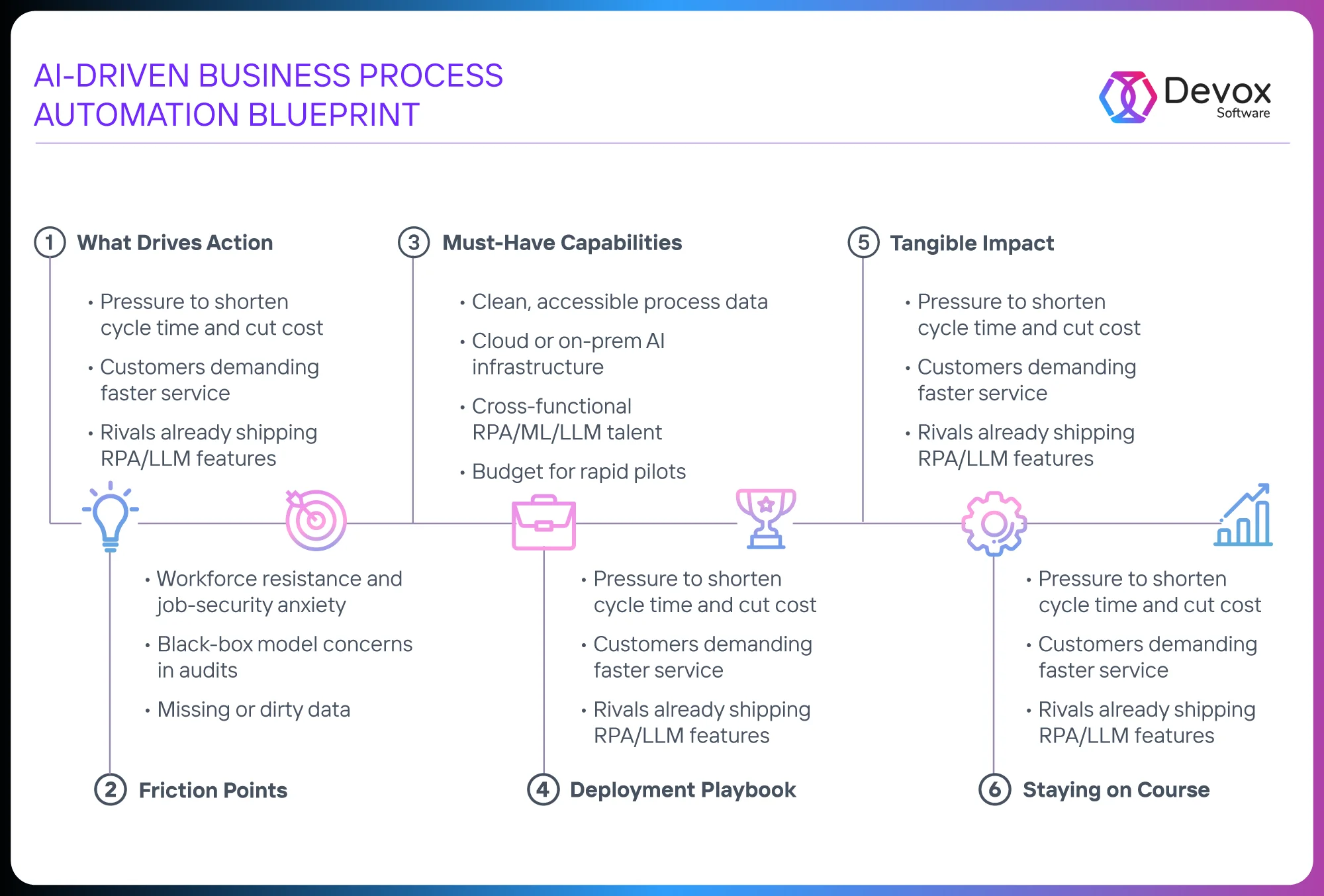
What happens after launch
Launch is only the point where the team begins seeing real operating behavior. After deployment, three things need clear ownership. The event data must remain complete. If manual corrections, retries, or system delays disappear from the log, the performance view becomes unreliable.
The team also needs to watch for changes in behavior. A rise in errors, escalations, tool usage, or case duration should trigger a review. The response may be a rule change, a prompt update, model retraining, or a correction to the upstream data. Any production change still goes through validation and release control.
The process owner remains accountable after launch. That person watches the overall cycle time, exception rate, and business result across the systems involved.
Operating the agent
Once the agent is running, somebody still has to operate it. That means tracking versions, evaluations, permissions, tool calls, execution records, and behavior changes.
Some teams call that AgentOps.
The name matters less than ownership. Somebody has to know when the agent changed, what changed, and whether the current version is still operating within the agreed limits.
At Devox Software, this is how we approach the work:
- We start with one process where the cost of the current failure is already measurable.
- We reconstruct the real flow, define the part an agent can safely own, and connect only the tools required for that path.
- Then we test the workflow against the existing business baseline. We look at cycle time, manual handling, exceptions, financial impact, and the number of cases that complete within the agreed controls. The implementation includes action-level permissions, structured logs, evaluations, and clear ownership after handoff.
The goal is not to automate the largest possible process. It is to prove that one useful process can run better, remain observable, and stay under operational control.
Frequently Asked Questions
-
Do we need to “clean all the data” before launching AI, or is that just another way to stall?
True intelligence emerges not from pristine spreadsheets but from the messy trace of real operations — timestamps that fall on weekends, mis-typed IDs, exception flags that reveal where people step in. An AI pilot ingests those glitches and highlights them: it surfaces the loops nobody drew on the Visio, the hand-offs dragging work into the backlog. As each anomaly is corrected, the pipeline self-refines, event by event, so data quality evolves in lockstep with process clarity. The momentum from seeing actual bottlenecks collapse in days ignites the discipline to clean at scale, long before any hypothetical “perfect” data ever exists.
-
What are the core data requirements for effective BPA?
For process optimization AI to deliver value, it needs clean, time-stamped event logs, consistent primary keys across systems, and explicit ownership of exceptions. Without these, the AI chases noise or stalls in ambiguity. When the structure is sound, optimization becomes continuous — each loop shorter, each output smarter.
-
Can we accelerate AI adoption without a multi-year data overhaul?
Every month sunk into rewriting every database schema steals the spotlight from breakthroughs at the edges. A targeted pilot can run today on existing logs, catching timestamp drifts, exception flags, and user-triggered workarounds. That early glimpse reveals the handful of data pathways that carry the most drag, so you hardwire lightweight adapters around those points and feed live events straight into the model. Each sprint increases coverage, stitches in new sources, and sharpens signal quality. Within weeks, the CFO watches cycle times compress and variance shrink — exactly the kind of early result that validates enterprise AI process optimization without massive infrastructure changes. This dual-track method sprints past the glacial pace of “big bang” cleanses, turning imperfect data into actionable intelligence from day one.
-
What happens to my business process automation AI solution a year from now, when the system shifts, the team changes, or the process moves?
A year down the road, every tweak in your ERP, every shuffle on the operations team, and every tiny process pivot feeds straight into the same living pipeline that first powered your pilot. Every event remains time-stamped and immutable, and every decision is logged alongside the model version that made it. When a new exception pattern emerges, retraining kicks off automatically against the freshest traces, keeping predictions in line with reality. Turnover in the squad becomes a non-event — new engineers inherit a system where provenance lives in code commits and deployment manifests, not tribal knowledge. And as processes evolve, the same lightweight adapters you first spun up simply capture the new signals, folding them into dashboards and alerting you before any drift ever touches the balance sheet. This continuous feedback loop turns change from a threat into the very fuel that keeps your automation sharp.
-
What is the demand for home AI automation business, and does it influence enterprise automation strategies?
The consumer AI space, including smart homes, voice assistants, and personal automation, is growing rapidly, driven by convenience and energy savings. While enterprise and residential domains differ in scale, the rising demand for intelligent automation at home increases user comfort with AI-driven decision-making. For enterprise leaders, this signals a cultural shift: employees and customers increasingly expect the same intelligence and responsiveness in business systems that they now get in their homes.
-
How do we ensure explainability, logging, and policy alignment before launch?
Every decision carves its audit trail. Before a single prediction reaches production, each model call wraps itself in a structured metadata envelope — input payload, feature versions, model weights, policy rules, and user context all recorded in append-only logs. Those logs feed a real-time compliance layer that validates every inference against your governance playbook — data retention rules, bias checks, and access controls. An embedded explainability engine then translates black-box outputs into human-readable rationales, linking each recommended action back to the exact features and thresholds that drove it. All components run under consistent versioned pipelines, so when an auditor demands proof, you can replay any transaction at any moment, with complete fidelity to the policies and data definitions that governed it. Continuous monitoring flags any deviation immediately, turning compliance into an automatic heartbeat rather than a manual afterthought.
This level of traceability is also how AI and automation help small businesses build trust in automation early, proving that decisions are not only fast and efficient but also explainable, auditable, and safe from day one.
-
Can we launch an AI-powered MVP without overhauling our entire system landscape?
AI-powered automation for businesses can spring to life atop your existing architecture through modular adapters and lightweight inference layers. Smart adapters sit beside legacy services, streaming just the critical event streams into your model without disturbing core transactions. In parallel, a containerized inference endpoint lives in its own namespace, consuming those events, issuing decisions, and logging every call. As the proof of value unfolds, you extend each adapter only when its signal proves essential, so the system grows organically, feature by feature, rather than collapsing under a simultaneous “big bang” refactor. The result: a living MVP that delivers intelligent automation today and coexists with tomorrow’s sweeping overhaul, each evolution building on a foundation already proven in production.